Bulk Plastic Card Order Turnaround Times: What Buyers Should Know
Table of Contents []
- What to Expect When You Place a Bulk Plastic Card Order with Plastic Card ID
- The Anatomy of a Bulk Plastic Card Order Timeline
- Factors That Influence Turnaround on Large Volume Orders
- Why Blank PVC Cards Are the Speed Champion of Bulk Orders
- Specialty Cards: Turnaround Expectations for Advanced Products
- Buyer Tips for Optimizing Your Bulk Card Order Turnaround
- Partner with Plastic Card ID for Reliable Bulk Card Order Turnaround
What to Expect When You Place a Bulk Plastic Card Order with Plastic Card ID
Timing is everything. Whether you are launching a new loyalty program, replenishing employee ID cards before a busy season, or preparing for a major event, knowing exactly when your cards will arrive shapes every downstream decision your team makes. Bulk plastic card order turnaround times are not a minor logistical footnote - they are a mission-critical variable that separates a smooth rollout from a scramble.
At Plastic Card ID, we have spent more than 25 years helping businesses across the United States navigate precisely this challenge. With over 100,000 customers served and more than 50 million cards shipped, we have seen every scenario: the retailer who needs gift cards in time for the holiday rush, the gym that wants membership cards ready for a January enrollment spike, the corporation that needs freshly encoded access cards before a Monday morning move-in. The answer is never one-size-fits-all - and that is exactly why we treat every order as a conversation, not a transaction.
| Card Type | Typical Production Time | Standard Shipping | Rush Available? |
|---|---|---|---|
| Blank PVC CR80 Cards | 1-3 business days | 2-5 business days | Yes |
| Magnetic Stripe Cards (HiCo/LoCo) | 2-4 business days | 2-5 business days | Yes |
| RFID and Proximity Cards | 3-7 business days | 2-5 business days | Varies by spec |
| Smart Chip Cards | 5-10 business days | 2-5 business days | Inquire directly |
| Custom Die-Cut or Specialty Cards | 7-14 business days | 2-5 business days | Limited availability |
The Anatomy of a Bulk Plastic Card Order Timeline
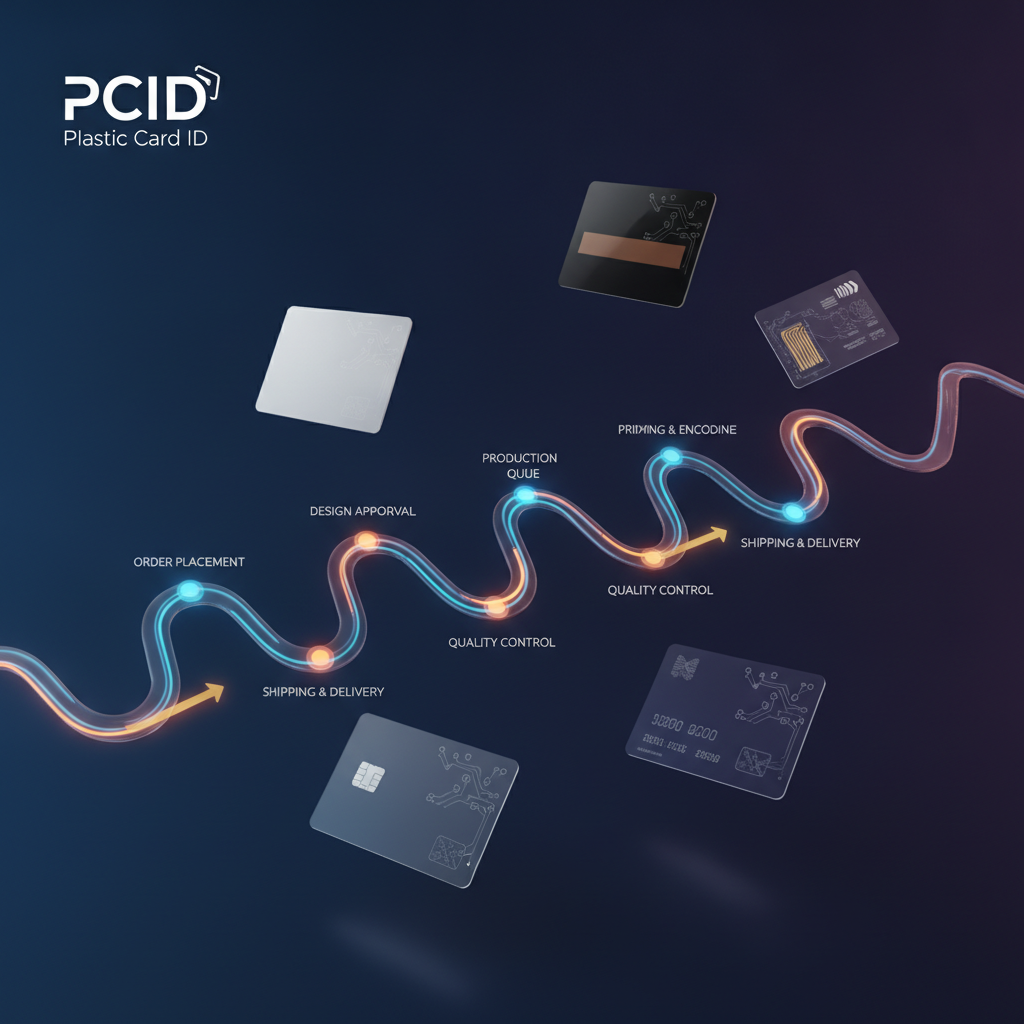 People often assume that ordering plastic cards in volume is simply a matter of clicking "submit" and waiting. In practice, the timeline for any bulk order moves through several distinct phases, and understanding each one gives buyers a meaningful advantage. From order confirmation to doorstep delivery, every step has its own rhythm.
The cleaner your specifications come in, the faster everything moves. Organizations that know their card type, quantity, encoding requirements, and shipping address before picking up the phone consistently see faster delivery. That is not an accident - it is preparation compressing production time.
Phase One: Order Intake and Specification Review
The moment your order enters our system, a review process begins. For straightforward blank card orders - say, 500 standard CR80 PVC cards in white - this phase is brief, often completed the same day. For more complex requests involving RFID encoding, custom colors, or specialty formats, our team may reach out to confirm technical details before production begins.
This upfront dialogue is not a delay - it is a time-saver. Catching a specification mismatch before production begins costs minutes. Catching it after costs days and money. Clients who work with CPE long-term learn this quickly and come prepared, which is one reason our repeat order rate is so high.
Phase Two: Production Scheduling and Card Manufacturing
Once specifications are confirmed, your order enters the production queue. Blank PVC card orders are often among the fastest to fulfill, since no encoding or programming is required. These cards - built to the ISO 7810 CR80 standard at 30 mil thickness - move through production rapidly and are ready for quality inspection quickly.
Magnetic stripe cards require an additional encoding step. HiCo (high-coercivity) cards, rated at 2750 Oe, are ideal for applications where cards pass near magnets or suffer regular wear. LoCo (low-coercivity) cards, rated at 300 Oe, suit lower-security or short-term applications. Both variants add modest production time, but the result is a card that works reliably from the first swipe.
Phase Three: Quality Verification and Packing
Before any bulk order ships, it goes through a verification process. For encoded cards, this means functional testing. For blank stock, it means confirming counts and inspecting for surface defects. This quality step is non-negotiable - 50 million cards shipped over a quarter century did not happen by accident. It happened because every order gets treated as if it is the only order.
Packing for bulk orders is designed to minimize transit damage. Cards are packaged in secure, sturdy configurations to prevent bending or surface marring during shipping. When you open the box, the cards should look exactly as expected - not like they survived an adventure.
Phase Four: Shipping and Delivery Windows
Shipping timelines depend on carrier, destination, and the service tier selected. Standard ground shipping typically delivers within 2-5 business days across the continental United States. Expedited options can compress this window meaningfully. For clients in remote locations or with hard deadlines, we strongly recommend discussing shipping options at the time of order placement rather than at checkout.
If you are working against a specific event date, build in a minimum buffer of three business days beyond your expected delivery. This accounts for carrier variability and gives your team time to verify the order before deployment. Experience has shown that clients who plan with a buffer sleep better during the final stretch before a launch.
Factors That Influence Turnaround on Large Volume Orders
Not every bulk order is the same. A 500-card order of blank white PVC and a 25,000-card order of RFID-encoded hotel key cards inhabit entirely different operational universes. Understanding what drives turnaround variation helps you plan better and set realistic internal expectations.
Several variables interact in ways that are not always intuitive. Card complexity, encoding requirements, volume tier, current production load, and shipping destination all contribute. The good news: with CPE, you can get honest lead time estimates before you commit, which removes the guesswork entirely.
Card Complexity and Encoding Depth
Blank PVC cards are the simplest and fastest product in the catalog. They require no encoding, no programming, and no post-production testing. A large order of blanks can move from production queue to shipping dock faster than almost any other card type. Complexity scales with technology - proximity cards, MIFARE DESFire smart chips, and multi-application smart cards all require additional configuration steps.
RFID cards for access control or contactless loyalty applications go through programming steps that are carefully sequenced to ensure every card in a bulk order performs consistently. For casino player cards or hotel key cards, where a failed card means a frustrated guest at 2 a.m., this testing phase is not optional. It is the price of reliability.
Order Volume and Production Queue Position
Volume affects timing in two directions. Very large orders - tens of thousands of cards - may require extended production runs, which naturally take longer. However, bulk buyers often benefit from prioritized scheduling and dedicated account attention that smaller orders may not receive. High-volume clients who communicate their deadlines early almost always get the outcome they need.
Production queue position matters too. Placing an order during peak periods - think Q4 for retail gift cards or late summer for back-to-school employee badges - means you are competing for production slots. The earlier you place a seasonal bulk order, the better your position in the queue and the lower your stress level in the final weeks before your deadline.
Rush Order Options and What They Actually Mean
Rush production is available for many card types, but the word "rush" means something specific here. It does not mean instantaneous. It means your order is elevated in the production queue and handled with priority scheduling. For straightforward card types like blank PVC or standard magnetic stripe cards, rush production can shave significant time off a standard lead. Rush shipping, combined with rush production, gives buyers the shortest possible end-to-end window.
- Rush production is most effective when specifications are submitted cleanly with no back-and-forth required.
- It is available for blank PVC, magnetic stripe (HiCo and LoCo), and select proximity card orders.
- Smart chip cards and custom die-cut formats have longer baseline production times that rush upgrades cannot always fully overcome.
- Combining rush production with expedited shipping gives the most compressed possible total timeline.
- Always confirm rush availability by phone before placing a time-sensitive order of any kind.
Why Blank PVC Cards Are the Speed Champion of Bulk Orders
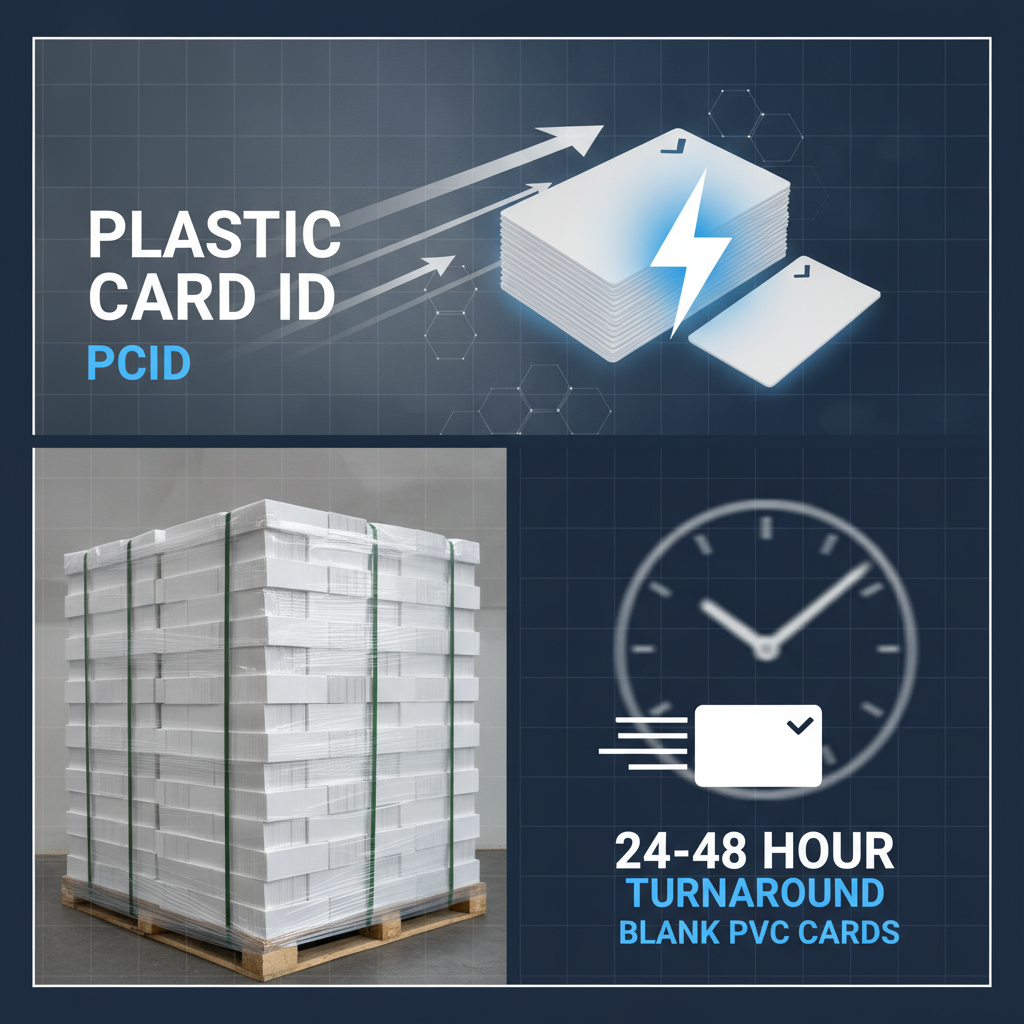 There is a reason blank CR80 PVC cards make up such a large share of bulk orders across nearly every industry. They are fast, flexible, and affordable at scale. A blank card is not an unfinished product - it is a canvas. Print it in-house and it becomes whatever your program demands: an employee badge, a loyalty card, an access credential, a gift card, a membership card.
For organizations that operate their own card printers - whether an Evolis, Zebra, or Fargo model - the blank card is the engine of a self-sufficient card program. You control the design, the timing, and the per-card cost. Turnaround for blank stock is driven purely by production and shipping, with no encoding complexity to factor in.
The CR80 Standard Explained
CR80 is the ISO 7810 standard card format - 3.375 inches by 2.125 inches, 30 mil thick. It is the exact size of a standard credit card, which means it fits wallets, badge holders, card sleeves, and every reader or printer designed for standard card formats. Standardization is what makes CR80 cards universally deployable across industries and applications without special accommodations.
At 30 mil thickness, these cards strike a balance between durability and cost efficiency. They are stiff enough to withstand daily handling in a wallet or badge holder, yet thin enough to stack and ship efficiently in bulk quantities. This is why CR80 PVC cards remain the workhorse of card programs ranging from 50 units per month to tens of thousands.
Colored Stock, Frosted, and Clear Card Variants
Beyond standard white PVC, CPE offers a catalog of colored stock cards, frosted cards, and completely clear plastic cards. These variants share the same CR80 dimensions and blank-card turnaround advantages, but introduce visual differentiation that supports branding, department coding, or tiered membership programs. A clear card with the right printed design creates a premium feel that resonates with cardholders.
Frosted cards offer a matte visual texture that many brands find compelling for upscale loyalty or membership programs. Colored stock allows instant department or access-level differentiation without the need for printing. These options expand the creative toolkit for in-house card programs without adding meaningful time to the order fulfillment cycle.
Pairing Blank Cards with In-House Printers
Ordering blank PVC cards in bulk pairs naturally with an in-house card printer. Evolis, Zebra, and Fargo printers are each capable of producing professional, full-color ID and loyalty cards on demand. The combination of bulk blank card inventory and a reliable desktop printer gives organizations maximum control over their card programs - including the ability to print one card or one hundred cards as needed, without waiting for an outside production run.
This model is especially attractive for organizations with variable or unpredictable card demand. Employee turnover, event registrations, and new member enrollments do not follow a predictable schedule. Having blank card stock on hand and a printer at the ready means you are always prepared, regardless of when the need arises.
Specialty Cards: Turnaround Expectations for Advanced Products
Not every card program runs on simple blank PVC. Casinos, hotels, healthcare facilities, corporate campuses, and high-security environments often require cards with embedded technology that demands more from the manufacturing process. These cards are worth the wait - but buyers need accurate timeline expectations to plan effectively.
RFID, smart chip, and contactless card programs carry longer baseline production times for legitimate reasons. Each card must be individually programmed, verified, and quality-checked before shipping. A single malfunctioning card in a 10,000-unit hotel key card order has real operational consequences. Precision takes time, and the tradeoff is worth it.
RFID and Proximity Cards for Access Control
Proximity access cards and RFID cards are engineered for contactless communication with readers at distances ranging from a few centimeters to several feet, depending on the frequency and antenna design. These cards are widely used in corporate access control systems, parking facilities, and secure government locations. Production timelines for proximity cards typically run 3-7 business days, reflecting the additional steps involved in embedding and verifying the antenna and chip components.
For buyers with access control systems already in place, specifying the correct frequency and format at order time is critical. Our team works with buyers to confirm compatibility before production begins, eliminating costly mismatches. This verification step adds a small amount of time upfront but prevents far larger delays and expenses after delivery.
Smart Chip and MIFARE DESFire Cards
Smart chip cards represent the upper tier of card technology in terms of security and versatility. MIFARE DESFire EV2 and EV3 cards support advanced encryption and multi-application architectures, making them suitable for environments where data security is a primary concern. These are not off-the-shelf items - each order is configured to specification, and production timelines reflect that precision.
Buyers considering smart chip programs should begin the conversation with CPE well in advance of their intended deployment date. A 5-10 business day production window, plus shipping, adds up quickly when layered against a firm launch date. Early engagement with our team is the single most effective strategy for ensuring your smart card program launches on schedule.
Luxury Metal Cards and Custom Die-Cut Formats
Stainless steel, brass, and gold metal cards occupy a unique space in the card catalog. These are not standard cards with a metallic finish - they are precision-manufactured physical objects designed to make a lasting impression. Metal cards are deployed in premium loyalty programs, VIP membership tiers, and corporate gifting contexts where the card itself is part of the brand message.
Custom die-cut shapes - cards that deviate from the standard rectangular CR80 format - are similarly specialized. Whether you are producing a key-tag shaped card, a card with custom corner cuts, or a completely bespoke shape, the manufacturing process requires tooling and setup that adds to the baseline timeline. These cards are worth the lead time, but plan accordingly.
Buyer Tips for Optimizing Your Bulk Card Order Turnaround
After 25 years and more than 100,000 clients, certain patterns emerge consistently. Organizations that get their cards on time - and in exactly the specification they need - share a few common habits. These are not complicated strategies. They are disciplined practices that compress timelines and eliminate surprises.
The single greatest turnaround accelerator is preparation. Buyers who arrive with clear specifications, a confirmed shipping address, and an honest understanding of their deadline almost always get what they need on time. Those who treat the order as an afterthought until the last moment often discover that production reality does not bend to wishful thinking.
How to Prepare Before You Place Your Order
- Know your card type: blank PVC, magnetic stripe, RFID, smart chip, specialty, or a combination.
- Confirm your quantity - and whether you anticipate needing a reorder within 90 days, which may affect volume pricing.
- Have your encoding specifications ready if your cards require magnetic stripe or chip programming.
- Know your hard deadline and work backwards to identify your latest acceptable order date.
- Confirm your shipping address is accurate and deliverable before finalizing the order.
Calling 800.835.7919 before placing a complex or time-sensitive order is always a worthwhile step. Our team can confirm current production availability, suggest the most efficient card configuration for your application, and flag any specification details that could cause delays if left unresolved.
Understanding Reorder Cycles and Inventory Planning
One underappreciated strategy for eliminating turnaround stress entirely is maintaining a standing inventory of your most frequently used card stock. Organizations that reorder before they run out - rather than when they run out - never face emergency timelines. A standing inventory of blank PVC cards paired with an in-house printer is the ultimate insurance policy against card program disruptions.
For encoded or specialty cards that require outside production, establishing a reorder trigger - say, when inventory drops below a 30-day supply - gives you comfortable lead time on every replenishment. This is not a complex system. It is simple supply chain discipline applied to your card program.
Communicating Deadlines Clearly and Early
When you have a hard deadline - an event date, a store opening, a corporate enrollment period - communicate that deadline explicitly at order placement. Do not assume it will be inferred. A clearly stated deadline allows our team to sequence your order appropriately and alert you immediately if anything puts that timeline at risk.
Early communication also creates the opportunity for alternatives. If your first-choice card specification cannot meet your deadline, knowing that early leaves time to identify a compatible alternative that can. Discovering that mismatch the day before your event does not. Experience has shown us, again and again, that clients who communicate deadlines early almost always leave satisfied.
Partner with Plastic Card ID for Reliable Bulk Card Order Turnaround
There is a meaningful difference between a supplier that ships cards and a strategic partner that helps you run a successful card program. Plastic Card ID has spent over 25 years earning that distinction, one order and one relationship at a time. From blank PVC to MIFARE DESFire smart cards, from 50 cards a month to tens of thousands in a single run, our role is to make your timeline work.
The catalog we offer - spanning blank cards, magnetic stripe, RFID, smart chip, clear and frosted stock, colored variants, luxury metal cards, card printers, ribbons, cleaning kits, card carriers, and mailing services - is not an accident of accumulation. It is the result of listening to clients across more than 100,000 relationships and building the inventory and capabilities those clients actually need. One phone call connects you to all of it.
Ready to place your bulk plastic card order or discuss your timeline requirements? Call Plastic Card ID today at 800.835.7919 and speak directly with a team that has been solving card program challenges for over 25 years. Your deadline matters. Let us help you meet it.
Previous Page