Shipping Blank Plastic Cards: What to Expect Every Time
Table of Contents []
- What Really Happens When You Order Blank Plastic Cards From Plastic Card ID
- Packaging Standards: How Your Cards Arrive in Perfect Condition
- Shipping Methods, Carriers, and Delivery Speed Options
- Ordering the Right Blank Card for Your Card Printer
- Recurring Orders and Program Replenishment: Building a Reliable Supply Chain
- Beyond Blank Cards: Completing Your Card Program With Plastic Card ID
What Really Happens When You Order Blank Plastic Cards From Plastic Card ID
You clicked "order," entered your quantity, and hit confirm. Now what? Whether this is your first time buying blank plastic cards or your fiftieth, understanding the journey from warehouse shelf to your front door changes everything about how you plan, budget, and build your card program. Surprises are fine at birthday parties - not in business operations.
At Plastic Card ID, transparency is not a marketing phrase. It is a practice built over 25 years and more than 50 million cards shipped across the United States. This page breaks down the shipping process in honest, practical detail - so you know exactly what to expect, when to expect it, and how to make the most of every order.
Why Shipping Clarity Matters More Than You Think
A delayed card shipment can stall an entire loyalty program launch, hold up employee onboarding, or leave an event registration table scrambling. The stakes are real. Knowing your timeline before you order - not after - lets you schedule your card printer setup, staff training, and program kickoff with confidence.
Most buyers focus heavily on card specs and price, which makes sense. But shipping timelines and packaging standards are equally important, especially when you're managing programs with recurring monthly orders or time-sensitive event deadlines. Getting this right from the start saves money and avoids headaches down the line.
The Standard Order Window at Plastic Card ID
CPE maintains an extensive in-stock inventory of blank CR80 PVC cards - the industry-standard 30 mil thickness, ISO 7810 compliant - across dozens of card types. Because these are not custom-printed cards requiring production queues, most blank card orders process and ship quickly, often within one to two business days of order confirmation.
Specialty blanks - think frosted cards, colored stock, magnetic stripe configurations, or RFID and smart chip varieties - may have slightly different lead times depending on current inventory levels. Checking stock before placing a large order is always a smart move, and the team at Plastic Card ID is ready to help you verify availability before you commit.
Contacting the Team Before You Order
Not sure which card type you need? Buying blank cards for the first time involves more decisions than most people expect - HiCo vs. LoCo magnetic stripe, RFID frequency, card thickness, surface finish. Reaching out before you order can save you from selecting the wrong product entirely. 800.835.7919 connects you directly with a knowledgeable product specialist who can walk you through your options without the sales pressure.
This kind of pre-order consultation is especially valuable for organizations setting up card programs from scratch. Whether you're outfitting a hotel with key cards, launching a retail loyalty program, or establishing employee access credentials, starting with a quick conversation ensures your blank cards match your card printer, encoder, and program requirements perfectly.
| Card Type | Common Use | Typical Processing Time |
|---|---|---|
| Blank CR80 PVC (White) | ID, membership, loyalty, events | 1-2 business days |
| HiCo Magnetic Stripe | Gift cards, hotel keys, access | 1-2 business days |
| LoCo Magnetic Stripe | Short-term event passes, basic loyalty | 1-2 business days |
| RFID / Proximity Cards | Access control, contactless entry | 2-3 business days |
| Smart Chip Cards | Casino player cards, secure ID | 2-4 business days |
| Frosted / Clear Cards | Specialty membership, VIP programs | 2-3 business days |
| Colored Stock Cards | Department coding, event tiers | 1-3 business days |
Packaging Standards: How Your Cards Arrive in Perfect Condition
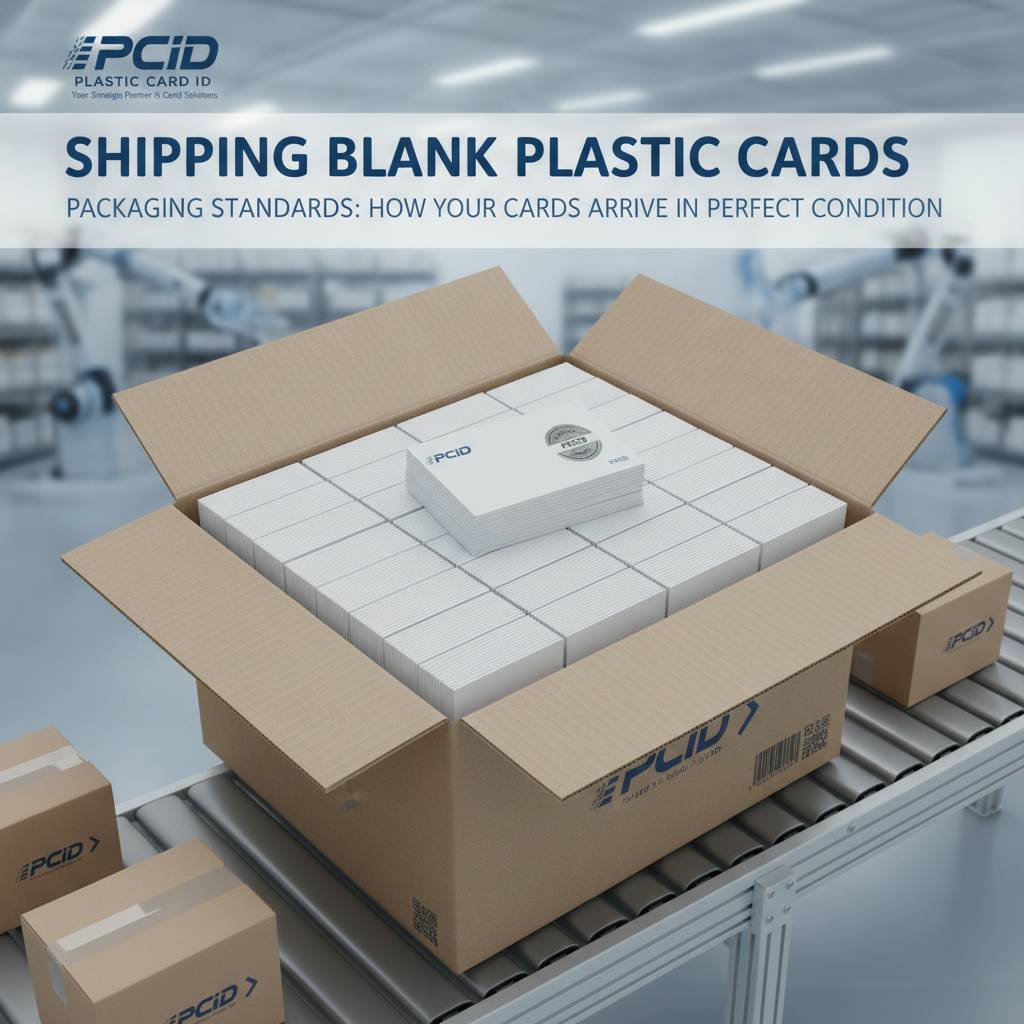 Blank plastic cards are deceptively straightforward to ship - until they arrive warped, scratched, or jumbled from poor packaging. Card integrity on arrival is not a luxury; it is a baseline requirement for any organization running an in-house printing operation. A scratch on a blank card surface can ruin a printed badge or loyalty card and waste both time and money.
Plastic Card ID packages blank cards in protective, appropriately sized boxes designed to prevent shifting, compression, and surface contact damage during transit. Cards are typically wrapped or separated to protect glossy and matte surfaces. Every detail of the packing process is designed around what happens to your cards before they reach your printer.
Card Quantities and Box Configurations
Blank PVC cards typically ship in increments of 100, 200, 500, or 1,000 cards per box. Larger orders may arrive in multiple boxes, each clearly labeled. Understanding how your cards are configured helps you store them properly before use - keeping them flat, away from heat sources, and in a dust-free environment to maintain print-ready surfaces.
For organizations ordering at scale - think 10,000 cards or more - CPE can discuss bulk packaging options that reduce per-unit costs and simplify inventory management. Smart buyers plan their storage before the shipment arrives, not after they're staring at a stack of boxes in the hallway.
Protecting Specialty Card Surfaces During Shipment
Frosted cards, clear cards, and cards with pre-printed overlaminates require extra attention during packaging because their surfaces show handling marks more readily than standard white PVC. Plastic Card ID accounts for these differences in its packaging approach, ensuring specialty cards arrive with the same surface quality they left the warehouse with.
If you are ordering magnetic stripe cards, the magnetic band is pre-tested and protected during packing. RFID and smart chip cards are similarly handled with care to prevent any interference or physical damage to embedded components. The technology inside your card is just as important as the surface you print on.
What to Do When Your Order Arrives
Open and inspect your order as soon as it arrives. Count your cards, check for visible surface damage, and verify the correct card type was delivered - especially if you ordered magnetic stripe or RFID varieties, which may look similar to standard blank cards at a glance. Catching any discrepancy early makes resolution faster and simpler.
If something is not right, reach out immediately. Plastic Card ID stands behind every order and works swiftly to resolve problems. The quicker you flag an issue, the quicker it gets corrected - and your card program stays on schedule. Proactive inspection is the simplest quality control step you can take on your end.
Shipping Methods, Carriers, and Delivery Speed Options
Speed matters differently for different buyers. A school ordering student ID cards for the upcoming semester has different urgency than a restaurant launching a gift card program before the holiday shopping rush. Plastic Card ID offers shipping options that match real-world business timelines rather than forcing everyone into a single shipping tier.
Standard ground shipping is the most economical choice for orders without hard deadlines. Expedited and overnight options are available when timing is critical. Choosing the right shipping speed upfront is far less expensive than rushing to fix a timeline that went sideways. Factor your shipping choice into your program planning from day one.
Ground Shipping Across the USA
For most blank card orders, ground shipping delivers within three to seven business days depending on the destination. Orders shipping from the Plastic Card ID warehouse to customers in adjacent regions typically arrive in two to three business days. Cross-country shipments naturally take longer, but ground shipping costs remain the most budget-friendly option for non-urgent restocks.
CPE ships to all 50 states, covering the full spectrum of USA-based businesses and organizations. Whether you are a small gym in rural Montana or a hotel chain with properties across multiple states, your order gets the same careful attention and packaging regardless of destination.
Expedited Shipping When Time Is Short
Event season, grand openings, and program launches do not wait for standard shipping windows. When you need cards in a hurry, expedited two-day and overnight shipping options are available. Planning for expedited shipping in your budget before launch season starts is far smarter than paying emergency freight costs at the last minute.
If you are unsure which shipping option fits your timeline, the Plastic Card ID team can help you calculate the realistic delivery date based on your order date, card type, and destination zip code. 800.835.7919 is the fastest way to get that calculation before you finalize your order.
Tracking Your Blank Card Shipment
Once your order ships, you receive tracking information to monitor your package in transit. This is especially useful for time-sensitive orders where you need to coordinate printer setup, staff training, or event prep around the card arrival date. Tracking gives you control over your own program timeline rather than leaving you waiting and guessing.
If your tracking information shows a delay or unexpected routing, contact Plastic Card ID promptly. Transit issues occasionally occur with all carriers, and the team can intervene, escalate with the carrier, or arrange a replacement shipment when necessary. Being proactive about a shipping delay almost always leads to a faster resolution.
Ordering the Right Blank Card for Your Card Printer
 Here is something many first-time buyers do not realize until it is too late: not all blank cards are compatible with all card printers. Card thickness, surface finish, and embedded components all affect how a card feeds, prints, and ejects from your printer. Ordering the wrong blank card - even if it is technically the same CR80 size - can cause feeding errors, ribbon damage, or printhead wear.
Plastic Card ID carries a full lineup of card printers from Evolis, Zebra, and Fargo - and the team understands how each printer interacts with different card stock. This is a meaningful advantage when you are building a complete in-house card program rather than just buying cards in isolation.
Matching Blank Cards to Evolis Printers
Evolis card printers are popular for mid-volume programs - retail loyalty, membership, employee ID, and event credential issuance. They pair well with standard 30 mil white PVC blank cards and many specialty surfaces. Using Evolis-certified compatible card stock protects your printhead warranty and print quality over the lifetime of the printer.
CPE stocks blank cards that are confirmed compatible with Evolis printer models including the Primacy, Badgy, and Zenius lines. When in doubt about compatibility, bring your printer model number into the conversation when you call the team.
Zebra and Fargo Printer Compatibility
Zebra and Fargo printers are common in higher-volume environments - large employers, universities, hotels, and government organizations. These printers often have specific card thickness tolerances and surface finish requirements. Running off-spec cards through a Fargo HDP printer, for example, can cause costly mechanical issues that far outweigh any per-card savings from cheaper stock.
The Plastic Card ID catalog includes blank cards tested for compatibility with Zebra ZXP and ZC series printers as well as Fargo HDP and DTC series models. Matching the right blank card to your printer from the first order avoids unnecessary troubleshooting and keeps your program running smoothly from day one.
Buyer Tips: Getting Your Blank Card Selection Right
- Know your card printer model before selecting blank stock - compatibility matters more than price alone.
- Decide upfront whether you need encoding capabilities: HiCo magnetic stripe for durable long-term cards, LoCo for shorter-term use cases.
- If your program involves contactless access, confirm your RFID card frequency matches your access control reader before ordering.
- Order a small sample quantity first if you are testing a new card type or starting a new program - validate before you buy in bulk.
- Factor card storage conditions into your order size; large quantities stored improperly can develop surface issues before you even print on them.
- Confirm your card printer ribbon type is in stock alongside your blank cards so both arrive together and your program can launch on schedule.
Recurring Orders and Program Replenishment: Building a Reliable Supply Chain
For businesses running active card programs - employee ID systems, ongoing loyalty issuance, hotel key card operations - blank card replenishment is not a one-time event. It is a recurring operational requirement. Running out of blank cards mid-program is surprisingly disruptive: printers sit idle, staff cannot issue credentials, and customers leave without the card that was supposed to bring them back.
Building a reliable replenishment rhythm with a consistent supplier is one of the most underrated operational decisions a card program manager can make. Plastic Card ID serves over 100,000 customers precisely because it functions as a long-term partner rather than a transactional vendor.
How to Estimate Your Monthly Card Volume
Start with your actual card issuance rate - how many cards did you print last month? Add roughly 10-15% buffer for spoilage, test prints, and unexpected demand spikes. If you are launching a new program without historical data, estimate conservatively for the first two months, then adjust based on real usage data. Underestimating your volume leads to rush orders; overestimating ties up cash in inventory - neither is ideal.
CPE serves programs as small as 50 cards per month and scales seamlessly to tens of thousands. There is no order too modest for careful attention or too large for reliable fulfillment. Your program size does not determine the quality of service you receive.
Setting Up Consistent Reorder Schedules
The most operationally smooth card programs set a reorder trigger - a minimum on-hand card count that automatically prompts a new order. For a program issuing 500 cards per month with a five-day shipping window, maintaining at least 1,000 blank cards in reserve ensures you never face an inventory gap. Inventory discipline is a simple habit with outsized impact on program continuity.
Calling 800.835.7919 to discuss your program's volume and reorder needs takes less than ten minutes and can result in a purchasing plan that eliminates the guesswork and emergency ordering that drain both time and budget. The Plastic Card ID team helps you think through this systematically.
Bulk Ordering Benefits for High-Volume Programs
Larger orders typically carry a lower per-card cost - a simple economy of scale that adds up meaningfully over a year of program operation. Organizations that plan their card purchasing quarterly rather than monthly often achieve significant savings per card while simultaneously reducing the number of orders they need to manage administratively.
For organizations with storage capacity, buying in bulk also reduces the risk of stock-outs caused by carrier delays or temporary inventory shortages. Having a two to three month supply on hand creates a buffer that keeps your program running regardless of what happens in any given shipping week.
Beyond Blank Cards: Completing Your Card Program With Plastic Card ID
A blank card is the starting point - not the finish line. The most successful card programs are built on a complete ecosystem of products working together seamlessly. Printer ribbons that run out mid-batch, cleaning kits that never arrive, card sleeves left unordered - these gaps create operational friction that undermines even the best-designed programs.

Plastic Card ID is genuinely a one-stop shop for the full card program supply chain. From the blank card itself to the ribbon that prints on it, the sleeve that protects it, and the carrier that ships it to a cardholder, every component is available from a single supplier who already knows your program needs.
Printer Ribbons and Cleaning Kits
Your blank card prints exactly as well as the ribbon it goes through allows. Using off-brand or incompatible ribbons on Evolis, Zebra, or Fargo printers risks print quality degradation and mechanical wear. CPE stocks genuine ribbons matched to specific printer models, taking the guesswork out of reordering consumables. Pairing your blank card order with a ribbon restock is simply good operational practice.
Cleaning kits are similarly non-negotiable for print quality and printer longevity. Dust, card residue, and ribbon debris accumulate in card printers faster than most users expect. A regular cleaning schedule - supported by proper cleaning cards and rollers - extends the life of a card printer dramatically and protects every blank card that runs through it.
Card Sleeves, Carriers, and Mailing Services
Printed cards often need protective sleeves for longevity in wallets and cardholders. Plastic Card ID carries card sleeves and holders in a variety of styles appropriate for employee badges, loyalty cards, membership cards, and more. These accessories protect the card surface from wear and signal professionalism to the cardholder receiving them.
For programs that mail cards directly to members, customers, or employees, Plastic Card ID offers card affixing and mailing services that handle the logistics on your behalf. Mailing cards at scale is a logistical undertaking that the right partner makes effortless - keeping your team focused on the program rather than the fulfillment.
Specialty Cards That Expand Your Program's Reach
As your program grows, so do your card options. Clear and frosted cards create a premium visual impression for VIP tiers and luxury membership programs. Custom die-cut shapes differentiate your card in a wallet full of standard rectangles. Casino player cards, hotel key cards with RFID, and MIFARE DESFire smart cards open up capabilities that paper and standard PVC simply cannot match.
Luxury metal cards in stainless steel, brass, and gold represent the pinnacle of card program prestige - reserved for top-tier members, elite loyalty levels, and brand experiences that demand a physical artifact that communicates exclusivity the moment someone holds it. Plastic Card ID offers these alongside every other card type in its catalog, making it possible to run every tier of your program through a single supplier.
Ready to place your blank card order or talk through your program needs? The team at Plastic Card ID is standing by.
Call 800.835.7919 today - get answers fast, place your order with confidence, and keep your card program running without interruption.
Plastic Card ID has spent 25 years earning the trust of over 100,000 customers across the United States. Your blank plastic cards - and the program built around them - are in exactly the right hands. Call Plastic Card ID at 800.835.7919 and let's build something that lasts.
Previous Page