ISO 7810 Card Standard: What It Means for Buyers
Table of Contents []
- What the ISO 7810 Card Standard Actually Means for Buyers - Plastic Card ID
- Breaking Down the ISO 7810 Standard - What It Defines and Why It Matters
- How ISO 7810 Compliance Affects Your Card Printer Purchase
- Card Types That Must Meet ISO 7810 - A Buyer's Category Guide
- Real-World Impact - What Happens When You Upgrade to ISO-Compliant Plastic Cards
- Buying Smart - What to Confirm Before You Order Blank PVC Cards
- Why Plastic Card ID Is the Right Partner for Your ISO 7810 Card Program
What the ISO 7810 Card Standard Actually Means for Buyers - Plastic Card ID
You have probably seen the term CR80 on a product page or heard someone mention "ISO 7810 compliant" cards without much explanation. Here is the truth: this standard is not bureaucratic noise. It is the backbone of every plastic card program that actually works - membership cards, employee badges, hotel keys, loyalty programs. Understanding it makes you a smarter buyer and helps you avoid costly compatibility mistakes.
The ISO 7810 standard defines the physical dimensions, thickness, and material characteristics of identification cards. When a card meets this standard, it works reliably in card printers, mag stripe readers, badge holders, and card wallets - the tools your operation already uses or plans to buy. It is a quiet guarantee of interoperability that most buyers never think about until something goes wrong.
| Card Format | Dimensions (mm) | Thickness (mil) | Common Use |
|---|---|---|---|
| CR80 (ID-1) | 85.60 x 53.98 | 30 mil | Employee ID, loyalty, membership, access |
| CR79 | 84.00 x 52.50 | 30 mil | Hotel keys, mag stripe overlays |
| CR100 | 88.90 x 63.50 | 30 mil | Extended cards, medical ID, specialty programs |
| CR50 | 88.90 x 31.75 | 30 mil | Keytag loyalty cards, compact credentials |
Breaking Down the ISO 7810 Standard - What It Defines and Why It Matters
 ISO 7810 is an international standard published by the International Organization for Standardization. It specifies the physical characteristics of identification cards - dimensions, thickness, flexibility, surface quality, and more. The goal is simple: cards made anywhere in the world should work in card-handling equipment everywhere in the world.
For buyers, this means one critical thing. A card labeled ISO 7810 compliant will fit your printer, your badge holder, your reader, and your wallet slot without modification. That predictability is worth real money in a card program, especially when you are purchasing in the thousands or tens of thousands.
The ID-1 Format - The Card in Your Wallet Right Now
The ID-1 format - the one you know as CR80 - is defined by ISO 7810 as 85.60 mm wide by 53.98 mm tall, with a thickness of 0.76 mm (that is 30 mil in American measurement). It is the same size as a standard credit card, which is not a coincidence. That universal footprint is why it fits everywhere.
When CPE supplies blank CR80 cards, every single card in the stack meets this tolerance. That consistency is what allows direct-to-card and retransfer printers from Evolis, Zebra, and Fargo to run hundreds of cards without jams, misfeeds, or registration errors. Dimensional precision is a production efficiency factor, not just a technical checkbox.
Thickness Tolerances and Why 30 Mil Is the Sweet Spot
The 30 mil specification is not arbitrary. Cards thinner than the standard can flex through printer rollers inconsistently, causing print registration problems. Cards thicker than the standard can jam feeders, void printer warranties, or simply fail to seat properly in card readers. Thirty mil is the universally accepted production thickness for a reason.
Some specialty applications call for 20 mil cards - thinner, lighter, used in overlays or insert applications. Others demand 40 mil, which is used in certain casino and hospitality environments where durability under daily handling is paramount. CPE carries the full range, but for most programs, 30 mil CR80 is the correct starting point.
Surface Finish, Flexibility, and Warp Resistance
ISO 7810 also addresses surface quality. Cards must be smooth enough to accept print uniformly and stiff enough to resist warping under normal storage and handling conditions. PVC cards from quality suppliers meet these surface standards out of the box - the white glossy surface accepts dye-sublimation and thermal transfer printing without pre-treatment.
Warp resistance matters more than buyers often realize. Warped cards skip in hoppers, feed crooked, and print with gradients that look like printer errors. Properly manufactured ISO-compliant cards stay flat through the print process and through years of use, which is exactly what a reliable card program requires.
How ISO 7810 Compliance Affects Your Card Printer Purchase
Buying a card printer and buying blank cards are not independent decisions. They are part of the same system, and ISO 7810 is the specification that ties them together. When your cards meet the standard and your printer is designed for the standard, the system runs smoothly. When they do not match, you get costly troubleshooting.
Every Evolis, Zebra, and Fargo card printer in the CPE catalog is built around CR80, 30 mil cards as the primary input. Feeding cards outside of spec - even slightly - will shorten the life of the feed rollers and print head, two of the most expensive components in any desktop card printer.
Direct-to-Card vs. Retransfer Printers - Does Card Spec Change?
The short answer is no - both printer types are designed around ISO 7810 dimensions. However, retransfer printers apply the image to a film that then bonds to the card surface, which means they are slightly more forgiving of minor surface imperfections. For cards with textured surfaces, embedded RFID components, or specialty coatings, retransfer printing often delivers cleaner results.
Direct-to-card printers apply the print head directly to the card surface, which means surface consistency matters more. High-quality ISO-compliant blank PVC cards produce significantly better print results in direct-to-card systems than cheaper, off-spec alternatives. This is one of the places where buying quality stock pays for itself visibly, on every card you print.
Ribbon Compatibility and Card Surface Standards
Your printer ribbon and your card surface must work together. ISO-compliant PVC cards have a specific surface energy that allows dye-sublimation inks and thermal transfer ribbons to bond correctly. Cards with incorrect coatings or surface treatments - even cards that meet dimensional specs - can cause ribbon wrinkle, incomplete color transfer, or adhesion failure.
When you source cards and ribbons from CPE, you get matched components. The blank PVC cards, YMCK ribbons, and cleaning kits are selected to work together as a system. That match eliminates one of the most frustrating variables in in-house card production. Call 800.835.7919 if you are uncertain about which ribbon pairs with your specific printer and card type.
Card Printer Maintenance - Where ISO Compliance Keeps Costs Down
Card printers have recommended cleaning cycles measured in cards printed. When cards are exactly to spec - consistent thickness, clean surfaces, no debris shedding - those cleaning intervals extend. Out-of-spec cards introduce dust, thickness variation, and surface chemistry problems that accelerate wear on feed rollers and print heads.
Using ISO 7810 compliant blank cards is one of the simplest ways to reduce your total cost of card printer ownership. It is not a dramatic statement - it is just mechanics. Components last longer when they operate within their designed tolerances. This is especially relevant for organizations running high-volume monthly print jobs where printer uptime is a genuine operational concern.
Card Types That Must Meet ISO 7810 - A Buyer's Category Guide
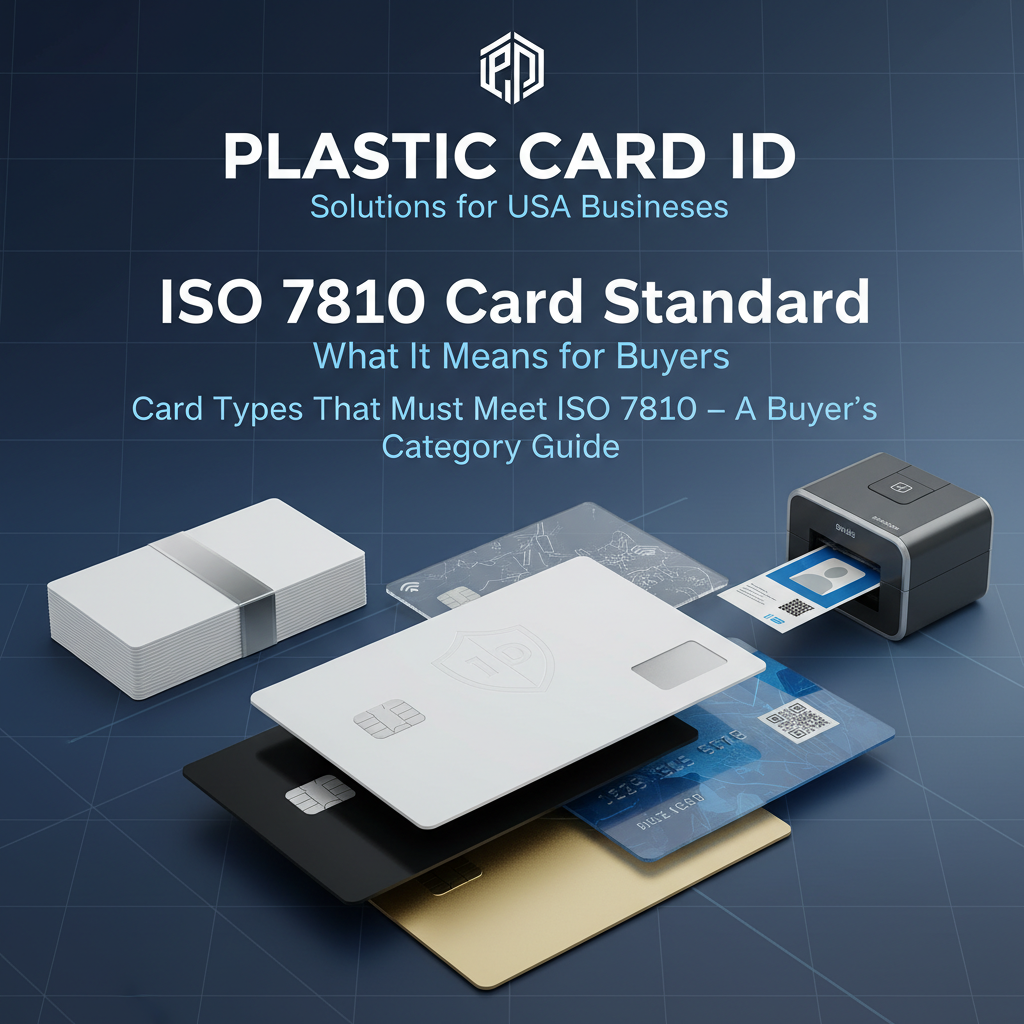 Not all card applications have the same requirements beyond the basic dimensional standard. Some need encoded magnetic stripes, some need embedded chips, and some need RFID technology built into the card body. All of them, however, start with the same ISO 7810 foundation. Understanding how different card types build on that foundation helps you order the right product the first time.
Magnetic Stripe Cards - HiCo vs. LoCo
Magnetic stripe cards add a stripe of magnetically sensitive material across the back of an ISO 7810 card. There are two coercivity levels: HiCo (High Coercivity, typically 2750 Oe) and LoCo (Low Coercivity, typically 300 Oe). HiCo stripes are much harder to accidentally erase and are used for employee badges, access control, and long-use loyalty cards. LoCo cards are used in lower-security, shorter-lifespan applications.
Choosing the wrong coercivity for your application is a common and expensive mistake. A hotel using HiCo cards in a system designed for LoCo - or vice versa - will see encoding failures and guest complaints. CPE carries both HiCo and LoCo magnetic stripe cards in CR80, and the team can help you confirm which specification matches your existing reader and encoder infrastructure.
- HiCo (2750 Oe): Employee ID cards, loyalty programs, transit cards, long-term access credentials
- LoCo (300 Oe): Hotel key cards, short-term event credentials, vending access
- Track 1: Alphanumeric, 79 characters, used in airline and ID applications
- Track 2: Numeric only, 40 characters, most common in access and payment-adjacent programs
- Track 3: Numeric, 107 characters, used in banking and some transit systems
RFID, Proximity, and Smart Chip Cards
RFID and proximity cards embed an antenna and a chip within the card body while still maintaining ISO 7810 physical dimensions. This is a manufacturing achievement - the antenna coil, chip, and connection points are all laminated within the standard 30 mil thickness. Contactless cards using technologies like MIFARE DESFire provide encrypted, high-security access control for facilities, casinos, and multi-tenant buildings.
Smart contact chip cards follow the ISO 7816 standard for chip interface, but the card body itself still conforms to ISO 7810. This dual-standard compliance is what allows smart cards to work in both chip readers and standard card holders without issue. For organizations scaling up access control or membership programs, RFID and smart cards deliver the security and automation that magnetic stripe alone cannot match.
Specialty Cards - Clear, Frosted, and Custom Formats
Clear and frosted PVC cards bring a distinctive visual impact to loyalty, VIP, and membership programs. Both formats still conform to ISO 7810 dimensions and 30 mil thickness, which means they run through the same printers and fit the same card wallets as standard white PVC stock. The visual difference is significant - clear cards in a loyalty program signal premium status in a way that white cards simply do not.
Custom die-cut shapes move outside the strict CR80 footprint and are typically used for keytags, non-standard credentials, and marketing pieces. Luxury metal cards in stainless steel, brass, and gold represent the top tier of physical card prestige - used for VIP programs, elite membership tiers, and high-touch hospitality applications. These do not run through desktop card printers but are produced as finished, custom products.
Real-World Impact - What Happens When You Upgrade to ISO-Compliant Plastic Cards
The numbers from retailers who have switched from paper gift certificates to ISO 7810 standard plastic gift cards are striking. Sales increases of 35-50% are well-documented across the retail card industry. The reason is psychological and practical simultaneously - a plastic card feels like currency. It lives in wallets. It gets noticed at the register by other customers. Paper punch cards get lost in junk drawers.
For membership organizations, the card itself communicates legitimacy. A laminated paper card says temporary. A professional CR80 plastic card with your logo, member name, and ID number says permanent, valuable, and worth keeping. That physical signal changes how members engage with your organization, and it changes how prospects perceive you when they see those cards in use.
Loyalty Programs - The Wallet Test
A loyalty card that lives in a wallet generates repeat visits because it is a constant, low-friction reminder. Every time your member opens their wallet, your brand is visible. Plastic loyalty cards that pass the wallet test outperform paper punch cards in every measurable retention metric, from visit frequency to average transaction value. This is not a design opinion - it is a behavioral reality backed by program data across industries.
The ISO 7810 CR80 form factor is specifically what makes the wallet test possible. Cards that are too thick, too stiff, or even slightly oversized get removed from wallets and left at home. Standard 30 mil CR80 cards slide into card slots perfectly, and they stay there - quietly doing brand work every time the wallet opens.
Employee Badge and Access Control Programs
Employee ID card programs have a compliance dimension that goes beyond aesthetics. In regulated industries - healthcare, education, government contracting - ID cards must meet specific physical standards to be accepted as valid credentials. ISO 7810 compliance is often a baseline requirement in those specifications, not an optional feature.
For access control applications combining printed ID with magnetic stripe or RFID encoding, card dimensional consistency is critical to reader reliability. Readers are calibrated to accept cards within specific thickness and size tolerances. Running cards that drift from ISO spec in an access control system creates security gaps - doors that do not open, credentials that fail intermittently, and security audits that flag non-compliant hardware use.
Event Credentials and Short-Term Programs
One area where buyers frequently underestimate card quality requirements is short-term event credentials. Conferences, trade shows, festivals, and corporate events issue hundreds or thousands of cards for temporary use. Because the use period is short, buyers sometimes reach for the cheapest cards available - only to discover that off-spec cards jam the on-site printers rented or purchased for the event, creating lines and delays at exactly the wrong moment.
ISO-compliant blank PVC cards eliminate that event-day risk. They feed reliably at volume, print consistently, and survive the badge-clip, lanyard, and repeated swipe conditions of a busy event without delaminating or deforming. For event organizers who have experienced the alternative, the marginal cost difference between spec and off-spec cards is obviously worth paying.
Buying Smart - What to Confirm Before You Order Blank PVC Cards
Knowing the ISO 7810 standard helps you ask better questions before you buy. Whether you are setting up a new card program or scaling an existing one, a few key confirmations will prevent the most common sourcing mistakes. The goal is not to become a card manufacturing expert - it is to order with confidence and receive cards that work the first time.
Questions Every Card Buyer Should Ask Their Supplier
- Are the cards confirmed ISO 7810 compliant at 85.60 x 53.98 mm and 30 mil thickness?
- What surface finish do the cards carry - gloss, matte, or specialty coating?
- Are the cards compatible with my specific printer model and ribbon type?
- If ordering magnetic stripe cards, what coercivity level is encoded on the stripe?
- What is the minimum order quantity, and are volume price breaks available?
- Are samples available before committing to a large order?
CPE is equipped to answer every one of those questions clearly, and the team actively helps buyers avoid specification mismatches before an order is placed. With more than 50 million cards sold and over 100,000 customers served across the United States, the experience base behind that guidance is substantial.
Matching Card Spec to Program Scale
A program running 50 cards a month has different priorities than one producing 10,000 cards monthly. At small scale, flexibility and ease of setup matter most - a straightforward CR80 blank card, a desktop Evolis printer, and a YMCK ribbon gets you printing professional cards in an afternoon. At large scale, per-card cost, batch consistency, and encoder reliability become the dominant variables.
Scaling a card program is far easier when the card specification stays consistent from startup through growth. Organizations that start with ISO 7810 compliant CR80 stock never need to retrofit their printer setup, change their badge holder inventory, or re-engineer their reader calibration as volume increases. The standard scales with you because the entire card industry is built around it.
Understanding Value-Added Card Services
Beyond the cards themselves, CPE offers card carriers, sleeves, affixing services, and card mailing - the logistics layer that turns printed cards into delivered, usable credentials. For membership organizations issuing cards to hundreds of new members monthly, in-house card mailing can consume significant staff time. Outsourcing that process to a supplier with the infrastructure to handle it is a genuine operational efficiency gain.
Card carriers are another frequently overlooked detail. A professionally designed card carrier accompanying a new membership card or loyalty card elevates the entire unboxing experience. It reinforces the brand, communicates program benefits, and reduces the chance that the card is mistaken for junk mail and discarded unopened. These are the finishing details that separate a great card program from a functional one.
Why Plastic Card ID Is the Right Partner for Your ISO 7810 Card Program
Over 25 years of serving United States businesses across every industry vertical - retail, hospitality, healthcare, education, access control, event management, and more - creates a knowledge base that no newcomer supplier can replicate. CPE has seen the mistakes, solved the compatibility problems, and built the product catalog that addresses real-world card program needs at every scale.
The catalog depth matters. Blank white CR80, magnetic stripe HiCo and LoCo, RFID and proximity cards, smart chip cards, clear and frosted stock, colored PVC, casino player cards, hotel key cards, luxury metal cards in stainless steel and brass and gold - plus the printers, ribbons, cleaning kits, and accessories to run it all. That depth means buyers can build and scale an entire card program without sourcing from multiple vendors and managing multiple relationships.
The Strategic Partner Difference
There is a real difference between a supplier that ships boxes and a partner that helps you build a successful card program. CPE functions as the latter. When a buyer is uncertain about card specifications, compatible printers, or how to configure an access control card program, the team engages with the specifics of that program - not just the product SKU. That engagement is the reason the customer retention numbers are what they are after 25 years.
A strategic card program partner saves you money, reduces errors, and helps your program grow in ways a transactional vendor relationship never will. The questions you have not thought to ask yet - about encoder compatibility, ribbon yield per card, hopper capacity for your print volume - get answered before they become problems. That proactive value is built into every relationship CPE builds.
Ready to Start or Scale Your Card Program
Whether you are issuing your first 500 blank PVC cards for a new employee badge program or scaling a loyalty card initiative to tens of thousands of members, the path starts with a conversation. 800.835.7919 connects you directly to a team that understands card specifications, printer compatibility, and program design from the ground up.
Getting the card specification right from the start - ISO 7810 compliant, correct coercivity, right surface finish for your printer - eliminates the most common and most expensive early mistakes in card program management. That expertise is available to every buyer, at every scale, from day one.
Contact Plastic Card ID today and let the team help you build a card program that works from the first card to the millionth. Call 800.835.7919 now - and do it right the first time.
Previous Page