Preventing Counterfeit Plastic ID Cards: Expert Tips
Table of Contents []
- Why Counterfeit Plastic ID Cards Are a Bigger Problem Than Most Organizations Realize
- Physical Security Features That Make Plastic ID Cards Harder to Fake
- Encoding Technology: Protecting the Data Inside the Card
- Building a Card Program That Resists Counterfeiting From the Ground Up
- Choosing the Right Card Printer for a Secure In-House Card Program
- Frequently Asked Questions About Preventing Counterfeit Plastic ID Cards
- Plastic Card ID Is Ready to Help You Build a Secure Card Program That Actually Holds Up
Why Counterfeit Plastic ID Cards Are a Bigger Problem Than Most Organizations Realize
Walk into almost any venue, business, or institution that issues plastic ID cards, and you will find the same quiet assumption humming beneath every transaction: that the card being presented is genuine. That assumption is increasingly dangerous. Counterfeit plastic ID cards are not a fringe concern reserved for government agencies or high-security facilities. They show up in employee badge programs, membership clubs, event credential systems, and access control setups of all sizes - and they do real damage when they go undetected.
The scale of the problem surprises people. A convincing fake does not require sophisticated equipment; consumer-grade card printers and blank PVC stock are widely available, and that accessibility cuts both ways. Organizations that invest nothing in anti-counterfeiting measures are essentially leaving the front door open. The good news is that the right card design, materials, and encoding strategies create layers of protection that are genuinely difficult and expensive to defeat.
Plastic Card ID has spent more than 25 years helping businesses across the United States build card programs that hold up under real-world scrutiny. From magnetic stripe encoding to RFID smart chip technology, the solutions exist - and they are more affordable and accessible than most organizations expect.
What Counterfeiters Are Actually Doing
Most counterfeit ID cards are not elaborate forgeries produced in criminal laboratories. They are opportunistic duplications - someone acquires a blank card, photographs or scans a legitimate credential, and reprints it on consumer hardware. The result is often visually close enough to fool an untrained eye, especially in a busy environment where badge checks happen in seconds.
More sophisticated operations go further: encoding fake data onto magnetic stripes, cloning proximity card signals, or reproducing holographic overlaminates with embossed foils purchased from unscrupulous suppliers. Understanding the methods counterfeiters use is the first step toward designing a card program that defeats them. Security is not a single feature; it is a stack of overlapping measures, each one raising the cost and complexity of a successful fake.
The Real Cost of a Compromised Card Program
When a counterfeit card gains access to a facility, the costs branch in every direction. There are direct losses - stolen inventory, unauthorized service use, fraudulent loyalty redemptions - and indirect ones that are often larger: liability exposure, reputational damage, and the expensive process of revoking and reissuing an entire card population. A loyalty program that hemorrhages fraudulent point redemptions can lose thousands of dollars before anyone notices the pattern.
Membership organizations face a different version of the same problem. A counterfeit membership card undermines the exclusivity and trust that make the program valuable in the first place. When illegitimate cardholders receive benefits they did not earn, real members subsidize the fraud - and eventually, they notice. The damage to member satisfaction and retention can outlast the financial loss by years.
Why Plastic Cards Are Worth Protecting in the First Place
It is worth stepping back to remember what makes a plastic card program worth counterfeiting at all: the cards work. Retailers that switch from paper gift cards to plastic see revenue increases of 35-50%, because plastic cards are kept, displayed, and shared in ways paper never is. Loyalty cards that live in wallets generate more repeat visits than punch cards that live in junk drawers.
Plastic membership and ID cards carry a sense of legitimacy and permanence. They signal that an organization is serious, established, and worth belonging to. That credibility is precisely what makes a convincing fake so valuable to bad actors - and so worth protecting against with thoughtful, layered security design.
| Card Type | Primary Use | Key Vulnerability | Recommended Protection |
|---|---|---|---|
| Blank PVC (CR80) | Employee badges, event passes | Easy to reprint over blank stock | Holographic overlaminates, UV ink |
| Magnetic Stripe (HiCo/LoCo) | Access control, loyalty | Stripe data can be cloned | HiCo encoding, encrypted data |
| Proximity / RFID | Building access, time tracking | Signal interception and cloning | Encrypted RFID chips, mutual auth |
| Smart Chip (MIFARE DESFire) | High-security access, campus IDs | Advanced cloning attempts | AES encryption, rolling codes |
| Clear / Frosted PVC | Specialty membership, VIP | Distinctive look can be approximated | Custom print elements, encoding |
Physical Security Features That Make Plastic ID Cards Harder to Fake
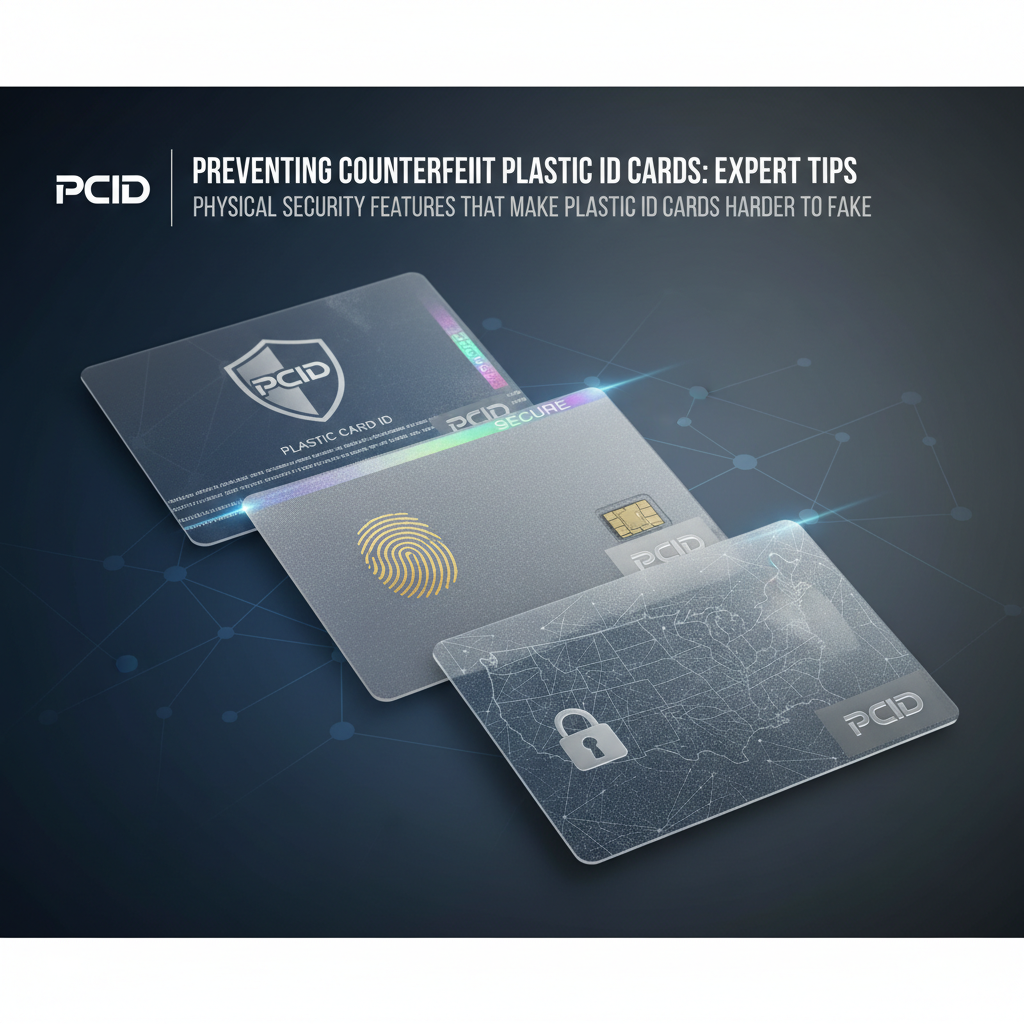 Security starts at the surface. A well-designed card communicates authenticity before anyone examines its data. Visual security features serve two purposes simultaneously: they deter counterfeiting attempts by raising the complexity and cost of a convincing reproduction, and they give trained staff something concrete and fast to check during a credential inspection. The best physical security features are easy for insiders to verify and difficult for outsiders to replicate.
The card printing technology used matters enormously here. Professional-grade card printers from manufacturers like Evolis, Zebra, and Fargo produce output quality that is measurably different from consumer hardware - finer detail, more consistent color density, and the ability to apply security overlaminates in a single integrated pass. Organizations that print in-house using quality equipment start with a meaningful advantage over anyone attempting to duplicate their cards.
Holographic Overlaminates and Security Laminates
A holographic overlaminate is a thin film applied over the printed card surface that produces shifting rainbow effects visible under normal light. The effect is produced by microscopic optical structures that are extremely difficult and expensive to replicate without industrial equipment. Holographic security laminates are one of the most cost-effective anti-counterfeiting upgrades available for any card program, adding only cents per card in materials cost.
There are different grades and pattern types: generic holographic patterns provide basic deterrence, while custom holographic patterns - featuring logos, text, or specific geometric designs unique to your organization - provide a much higher level of protection. Anyone familiar with the legitimate card knows exactly what pattern to look for, and any deviation is immediately visible.
UV Fluorescent Ink Printing
Ultraviolet fluorescent ink is invisible under normal lighting and glows brightly when exposed to a UV blacklight. Printing a hidden element - a logo, serial number, employee ID, or security code - in UV ink creates a verification layer that requires specific equipment to check and specific knowledge to replicate. It is not foolproof on its own, but as one layer in a stack of security features, it adds meaningful friction to counterfeiting attempts.
The practical implementation is straightforward. Card printers from CPE's catalog that support UV ink panels can print the fluorescent element automatically as part of the regular card production workflow. Staff at entry points, service counters, or verification checkpoints can carry an inexpensive UV penlight and check credentials in seconds without slowing down the flow of a busy environment.
Microprinting and Fine-Line Background Designs
Microprinting involves printing text or patterns at a scale so small it appears as a line or texture to the naked eye but is legible under magnification. A card might appear to have a simple geometric border that, under a loupe, reveals a repeating sequence of your organization's name or a verification code. Consumer card printers cannot reproduce microprinted elements faithfully - the resolution simply is not there - which makes microprinting a reliable differentiator.
Fine-line guilloche patterns - the complex, interwoven line designs familiar from currency printing - serve a similar purpose. They are visually distinctive, aesthetically professional, and computationally demanding to reproduce with fidelity on equipment that is not designed for the task. Incorporating these elements into a card template costs nothing beyond the design work and produces a credential that announces its legitimacy without saying a word.
Card Material Choices as a Security Factor
Standard CR80 blank PVC cards at 30 mil thickness are the industry workhorse for good reason - they are durable, universally compatible, and cost-effective. But for programs that need higher security signals, specialty materials add another layer of differentiation. Clear and frosted PVC cards are visually distinctive in ways that are immediately obvious; a frosted card presented somewhere that issues standard white cards stands out immediately as either correct or wrong.
Luxury metal cards in stainless steel, brass, or gold create a tactile experience that cannot be replicated with plastic stock - the weight alone is a verification cue. For high-value membership programs, VIP credentials, and executive-level access cards, the material itself communicates something no counterfeiter can easily match. These are not entry-level options, but for programs where the stakes justify the investment, they represent a genuinely powerful security feature.
Encoding Technology: Protecting the Data Inside the Card
Physical appearance is only half the security equation. A card's encoded data - the information on its magnetic stripe, stored in its chip, or broadcast by its RFID antenna - must be equally protected. In many access control and loyalty systems, it is the data that actually unlocks the door, redeems the points, or grants the privilege. A card that looks perfect but carries wrong or forged data fails; more dangerously, a card that looks wrong but carries valid data succeeds.
Encoding security is where technology does the heaviest lifting, and where the choice of card type becomes critically important. Not all magnetic stripes are equal. Not all RFID chips are equal. Understanding what each technology offers - and what it does not - is essential for building a card program that holds up against determined fraud attempts.
HiCo vs. LoCo Magnetic Stripe Security
High-coercivity (HiCo) magnetic stripes operate at 2750 Oe, meaning they require much stronger magnetic fields to read, write, or erase compared to low-coercivity (LoCo) stripes at 300 Oe. The practical result is that HiCo data is more resistant to accidental erasure from everyday magnetic fields - and somewhat more resistant to casual overwriting by someone trying to clone or alter the card's data without the right equipment.
For any card program where the magnetic stripe carries access or authorization data, HiCo is the correct choice. LoCo cards have their place in applications where the lower encoding strength is sufficient and cost is the primary concern, but they should not be used when data integrity and security are priorities. CPE carries both formats precisely because different applications have genuinely different requirements - the right choice depends on what is at stake.
RFID and Proximity Card Security Considerations
Proximity cards operating at 125 kHz have been the building access standard for decades - and they have known vulnerabilities. The signal broadcast by a 125 kHz proximity card can be captured at close range by a device concealed in a bag or pocket, and the captured code can be written to a blank card in seconds. This attack is not theoretical; the equipment required is available online for under $50, and documented demonstrations are easy to find.
The solution is not to abandon contactless technology but to upgrade to encrypted options. RFID smart cards operating at 13.56 MHz - particularly those implementing MIFARE DESFire with AES encryption - use mutual authentication protocols that make signal capture attacks effectively useless. The card and the reader verify each other cryptographically before any data is exchanged, and the exchanged data changes with each transaction, making captured signals non-replayable.
Smart Chip Cards and MIFARE DESFire Encryption
MIFARE DESFire EV2 and EV3 cards represent the current high-water mark in contactless smart card security for commercial applications. They implement 128-bit AES encryption, mutual authentication, and support rolling cryptographic keys that change with every transaction. A card cloned from a DESFire card cannot authenticate against a reader that has not been presented with the original card's secret keys - and those keys are never transmitted in readable form.
For organizations running casino player card programs, hotel key card systems, campus ID programs, or any application where access has meaningful financial or safety value, smart chip cards with proper encryption are not optional. They are the baseline. CPE's catalog includes these cards precisely because Plastic Card ID operates as a strategic partner, not just a supplier - helping clients choose the right technology for what they are actually trying to protect.
Building a Card Program That Resists Counterfeiting From the Ground Up
 The most effective anti-counterfeiting strategy is not reactive - it is built into the card program from the beginning. Organizations that treat security as an afterthought find themselves facing an expensive card recall and reissuance when problems emerge. Those that design security into their card specifications from day one spend less, protect more, and maintain credibility with the people who matter: their cardholders.
A layered approach is always more effective than a single measure. Visual features stop casual attempts. Encoding features stop technical attempts. Operational procedures - card tracking, expiration dates, periodic reissuance - close the gaps that technology cannot address alone. Real card program security is a system, not a feature.
Designing Security Into Your Card Template
Card design is where visual security begins. A template that incorporates multiple security elements - holographic laminate, UV print panels, microprinted borders, a custom overlaminate pattern unique to the organization - creates a credential that is genuinely difficult to replicate without access to the same production setup. Each element is individually defeatable with enough effort and investment; together, they represent a barrier that most counterfeiters will not bother to clear when easier targets exist.
- Use custom holographic overlaminates with organization-specific patterns rather than generic rainbow film
- Incorporate UV fluorescent ink elements that staff are trained to verify
- Add microprinted text in border areas that appears as a decorative line at normal viewing distance
- Include a card serial number or unique identifier on every card issued
- Use a card issuance log to track every card by number, recipient, and issue date
- Set expiration dates and plan a regular reissuance cycle to retire aging card populations
Training Staff to Spot a Fake
Technology protects the card. People protect the program. A holographic overlaminate provides zero security value if the staff checking credentials do not know what it looks like or do not bother to look. Staff training is one of the highest-return investments in card program security and one of the most consistently overlooked. Ten minutes with a legitimate card sample and a counterfeit example - or even a deliberately degraded reproduction - creates a reference experience that sticks.
Training should cover the specific security features on your cards, the physical feel of the correct material, the correct behavior of any encoded element when scanned, and what to do when something does not match. Providing a reference card that staff can compare against a presented credential creates an instant benchmark. The combination of trained eyes and encoded verification covers the two most common attack vectors simultaneously.
Card Issuance Procedures That Close Operational Gaps
Even perfect cards fail if the issuance process is not controlled. A counterfeit card is unnecessary if a legitimate card can be obtained under false pretenses. Strong issuance procedures require identity verification before a card is issued, maintain a numbered inventory of blank card stock, log every card produced and to whom it was issued, and include a process for immediate deactivation of reported lost or stolen cards.
For encoded card programs, deactivation should be fast and system-wide - not a manual database update that takes a week to propagate. The gap between "card reported lost" and "card deactivated" is an attack window that disciplined procedures close. Pairing solid issuance procedures with the right encoding technology - particularly smart chip cards whose credentials can be invalidated without physical card recovery - creates a program that is resilient even when individual cards are compromised.
Choosing the Right Card Printer for a Secure In-House Card Program
Organizations that print cards in-house control their own security destiny. They choose when to print, how many to print, what security features to include, and who has access to blank stock and the printer itself. That control is powerful - and it depends entirely on choosing the right equipment. Professional card printers from Evolis, Zebra, and Fargo are designed to produce output that consumer hardware cannot match, and many models support security features - holographic overlaminates, UV ink panels, magnetic encoding, and smart chip programming - in a single integrated workflow.
The investment in a quality card printer pays back quickly in per-card cost savings compared to outsourced production, and it delivers something outsourcing cannot: the ability to issue a card the same day it is needed. Speed and control together make in-house printing the right choice for most organizations serious about their card program.
Printer Features That Support Security Card Production
Not every card printer supports every security feature. Organizations planning to issue cards with holographic overlaminates need a printer with an integrated lamination module. UV ink printing requires a printer with a UV panel in its ribbon configuration. Magnetic stripe encoding and smart chip programming require the appropriate encoding modules, which are available as factory options or field-upgrade kits on many models in the Evolis, Zebra, and Fargo lineups.
Choosing a printer that can grow with a card program's security requirements - rather than requiring replacement when requirements change - is a meaningful cost consideration. A printer that supports lamination, UV, encoding, and chip programming in a single pass is a long-term asset, not just a purchase. CPE carries printers across a range of price points to match different organization sizes and security requirements, from small-batch single-sided desktop units to high-volume dual-sided production printers.
Ribbons, Supplies, and Maintenance That Protect Print Quality
A card printer produces secure output only as well as its consumables allow. Off-brand or incompatible ribbons produce inconsistent color density, poor detail resolution, and unreliable laminate adhesion - exactly the quality degradation that makes a legitimate card easier to approximate with a fake. Using manufacturer-specified ribbons and cleaning kits is not a upsell; it is the difference between a security card program and a card program that only looks like one on paper.
Call 800.835.7919 to speak with a CPE specialist about the right ribbon and supply configuration for your specific printer model and card security requirements. Regular cleaning - using the cleaning kits designed for each printer model - maintains print head performance and prolongs the equipment's service life significantly.
Securing the Printer Itself
A card printer loaded with blank PVC stock and connected to a card management system is a credential production asset - and it needs to be treated like one. Physical access controls on the printer, a secure location for blank card stock, and audit logging for print jobs are basic operational security measures that many organizations skip entirely. An unsecured card printer is an invitation to insider fraud.
Many professional printers include password protection, print job logging, and the ability to require user authentication before a print job begins. These features should be enabled as a matter of course, not as optional extras. Combined with a numbered blank card inventory and a print log that ties every card to a specific operator and recipient, these measures close the operational vulnerability that physical and encoding security cannot address on their own.
Frequently Asked Questions About Preventing Counterfeit Plastic ID Cards
Organizations encountering card security questions for the first time often have similar concerns. The following answers address the questions CPE hears most frequently from clients evaluating or upgrading their card programs.

How do I know which security features are right for my card program?
The right security features depend on what your cards protect and how they are used. A membership card for a fitness club has different requirements than an employee badge for a pharmaceutical facility. Start by asking: what does unauthorized access cost us? The higher the cost of a successful fake, the more investment in security features is justified. CPE specialists work through this analysis with clients as part of the program design process.
As a general starting point: visual security features (holographic laminates, UV ink, microprinting) are appropriate for nearly all card programs and add minimal cost. Encoding security (HiCo stripe, encrypted RFID, smart chips) is appropriate whenever the card grants access to something of measurable value. The two layers together cover the vast majority of commercial card security requirements effectively and affordably.
What is the difference between proximity cards and smart chip cards?
Proximity cards broadcast a fixed, unencrypted code at 125 kHz. Smart chip cards (including MIFARE DESFire) operate at 13.56 MHz and use encrypted, mutually authenticated communication that changes with every transaction. Proximity cards are lower cost and widely installed but carry known cloning vulnerabilities. Smart chip cards cost more and require compatible readers but provide dramatically stronger protection against signal interception attacks.
For new installations, smart chip technology is the correct choice for any access control application. For organizations with existing 125 kHz infrastructure, a phased migration to encrypted 13.56 MHz cards and updated readers is strongly recommended. CPE carries both card types and can advise on migration paths that work within existing infrastructure constraints.
Can I add security features to cards I am already printing?
Yes, in most cases. Holographic overlaminates can be applied by printers with lamination modules - if your current printer lacks that capability, a separate laminator can be added to the workflow. UV ink printing requires a printer with UV panel support, which may be a field-upgradeable option on your existing model. Encoding upgrades (magnetic stripe, RFID, smart chip) depend on your printer model and the availability of appropriate modules.
Some security upgrades require a new printer rather than a module addition - this is especially true for smart chip encoding, which requires precision contact programming hardware. CPE's team can assess your current setup and identify which upgrades are possible without new hardware, which require a printer upgrade, and what the cost-benefit calculation looks like for each option.
Plastic Card ID Is Ready to Help You Build a Secure Card Program That Actually Holds Up
Counterfeit plastic ID cards are a real threat, and the organizations best protected against them are the ones that designed security into their card programs from the start rather than scrambling to respond after a problem surfaced. The technology exists. The card options exist. The expertise exists. What is needed is a partner who can translate all of that into a card program that works in the real world, at the scale you actually operate, within a budget that makes sense.
That is exactly what Plastic Card ID has been doing for more than 25 years and more than 100,000 customers across the United States. From blank CR80 stock and HiCo magnetic stripe cards to MIFARE DESFire smart chip cards, holographic overlaminates, professional card printers, and the full range of supplies that keep a card program running - CPE is the one-stop resource for organizations that take their card programs seriously.
Do not wait for a counterfeit incident to take card security seriously. Whether you are starting a new card program, evaluating the security of an existing one, or scaling up production to meet growing demand, Plastic Card ID is ready to help. Call 800.835.7919 today and speak with a specialist who will give you straight answers, practical recommendations, and pricing that makes sense for your organization's size and needs. Plastic Card ID - your strategic partner in card programs that work.
Previous Page