How to Store Blank Plastic Cards Properly: Best Practices
Table of Contents []
- Blank Plastic Cards Deserve Better Than a Dusty Drawer - Plastic Card ID Explains How to Store Them Right
- Why Blank Card Storage Actually Matters More Than You Think
- Temperature and Humidity: The Two Variables That Control Everything
- Physical Storage: How You Stack, Wrap, and Contain Your Cards
- Handling Practices That Protect Your Card Inventory
- Matching the Right Card Type to Your Storage Capabilities
- Your Card Program Runs Better When Plastic Card ID Is in Your Corner
Blank Plastic Cards Deserve Better Than a Dusty Drawer - Plastic Card ID Explains How to Store Them Right
You spent money on quality blank PVC cards. Maybe a few hundred, maybe a few thousand. They are sitting somewhere in your office right now - and depending on where that "somewhere" is, they could be slowly degrading before a single one gets printed. Proper blank card storage is one of the most overlooked aspects of running a successful in-house card program, and it costs organizations real money when ignored.
Card warping, static buildup, surface contamination, and humidity damage are not hypothetical risks. They happen in real offices, real warehouses, and real supply rooms every day. The good news? Every one of these problems is entirely preventable with the right storage approach. Whether you run a small employee badge program or manage tens of thousands of loyalty cards per year, these principles apply to you.
| Storage Factor | Ideal Range | Risk If Ignored |
|---|---|---|
| Temperature | 65-75F (18-24C) | Warping, brittleness |
| Relative Humidity | 40-60% RH | Curling, static, delamination |
| Light Exposure | Minimal / indirect | Surface yellowing, fading |
| Dust and Contaminants | None | Print defects, head damage |
| Stack Pressure | Moderate, flat surface | Bowing, feed jams |
Why Blank Card Storage Actually Matters More Than You Think
 There is a persistent assumption among card program managers that blank PVC cards are essentially indestructible. They are thick, rigid, and made from industrial-grade materials - so what could go wrong in storage? Quite a bit, actually. PVC cards are sensitive to environmental conditions in ways that are not immediately visible, and the damage usually reveals itself only when it is too late: mid-print job, with a wasted ribbon and a jammed feeder.
The CR80 format - the standard 30 mil card used in virtually every ID badge, loyalty card, and access credential program in the country - is engineered to ISO 7810 tolerances. That precision is an asset in the printer, but it also means environmental stress has a measurable effect. Cards that have absorbed humidity or been exposed to heat gradients can deviate from spec in ways your printer's card feeder will absolutely notice.
The Hidden Costs of Poor Card Storage
When a card warps even slightly, it can cause feed errors, ribbon misalignment, or incomplete transfers during the printing process. Each failed print wastes a ribbon panel - and card printer ribbons are not cheap. Multiply that by dozens of bad cards in a batch, and you have a storage problem that is also a supply budget problem.
Beyond print failures, contaminated card surfaces can damage the printhead of your card printer. Dust particles, oils from handling, and chemical residue act like sandpaper against the delicate thermal printhead. Replacing a printhead is significantly more expensive than a box of properly stored cards, making smart storage a form of equipment protection as much as inventory management.
What Makes PVC Cards Vulnerable
Standard CR80 PVC cards are composed of multiple laminated layers bonded under heat and pressure. Those layers respond differently to temperature and humidity changes. When conditions shift dramatically - say, from a cold delivery truck to a warm office without any acclimation period - the layers can stress against each other, producing micro-warps that are invisible to the eye but very real to a precision card feeder.
Magnetic stripe cards add another layer of complexity. The oxide coating on HiCo and LoCo magnetic stripes can be affected by proximity to strong magnetic fields. Never store magnetic stripe cards near speakers, monitors, or other magnetized equipment - a lesson some organizations learn the hard way after a batch of preencoded cards loses its data before being issued.
RFID and Smart Card Considerations
RFID proximity cards and smart chip cards introduce additional storage sensitivities. The embedded antenna and chip components within contactless cards can be affected by electrostatic discharge (ESD) if cards are stored improperly, particularly in dry environments where static buildup is more likely. Bulk storage of RFID cards without antistatic packaging is a risk most vendors do not advertise clearly.
Cards with embedded chips - including advanced contactless formats like MIFARE DESFire - should be stored in their original packaging or in purpose-built antistatic trays until use. Treating every smart card as a delicate electronic component is the right mindset, because that is precisely what it is. The plastic exterior is just the housing.
Temperature and Humidity: The Two Variables That Control Everything
If you control nothing else about your card storage environment, control these two things. Temperature and relative humidity are the primary environmental drivers of card degradation, and they work in combination. High humidity at moderate temperatures is worse than either high temperature or high humidity alone. The interaction between heat and moisture is what causes the most dramatic card damage.
The target storage range of 65-75F with 40-60% relative humidity is not arbitrary - it mirrors the controlled conditions under which card printers are designed to operate. Storing your cards in those same conditions means the cards go into the printer already acclimated, reducing thermal shock and the feed errors that accompany it. Think of card storage as pre-conditioning for your printing workflow.
Seasonal Storage Adjustments
Office environments are not static. Summer humidity can push interior spaces well above the 60% RH threshold even with air conditioning, while winter heating systems routinely drop humidity below 30% - far too dry for optimal card storage. Organizations running year-round card programs should monitor storage area humidity seasonally and adjust accordingly, using either a dehumidifier or a room humidifier depending on the season.
A simple digital hygrometer placed near your card storage area costs very little and gives you continuous visibility into conditions. If you see readings outside the target range consistently, that is a signal to move your card inventory to a more controlled location or invest in a small dedicated storage cabinet with better environmental control.
The Acclimation Window
Cards shipped from a supplier arrive in packaging that has been subjected to transit conditions - temperature swings, humidity variations, and sometimes rough handling. Before loading a new shipment into your card printer, allow the sealed packaging to acclimate to your office environment for at least two to four hours. This acclimation window is one of the easiest ways to prevent print defects and it costs nothing but a small amount of patience.
If you operate in a climate with significant seasonal temperature swings, extend that acclimation period accordingly. Cards that arrive from a cold delivery vehicle in January and go straight into a warm printer feeder are asking for trouble. The plastic contracts and expands in response to temperature change, and that dimensional shift matters more than most people assume.
Climate-Controlled Storage Solutions
For organizations holding significant card inventory - tens of thousands of cards or specialty items like clear PVC, frosted cards, or metallic stock - dedicated climate-controlled storage is worth considering. A small office refrigerator is not ideal, but a climate-controlled storage cabinet or a designated supply room with consistent HVAC coverage works well. The investment in controlled storage is usually recovered quickly through reduced card waste and print failures.
Contact CPE at 800.835.7919 to discuss how your card volume and card type affect storage recommendations. Some specialty cards, including certain RFID formats and premium clear cards, have specific guidance that goes beyond standard PVC storage advice.
Physical Storage: How You Stack, Wrap, and Contain Your Cards
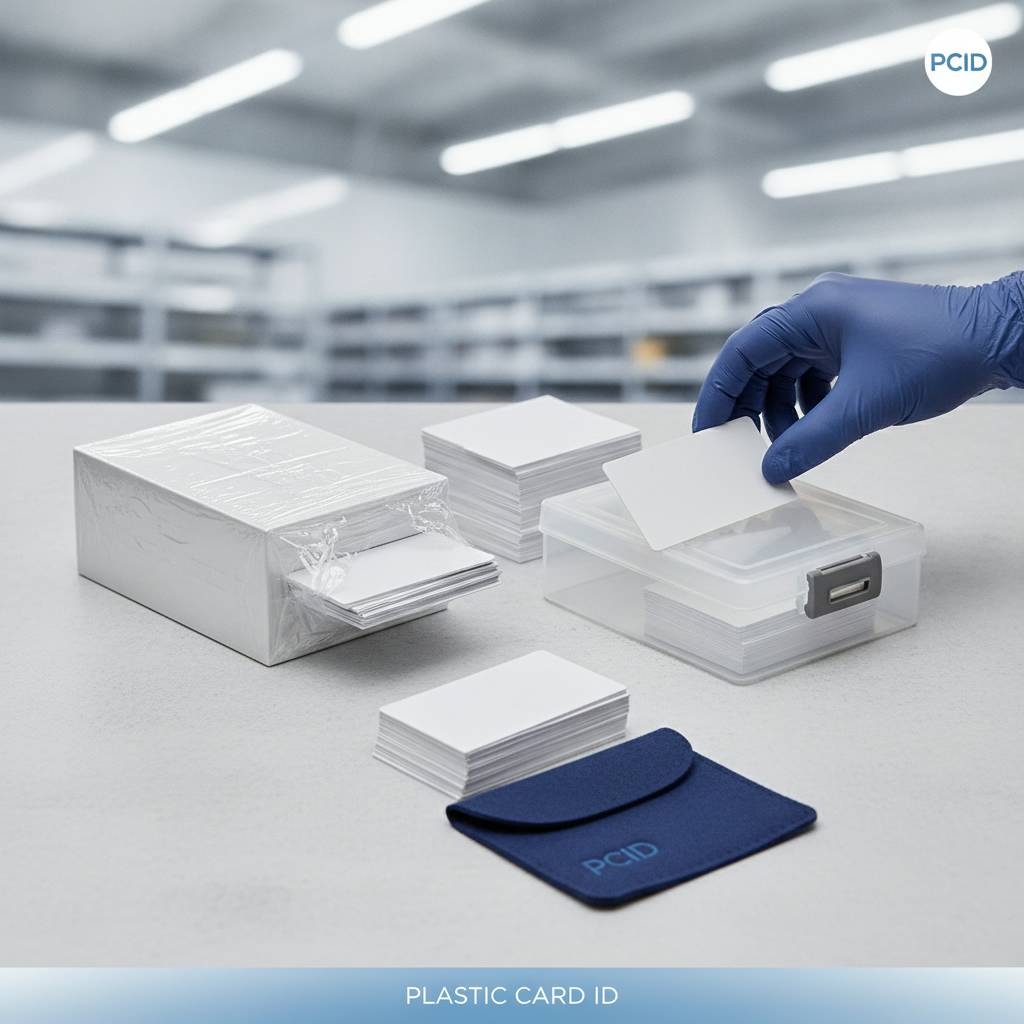 Environmental conditions matter enormously, but so does the physical arrangement of your stored cards. Cards are meant to be stacked flat - horizontally, not vertically on edge like books on a shelf. Storing cards vertically causes uneven pressure distribution across the card face, which over time contributes to bowing in the direction of the unsupported edge. Flat, horizontal storage on a stable, level surface is always the correct default.
The original factory packaging - typically a sealed plastic bag or shrink wrap inside a cardboard box - is your best storage container until you are ready to use the cards. It is designed specifically for the card dimensions, offers protection from dust and handling oils, and usually includes some degree of moisture barrier. Keep cards in their original packaging until needed, opening only what you plan to use in the near term.
Packaging and Containment Best Practices
Once a box of cards has been opened, the remaining unused cards should be stored in a resealable plastic bag or returned to their original inner packaging. Leaving a partial stack of cards sitting loose on a desk or shelf exposes them to dust, ambient oils, and accidental contamination. Even fingerprints matter - the oils in human skin can interfere with dye-sublimation printing if they coat the card surface before it enters the printer.
Card sleeves and card carriers, which CPE carries as part of its full product lineup, serve a dual purpose: they protect finished printed cards from surface scratches and handling damage, and they can also be used to protect unprinted blank stock during interim storage between uses. Any protective layer between a card surface and its environment is working in your favor.
Organizing Large Card Inventories
- Label each box clearly with card type, quantity, and receipt date to ensure first-in, first-out rotation.
- Store different card types separately - magnetic stripe, RFID, plain PVC, and specialty stock should not be commingled in the same container.
- Keep card inventory off the floor; shelving protects against moisture wicking and physical damage from foot traffic.
- Do not store heavy objects on top of card boxes, as excessive compression over time can cause warping in the bottom layers of a stack.
- Keep cards away from direct sunlight and fluorescent lighting wherever possible to prevent surface yellowing of white PVC stock.
These practices apply whether you are managing 500 cards or 50,000. Scale changes the logistics, but the underlying principles remain constant. A disciplined inventory rotation habit prevents you from discovering degraded old stock at the worst possible moment - right before a major event or badge issuance deadline.
Specialty Card Storage: Clear, Frosted, and Metal Cards
Clear and frosted PVC cards require additional handling care because their transparency makes surface scratches and smudges far more visible than on standard white stock. These cards should be stored with interleaving tissue or silicone-release paper between stacks to prevent surface-to-surface abrasion. Keep them sealed until use and handle only by the edges when loading into a printer.
Luxury metal cards - available in stainless steel, brass, and gold formats - have different storage needs entirely. Metal cards should be stored flat, away from moisture, and ideally wrapped individually or stored in compartmentalized cases to prevent surface scratching. Metal cards represent a premium investment and deserve premium storage treatment to arrive at the recipient looking impeccable.
Handling Practices That Protect Your Card Inventory
Storage conditions only tell part of the story. How cards are handled during retrieval, loading, and transport between storage and printer makes a significant difference in card quality and print outcomes. Human hands are a primary source of contamination - oils, moisture, and fine particles transfer to card surfaces with every touch, and those contaminants go directly into your printer when the card is loaded.
The professional standard for card handling in high-volume environments is to use lint-free cotton gloves when handling blank card stock. This is standard practice in photo printing and document production for the same reasons. For lower-volume operations, at minimum, handle cards by their edges rather than touching the broad faces and wash hands before loading card stock into your printer feeder.
Loading Cards Into Your Printer Correctly
Even a perfectly stored card can cause print problems if loaded into the printer incorrectly. Always follow your card printer manufacturer's guidance for feeder capacity and card orientation. Overloading the feeder hopper creates pressure that can cause feed misalignment, particularly with cards that are already at the edge of acceptable flatness tolerance. Load in smaller batches if you experience recurring feed errors.
Fan the card stack gently before loading to release any static cling that may have developed between cards during storage. Static is particularly problematic in low-humidity environments and with certain card stocks like glossy-finish PVC. A quick fan before loading takes two seconds and prevents a surprising number of card-sticking jams.
Transporting Cards Between Locations
Organizations that manage card programs across multiple sites - issuing cards at events, distributing through branch offices, or shipping printed credentials to remote locations - need to think carefully about transport conditions. Cards in transit are subject to the same environmental risks as cards in storage, compounded by vibration, compression in bags or boxes, and exposure to vehicle temperature extremes.
Use rigid card cases or padded card carriers for transporting blank or printed card stock. Avoid placing card stock in the same bag as keys, coins, or any abrasive item. For large shipments between locations, use original manufacturer packaging or equivalent rigid boxes, and allow the expected acclimation window once cards arrive at their destination before printing or issuing.
Matching the Right Card Type to Your Storage Capabilities
Not every organization has the same storage infrastructure, and not every card type has the same storage demands. Part of building a successful card program is honestly assessing your storage environment before deciding on card type and order quantity. Ordering 10,000 RFID cards when you have no antistatic storage solution and no climate-controlled area is a recipe for waste, regardless of how good the per-unit price looks.
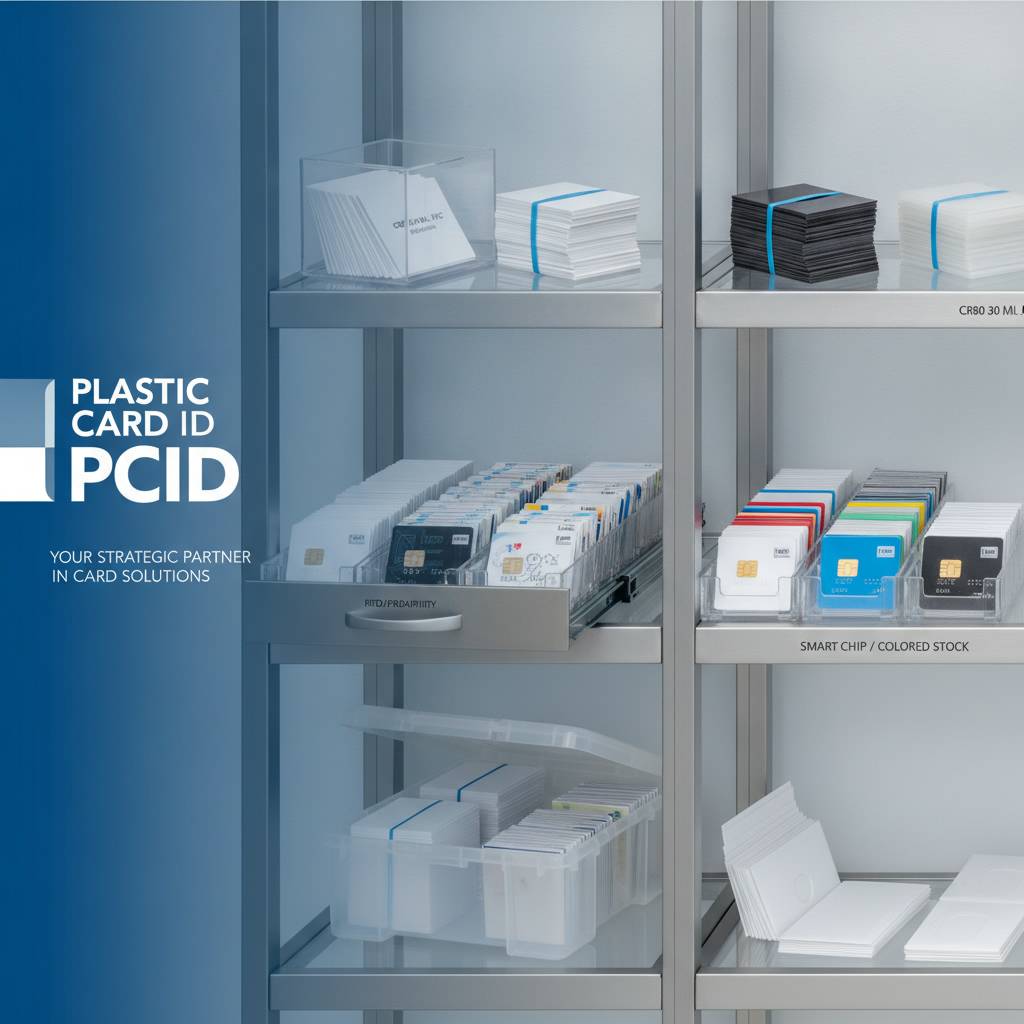
CPE helps clients think through these decisions as part of its strategic partner approach. Choosing the right card type and the right order quantity for your actual storage and usage conditions is how you protect your investment. There is no one-size-fits-all answer - a hotel managing key card inventory needs a different approach than a retailer running a gift card program, even if both are using the same CR80 form factor.
Blank PVC Cards for High-Volume Programs
Standard blank CR80 PVC cards at 30 mil thickness are the most forgiving of all card types when it comes to storage. They have no electronic components to worry about, no magnetic stripe to demagnetize, and a robust physical profile that tolerates a wider range of environmental conditions than specialty formats. For organizations printing employee badges, event credentials, or membership cards in-house, bulk blank PVC stock is both economical and storage-practical.
Buying in volume lowers per-card cost significantly - a major advantage for programs printing 500 to 5,000 cards per month. The key is matching order quantity to realistic storage conditions and usage timelines. Cards stored properly for up to 12 months retain their full print quality. Beyond that window, inspect stock before use and replace any cards showing visible warping or surface changes.
Magnetic Stripe Cards and Storage Zones
HiCo and LoCo magnetic stripe cards demand a storage zone that is definitively free from magnetic interference. This sounds simple, but office environments are full of hidden magnetic fields - from monitors and speakers to certain types of power supplies and even some desk accessories. Designate a specific drawer or cabinet for magnetic stripe card storage and keep it well away from any electronics.
HiCo cards, with their higher coercivity rating, are more resistant to accidental demagnetization than LoCo cards and are the better choice for programs where storage proximity to electronics cannot always be guaranteed. If you are unsure which stripe specification fits your program, CPE can walk you through the selection criteria based on your use case and storage reality.
Choosing Order Quantities That Match Your Storage Reality
Larger orders mean better pricing per card, but only if the cards survive long enough to be used. Before placing a large order, honestly evaluate how much usable storage space you have, whether that space meets environmental targets, and how quickly your program realistically cycles through inventory. A 90-day supply is a safer starting point for organizations without dedicated climate-controlled card storage.
Once you have established reliable storage practices and confirmed your usage rate, scaling up order quantities makes clear economic sense. The per-card savings on a 5,000-card order versus a 500-card order are substantial. Let your storage capability grow with your confidence in your inventory management system - that progression is exactly how successful card programs are built.
Your Card Program Runs Better When Plastic Card ID Is in Your Corner
Blank plastic card storage is not glamorous subject matter, but it is the foundation of a card program that runs smoothly, wastes less, and delivers professional results consistently. Every detail covered in this guide - temperature, humidity, physical containment, handling, card type matching - directly affects the quality of the cards your recipients hold in their hands. The organizations that take this seriously have better-performing programs, period.
With more than 25 years of experience supplying blank and custom plastic cards to over 100,000 customers across the United States, Plastic Card ID has seen what works and what does not. The advice on this page comes from real-world program experience, not theory. Whether you are just starting a card program or optimizing one that has been running for years, there is always a smarter way to manage your card inventory - and Plastic Card ID can help you find it.
Resources and Support Beyond the Card Sale
A card order from CPE comes with access to knowledgeable support staff who understand card programs from the ground up. Questions about ribbon compatibility, printer maintenance, card carrier options, storage solutions, and reorder timing are all within scope. The goal is to be the last card supplier you ever need to find - handling everything from blank PVC stock to card printers, cleaning kits, and accessories under one roof.
The full product catalog includes Evolis, Zebra, and Fargo card printers, all major ribbon formats, card cleaning kits, card carriers and sleeves, and a complete range of blank card stock covering standard white PVC, magnetic stripe, RFID, smart chip, clear, frosted, and specialty colored stock. Everything your program needs is available from a single, experienced source.
Get the Right Cards, Stored the Right Way, Starting Today
There is no reason to lose cards to avoidable storage damage when the solutions are this straightforward. Implement the temperature and humidity targets. Keep cards in sealed packaging. Handle them by the edges. Rotate your inventory. Match your order size to your storage reality. These steps cost nothing but attention, and they pay back in better print quality, less waste, and a card program that runs the way it should.
Ready to stock up on blank card inventory with the confidence of knowing exactly how to store it? Plastic Card ID is ready to help. Call 800.835.7919 today and speak with a card program specialist who will match you with the right card types, quantities, and supporting products for your specific operation. Your card program deserves a partner who takes the full picture seriously - and that is exactly what Plastic Card ID delivers.