PVC Plastic Card Environmental Considerations: What You Should Know
Table of Contents []
- What Every Business Should Know: PVC Plastic Card Environmental Considerations with Plastic Card ID
- Understanding PVC as a Card Material
- Responsible End-of-Life Handling for PVC Cards
- The Long-Term Value Argument for Durable PVC Cards
- Frequently Asked Questions: PVC Cards and Environmental Considerations
- Choosing the Right Card and Printer for Your Program
- Why Plastic Card ID Is the Right Partner for Your Card Program
What Every Business Should Know: PVC Plastic Card Environmental Considerations with Plastic Card ID
Most companies ordering plastic cards for the first time ask about pricing, quantities, and turnaround. Fewer think to ask about the material itself - what it is, how it behaves over time, and what responsible handling looks like at the end of a card's useful life. That gap in knowledge can lead to uninformed decisions, and CPE believes well-informed customers make better partners.
PVC, or polyvinyl chloride, is the industry-standard material for CR80 plastic cards precisely because it is durable, printable, encodable, and dimensionally stable. It does not warp in a wallet, fade on a shelf, or degrade in normal use conditions. Those properties make it the right material for serious card programs - but they also mean PVC cards require thoughtful handling when their useful life ends. Understanding this upfront helps your organization plan smarter programs, order the right quantities, and dispose of retired cards appropriately through specialty recycling channels.
| Property | PVC Card Standard | Why It Matters |
|---|---|---|
| Card Size | CR80, ISO 7810 Standard | Universal wallet and reader compatibility |
| Thickness | 30 mil | Rigid, durable, professional feel |
| Material | Polyvinyl Chloride (PVC) | Long lifespan, printable, encodable |
| End-of-Life | Specialty recycling required | Not accepted in curbside bins |
| Typical Card Lifespan | 3-5 years active use | Fewer replacements, lower long-term cost |
Understanding PVC as a Card Material
 There is a reason the entire global card industry built itself around PVC. From access control badges to hotel key cards to loyalty programs used by tens of millions of consumers, this material has proven itself over decades of real-world use. Its physical consistency is extraordinary - a CR80 card at 30 mil thickness will not bow, crack, or absorb moisture under normal conditions. That reliability is not incidental; it is the whole point.
When your business invests in a card program, you are investing in a physical artifact that represents your brand every single time someone pulls it out of their wallet. The durability of PVC is a feature, not a liability. A card that lasts three to five years of active daily use means fewer reprints, less waste, and a lower cost-per-interaction over the life of your program. That longevity is why CPE has been supplying PVC cards to businesses across the United States for over 25 years.
Why PVC Outlasts Alternatives
Paper cards buckle. Paper-laminate hybrid cards delaminate. Cards printed on thinner substrates lose their printed information faster in wallet friction environments. PVC holds color, holds encoding, and holds its shape. For a loyalty card scanned dozens of times per year or an employee badge swiped through an access reader daily, that structural integrity is non-negotiable.
The ISO 7810 standard exists precisely because the global card infrastructure, from magnetic stripe readers to RFID scanners to card printers, was built around specific dimensional tolerances. PVC CR80 cards meet those tolerances consistently, which means your cards will work reliably in the equipment they are designed to interact with.
The Composition of a Standard PVC Card
A standard blank PVC card is a laminated sandwich of PVC layers fused under heat and pressure. The result is a single, rigid unit. Specialty cards introduce additional components: magnetic stripes contain iron oxide particles suspended in a binder; smart chip cards contain embedded microchips and antenna coils; RFID cards contain inductive antenna loops. These additions serve specific functional purposes but also affect how cards should be handled at end of life.
Knowing what is inside your card helps you plan for responsible retirement. Organizations running large-scale card programs, like casino floors, hotel chains, or corporate campuses with thousands of access badges, should have a documented card retirement process that routes spent cards to appropriate specialty recyclers rather than general waste streams.
Composite and Specialty Card Variants
Not every card in CPE's catalog is pure PVC. Clear and frosted cards use different optical-grade PVC or PETG materials. Metal cards in stainless steel, brass, and gold are an entirely different product category, with their own material properties and end-of-life considerations. Die-cut cards in custom shapes follow the same PVC material guidelines as standard CR80 blanks but in unique geometries.
Each variant serves a specific strategic purpose. A luxury metal card signals an entirely different brand message than a standard white PVC card. A clear card creates a visual effect that works beautifully for certain membership and VIP programs. Matching the card type to the program goal is a conversation Plastic Card ID has had with over 100,000 customers, and it starts with understanding what the material will and will not do.
Responsible End-of-Life Handling for PVC Cards
PVC is not accepted in standard curbside recycling programs in most municipalities across the United States. This is a practical reality of municipal recycling infrastructure, not a reason to avoid PVC cards. The material is recyclable, but it requires dedicated facilities that handle plastics coded as type 3. Organizations that run high-volume card programs should build end-of-life planning into their card program management from the start.
The good news is that the long lifespan of a well-made PVC card means the volume of cards reaching end-of-life in any given year is a small fraction of the cards in active use. A loyalty card that lives in a customer wallet for four years generates far less material turnover than a paper punch card replaced multiple times per year. Longevity itself is the most practical approach to reducing card program material throughput.
Specialty Recycling Channels for PVC Cards
Several national recycling programs accept PVC cards, including spent gift cards, membership cards, and access badges. Organizations like TerraCycle have historically offered card recycling programs, and some office supply retailers have participated in collection programs for spent plastic cards. A quick search for "PVC card recycling near me" or "type 3 plastic recycling" will surface options in most metropolitan areas.
For large enterprises retiring thousands of cards at once, industrial plastic recyclers who handle PVC feedstock are another route. These facilities can process bulk volumes efficiently. The key step is shredding or otherwise destroying sensitive card data before routing cards to any recycling stream, particularly for access badges, smart cards, and any card carrying personal identification information.
Data Security Before Disposal
Before a PVC card reaches any recycling or disposal channel, the information it carries must be rendered unreadable. This applies to magnetic stripe data, smart chip data, printed cardholder information, and RFID encoding. A card shredder capable of handling 30-mil PVC cards is an essential tool for any organization retiring sensitive cards at scale. Standard office paper shredders are typically not rated for plastic card stock.
Magnetic stripe data can theoretically be read from an intact retired card. Smart chip data is more secure by design but cards carrying sensitive credentials should still be physically destroyed before disposal. Proximity and RFID cards should be decommissioned in the access control system and physically destroyed. This is standard practice in any security-conscious organization and should be part of your card program documentation.
Planning Card Quantities to Minimize Waste
One of the most practical ways to run a responsible card program is to order quantities aligned with realistic program timelines. Ordering 50,000 cards for a program that realistically needs 5,000 per year creates unnecessary inventory risk and, ultimately, more material to manage. CPE works with clients ranging from 50 cards a month to mass production volumes, and part of that relationship is helping clients find the right quantity tier for their actual needs.
- Assess your monthly or annual card issuance rate before placing large quantity orders.
- Factor in card lifespan when calculating reorder frequency, a durable PVC card used daily may last 3-5 years.
- Consider phased ordering for new programs where enrollment projections are uncertain.
- Track card return and retirement rates for employee badge and access card programs.
- Store unused blank cards properly, away from heat and direct sunlight, to preserve print quality and shelf life.
Getting quantity right is not just about cost per unit. It is about running a program that generates real value, real results, and a manageable material footprint over time. That kind of strategic thinking is exactly what separates a transactional card vendor from a genuine program partner.
The Long-Term Value Argument for Durable PVC Cards
 It bears repeating: the single most impactful decision you can make for a responsible, cost-effective card program is choosing a card that lasts. Retailers who switch from paper gift cards to plastic gift cards routinely see sales increases of 35-50%. That gain comes not just from aesthetics but from durability, the card stays in the wallet, stays visible, stays usable. A paper gift certificate is easy to lose or damage. A PVC card is not.
The same principle applies to loyalty cards. A loyalty card that survives two years of wallet use generates two years of touchpoints, two years of brand impressions, two years of potential return visits. The economics of durability compound powerfully over time. Replacing a card program twice because cheaper cards wore out is more expensive and more materially intensive than using quality PVC from the start.
Loyalty and Membership Cards: Where Durability Drives ROI
Paper punch cards are charming. They are also easy to forget, easy to lose, and easy to fake. A printed PVC loyalty card with a barcode or magnetic stripe is none of those things. It scans reliably, it carries your brand with authority, and it signals to the customer that your program is a serious, ongoing commitment, not a trial promotion.
Membership cards for gyms, clubs, associations, and professional organizations carry even higher expectations. A member who receives a flimsy laminated paper card may subconsciously question the permanence of the organization. A rigid, professionally printed PVC membership card communicates something entirely different: that this organization is established, that membership means something, and that the relationship is built to last.
Employee Badges and Access Cards: The Cost of Failure
A failed access card is not just an inconvenience. In a secure facility, it is a security gap. An employee badge that loses its magnetic encoding after six months of regular use creates reprinting costs, administrative overhead, and potential security incidents during the window between card failure and replacement. Investing in quality PVC cards for access control programs is a direct investment in operational continuity.
RFID and proximity cards add another layer of technology that demands robust physical housing. The antenna coil embedded in a proximity card needs its PVC shell to maintain dimensional integrity through repeated pocket and lanyard use. Cards that flex too much risk antenna delamination and read failures. The structural rigidity of a proper 30-mil PVC card is not incidental to RFID function; it is part of what makes the technology work reliably in the field.
Hotel Key Cards, Casino Player Cards, and High-Turnover Programs
Some card programs are designed for short deployment cycles. A hotel key card may be in service for two or three days. A casino player card may be issued, used, and retired over a single visit. These high-turnover programs generate more material per unit time than long-lifecycle programs, which makes quantity planning and disposal infrastructure especially important for these operators.
For high-turnover hotel and casino programs, Plastic Card ID recommends establishing relationships with local specialty recyclers and implementing card collection programs at checkout. Guests can be offered a convenient card return point, reducing the number of cards leaving the property and entering general waste streams. This kind of operational detail is the mark of a well-run program, and it is the kind of conversation that distinguishes a strategic card program partner from a simple card supplier.
Frequently Asked Questions: PVC Cards and Environmental Considerations
Customers ask smart questions. After serving over 100,000 businesses across the United States, CPE has heard most of them. The following reflects the questions most commonly raised by organizations thinking carefully about the materials in their card programs.
Can PVC Cards Be Recycled?
Yes, with the right infrastructure. PVC is a type 3 plastic and is not accepted in curbside recycling programs in most U.S. municipalities. However, dedicated specialty recycling facilities and programs exist that can process spent PVC cards. Organizations retiring large volumes of cards should research regional options or national mail-in programs designed specifically for this material type.
For organizations with active card programs issuing hundreds or thousands of cards annually, building a card retirement and recycling protocol into standard operating procedures is a straightforward step. Designate a collection point for returned cards, partner with a local specialty recycler or national take-back program, and document the process. It takes minimal overhead to implement and reflects well on your organization's operational maturity.
How Long Do PVC Cards Last?
Under normal use conditions, a quality 30-mil PVC CR80 card can last three to five years or longer in active service. Cards used in harsh environments, exposed to extreme temperatures, or subjected to heavy mechanical stress may have shorter practical lifespans. Magnetic stripes can wear faster than the card body itself in high-swipe applications, which is why HiCo magnetic stripes are recommended for programs with frequent daily encoding reads.
Smart chip and RFID cards are rated for thousands of read/write cycles and typically outlast the program timelines they are deployed in. For most employee badge and access control programs, the card will outlast the employee's tenure or the access control system update cycle, whichever comes first. Designing programs around realistic lifespans prevents unnecessary over-ordering and premature retirement of usable inventory.
What Should I Do With Old Employee Badges?
First, decommission the card in your access control system. A physically retired badge that is still active in your system is a security risk. Second, destroy the card physically using a card-capable shredder or punch to render both the printed information and any encoded data unreadable. Third, route the destroyed material to a specialty recycler who handles PVC or type 3 plastic. If your volume is too small for a dedicated recycler pickup, accumulate cards until you have a viable batch for a mail-in program.
Some card printer manufacturers and card suppliers have partnered with recycling programs over the years. Check with Plastic Card ID about current options, and reach out to card industry associations for updated guidance as recycling infrastructure for plastic cards continues to develop across the United States.
Choosing the Right Card and Printer for Your Program
The material conversation is inseparable from the product selection conversation. The card type you choose, whether blank PVC, magnetic stripe, RFID, smart chip, or specialty stock, determines how the card functions, how long it lasts, and how it should be handled at end of life. Getting this right from the beginning of a program is far more efficient than discovering mid-program that the card spec does not match the operational requirements.
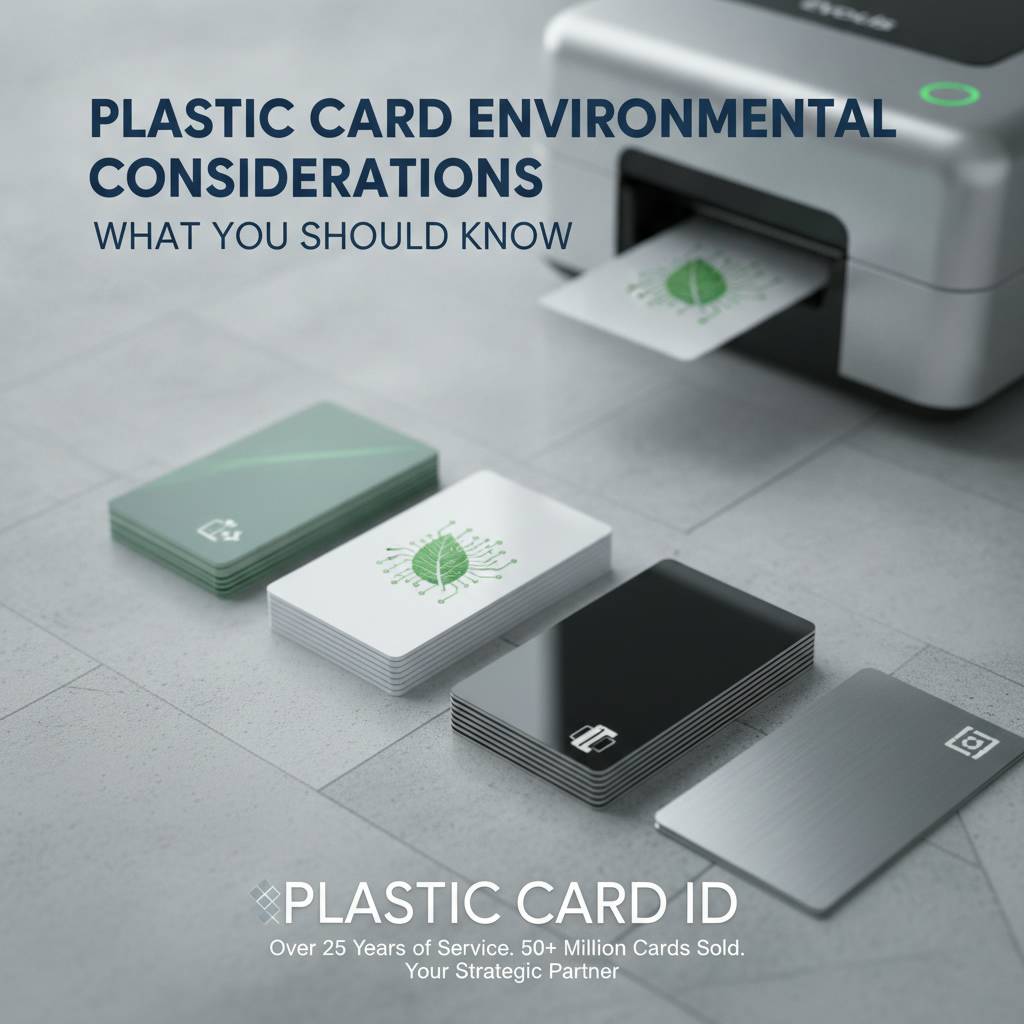
CPE stocks the full spectrum: blank white PVC cards, HiCo and LoCo magnetic stripe cards, proximity and RFID cards including MIFARE DESFire contactless smart cards, clear and frosted stock, colored card stock, and premium metal cards for programs that demand maximum perceived value. Paired with card printers from Evolis, Zebra, and Fargo, and supported with ribbons, cleaning kits, card carriers, and sleeves, this is a complete program infrastructure available from a single source.
Matching Card Technology to Program Requirements
Not every program needs the most advanced card technology available. A basic employee photo ID at a low-security facility may need nothing more than a blank white PVC card printed on a desktop direct-to-card printer. A hospital with strict access tiers may require RFID smart cards with MIFARE DESFire encryption. A regional loyalty program may perform perfectly well with a simple barcode on a standard PVC card.
Matching technology to requirement avoids both under-engineering and over-engineering your card program. An overly complex card specification adds cost without adding value if the additional capability is never used. An under-spec'd card that fails in the field creates costs that dwarf any upfront savings. This calibration is something Plastic Card ID helps clients navigate through consultation, not just catalog browsing. Contact us at 800.835.7919 to discuss which card type fits your specific operational needs.
Printer Selection and Long-Term Program Costs
The card printer you choose has a significant impact on your long-term program economics. Direct-to-card printers are cost-effective for low-to-medium volume programs and deliver excellent print quality on standard PVC stock. Retransfer printers offer edge-to-edge printing and better performance on smart card surfaces but carry a higher hardware and ribbon cost. Selecting the wrong printer type for your volume tier creates either capacity bottlenecks or unnecessary capital expenditure.
Ribbon consumption, cleaning kit frequency, and printer maintenance schedules all affect the total cost of your in-house card printing operation. CPE supplies ribbons and maintenance accessories for all major printer lines in its catalog, ensuring that the consumables you need are available with the same reliability as the cards themselves. A complete program means printer hardware, card stock, ribbons, and support in one place.
Blank Cards vs. Pre-Printed: Which Path Fits Your Program
Blank CR80 cards give organizations maximum flexibility and the lowest per-card cost over time when printing in-house. The investment is in the printer and ribbon supply, but the unit economics improve dramatically at medium and high volume. Organizations that need frequently updated card designs, variable data like names and photos, or the ability to produce cards on demand benefit most from the blank card plus in-house printer model.
Custom pre-printed cards make sense when design complexity exceeds in-house print capability, when quantities justify print run economics, or when specialty finishes are required. Both paths lead to a high-quality finished card; the right choice depends on your operational setup, volume, and design requirements. Plastic Card ID is equipped to support either approach at any scale.
Why Plastic Card ID Is the Right Partner for Your Card Program
Twenty-five years. Over 100,000 customers. More than 50 million cards shipped. These are not marketing numbers; they are the accumulated weight of consistent execution across every type of card program an American business might run. From a 50-card-per-month boutique loyalty program to a tens-of-thousands-per-month enterprise rollout, CPE has been the supplier behind more U.S. card programs than most organizations will ever need to count.
The difference between a supplier and a strategic partner is the depth of the conversation before the order is placed. A supplier takes your specifications and ships your cards. A partner helps you figure out the right specification in the first place, flags potential issues before they become expensive problems, and stays engaged as your program evolves. That is the relationship model Plastic Card ID has operated on since day one, and it is why customers return year after year, program after program.
A Catalog Built for Real Program Needs
Every product in the Plastic Card ID catalog exists because a real program needed it. Blank PVC cards for in-house printing flexibility. HiCo magnetic stripe cards for high-frequency swipe environments. Proximity and RFID cards for access control and contactless applications. Clear and frosted cards for specialty visual effects. Metal cards for luxury membership and VIP programs. Card printers, ribbons, cleaning kits, card carriers, sleeves, and card mailing services for complete program support.
This is not a catalog assembled for appearance. It is a working toolkit built from 25 years of listening to what businesses actually need when they set out to run a card program that performs in the real world. The breadth of the catalog means you can grow your program, pivot your technology, or expand into new card types without ever needing to find a new vendor.
U.S.-Based Service and Support
Every customer served by CPE is a U.S.-based business or organization. This focus means deep familiarity with U.S. compliance contexts, U.S. shipping logistics, and U.S. business operational rhythms. There is no confusion about time zones, no ambiguity about shipping carriers, and no disconnect between what a customer needs and what the team on the other end of the phone understands about running a business in America.
Card program questions are real operational questions. When an access control system needs a specific card encoding spec, or when a new loyalty program needs to hit a launch deadline, or when an organization is trying to figure out the right quantity for a first-time card program, the ability to pick up the phone and talk to someone who knows the product and the industry is genuinely valuable. That accessibility is part of what Plastic Card ID has always offered.
Getting Started: What to Expect
Starting a card program with Plastic Card ID is straightforward. Identify the card type that matches your application, whether that is a basic blank card for in-house printing, a magnetic stripe card for POS integration, an RFID card for access control, or something in the specialty lineup. Determine your quantity tier based on realistic issuance rates. Select the printer and consumables that match your volume and card type. Place your order and receive it shipped to your U.S. address.
For organizations new to card programs or transitioning from paper-based systems, the team at CPE is available to guide the technology and product selection process. The goal is always the same: a card program that works reliably, represents your brand well, and delivers measurable results over its operational life. Reach out, describe your program, and let the conversation begin.
Ready to build a card program that performs? Call Plastic Card ID today at 800.835.7919 and speak with a specialist who knows PVC plastic cards inside and out. From blank stock to smart chip technology to full printer setups, Plastic Card ID has what your program needs, and the experience to help you use it well.
Previous Page