Difference Between Blank Cards and Pre-Printed Cards Explained
Table of Contents []
- Blank Cards vs. Pre-Printed Cards: What Every Business Should Know Before Ordering
- Understanding the Core Difference Between Blank Cards and Pre-Printed Cards
- When Blank Cards Are the Smarter Choice for Your Organization
- When Pre-Printed Cards Deliver the Advantage
- Magnetic Stripe, RFID, and Smart Cards: How the Blank vs. Pre-Printed Decision Intersects With Technology
- Buyer's Guide: Choosing Between Blank and Pre-Printed Cards for Your Program
- Why Plastic Card ID Is the Right Partner for Your Card Program
Blank Cards vs. Pre-Printed Cards: What Every Business Should Know Before Ordering
Walk into almost any organization running a card program - a gym, a hotel, a retailer, a hospital - and you will find the same quiet debate happening behind the scenes: should we order blank cards and print them ourselves, or should we order pre-printed cards ready to hand out? It sounds like a simple question. It rarely is. The answer depends on volume, flexibility, budget cycles, technology, and how much control your team actually wants over the finished product.
Plastic Card ID has spent over 25 years helping businesses across the United States navigate exactly this decision. With more than 50 million cards sold and over 100,000 customers served, the team at CPE has seen every use case imaginable - and the nuances between blank and pre-printed cards matter far more than most buyers initially realize.
| Feature | Blank Cards | Pre-Printed Cards |
|---|---|---|
| Design Flexibility | Total in-house control | Fixed design per order |
| Per-Card Cost (High Volume) | Lower over time | Can be competitive at scale |
| Personalization | Unlimited on-demand | Requires new order run |
| Minimum Order Quantities | Often very low | Typically higher minimums |
| Turnaround Speed | Immediate (on-site printing) | Production lead time required |
| Best For | ID badges, loyalty, access | Gift cards, branded promos |
Understanding the Core Difference Between Blank Cards and Pre-Printed Cards
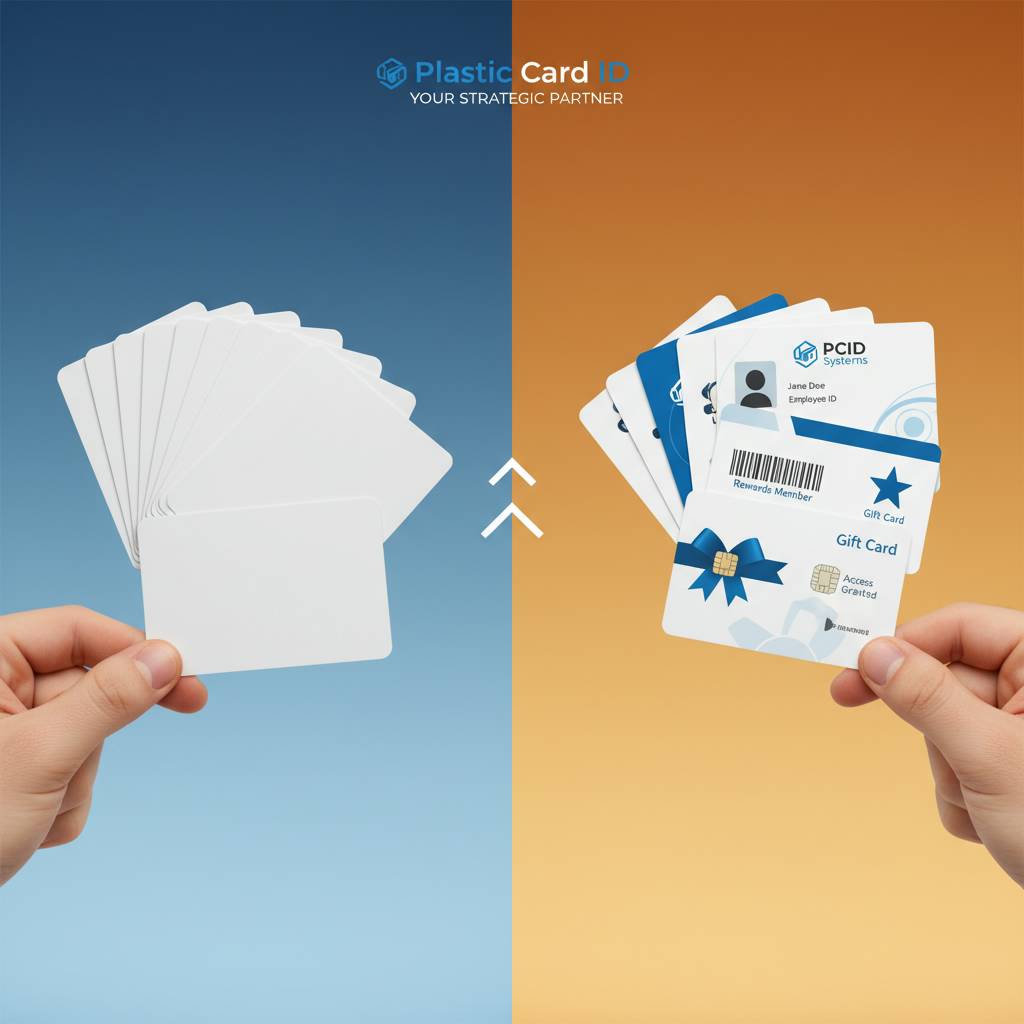
 At the most fundamental level, a blank card is exactly what it sounds like: a plain PVC card, typically CR80 size (the same dimensions as a standard credit card), manufactured to ISO 7810 standards at 30 mil thickness. No design, no logo, no text. What you see is a clean white - or colored, or clear - canvas ready for whatever your card printer, encoder, or laminator will do to it. The blank card is potential in physical form.
A pre-printed card, by contrast, arrives from the manufacturer with graphics, branding, color fills, or partial artwork already applied. These might be fully finished cards ready for distribution, or they might have variable data fields left open - spaces for a name, number, or barcode that gets added later. The distinction matters because it determines who controls the process, when the card becomes useful, and how much flexibility you retain as your needs evolve.
What Blank PVC Cards Actually Are
Blank CR80 cards are the workhorse of any serious in-house card program. At 3.375 inches by 2.125 inches and 30 mil thick, they match the dimensions of virtually every card printer on the market. They are durable, consistent, and engineered for professional printing results - not the flimsy paper cards or laminated printouts that look like someone made them in a hurry.
These cards can be printed with any design your organization needs - employee photos, variable barcodes, magnetic stripe encoding, even smart chip personalization - all done in-house, on demand. A single box of blank cards could become fifty different card types depending on what you print onto them. That flexibility is enormously valuable for organizations managing multiple programs simultaneously.
What Pre-Printed Cards Actually Are
Pre-printed cards are produced in a commercial print environment, usually with offset or digital printing methods that deliver rich color reproduction, photographic-quality gradients, and specialty finishes like spot UV or metallic ink. The card arrives fully or partially branded. For a retailer ordering 10,000 gift cards with their logo and seasonal artwork, pre-printing is efficient and visually polished.
The tradeoff is rigidity. Once you commit to a pre-printed design, you are committed to that quantity at that design. If your logo changes, if a promotion ends, or if you need to add a new cardholder category, you are placing a new order. Pre-printed cards excel at consistency at scale but struggle with agility.
The CR80 Standard and Why It Matters
Whether blank or pre-printed, professional plastic cards should conform to the CR80 standard and ISO 7810 specifications. This ensures compatibility with card printers, badge holders, wallets, card readers, and virtually every card-related accessory on the market. Ordering outside this standard - even slightly - creates downstream compatibility headaches that cost more to fix than they would have cost to avoid.
CPE stocks cards that meet these specifications precisely, which is one reason clients return order after order without the quality variation surprises that cheaper, off-spec sources sometimes produce. Consistency in card substrate quality directly affects print quality, encoding reliability, and cardholder experience.
When Blank Cards Are the Smarter Choice for Your Organization
Blank cards are the right call in more situations than many buyers initially expect. The obvious case is the organization that needs regular, individualized card issuance - employee ID badges that include photos and names, membership cards tied to specific accounts, student IDs that change every semester. You cannot batch-print those and wait weeks for delivery. You need to issue cards today, sometimes within the hour.
But there are subtler advantages too. Organizations with evolving branding, growing card programs, or multiple departments issuing cards under one umbrella often find that blank cards - combined with in-house printer capability - give them a level of operational independence that pre-printing simply cannot match. The investment in a card printer pays for itself faster than most buyers expect.
In-House Printing Control and Operational Speed
When you own the printer and the blank card stock, you control the entire pipeline. New employee starts on Monday? Print the badge Friday afternoon. Guest speaker arriving for an event? Print their credential while they check in. Lost card reported? Reprint in five minutes. This kind of operational responsiveness is genuinely impossible with pre-printed cards ordered from an outside vendor on a production schedule.
Card printers from brands like Evolis, Zebra, and Fargo - all available through CPE - are designed precisely for this workflow. Combined with the right blank card stock, they deliver professional, durable results that look indistinguishable from commercially printed cards to most end users.
Cost Efficiency Over Time
The math on blank cards gets compelling quickly. Per-card costs for blank PVC stock are low, and when you factor out the design fees, minimum order quantities, shipping lead times, and storage requirements associated with pre-printed runs, the total cost of ownership often favors blank cards for organizations issuing more than a few hundred cards per year.
Printer ribbons, cleaning kits, and card supplies from Plastic Card ID are priced and packaged to support ongoing programs without surprise costs. Knowing exactly what your per-card cost is - and keeping it predictable - matters enormously to budget-conscious program managers.
Blank Card Options Beyond Basic White
- Blank white CR80 cards - the universal standard, compatible with virtually every card printer and encoding system
- Colored blank cards - pre-colored stock in various hues, useful for color-coding departments, access levels, or card categories without printing a background
- Clear and frosted cards - specialty substrates that create distinctive visual effects when printed or used plain
- Magnetic stripe blanks (HiCo and LoCo) - blank cards with pre-applied magnetic stripes ready for encoding in-house
- RFID and proximity card blanks - cards with embedded chips or antennas, available blank for custom printing and programming
- Smart chip card blanks - including advanced options like MIFARE DESFire for high-security access control applications
Each of these blank formats gives organizations a head start on their specific card function while preserving full visual customization. That combination - functional infrastructure embedded in a blank substrate - is one of the more powerful things CPE offers that gets overlooked in a simple price comparison.
When Pre-Printed Cards Deliver the Advantage
 There are genuine scenarios where pre-printed cards outperform a blank-plus-printer setup, and intellectual honesty requires acknowledging them. Gift card programs at the retail level are the clearest example. A retailer launching a seasonal gift card campaign wants vivid, full-bleed imagery, metallic finishes, and brand-consistent color that an office card printer simply cannot replicate at the same quality level or speed for large runs.
Pre-printing is the right call when design consistency across thousands of identical cards is the primary goal and when the card design is unlikely to change for the duration of the program. Loyalty card launch campaigns, event credential runs with a fixed attendee design, and promotional card mailers can all fit this profile.
Commercial Print Quality for Brand-Sensitive Programs
The quality ceiling for commercially pre-printed cards is genuinely higher than what most in-house desktop card printers can achieve. Offset printing on PVC allows for richer color saturation, finer detail in gradients, and specialty finishes that desktop dye-sublimation printers are not designed to produce. For brand-sensitive programs where the card is a direct extension of a premium customer experience, that quality difference is visible and meaningful.
Retailers who switch from paper to plastic gift cards see sales increases in the range of 35-50%, and part of that uplift comes from the perceived value and permanence of the card format itself. A beautifully pre-printed plastic gift card communicates brand investment in a way that a desktop-printed card cannot always replicate.
High-Volume Uniform Runs and Distribution Programs
When you need 25,000 identical loyalty cards distributed through a direct mail campaign, pre-printing with affixing and mailing services becomes far more efficient than trying to run those cards through an in-house printer one at a time. The economics of scale favor commercial production at that volume, and the logistics of distribution are handled as part of the same workflow.
Plastic Card ID supports this end of the spectrum too - offering card affixing and mailing services that take the operational burden off organizations running large distribution campaigns. The goal is matching the right fulfillment approach to the program's actual scale and structure, not forcing every use case into the same solution.
Magnetic Stripe, RFID, and Smart Cards: How the Blank vs. Pre-Printed Decision Intersects With Technology
Once a card carries a magnetic stripe, an RFID chip, or a contact smart chip, the blank-versus-pre-printed question takes on a new dimension. The functional component embedded in the card does not care about the design on its surface - but the encoding or programming of that component typically happens separately from the visual printing, and the sequence matters.
Organizations running access control systems, hotel key programs, casino player card programs, or loyalty points platforms often need to encode each card individually with unique data. That individualization requirement is almost always better served by blank card stock that gets personalized at issuance rather than pre-printed cards waiting for a separate encoding step that may not align with the design production timeline.
HiCo vs. LoCo Magnetic Stripe Blanks
High-coercivity (HiCo) magnetic stripes are more resistant to accidental erasure from everyday magnetic exposure - making them the preferred choice for access cards, ID badges, and any card that will be carried near other magnets. Low-coercivity (LoCo) stripes are easier to encode and re-encode, making them suitable for hotel keys and short-term programs where frequent reprogramming is part of the workflow.
Both are available as blank card stock through CPE, ready for in-house encoding with compatible card printers or dedicated encoder hardware. Choosing the right magnetic stripe type before ordering blank stock prevents expensive compatibility problems downstream.
RFID and Proximity Cards in a Blank Format
Blank RFID and proximity cards look identical to standard blank PVC cards on the outside. The intelligence is embedded inside the card structure - an antenna and chip sealed within the laminate layers. These cards can be printed on the surface like any other blank card while being programmed separately for contactless access, time-and-attendance tracking, or cashless payment systems within a controlled environment like a campus or corporate facility.
Contact 800.835.7919 to discuss which RFID frequency, chip type, or proximity card format is appropriate for your specific access control or tracking system. The technical specifications vary between programs, and getting the substrate right before printing or programming saves significant rework cost.
Smart Cards and Advanced Applications
Smart chip cards - including those using the MIFARE DESFire standard - represent the most capable end of the plastic card technology spectrum. Used in high-security access control, casino player tracking, transit systems, and multi-application campus card programs, these cards carry encrypted data that standard card readers cannot duplicate without authorization.
Even at this level of technical sophistication, the blank-versus-pre-printed distinction applies. Smart card blanks allow organizations to handle visual personalization in-house while using specialized programming equipment or third-party integration to handle the chip-side data. Separating the visual layer from the functional layer gives organizations maximum control over both.
Buyer's Guide: Choosing Between Blank and Pre-Printed Cards for Your Program
Most organizations benefit from a clear framework before placing any card order. The questions below are not exhaustive, but they are the ones Plastic Card ID has found most reliably guide buyers toward the right decision. Running through them honestly before requesting a quote will save time, money, and the frustration of receiving cards that do not fit the actual operational reality of the program.
Key Questions to Ask Before You Order
- How many different cardholder types or designs does your program require?
- How frequently do individual card designs need to be updated - monthly, annually, per event?
- Do you need to issue cards on demand, or can you batch-issue on a schedule?
- What is the expected annual card volume, and how much does it fluctuate seasonally?
- Does the card need to carry a magnetic stripe, RFID chip, or smart card technology?
- Is premium commercial print quality essential to the brand experience, or is professional desktop quality sufficient?
- Does your organization already own a card printer, or is the printer investment part of the calculation?
Answering these questions honestly often reveals that most growing organizations benefit from a hybrid approach: blank card stock for day-to-day issuance and personalization, with occasional pre-printed runs for specific campaigns or large distribution events. The best card program strategy is rarely all-or-nothing.
Specialty Cards That Bridge Both Worlds
Luxury metal cards - available in stainless steel, brass, and gold formats - occupy a category that partially bridges the blank and pre-printed distinction. These cards typically require custom production because the material cannot be processed through a standard desktop card printer. However, the level of personalization and finish achievable through specialty metal card production is extraordinary, and for programs where the card itself is a premium product rather than just a credential, metal cards deliver an impression that PVC cannot replicate.
Custom die-cut shapes are another specialty option worth considering for organizations whose card program is also a marketing asset. Cards cut into a tool shape for a hardware brand, a house shape for a real estate firm, or a bottle shape for a beverage company become conversation pieces that cardholders actually keep. When a card is interesting enough to show someone else, it becomes free advertising.
Accessories That Complete Either Program Type
Whether you choose blank cards, pre-printed cards, or both, the program's success depends on more than the cards themselves. Card carriers for retail display, protective card sleeves, badge holders, lanyards, and card affixing services for mailers all contribute to how the card is experienced by the end user. CPE supplies the full accessory lineup alongside the cards themselves, so organizations can source everything through a single relationship rather than managing multiple vendors for what should be one unified program.
Printer ribbons and cleaning kits deserve particular attention for organizations running in-house print programs. Using the correct ribbon type for your specific printer model and card substrate is not optional - it directly determines print quality, card durability, and printer lifespan. The ribbon is not where you cut corners on a card program that matters.
Why Plastic Card ID Is the Right Partner for Your Card Program
Choosing a card supplier is not just a purchasing decision. It is a decision about who you want involved in an operational program that your organization will depend on month after month. Plastic Card ID has built its business over more than 25 years on the premise that a supplier who understands your program is worth more than a supplier who just ships boxes - and over 100,000 customers across the United States have found that to be true in practice.
Whether your program starts at 50 cards a month or scales to tens of thousands, CPE has the catalog depth, the technical knowledge, and the operational infrastructure to support it. From blank CR80 white cards to MIFARE DESFire smart card blanks, from Evolis desktop printers to hotel key card programs, the range of what Plastic Card ID carries is matched by the expertise to help clients choose correctly from it.
A Catalog Built for Every Card Program Scale
The breadth of the Plastic Card ID catalog is one of its most practical advantages. Organizations can start with basic blank white cards and a single entry-level printer, then expand into magnetic stripe blanks, colored stock, RFID cards, and higher-capacity printers as the program grows - all sourced from the same vendor relationship, with consistent quality and pricing continuity. That kind of scalable sourcing eliminates the disruption of switching suppliers as programs mature.
Membership cards. Employee ID badges. Hotel key cards. Casino player tracking cards. Event credentials. Access control cards. Loyalty cards. Gift cards. Each of these is a real program type that CPE supplies today, and each benefits from the blank-versus-pre-printed clarity that comes from working with a supplier who has seen every version of the question before.
Real Programs, Measurable Results
The case for plastic cards over paper alternatives is not theoretical. Loyalty programs running physical plastic cards outperform paper punch card equivalents in retention and redemption rates. Membership organizations report that plastic ID cards signal a permanence and legitimacy that paper cards simply cannot convey to members or to the public. And the 35-50% sales lift retailers see when switching to plastic gift cards represents real revenue, not a projection.
Physical cards drive measurable results because they are durable, visible, and present. They live in wallets next to credit cards. They get handed to cashiers, scanned at doors, and shown to colleagues. They are ongoing brand impressions that paper alternatives discard after one use - if they survive that long. The material choice is not cosmetic; it is functional.
Get the Right Cards for Your Program
Ready to stop guessing and start building a card program that actually works for your organization? Call 800.835.7919 to speak with the team at CPE about your specific use case. Whether you are starting from scratch or optimizing an existing program, the right card - blank or pre-printed, basic or technologically advanced - is a conversation away.
The difference between blank cards and pre-printed cards is not just a technical distinction. It is the foundation of how your entire card program will operate. Getting that foundation right from the start is exactly the kind of decision that pays dividends every month your program runs.
Plastic Card ID is ready to help you make it. Call 800.835.7919 today and let one of the most experienced card program teams in the country put 25 years of expertise to work for your organization.
Previous Page