CR80 Card Size Standard Guide: Dimensions and Specs
Table of Contents []
- The CR80 Card Size Standard: Everything You Need to Know - Plastic Card ID
- What Exactly Is the CR80 Standard?
- Why Blank CR80 Cards Are the Workhorse of Card Programs
- CR80 Card Applications: From Employee IDs to Access Control
- Specialty CR80 Options: Beyond the Standard White Card
- Buying Guide: Choosing the Right CR80 Cards for Your Program
- Frequently Asked Questions About CR80 Card Size
- Partner with Plastic Card ID for Your CR80 Card Program
The CR80 Card Size Standard: Everything You Need to Know - Plastic Card ID
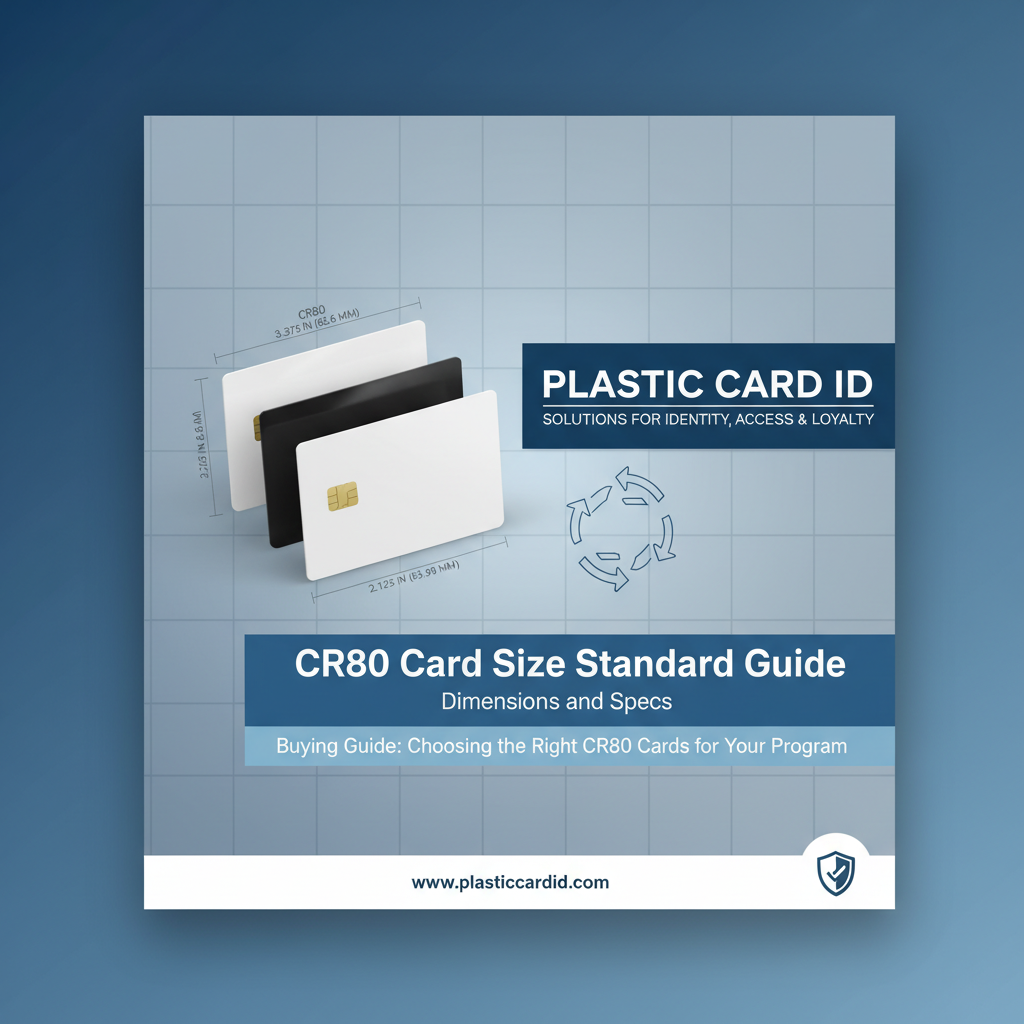
Pull a card out of your wallet right now. Chances are excellent it measures exactly 3.375 inches wide by 2.125 inches tall, with corners rounded to a 0.125-inch radius. That is the CR80 standard - the universal language of plastic cards, codified under ISO 7810 ID-1. It is not an accident that nearly every loyalty card, membership badge, hotel key, and employee credential on the planet shares these dimensions. It is engineering consensus in physical form.
Understanding the CR80 standard is not merely academic. Whether you are launching a loyalty program, issuing employee IDs, or rolling out access control credentials, knowing exactly what CR80 means - and why it matters - shapes every decision that follows. Plastic Card ID has spent over 25 years helping businesses across the United States navigate these decisions, and this guide distills the most useful knowledge from that experience.
| Specification | Imperial | Metric |
|---|---|---|
| Width | 3.375 inches | 85.6 mm |
| Height | 2.125 inches | 54 mm |
| Thickness | 0.030 inches (30 mil) | 0.76 mm |
| Corner Radius | 0.125 inches | 3.18 mm |
| ISO Standard | ISO 7810 ID-1 | |
What Exactly Is the CR80 Standard?
 The designation "CR80" comes from the card industry's own shorthand - CR standing for "credit card," and 80 referencing its position in a sizing hierarchy. The ISO 7810 ID-1 specification that governs it has been the global benchmark since the 1980s, and virtually every wallet, cardholder, badge holder, and card printer manufactured today is engineered around these exact dimensions. That universal compatibility is the point.
At 30 mil thickness (0.030 inches), a standard CR80 card strikes the ideal balance between rigidity and flexibility. It feels authoritative in hand - not flimsy like paper, not unnecessarily heavy. This thickness is compatible with every major desktop card printer on the market, including models from Evolis, Zebra, and Fargo, which means your investment in a printer today will still accept the same cards years from now.
The ISO 7810 ID-1 Connection
ISO 7810 is an international standard that defines four card formats: ID-1 (the CR80), ID-2, ID-3, and ID-000. Of these, ID-1 is by far the most prevalent in daily commerce and organizational life. When manufacturers worldwide align on ID-1, they are committing to the CR80 footprint - enabling a Mexican hotel key card to fit the same reader as an American university ID.
The practical consequence of this standardization is enormous. Any card printer, laminator, card carrier, sleeve, or badge holder labeled "standard card" is almost certainly designed for CR80 dimensions. Sourcing blank cards, ordering custom-printed stock, or shopping for accessories becomes dramatically simpler when there is a single universal baseline to work from.
Why 30 Mil Matters
Thickness is often overlooked in conversations about the CR80 standard, but it is just as precisely specified as the footprint dimensions. A 30 mil PVC card will feed cleanly through a single-card feed printer, stack properly in a hopper, and slide reliably into proximity and smart card readers. Deviate from 30 mil - say, with a 20 mil card or a 40 mil card - and compatibility problems follow quickly.
Thinner cards bend and crease under everyday wallet pressure. Thicker cards may jam card printers not rated for heavy stock. The 30 mil specification exists precisely because decades of real-world use validated it as optimal for the widest range of applications. When CPE recommends blank CR80 cards as the foundation of any in-house card program, the thickness specification is as important as the dimensions themselves.
CR80 vs. Other Card Sizes
Other card sizes do exist and serve specific niches. The CR79 is fractionally smaller (3.303 x 2.051 inches) and is often used for cards that will be laminated onto a paper carrier, since the laminate brings the total size up to CR80. The CR100 is larger, measuring 3.88 x 2.63 inches, and is used for some specialty loyalty cards intended to stand out in a display or mailing. Key tags and mini cards occupy entirely different size categories.
For virtually every mainstream use case - employee badges, membership cards, access credentials, loyalty programs, gift cards - the CR80 is the correct choice without qualification. Its compatibility with standard printers, readers, and cardholders makes alternatives a deliberate specialty decision rather than a default. Understanding this distinction helps buyers avoid costly mistakes when specifying cards for new programs.
Why Blank CR80 Cards Are the Workhorse of Card Programs
There is something quietly powerful about a stack of blank CR80 cards. Each one is a blank credential waiting to become an employee badge, a gift card, an access token, or a loyalty card - depending entirely on what gets printed or encoded onto it. This versatility is why organizations that run ongoing card programs almost universally stock blank cards and print in-house rather than ordering pre-printed cards for every batch.
The economics are straightforward. Blank PVC cards cost a fraction of pre-printed cards, especially at volume. A desktop card printer from Evolis, Zebra, or Fargo can produce a professional, full-color card in under a minute. For organizations issuing cards continuously - new employees, new members, event attendees - this model offers both speed and significant cost savings over the program's lifetime.
Total Design Control
When you print on blank CR80 stock, your design software and your printer ribbon determine the output - not a third-party print shop's interpretation of your artwork. Need to add a photo, update an expiration date, or encode a unique barcode? You can do it immediately, on-site, with no minimum order and no waiting for a shipment. This agility is genuinely transformative for busy organizations that cannot tolerate delays in credential issuance.
Card personalization - adding individual names, photos, employee numbers, or encoded data to each card - is only practical at scale through in-house printing on blank stock. A pre-printed card has a fixed design; a blank card becomes whatever your program needs it to be on any given day. That flexibility is the central argument for blank CR80 cards as a program foundation.
Blank CR80 Stock Options
Not all blank CR80 cards are identical. The most common option is standard white PVC, which accepts dye-sublimation or direct-to-card printing from any major card printer. But there are meaningful variations worth knowing. Colored PVC stock - available in black, gold, silver, red, blue, and other colors - adds visual distinction without the cost of printing a full-color background. Clear and frosted PVC cards create striking transparency effects that standard white cannot replicate.
Specialty blanks include cards with pre-applied magnetic stripes (available in High Coercivity HiCo and Low Coercivity LoCo formulations), cards with embedded RFID antennas and chips for contactless applications, and cards with pre-punched slots for badge reels or lanyards. Starting with the right blank stock for your application eliminates secondary processing steps and ensures your finished cards perform exactly as intended.
Pairing Blank Cards with the Right Printer
The blank CR80 card and the card printer are a system - they must be matched thoughtfully. Direct-to-card (DTC) printers are the most common and affordable category, printing directly onto the card surface using a thermal transfer ribbon. Retransfer printers apply the image to a clear film that is then laminated onto the card, producing edge-to-edge printing and exceptional image quality. Each has its place depending on volume, quality requirements, and budget.
Ribbon selection is equally important. Full-color YMCKO ribbons handle photos and complex graphics. KO ribbons handle black text and simple graphics at lower cost. Monochrome ribbons are ideal for high-volume single-color printing. CPE offers the full range of ribbons, cleaning kits, and accessories to keep card printers running cleanly and producing consistent output - because a great blank card deserves a great print result.
CR80 Card Applications: From Employee IDs to Access Control
 The CR80 format serves as the physical substrate for an enormous range of card programs, each with its own encoding requirements, printing needs, and operational context. Understanding the full landscape of applications helps organizations make smarter decisions when specifying their card stock - because the right blank card for a magnetic stripe loyalty program is not necessarily the right card for a contactless RFID access system.
Employee ID and Badge Programs
Employee ID cards represent one of the most consistent use cases for CR80 cards across every industry. A photo ID badge on a CR80 card signals professional legitimacy in a way that paper or laminated printouts simply cannot match. Physical plastic credentials communicate permanence, authority, and organizational seriousness - qualities that matter in healthcare facilities, corporate campuses, schools, and anywhere else that identity verification is part of daily operations.
For organizations with access control needs, employee ID cards frequently serve double duty: displaying printed identity information on one side while carrying a magnetic stripe or RFID chip for electronic door access. A single CR80 card can carry a photo, a name, a department designation, and an encoded access credential - all at the same time. This multi-function capability is one of the reasons CR80 cards remain the undisputed standard in workplace identity programs.
Loyalty and Gift Card Programs
Retailers and hospitality businesses that switch from paper punch cards or paper gift certificates to plastic CR80 cards consistently see measurable program improvements. Loyalty cards that live in wallets outperform paper alternatives by a wide margin - they are physically present at the point of purchase, they signal program value, and they have a longer effective lifespan. The data supports this: retailers switching to plastic gift cards frequently report sales increases in the 35-50% range compared to paper equivalents.
Magnetic stripe encoding on CR80 cards allows gift card balances to be loaded, tracked, and reloaded electronically. Barcode or QR code printing enables integration with most point-of-sale systems without any specialized reader hardware. For small businesses launching their first loyalty or gift card program, blank CR80 magnetic stripe cards combined with an entry-level card printer represent the most accessible and cost-effective entry point available.
Access Control and RFID Applications
Proximity cards and RFID smart cards follow the same CR80 physical standard as any other card, but carry embedded antennas and chips that enable contactless communication with readers. These cards are the backbone of modern access control systems in offices, hotels, universities, and healthcare facilities. Standards like MIFARE DESFire deliver advanced security with encrypted communication - a significant step up from older 125 kHz proximity cards.
Hotel key cards represent a specialized subset of RFID CR80 applications, combining a standard card footprint with a writable RFID chip that is programmed at check-in for each guest. Casino player cards similarly use the CR80 format with magnetic stripes or RFID chips to track gameplay and loyalty points. In every case, the physical standard remains constant - only the internal technology changes. Contact Plastic Card ID at 800.835.7919 to discuss which RFID or magnetic stripe specification is appropriate for your specific access or tracking application.
Specialty CR80 Options: Beyond the Standard White Card
The CR80 specification governs dimensions and thickness - it says nothing about what a card must look like or what it must be made of. Within that fixed physical footprint, the range of materials, finishes, and embedded technologies available today is genuinely impressive. For programs that want to stand out or require specific functional properties, specialty CR80 options expand the possibilities considerably.
Clear and Frosted PVC Cards
Clear PVC cards allow printed designs to take advantage of transparency - logos appear to float, backgrounds become visible through the card, and the overall visual effect is distinctly premium. Frosted cards offer a translucent, etched-glass appearance that pairs beautifully with printed metallic inks or foil elements. Both formats accept direct-to-card and retransfer printing and maintain full CR80 dimensional compatibility with standard printers and cardholders.
These specialty finishes work particularly well for VIP membership cards, spa and wellness programs, and boutique retail gift cards where visual differentiation from competitors is a genuine business goal. A clear card in a wallet stands out immediately - it communicates that the issuing organization took the presentation seriously, which subtly elevates the perceived value of the program itself.
Metal Cards and Premium Formats
For ultra-premium applications, CR80-format metal cards in stainless steel, brass, and gold offer an unmatched physical presence. These cards are heavier, more durable, and unmistakably premium - ideal for executive membership programs, high-end loyalty tiers, or any situation where the card itself is meant to communicate exclusivity. Engraved personalization adds an additional layer of distinction that no printed plastic card can replicate.
Custom die-cut cards break from the standard rectangular CR80 footprint while typically maintaining compatible thickness for wallet storage. A card shaped like a guitar pick, a house silhouette, or a company logo creates instant memorability. While these specialty formats require more planning and typically higher minimum orders, they deliver a differentiated physical impression that standard cards cannot achieve.
Colored Stock and Custom Pre-Printed Cards
Colored PVC stock - available in a wide range of solid colors - allows organizations to establish immediate visual category distinctions. A gym might issue green cards for monthly members and red cards for annual members; a hotel might use different colors to distinguish room tiers. Color-coded credentials simplify visual verification in high-traffic environments where staff needs to quickly assess credential category without reading fine print.
Custom pre-printed cards produced in quantity offer the highest level of brand consistency and visual complexity, including photographic backgrounds, gradients, and fine detail that exceeds what most desktop printers achieve. For programs with stable designs and sufficient volume to justify a minimum print run, custom pre-printed cards can deliver exceptional results. CPE can help determine whether blank-and-print-in-house or pre-printed custom cards better fit a given program's volume, budget, and operational needs.
Buying Guide: Choosing the Right CR80 Cards for Your Program
With so many options within the CR80 standard - plain white, magnetic stripe, RFID, clear, colored, pre-printed - choosing the right card stock requires a clear understanding of your program's functional requirements, printing setup, and volume expectations. A few structured questions can narrow the field quickly and prevent costly mismatches between card type and application.
Key Questions Before You Buy
- Does your program require encoding? Magnetic stripe cards (HiCo for long-term use, LoCo for temporary or low-security applications), RFID/proximity cards, and smart chip cards each serve distinct encoding needs. Blank white PVC is appropriate only if the card carries no electronic data.
- What printer do you own or plan to purchase? Not all printers handle all card types. Confirm that your printer model supports the card thickness and any special surface treatments of the cards you select.
- What is your monthly volume? Programs issuing fewer than 500 cards monthly typically benefit from blank stock and in-house printing. Higher-volume programs with stable designs may find custom pre-printed cards more economical.
- Do you need personalization on each card? Individual names, photos, or unique barcodes require in-house printing on blank stock. Pre-printed cards carry fixed designs only.
- What finish or visual effect supports your brand? Standard white, colored stock, clear, frosted, or metal - each communicates a different brand position and serves different program aesthetics.
- Will cards be used with badge holders, card sleeves, or affixed to mailers? Accessories are designed for standard CR80 dimensions, but it is worth confirming compatibility for any specialty formats.
HiCo vs. LoCo Magnetic Stripe
High Coercivity (HiCo) magnetic stripes require a stronger magnetic field to encode and are consequently more resistant to accidental erasure from proximity to everyday magnets. They are the correct choice for cards intended to remain in service for months or years - employee badges, membership cards, and durable loyalty cards. HiCo stripes are typically identified by a darker, charcoal-colored stripe.
Low Coercivity (LoCo) stripes encode with a weaker magnetic field and are more susceptible to erasure from strong magnets, but they cost slightly less and are appropriate for short-duration applications like hotel key cards or event credentials where the card's functional life is measured in days or weeks. Choosing the wrong coercivity for your application is a common and easily avoided mistake - when in doubt, HiCo is the more forgiving default for any application expected to last longer than a few weeks.
Volume Tiers and What to Expect
Card programs run at every conceivable scale, from a local gym issuing 50 new member cards monthly to a regional retailer rolling out 20,000 loyalty cards for a seasonal promotion. The CR80 blank card market accommodates this entire range. Entry-level quantities allow small organizations to test program formats without significant upfront investment; volume pricing makes large programs dramatically more economical per card.
CPE serves clients across this entire spectrum - from organizations issuing fewer than 100 cards monthly to enterprises running mass production programs in the tens of thousands. The approach and product recommendations differ at each scale, but the underlying CR80 standard remains the constant that makes all of it compatible and interchangeable. Reach out to discuss your specific volume needs and get guidance tailored to your program's actual requirements.
Frequently Asked Questions About CR80 Card Size
After 25 years and more than 50 million cards sold, certain questions about the CR80 standard come up consistently. The answers below address the most common points of confusion for organizations entering or expanding their card programs.
Is CR80 the Same as a Standard Credit Card Size?
Yes - exactly. The CR80 and the ISO 7810 ID-1 standard describe the same physical dimensions that define what most people call "credit card size." This is not coincidental; the CR80 specification was deliberately adopted from the banking industry's card standard to ensure universal compatibility across wallet slots, cardholders, and readers worldwide. Every standard wallet slot, badge holder, and card sleeve is designed for this footprint.
This compatibility is worth emphasizing because it means any organization producing CR80 cards can rely on the entire ecosystem of accessories - sleeves, cardholders, badge reels, lanyards, display stands - that was built around this size. No custom accessory sourcing is required, and no compatibility testing is necessary for standard accessories. The standard handles all of that interoperability by design.
Can I Print on Any CR80 Card with Any Printer?
The physical dimensions of CR80 cards are universal, but printing compatibility depends on the card's surface treatment and the printer's technology. Standard white PVC CR80 cards accept printing from virtually any direct-to-card or retransfer printer. However, cards with pre-applied overlaminates, specialty coatings, or unique surface textures may require specific printer settings or ribbon types to achieve proper adhesion and image quality.
RFID and smart chip cards with embedded electronics are fully printable on their surfaces using standard card printers, but the encoding of the chip requires either a printer equipped with an encoding module or a separate encoding station. Always confirm that your card printer model is rated for the specific card type you intend to print. CPE's team can assist with compatibility questions for any printer in the Evolis, Zebra, or Fargo lineup.
What Is the Difference Between CR80 and CR79?
The CR79 is fractionally smaller than the CR80 - measuring 3.303 x 2.051 inches compared to the CR80's 3.375 x 2.125 inches. This size difference exists specifically to accommodate lamination: a CR79 card laminated with a standard carrier sheet ends up at CR80 dimensions. For most in-house card programs printing directly on card stock without adhesive laminates, CR80 is the appropriate choice without qualification.
CR79 cards are a specialist product used in specific lamination workflows and are not interchangeable with CR80 in standard printers or cardholders without the laminate layer. Organizations unfamiliar with the distinction should default to CR80 for all standard applications and consult with a supplier before ordering CR79 stock to confirm it is genuinely required for their specific process.
Partner with Plastic Card ID for Your CR80 Card Program
 Twenty-five years. Over 100,000 customers. More than 50 million cards delivered to businesses across the United States. These numbers represent something real: a depth of program knowledge, supplier relationships, and operational experience that translates directly into better outcomes for every client. Plastic Card ID does not simply take orders - it helps organizations build card programs that work, scale, and deliver measurable results over time.
Whether you are launching a first-ever employee badge program, upgrading a paper loyalty card to plastic, rolling out contactless RFID access control, or exploring premium metal cards for a VIP tier, the starting point is always the same: a conversation about your specific goals. The CR80 standard provides the universal physical foundation; everything built on top of it is shaped by your program's unique requirements, volume, and vision.
From blank white PVC to magnetic stripe, RFID, clear, frosted, colored stock, and beyond - from individual desktop printers to accessories, ribbons, cleaning kits, card carriers, and mailing services - CPE has the catalog, the expertise, and the genuine commitment to client success that makes a supplier feel like a partner. Call 800.835.7919 today and put Plastic Card ID's 25 years of card program experience to work for your organization.
Previous Page