Smart Chip vs Magnetic Stripe Security Comparison Guide
Table of Contents []
- Smart Chip vs Magnetic Stripe Security: What Plastic Card ID Wants You to Know Before You Choose
- How Magnetic Stripe Cards Actually Work
- The Architecture of Smart Chip Card Security
- Side-by-Side Security Analysis: Where Each Technology Holds and Where It Breaks
- Choosing the Right Card Technology for Your Organization
- Card Printers and Encoding: Making the Technology Work In-House
- Why Plastic Card ID Is the Strategic Card Partner Your Program Deserves
Smart Chip vs Magnetic Stripe Security: What Plastic Card ID Wants You to Know Before You Choose
The card sitting in your wallet right now is making a security decision on your behalf - and most people have no idea which technology is actually protecting them. Whether you are managing employee access control, running a loyalty program, or issuing membership credentials, the difference between smart chip and magnetic stripe technology is not just technical trivia. It is the difference between a card program that holds up under pressure and one that becomes a liability.
At Plastic Card ID, we have spent more than two decades watching organizations choose the wrong card technology for the wrong reasons. Price alone is not the answer. Neither is complexity. The right choice depends on what you actually need the card to do, how sensitive the data on it is, and what infrastructure you are willing to build around it. This guide cuts through the noise.
| Feature | Magnetic Stripe | Smart Chip |
|---|---|---|
| Data Storage | Low (fixed tracks) | High (up to 64KB) |
| Cloning Risk | High | Very Low |
| Encryption | None | Advanced (AES, DES) |
| Read/Write Flexibility | Write-once limitations | Dynamic read/write |
| Cost Per Card | Lower | Moderate to Higher |
| Reader Infrastructure | Widely available | Requires chip readers |
| Best Use Case | Loyalty, gift, basic ID | Access control, high-security ID |
How Magnetic Stripe Cards Actually Work
 Magnetic stripe technology has been a workhorse of the card industry for decades, and there is a reason it is still very much in play. The stripe on the back of the card contains iron-based magnetic particles arranged in a specific pattern across three data tracks. When the card is swiped through a reader, those particles generate a signal that decodes into readable data. Fast, reliable, and supported by nearly universal reader infrastructure.
Here is the catch: that data does not change, and it is not encrypted. What is written on the stripe is what is read. Which means someone with the right equipment can copy it. Understanding this limitation is not a reason to dismiss magnetic stripe cards entirely - it is a reason to use them strategically.
HiCo vs LoCo: The Magnetic Strength You Actually Need
Not all magnetic stripes are created equal. High-coercivity (HiCo) stripes require a stronger magnetic field to write data, which makes them far more resistant to accidental erasure from everyday sources like bag closures, phone speakers, or magnetic clasps. HiCo cards are measured at 2750 Oersteds and are the industry standard for cards that see daily, heavy use.
Low-coercivity (LoCo) stripes, at 300 Oersteds, are easier and cheaper to encode but far more susceptible to data loss. They are best suited to short-term applications - event passes, one-day credentials, temporary access - where longevity is not a priority. Choosing the wrong coercivity level is one of the most common and costly mistakes in card program management.
What Data Lives on the Stripe and What That Means for Security
The three tracks on a standard magnetic stripe card each serve different purposes. Track 1 holds alphanumeric data including cardholder name. Track 2 is the most commonly read track and holds numeric data like account numbers. Track 3 is less commonly used and supports read/write functions in some applications. Most loyalty and gift card programs use Track 2 only, pointing to a backend database for everything else.
This is actually a smart security play when executed correctly. Keeping sensitive data off the card and in a secured database significantly reduces risk, even with magnetic stripe technology. The card number becomes a token - meaningless without the system it unlocks. CPE often works with organizations to help them think through this layer of program design before they ever order a single card.
When Magnetic Stripe Still Makes the Right Call
For gift card programs, retail loyalty schemes, and basic membership cards where the primary risk is inconvenience rather than identity theft or security breach, magnetic stripe is a sound, cost-effective choice. The reader infrastructure is already in place at most retail environments, and the per-card cost is substantially lower than smart chip alternatives.
Businesses running high-volume, lower-risk card programs - think hotel key cards for non-access-controlled areas, discount loyalty cards, or event credentials - will find that magnetic stripe delivers exactly what they need without overengineering the solution. Right-sizing your card security to your actual threat level is good business strategy.
The Architecture of Smart Chip Card Security
Smart chip cards operate on a fundamentally different principle. Instead of storing static data on a readable stripe, they embed a microprocessor - an actual tiny computer - within the card body. That chip can store data, execute programs, perform cryptographic operations, and communicate with readers in ways that are genuinely difficult to intercept or replicate. The security difference is not incremental. It is architectural.
Contact smart cards require physical insertion into a reader, establishing a direct electrical connection through the gold contact pads visible on the card face. Contactless smart cards - including proximity cards and RFID-enabled cards - use radio frequency to communicate without physical contact. Some cards are dual-interface, supporting both methods. Each configuration has distinct security profiles, use cases, and infrastructure requirements.
Cryptographic Authentication: Why Cloning Smart Chips Is So Difficult
The core reason smart chip cards resist cloning is cryptographic authentication. When a chip card communicates with a reader, it does not simply transmit stored data - it performs a challenge-response exchange. The reader sends a challenge, the chip performs an encrypted calculation using a secret key stored in secure memory, and returns the result. Without the key, the response cannot be replicated.
Advanced implementations like MIFARE DESFire use AES-128 encryption and mutual authentication protocols - meaning the card verifies the reader as much as the reader verifies the card. This bidirectional trust model is what makes high-security access control systems genuinely robust. Even if someone intercepted the communication, they would capture an encrypted exchange that changes every time, rendering the data useless.
MIFARE DESFire and What It Means for Your Access Control Program
MIFARE DESFire is one of the most widely deployed smart card platforms in high-security access control environments, and for good reason. It supports multiple applications on a single card - meaning one card can control building access, manage cafeteria accounts, and track time and attendance simultaneously. Each application is cryptographically isolated, so a compromise in one area does not expose another.
Organizations running campuses, corporate offices, healthcare facilities, or government buildings often choose DESFire-based cards precisely because of this compartmentalization. The ability to run multiple secure applications on a single credential streamlines operations and dramatically reduces credential overhead. CPE carries a full range of MIFARE DESFire smart cards and can help match the right chip specification to your reader environment.
Call 800.835.7919 to speak with a specialist about MIFARE DESFire card compatibility and volume pricing for your access control rollout.
Contact vs Contactless Smart Cards: Choosing the Right Interface
Contact smart cards offer a highly secure, interference-resistant connection because data transmission only occurs through physical contact. They are ideal for high-security environments where controlled access points are the norm - government ID programs, healthcare smart cards, and IT authentication tokens. The trade-off is speed and convenience at high-traffic checkpoints.
Contactless smart cards, operating on 13.56 MHz or 125 kHz frequencies, allow tap-or-wave transactions that move faster at doors, turnstiles, and transit gates. The 13.56 MHz frequency supports more sophisticated protocols including encryption, while 125 kHz proximity cards offer basic, faster reads with fewer security features. Understanding frequency and protocol is not optional - it determines what your card can and cannot do.
Side-by-Side Security Analysis: Where Each Technology Holds and Where It Breaks
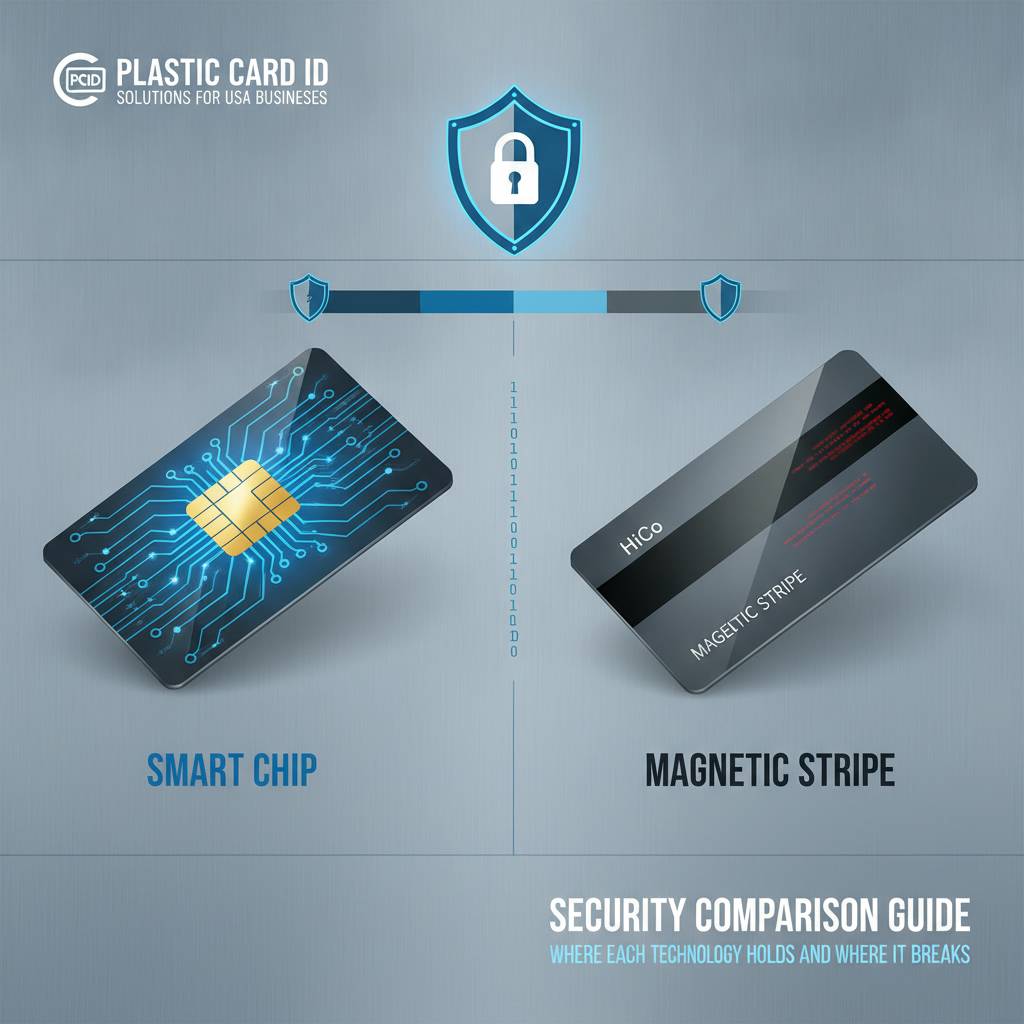 Comparing smart chip and magnetic stripe cards on security alone can mislead decision-makers if the analysis is not grounded in real-world threat modeling. A magnetic stripe gift card program is not exposed to the same threat landscape as an access control credential for a data center. Treating all security decisions as equivalent leads to either overspending or underprotecting. Context is everything in card security architecture.
The following breakdown addresses the most meaningful security dimensions - not just technical specs - so that organizations can map technology choice to actual risk exposure.
Cloning and Skimming Vulnerability Compared
Magnetic stripe cards can be skimmed with devices that cost under $100 and are readily available. The data captured from a skimmed card is static and immediately usable. Smart chip cards, by contrast, require the attacker to not only intercept the communication but also defeat cryptographic authentication protocols designed by security engineers specifically to resist such attacks. The practical barrier is orders of magnitude higher.
That said, proximity and RFID cards operating without encryption - particularly older 125 kHz proximity cards - can also be read at a distance with the right equipment. Not all contactless cards are created equal, and assuming all RFID equals high security is a dangerous oversimplification. The security level is determined by the protocol, not merely the form factor.
Data Integrity and Tamper Resistance
- Magnetic stripe: Data can be overwritten by strong magnetic fields and offers no tamper detection. Once the data is on the stripe, the card cannot report or resist unauthorized reads.
- Contact smart chip: Secure memory zones protect stored data. Attempts to physically probe the chip trigger protective mechanisms. Sensitive keys are never transmitted externally.
- Contactless smart chip (high-frequency): Encrypted communication means intercepted data cannot be used. Mutual authentication confirms card and reader legitimacy before any data exchange occurs.
- Legacy proximity (125 kHz): No encryption. Card ID is transmitted in plain text. Vulnerable to cloning, though not as easily as magnetic stripe in most retail environments.
- Dual-interface smart cards: Combine contact security with contactless convenience. Strong choice for environments requiring both high throughput and high assurance.
Real-World Breach Scenarios and Card Technology Response
Consider a hotel that uses magnetic stripe room keys. A guest's key is accidentally swiped near a strong magnet and is erased - a minor inconvenience. Now consider that same hotel using a system where the key number is also stored in a poorly secured database. Suddenly, a simple key duplication becomes a record-level vulnerability. The card technology and the backend system together define the actual security posture.
Contrast this with a corporate campus using MIFARE DESFire contactless smart cards for access control. An employee loses their card. The card itself cannot be cloned in any operationally practical timeframe. The card is revoked in the access control system within minutes of being reported. The attacker who finds the card cannot use it, cannot copy it, and cannot reverse-engineer the keys from it. This is what layered, architecture-level security looks like in practice.
Choosing the Right Card Technology for Your Organization
The decision framework is simpler than most vendors make it seem. Start with your threat model. What are you actually protecting - physical spaces, financial balances, personal identity data, or brand loyalty? Each answer points toward a different technology tier. Then layer in operational realities: what readers do you already have, what volume are you running, and what is your per-card budget?
CPE works with organizations across every sector - corporate, healthcare, hospitality, retail, education, and government - to match card specifications to program requirements. There is no universally right answer, but there is always a right answer for your specific situation.
When to Choose Magnetic Stripe Cards
Magnetic stripe is the right choice when you need broad reader compatibility, lower per-card costs, and the risk profile of your program does not involve sensitive personal data or physical security access. Gift card programs, retail loyalty cards, library cards, basic membership credentials - these applications benefit from magnetic stripe's simplicity and cost efficiency without meaningfully compromising program integrity.
HiCo magnetic stripe cards from CPE are available in blank CR80 format, giving your organization full design control while keeping per-unit costs manageable at scale. Running programs of 50 cards per month or scaling to tens of thousands - the infrastructure is straightforward and the total cost of ownership is predictable. Simplicity, when appropriate, is a virtue, not a compromise.
When to Choose Smart Chip Cards
Smart chip is the right choice when you are controlling physical access to secured spaces, managing credentials where impersonation carries real risk, or building a card program that needs to evolve over time without reissuing cards. Employee ID badges that double as access credentials, student cards that manage both campus access and dining accounts, casino player cards tracking session data - these are smart chip territory.
The infrastructure investment is real, but so is the risk reduction. Organizations that have experienced an access control breach or credential compromise rarely debate the ROI of chip-based security afterward. The conversation shifts from cost to capability very quickly when the alternative is a security incident. Call 800.835.7919 to discuss your specific access control or smart card program needs with a CPE specialist.
Hybrid Programs: Using Both Technologies Strategically
Many organizations run parallel programs - smart chip cards for employee access and magnetic stripe cards for customer loyalty or gift programs. This is not redundancy; it is precision. Matching technology to function within a single organization's card ecosystem is a sign of mature program management, not unnecessary complexity.
Plastic Card ID stocks both technology types across a range of configurations and can supply cards for both tiers of a hybrid program, often with volume pricing that makes the combined approach more cost-effective than sourcing from multiple vendors. Consolidating your card supply chain is one of the fastest ways to reduce program overhead without sacrificing quality.
Card Printers and Encoding: Making the Technology Work In-House
Choosing the right card technology is only part of the equation. The printer you use to produce those cards - and the encoding capabilities it supports - determines what you can actually do in-house versus what requires external production. This matters enormously for organizations that need to issue cards on demand, update credentials quickly, or maintain tight control over their card production process.

CPE carries card printers from Evolis, Zebra, and Fargo, each supporting different combinations of printing quality, encoding options, and production volume. Matching your printer to your card technology is not optional - it is the foundation of a functional card program.
Encoding Magnetic Stripe Cards In-House
Most mid-range card printers support magnetic stripe encoding as a built-in or add-on module. HiCo encoding requires a printer specifically configured for the higher magnetic field strength - not all printers handle both HiCo and LoCo, so specification matching matters. For organizations issuing cards with variable data - different account numbers, employee IDs, or loyalty identifiers - in-house encoding is dramatically faster and more cost-effective than batch outsourcing.
Software integration is the key enabler here. A printer paired with card design and database software can pull from a spreadsheet or HR system and produce individually encoded cards in sequence without manual data entry. Automating the encoding process eliminates a significant source of human error in card programs.
Smart Card Encoding and Contact Station Printers
Encoding smart chip cards requires a printer equipped with a contact station (for contact chips) or an RFID encoding module (for contactless). Not all printer models in the Evolis, Zebra, or Fargo lineup include these by default - they are often optional modules that must be specified at purchase. Getting this wrong means returning or upgrading equipment, which is both costly and time-consuming.
Smart card encoding also requires compatible software that can communicate with the chip's operating system and write data to the correct memory sectors using the right authentication keys. This is where having a knowledgeable supply partner pays dividends - ensuring the printer, card, and software are all aligned before a single card is produced. CPE can walk you through compatibility requirements from the start.
Why Plastic Card ID Is the Strategic Card Partner Your Program Deserves
Over 100,000 customers and more than 50 million cards shipped - those numbers reflect something more than volume. They reflect a track record of organizations trusting Plastic Card ID not just to deliver cards, but to help them build programs that actually perform. The difference between a card supplier and a card program partner is the difference between a transaction and a relationship.
From the first 50-card order for a small membership organization to multi-year supply agreements for large enterprise access control deployments, CPE brings the same attention to specification matching, program design input, and long-term support. Whether your need today is blank HiCo magnetic stripe cards or MIFARE DESFire smart cards with contactless encoding, the catalog and the expertise are both here.
A Catalog Built for Every Stage of Your Card Program
Blank CR80 cards in standard white, colored stock, clear, and frosted finishes. Magnetic stripe cards in HiCo and LoCo. RFID and proximity cards. Contact and contactless smart chip cards. Custom die-cut shapes. Specialty luxury cards in stainless steel, brass, and gold. Card printers, ribbons, cleaning kits, card carriers, sleeves, and mailing services. Everything your card program needs lives under one roof at Plastic Card ID.
The ability to source everything from one supplier simplifies procurement, reduces vendor management overhead, and creates a single point of accountability when questions arise. For organizations managing ongoing card programs, this matters more than most buyers realize until they have experienced the alternative.
Volume Flexibility That Grows With You
Not every organization needs to order 10,000 cards at a time, and not every organization wants to be locked into a supplier that only cares about large orders. CPE serves programs of all scales - small nonprofits issuing 50 membership cards per month and regional chains running loyalty programs in the tens of thousands. Your program's size does not determine the quality of service you receive here.
As your program scales, pricing adjusts to reflect volume - and your card specifications can evolve without switching suppliers. Starting with blank magnetic stripe cards and growing into smart chip access credentials as your organization expands is a journey Plastic Card ID has walked with many clients before.
Expert Guidance You Can Actually Reach
One of the most consistent frustrations organizations express about card supply is the lack of accessible expertise. Online-only suppliers offer catalogs but not counsel. Making the wrong technology choice because no one was available to answer a specific question costs more than the cards themselves. That is precisely why direct access to knowledgeable specialists matters.
When the smart chip vs magnetic stripe question is not purely academic but has real dollars and program outcomes attached to it, having someone at 800.835.7919 who can talk through your specific situation - your reader environment, your volume, your security requirements, your timeline - is what separates a good purchasing decision from an expensive one.
Ready to make the right card technology decision for your organization? Contact Plastic Card ID today at 800.835.7919 and let our specialists help you build a card program that is secure, scalable, and exactly right for what you need.
Previous Page