Blank Plastic Cards vs Paper Cards: Durability Comparison Guide
Table of Contents []
- Blank Plastic Cards vs Paper Cards: Why the Material You Choose Changes Everything - Plastic Card ID
- The Physical Science Behind PVC Card Durability
- Loyalty Programs, Gift Cards, and the Revenue Impact of Going Plastic
- Blank Cards for In-House Printing: Control, Cost, and Customization
- Specialty Card Options: When Standard PVC Is Not Enough
- Frequently Asked Questions About Blank Plastic Cards vs Paper Cards
- Build Your Card Program on the Right Foundation - Plastic Card ID
Blank Plastic Cards vs Paper Cards: Why the Material You Choose Changes Everything - Plastic Card ID
Walk into any thriving retail store, hotel lobby, or corporate office and look at what people are actually carrying. Not paper. Not cardboard. Plastic cards that survive real-world use - tucked into wallets, swiped through readers, scanned at entry points, and pulled out hundreds of times without showing their age. The durability gap between plastic and paper is not subtle. It is enormous. And it affects your brand, your budget, and your results in ways that compound over time.
The comparison is almost unfair. Paper cards warp in humidity, tear at edges, fade under light, and communicate something unintentional: impermanence. Plastic CR80 cards at 30 mil thickness - the ISO 7810 standard - signal something entirely different. They signal that your organization is serious, established, and worth trusting. That impression has measurable business value.
What "Durability" Actually Means in a Card Program
Durability is not just about whether a card tears. It is about how many interactions a card survives before it needs replacing, how it looks on interaction number 47 compared to interaction number one, and whether it still functions reliably in a reader or printer after months in circulation. Paper fails all three tests quickly. Blank PVC plastic cards pass all three consistently.
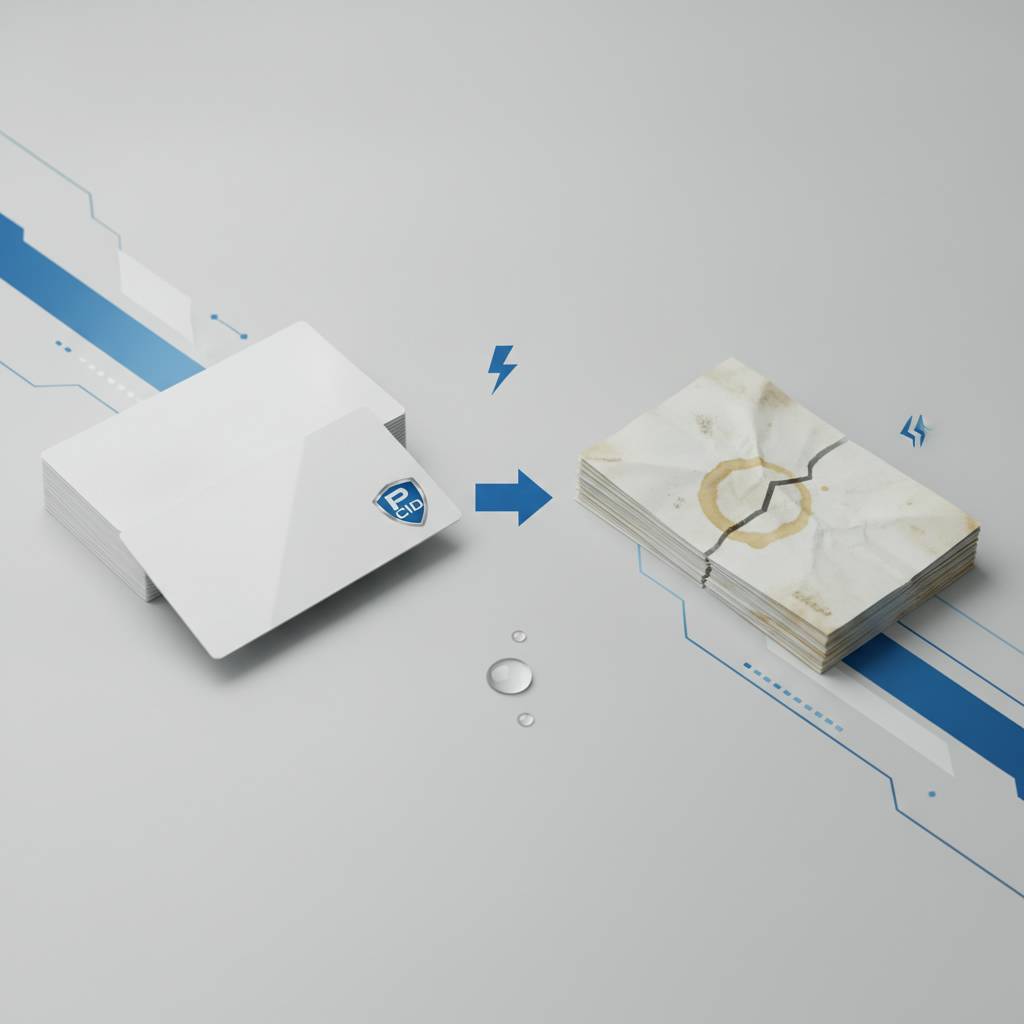
A standard blank CR80 plastic card resists moisture, bending, cracking, and UV fading far beyond what any paper alternative can offer. Businesses that have switched from paper punch cards to plastic loyalty cards often never go back - not because of sentimentality, but because the numbers improve and the customer experience visibly improves alongside them.
The Cost Illusion: Why Paper Feels Cheaper Than It Is
Paper cards often appear cheaper on a per-unit basis at first glance. But that calculation omits replacement frequency, reprinting costs, handling damage rates, and the revenue lost when a card is too damaged to use or too unappealing to keep. Plastic cards last dramatically longer, meaning the real per-use cost is frequently lower than paper - sometimes significantly so.
Organizations running ongoing programs - loyalty, membership, ID, access control - consistently find that the upfront difference in material cost pays for itself within the first program cycle. Cards that do not need monthly replacement reduce administrative overhead, reduce reorder frequency, and reduce the friction that kills customer participation rates.
Paper Cards vs Plastic: A Head-to-Head Reality Check
| Characteristic | Paper Cards | Blank PVC Plastic Cards |
|---|---|---|
| Moisture Resistance | Fails rapidly | Fully resistant |
| Average Lifespan | Weeks to months | Years |
| Wallet Durability | Folds, tears, degrades | Rigid, holds shape |
| Magnetic Stripe Encoding | Not feasible | HiCo and LoCo available |
| RFID / Smart Chip Support | Not compatible | Full support |
| Brand Perception | Budget, temporary | Professional, credible |
| Replacement Frequency | High | Low |
| Printing Compatibility | Limited | Full color, variable data |
The Physical Science Behind PVC Card Durability
 Polyvinyl chloride - PVC - is the material standard for professional plastic cards because it balances flexibility with rigidity in exactly the right proportion. A 30 mil card is thick enough to hold its shape through daily handling but thin enough to fit comfortably in any standard wallet slot or card reader. The material itself is chemically stable under normal use conditions, resisting the oils, moisture, and pressure that destroy paper-based alternatives.
Understanding what goes into a blank PVC card helps explain why it performs so differently than paper. The laminated layers of a standard CR80 card create a sealed structure. Print applied to that structure - by a card printer using dye-sublimation or resin transfer - bonds at a molecular level to the card surface. The result is an image that does not scratch off, wash away, or fade under typical indoor UV exposure the way inkjet-printed paper cards do.
CR80 Dimensions and the ISO 7810 Standard
Every standard blank plastic card from CPE is manufactured to CR80 specifications: 3.375 inches by 2.125 inches, at 30 mil thickness. This is not arbitrary. ISO 7810 is the international standard that ensures your cards work with every compatible reader, printer, and wallet on the planet. When you build a card program on ISO-compliant stock, you eliminate compatibility guesswork entirely.
Paper alternatives have no such standard. Custom paper cards are frequently cut slightly off-spec, printed on inconsistent stock weights, and incompatible with automated processing equipment. The moment your program requires a magnetic stripe reader or card printer, paper is simply not a participant in that conversation. ISO-standard plastic card stock is the only real foundation for a scalable card program.
Magnetic Stripe Technology: HiCo vs LoCo Encoding
Blank magnetic stripe cards are among the most versatile tools in any card program. HiCo (high coercivity) stripes are encoded at 2750 Oersteds, making them highly resistant to accidental demagnetization. LoCo (low coercivity) stripes at 300 Oersteds are more suitable for short-term or controlled-environment applications like hotel key cards or event access. Neither format is available on paper cards - it is a capability exclusive to plastic.
HiCo magnetic stripe cards are the professional standard for loyalty programs, access control, and ID applications where the card will be used frequently over a long period. The ability to encode and re-encode data onto a magnetic stripe transforms a blank card into a dynamic tool - an employee badge today, a reprogrammed access credential tomorrow.
RFID, Proximity, and Smart Chip Cards: The Next Level
Beyond magnetic stripes, plastic card technology supports an entirely different class of functionality: contactless communication. Proximity cards and RFID-enabled smart cards communicate with readers without requiring physical contact. Technologies like MIFARE DESFire bring encrypted, high-security data exchange to access control applications in corporate campuses, healthcare facilities, and secure government environments.
Paper cards cannot embed an antenna or a microprocessor. The substrate simply does not support it. Plastic is the only viable platform for contactless card technology, which means any organization planning to move toward touchless access, contactless loyalty scanning, or smart card integration must start with plastic. There is no paper-based pathway to these capabilities.
Loyalty Programs, Gift Cards, and the Revenue Impact of Going Plastic
The numbers are striking and consistently replicated across industries. Retailers that transition their gift card programs from paper certificates to plastic cards see sales increases in the range of 35-50%. That is not a rounding error. That is a structural change in how customers perceive, handle, and use the cards they receive. Plastic gift cards get kept. Paper certificates get lost, forgotten, or left in coat pockets until they are unreadable.
Loyalty programs show a parallel pattern. A plastic loyalty card that lives in a customer's wallet is a constant, passive brand impression. Every time they reach for their debit card, your card is there. Paper punch cards that live loose in a purse or glove compartment do not generate that passive visibility - and they deteriorate before the customer earns enough punches to redeem a reward, which eliminates the loyalty loop entirely.
Why Wallet Presence Is a Marketing Asset
A card in a wallet is real estate. It occupies physical space in a location your customer visits multiple times per day. Every encounter with your card reinforces brand recognition without any additional cost to your program. That kind of passive impression frequency is simply not available through paper-based alternatives. Paper cards typically end up discarded, while plastic cards are retained, sometimes for years.
Consider what that means for a loyalty program with 2,000 active customers. If plastic card retention rates run 60-70% higher than paper, your program is generating millions of additional brand impressions annually at no incremental cost. The card itself is doing marketing work long after the initial transaction that produced it.
Gift Cards as a Standalone Revenue Channel
Gift cards are not just a convenience feature - they are a revenue stream. The float from unredeemed balances, the new customer acquisition when recipients visit for the first time, the higher average transaction values when customers pay with gift cards - these effects compound. Plastic gift cards outperform paper in every one of these metrics because they survive long enough to be redeemed, retained long enough to generate repeat behavior, and look good enough to be given as genuine gifts.
CPE supplies blank card stock in configurations compatible with standard gift card program setups, including magnetic stripe encoding, allowing organizations to manage their own in-house gift card programs with full design control and without paying per-card customization fees at scale.
Membership Cards That Signal Permanence
Paper membership cards feel provisional. They communicate something their issuers likely do not intend: that membership is temporary, that the organization may not be around long, that the card itself is not worth investing in. Plastic membership cards send the opposite signal. They feel like a commitment. They feel like belonging to something real. That psychological effect influences member retention and engagement in ways that are difficult to fully quantify but consistently observed.
Gyms, clubs, associations, nonprofits, and professional organizations that issue plastic membership cards consistently report higher perceived value among members compared to paper alternatives. When members feel like they belong to something credible and permanent, they behave differently - they renew, they refer, and they engage more deeply with what membership offers them.
Blank Cards for In-House Printing: Control, Cost, and Customization
| Program Type | Recommended Card Stock | Key Feature |
|---|---|---|
| Employee ID | Blank CR80 PVC | Full-color photo printing |
| Access Control | Proximity / RFID | Contactless authentication |
| Loyalty Program | Magnetic Stripe HiCo | Swipeable POS integration |
| Event Credentials | Blank CR80 or RFID | On-demand printing flexibility |
| Hotel Keys | LoCo Magnetic Stripe | Standard hotel system compatible |
One of the most practical decisions a growing organization can make is investing in an in-house card printing setup. The economics shift significantly once volume reaches a consistent level. Buying blank PVC card stock in bulk and printing cards on demand using a desktop card printer from Evolis, Zebra, or Fargo gives organizations something external print orders cannot: immediate turnaround, real-time design updates, and per-card cost control that scales favorably as volume increases.
Blank cards are genuinely flexible assets. The same blank CR80 stock that becomes an employee badge on Monday can be printed as an event credential on Wednesday, a visitor pass on Friday, or a seasonal loyalty card the following month. Design control remains entirely with the organization - logos, color schemes, names, photos, barcodes, and variable data are all applied at the point of printing, not locked in at the point of ordering.
Choosing the Right Card Printer for Your Volume
CPE carries card printers from three leading manufacturers - Evolis, Zebra, and Fargo - covering the full range from low-volume desktop units to high-throughput production systems. Entry-level printers handle 50-150 cards per day easily and require minimal training. Mid-range models add features like double-sided printing, lamination overlays, and magnetic stripe encoding in a single pass. High-volume systems can produce thousands of cards per day with automated feeding.
Matching your printer to your actual volume requirements is critical. Overspending on a high-volume system for a 50-card-per-month program wastes capital, while underpowering a high-demand setup creates production bottlenecks. The team at CPE helps organizations assess their true requirements and select equipment that fits both current needs and anticipated growth.
Ribbons, Supplies, and Ongoing Program Support
A card printing program runs on more than just blank cards. Printer ribbons - YMCKO for full-color, KO for monochrome, or specialized ribbons for overlay laminate - must match your printer model exactly. Cleaning kits maintain print head performance and extend equipment life significantly. Card carriers, sleeves, and mailing services round out the fulfillment side for organizations distributing cards to members, customers, or employees at distance.
Sourcing all of these supplies from a single partner simplifies procurement, reduces the risk of compatibility errors, and ensures consistent availability. A true one-stop card program supplier removes the operational friction that causes programs to underperform - and CPE is structured precisely to serve that function for organizations of every size across the United States.
Contact the Team for Volume Pricing and Program Consultation
Whether your program runs 50 cards a month or tens of thousands, building it on the right material foundation matters. Reach out directly to discuss your specific requirements, compare card types, and get volume pricing that makes your program financially sound from day one. Call 800.835.7919 to speak with a card program specialist who understands both the product side and the operational realities of running successful card programs at scale.
Specialty Card Options: When Standard PVC Is Not Enough
Most card programs run perfectly well on standard blank PVC stock. But some applications demand something more distinctive, more secure, or more impressive. CPE offers specialty card options that extend well beyond the basics - clear and frosted plastic cards, custom die-cut shapes, and luxury metal cards in stainless steel, brass, and gold finishes that communicate premium positioning the moment they are held.
Casino player cards, hotel key cards, and high-security access credentials represent a distinct tier of application where the card itself carries significant functional and experiential weight. Getting the card specification right in these contexts is not optional - it directly affects system compatibility, user experience, and the impression your program makes on every cardholder.
Clear and Frosted Plastic Cards
Clear and frosted plastic cards offer visual differentiation that standard white PVC cannot achieve. A clear card with strategically placed printed elements creates a layered visual effect that looks genuinely distinctive in a wallet. Frosted cards carry a soft-touch, premium feel that customers notice immediately. Both are available in standard CR80 dimensions and are compatible with standard card printers.
Organizations using clear or frosted cards for VIP loyalty tiers, premium membership levels, or executive credentials find that the card material itself communicates status. The card becomes a physical manifestation of exclusivity - which is a marketing function as much as an operational one. Paper could never approximate this effect.
Metal Cards for Luxury Applications
Stainless steel, brass, and gold-finish metal cards represent the top of the card prestige spectrum. The weight alone communicates value in a way that no printed alternative can replicate - paper or plastic. When a customer receives a metal card, they keep it. The discard rate for metal cards approaches zero, making them among the highest-retention physical marketing assets available to any business.
High-end fitness clubs, luxury hotels, premium membership programs, and exclusive retail environments use metal cards to signal that their relationship with cardholders is categorically different from the standard. Metal cards are a statement of commitment, quality, and permanence that lands with cardholders in a visceral, immediate way.
Casino Player Cards and High-Use Applications
Casino player cards face some of the most demanding use conditions of any card type - handled multiple times daily, exposed to varying environmental conditions, processed through high-volume readers, and expected to remain functional and presentable over extended periods. Blank and custom PVC cards built to casino-grade specifications handle this punishment without the degradation that would destroy paper alternatives in days.
The functional requirements here - magnetic stripe integrity, read reliability, resistance to wear - map directly to the durability advantages of plastic over paper that define the entire comparison. At high use volumes, the material difference becomes the performance difference, and performance is what keeps casino rewards programs and player tracking systems running smoothly.
Frequently Asked Questions About Blank Plastic Cards vs Paper Cards
 Organizations new to building in-house card programs often have practical questions about the transition from paper to plastic. The answers tend to reinforce the same underlying conclusion: plastic is the more capable, more durable, and more cost-effective choice for any program intended to operate at scale or persist over time.
Below are the most common questions CPE fields from prospective clients evaluating whether to commit to a plastic card program - along with honest, direct answers based on over 25 years of experience supplying cards to more than 100,000 organizations across the United States.
How Long Does a Plastic Card Actually Last vs a Paper Card?
A standard blank PVC card in normal use conditions - carried in a wallet, scanned occasionally, handled frequently - typically lasts two to five years before showing meaningful wear. Paper cards in similar conditions typically last weeks to a few months before they become damaged enough to be unusable or embarrassing to present. The lifespan difference is measured in multiples, not percentages.
For programs where cards are used more intensively - daily access scanning, frequent POS swipes, high-contact environments - the gap widens further. Plastic holds up where paper simply fails, and that reliability difference directly affects how smoothly your program operates day to day.
What Is the Minimum Order Quantity for Blank PVC Cards?
Minimum order quantities vary by card type and configuration, but CPE is structured to serve organizations at virtually any scale - from small businesses running programs of 50 cards per month to enterprises ordering in the tens of thousands. Blank standard CR80 white PVC cards are available in quantities starting small enough for pilot programs and scaling to mass production without requiring a different supplier relationship.
- Standard blank CR80 white PVC cards available in small to bulk quantities
- Magnetic stripe cards (HiCo and LoCo) available in multiple quantity tiers
- RFID and proximity cards available for small pilots and full production runs
- Volume pricing available for larger orders - contact for specific pricing
- Consistent availability across the full catalog for ongoing program needs
Do I Need Special Equipment to Print Blank Plastic Cards In-House?
Yes - standard inkjet or laser printers are not designed for PVC card stock and will not produce acceptable results. A dedicated card printer using dye-sublimation or direct-to-card thermal printing technology is required for quality results on plastic card stock. These printers are designed specifically for CR80 card dimensions and apply print at a level of resolution and durability that general-purpose printers cannot match.
CPE carries printers from Evolis, Zebra, and Fargo to match every volume requirement and budget range. The investment in the right printer pays for itself quickly in programs that previously relied on external print orders - and the operational flexibility of printing on demand is a significant advantage that compounds in value over time.
Build Your Card Program on the Right Foundation - Plastic Card ID
The comparison between blank plastic cards and paper cards ends the same way every time, across every application, at every scale: plastic wins on durability, functionality, appearance, retention, and long-term cost. Paper has no functional role in a serious, scalable card program. It is a placeholder technology for organizations that have not yet made the commitment to doing cards properly.
Plastic Card ID has spent over 25 years helping USA-based businesses and organizations make that commitment - and execute it with the right card stock, the right equipment, and the right support to build programs that perform. More than 50 million cards supplied. More than 100,000 clients served. Programs ranging from 50 cards a month to mass production at enterprise scale. The experience and the catalog are both here, ready to serve your program wherever it is today and wherever it is going.
Call Plastic Card ID today at 800.835.7919 to speak with a card program specialist and start building your program on the only foundation that makes sense: durable, professional, high-performance blank plastic cards built for real-world use and real-world results.
Previous Page