Access Control Levels with Plastic Cards: A Complete Guide
Table of Contents []
- Access Control Levels With Plastic Cards - Plastic Card ID
- Choosing the Right Card Technology for Your Access Tiers
- Structuring Your Access Level Program
- Card Printers for On-Site Access Credential Production
- Specialty Card Options for Advanced Access Programs
- Frequently Asked Questions About Access Control Cards
- Partner With Plastic Card ID for Your Access Card Program
Access Control Levels With Plastic Cards - Plastic Card ID
Walk into any modern office building, hospital, university, or hotel and you will notice something immediately: access is managed, tiered, and deliberate. Not everyone gets into every room. That structure is not accidental - it is engineered, and plastic cards are often the mechanism making it all work. Understanding access control levels with plastic cards is not just a technical exercise; it is a strategic decision that shapes how your organization operates every single day.
Whether you are managing a small business with a handful of employees or overseeing a multi-site enterprise with hundreds of staff, contractors, and visitors, the right card-based access system delivers security, accountability, and operational clarity. CPE has supplied blank and encoded plastic cards to thousands of businesses across the United States, and the patterns are clear: organizations that invest in structured card-based access control experience fewer security incidents, faster audits, and smoother daily operations.
What Access Control Levels Actually Mean
Access control levels define who can go where, and when. A standard employee might have access to the main floor and break room. A department manager might additionally access a server room. An IT administrator might unlock restricted infrastructure zones. These distinctions - implemented through plastic cards and readers - are called access levels, tiers, or zones depending on the system you use.
The card itself is the credential. Whether it carries a magnetic stripe, an embedded RFID chip, or a proximity antenna, the card communicates with a reader or controller that checks the encoded data against a database of permissions. The result is a real-time, automated gate between a person and a space. It is elegant, scalable, and far more reliable than keys, codes, or human oversight alone.
Most modern systems support anywhere from two to dozens of distinct access levels. A basic setup might have just "general access" and "restricted access." A complex facility - think casino floors, hospital wings, or university research labs - might run twenty or more distinct permission tiers. The card technology you choose determines how much complexity your system can support.
Why Plastic Cards Outperform Every Alternative
Metal keys are easily duplicated, never expirable, and provide zero audit trail. Keypad codes get shared and rarely changed. Mobile credentials are advancing but require employee smartphones and often face IT resistance. Plastic cards remain the dominant access credential for one simple reason: they are affordable, reliable, programmable, and universally understood by every access control platform on the market.
A plastic card can be reprogrammed in seconds. An employee departs? The card is deactivated at the controller level - no lock changes required. A contractor arrives for a one-week engagement? Issue a temporary card with limited access levels that automatically expire. No keys, no code resets, no friction. The operational efficiency alone justifies the investment.
The Business Case for Tiered Card Access
Security is not the only reason to implement access levels. Liability, compliance, and insurance considerations all factor in. Many industries - healthcare, finance, education, government contracting - carry regulatory obligations around who can access certain data centers, medication storage areas, or record rooms. A properly tiered card access program creates a defensible, documented compliance posture.
There is also the softer side of the equation: employee trust. When staff know that access to sensitive areas is controlled and monitored, there is an inherent accountability that changes behavior. Tiered access creates a culture of responsibility that permeates the workplace, often reducing internal theft, data breaches, and liability exposure without anyone ever saying a word about it.
| Card Type | Access Control Use Case | Technology | Typical Access Levels Supported |
|---|---|---|---|
| Proximity Cards (125kHz) | Office entry, parking, basic zones | RFID - 125kHz read-only | 2-16 levels |
| MIFARE Classic Smart Cards | Employee ID, multi-door access | RFID - 13.56MHz | 4-32 levels |
| MIFARE DESFire Smart Cards | High-security enterprise, government | RFID - 13.56MHz encrypted | 8-64 levels |
| HiCo Magnetic Stripe Cards | Hotel keys, event credentials | Magnetic stripe - 2750 Oe | 2-8 levels |
| Combo Cards (RFID Mag Stripe) | Multi-function enterprise ID | Dual technology | 4-32 levels |
Choosing the Right Card Technology for Your Access Tiers
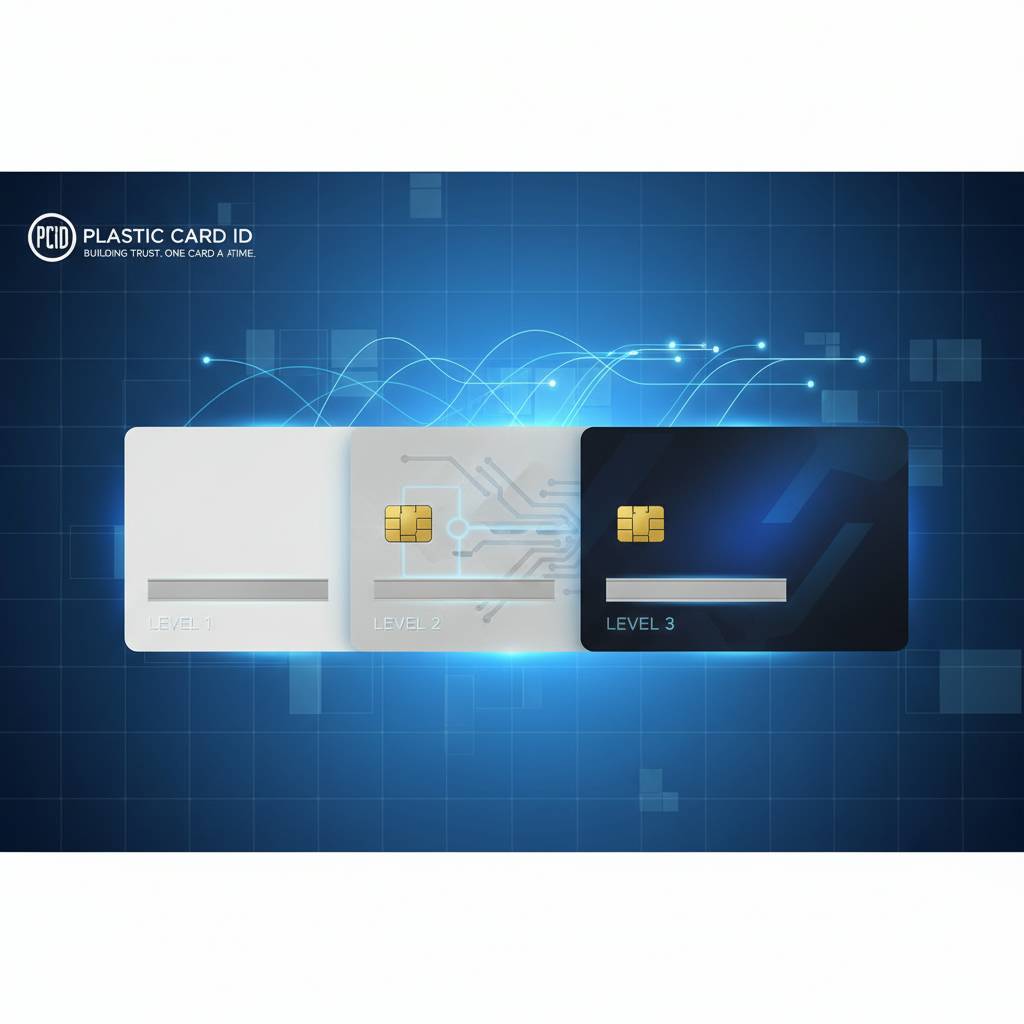 The technology embedded in your plastic card determines the ceiling of your access control program. Not all cards are created equal, and the distinction between a basic proximity card and a MIFARE DESFire encrypted smart card is significant - in capability, security depth, and long-term flexibility. Choosing the wrong technology today can cost your organization significantly more to fix tomorrow.
Fortunately, the market for access control cards is mature and well-documented. The path from simple single-door control to a sophisticated multi-site, multi-level system is well-traveled, and CPE has guided thousands of organizations through exactly this decision. Let us break down the most important card technologies and what they mean for your access level architecture.
Proximity Cards - The Reliable Workhorse
Proximity cards operating at 125kHz have been the backbone of commercial access control for decades. They are passive cards - no battery required - that emit a unique ID number when placed near a compatible reader. The reader sends that ID to a controller, which checks it against its permission database and grants or denies access accordingly. Simple, fast, and proven.
For organizations with two to eight access zones and a stable workforce, proximity cards offer an outstanding value proposition. They are durable, inexpensive per unit, and supported by virtually every access control panel on the market. The tradeoff is that 125kHz proximity technology offers limited encryption, meaning security-sensitive environments may eventually outgrow them.
That said, for retail backrooms, small offices, gyms, storage facilities, and light commercial applications, proximity cards remain one of the most cost-effective access control solutions available today. When your access level requirements are straightforward, do not over-engineer the credential.
Smart Cards and MIFARE Technology
Smart cards operating at 13.56MHz - including the widely adopted MIFARE Classic and MIFARE DESFire families - represent a significant leap in capability. These cards contain an actual integrated circuit that can store data, execute cryptographic functions, and communicate bidirectionally with readers. This opens the door to truly sophisticated access level management.
MIFARE DESFire EV2 and EV3 cards in particular are the gold standard for high-security environments. They support AES-128 encryption, multiple application sectors, and mutual authentication between card and reader. For government facilities, university campuses, hospitals, and any environment where both physical access and logical access (computer login) must be unified on a single card, DESFire delivers.
Magnetic Stripe Cards in Access Control
Magnetic stripe cards - particularly HiCo (High Coercivity) at 2750 Oe - still play a meaningful role in certain access control environments. Hotel key cards are the most visible example. A guest checks in, receives a card encoded with their room number and stay dates, and that encoding tells the door lock exactly what to allow and for how long. The access level is time-bounded and automatically expires.
For event venues, temporary work sites, and hospitality environments where access credentials are issued and retired frequently, magnetic stripe cards offer excellent flexibility. They can be encoded on-site with a simple card printer and encoder, making them fast to produce and easy to manage. Their limitation is durability near magnets and the relatively lower data security compared to RFID smart cards.
HiCo magnetic stripe cards resist demagnetization far better than LoCo (Low Coercivity) cards, making them the preferred choice for access applications where cards will be carried alongside other cards, kept in wallets, or exposed to mild electromagnetic fields. If your access program involves frequent re-encoding, HiCo is almost always the right answer.
Structuring Your Access Level Program
Technology is only half of the equation. The other half is organizational structure - mapping your physical spaces and job functions to a coherent permission architecture. A well-designed access level program is a living document that reflects your org chart, your floor plan, and your risk tolerance simultaneously. Getting this right from the beginning prevents the painful patchwork that plagues many organizations that build access control reactively.
The practical approach starts with a space audit. Walk every door, every gate, every drawer or cabinet that needs protection. Assign each one a risk tier: low, medium, or high. Then map those tiers to job roles, not individual people. You manage roles centrally, then assign cards to individuals within those roles. When someone changes roles, you change their card's level assignment in the controller - not every individual door permission.
Role-Based Access Level Design
Role-based access control (RBAC) is the framework most enterprise access programs use, and for good reason. Instead of assigning permissions door-by-door to each employee, you define roles - Receptionist, Manager, IT Staff, Executive, Contractor, Visitor - and assign access levels to those roles. Every person in a role gets the same card-level permissions automatically.
This scales beautifully. When you hire a new manager, you do not configure 47 door permissions manually - you assign the Manager role and issue a card encoded with that role's level. When you add a new restricted room, you update the Manager role in your controller software and every manager's card reflects the change at the next read cycle. Role-based card access turns a complex security task into a clean administrative one.
Visitor and Temporary Credential Management
One of the most overlooked elements of a tiered access program is the visitor management layer. Visitors, contractors, delivery personnel, and auditors all need some form of access but should never receive the same credential as permanent staff. Blank PVC cards printed and encoded on-site at a reception desk create an instant, professional-looking visitor badge with precisely limited access levels.
- Visitor cards can be time-limited - valid for one day, one week, or a specific date range
- Contractor cards can be encoded for specific zones only - no access to executive floors, server rooms, or storage areas
- Temporary employee cards can carry a full access level but expire automatically on their last day
- Vendor cards can be issued for recurring access within a narrow window - say, Tuesday mornings from 9-11am
- Auditor credentials can be issued with read-only zone access and no override capabilities
Having a printer and blank card stock at the front desk is not just convenient - it is a security posture. Organizations that manage temporary credentials in real time, with real plastic cards, have dramatically fewer unauthorized access incidents than those relying on sign-in sheets or verbal permissions.
Multi-Site Access Level Coordination
For organizations operating across multiple locations - retail chains, franchise networks, university systems, healthcare groups - card-based access control offers something that keys and codes simply cannot: centralized management of decentralized access. A single card can be authorized for Site A and Site B but not Site C, with those permissions managed from a central controller or cloud platform.
This is where MIFARE DESFire and other high-memory smart cards genuinely shine. Multiple application sectors on a single card allow it to carry credentials for different sites, different systems, and even different functions - access control, time and attendance, cafeteria payment, and parking validation - all encoded on one card the employee already carries in their wallet.
Card Printers for On-Site Access Credential Production
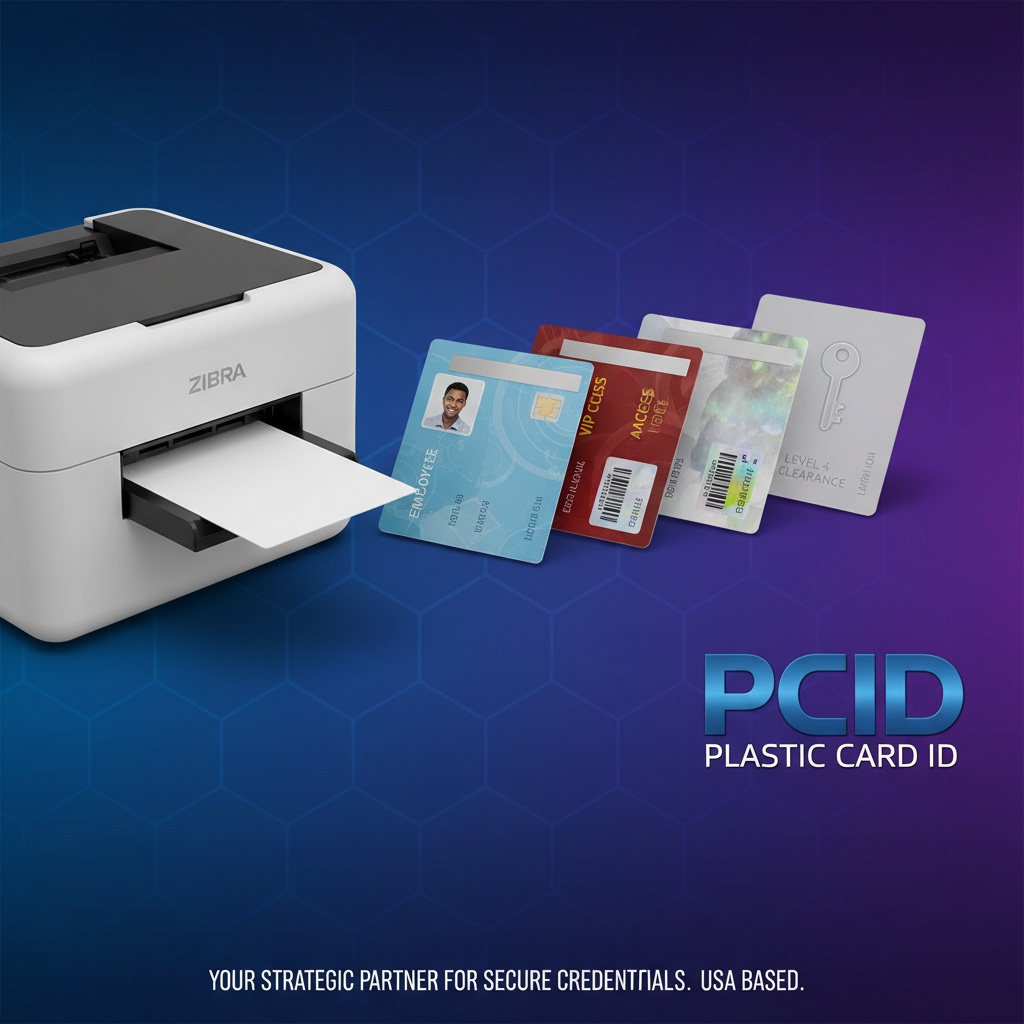 There is a compelling operational case for producing your own access cards in-house rather than ordering pre-encoded cards from an external supplier for every new hire. An on-site card printer paired with blank PVC card stock and encoding software gives your HR or security team the ability to issue a fully functional, professionally printed access card in under three minutes. That kind of responsiveness matters on a new employee's first day.
CPE carries a full lineup of card printers from Evolis, Zebra, and Fargo - three of the most trusted names in the industry. Whether you need a desktop single-sided printer for occasional use or a high-volume dual-sided printer with integrated RFID encoding and lamination, the right model exists for your program scale and budget.
Selecting the Right Printer for Access Card Production
The key specifications to evaluate when choosing a card printer for access control purposes are: encoding capability (magnetic stripe, RFID, or both), print speed (cards per hour), ribbon yield, and whether you need single-sided or dual-sided printing. For access cards, you almost always want dual-sided capability - the front carries the employee's photo and ID information, the back carries the magnetic stripe or RFID module programming details.
Fargo's HDP series printers are particularly well-suited for high-security access card production. The HDP (High Definition Printing) process applies ink to a film that is then transferred to the card surface, rather than printing directly onto the card. The result is a sharper image, better edge-to-edge coverage, and significantly more tamper-evident output - important for cards that must resist counterfeiting or alteration.
Ribbons, Supplies, and Ongoing Card Program Management
A card printer is only as good as its consumables. Ribbons, cleaning kits, and card stock are the recurring investment in any in-house card program. CPE stocks a full range of printer ribbons - YMCKO, YMCKOK, KO monochrome, and specialty overlay ribbons - for Evolis, Zebra, and Fargo printers. Ordering supplies from the same source as your blank cards simplifies your procurement and ensures compatibility.
Cleaning kits are genuinely important and genuinely underused. A dirty print head causes banding, color shifts, and card jams - all of which waste time, ribbon, and card stock. A routine cleaning cycle every 250-500 cards extends print head life dramatically. This small maintenance investment protects a much larger equipment investment.
For organizations that prefer to outsource card production entirely, pre-printed and pre-encoded cards ordered in bulk remain a cost-effective option - particularly for large, stable populations of employees where design rarely changes. Talk to a CPE representative at 800.835.7919 about which production model makes the most sense for your access program scale.
Specialty Card Options for Advanced Access Programs
Not every access control card needs to be a standard white CR80. Depending on your organization's brand standards, security requirements, and the physical environments cards will operate in, specialty card formats may serve you better. The right card signals the right things to the people who carry it and the systems that read it.
From clear and frosted PVC cards to custom die-cut shapes and luxury metal cards in stainless steel, brass, and gold, the options for differentiated card design are broader than most buyers realize. These are not gimmicks - they serve real functional and psychological purposes in access control programs.
Clear and Frosted Cards for Design Flexibility
Clear PVC cards and frosted cards offer a distinctive look that standard white cards cannot match. For premium membership programs, executive access credentials, or VIP designations within a multi-tier system, a clear or frosted card visually communicates elevated status. That distinction matters - both to the cardholder and to anyone observing the credential at a checkpoint.
Functionally, clear and frosted cards accept the same RFID chips, magnetic stripes, and printed graphics as standard white cards. The aesthetic difference is the point. In environments where different access tiers should be immediately visually distinguishable - casino floors, hospital departments, university research facilities - colored or specialty card stock creates an instant visual layer on top of the electronic access layer.
Metal Cards and High-Security Credentials
Luxury metal cards in stainless steel, brass, or gold are increasingly appearing in high-end access programs - executive suites, private clubs, exclusive event venues, and VIP hospitality. The weight and feel of a metal card communicates permanence and exclusivity in a way that plastic simply cannot replicate. For programs where card carrying behavior matters - where you want cardholders to keep and use their credentials - metal delivers unmatched retention value.
Metal cards can carry embedded RFID chips or magnetic stripes and function seamlessly with standard access control readers. They are not incompatible with modern infrastructure - they are simply a premium form factor for the same underlying technology.
Casino and Hospitality Access Cards
Casino player cards and hotel key cards represent two of the most sophisticated mass-market applications of tiered card access. A casino player card tracks tier status, accumulated points, and access to VIP areas or promotions - all on a single card that carries both RFID and magnetic stripe encoding. Hotel key cards are time-bounded access credentials that function as room keys, elevator access passes, and in some properties, spa and parking credentials simultaneously.
Both use cases demand cards that are durable, consistently readable, and produced in large quantities with high encoding accuracy. CPE has supplied cards for both casino and hospitality applications across the United States, with the volume and quality control infrastructure to support programs at any scale - from a boutique hotel with 40 rooms to a resort complex managing thousands of guests daily.
Frequently Asked Questions About Access Control Cards
Buyers new to card-based access control often have similar questions. The following addresses the most common ones clearly and directly, so your team can make confident decisions before reaching out for a formal consultation.
How Many Access Levels Can a Single Card Carry?
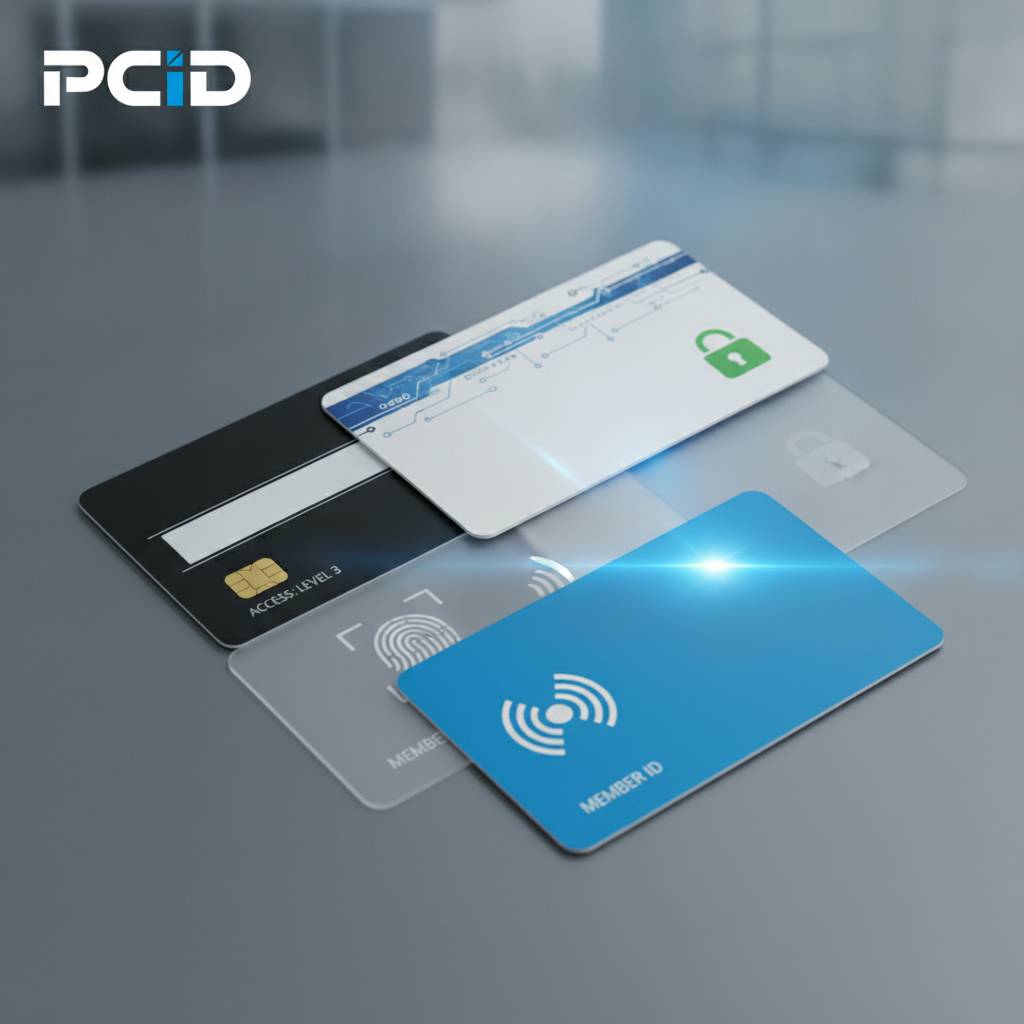
This depends entirely on the card technology. A basic magnetic stripe card carries a fixed encoded ID number - access levels are then managed at the controller level, not on the card itself. A MIFARE DESFire smart card, by contrast, can carry multiple application sectors with distinct permission sets for multiple systems. In practice, most organizations manage access levels at the controller, not the card - the card is the key, the controller is the lock logic.
For multi-site or multi-system programs, smart cards with sufficient memory allow for on-card storage of multiple credential sets. This is common in large enterprise and campus environments where a single card must interact with different controllers operated by different systems - parking, building access, IT login, and cafeteria payment, for example.
What Is the Difference Between HiCo and LoCo Magnetic Stripe Cards?
HiCo (High Coercivity) cards require a stronger magnetic field to encode but resist demagnetization far better than LoCo (Low Coercivity) cards. For access control applications - where cards will be carried in wallets, purses, or near other magnetic objects - HiCo at 2750 Oe is almost always the correct choice. LoCo cards at 300 Oe are typically reserved for short-lifecycle applications like gift cards or low-value transit tickets.
If your access card program involves any kind of magnetic stripe encoding, specify HiCo unless your reader infrastructure explicitly requires LoCo. The durability difference over the typical 1-3 year card lifecycle is significant - HiCo cards simply fail less often in real-world carry conditions.
Can I Print and Encode Access Cards In-House?
Yes - and for many organizations, in-house production is the most operationally practical approach. A mid-range card printer with built-in magnetic stripe or RFID encoding capability, a supply of blank HiCo or RFID cards, and compatible software is all you need. The startup investment ranges roughly $75-$200 per month in supplies for a small program, with printer costs in the $500-$3,500 range depending on features.
The advantage is speed and control. Issue a new card in minutes. Deactivate and replace a lost card same-day. Adjust an access level without waiting on an outside vendor. In-house production gives security teams genuine operational agility that outsourced card programs simply cannot match for day-to-day responsiveness.
Partner With Plastic Card ID for Your Access Card Program
Access control is not a one-time purchase - it is an ongoing program. Cards wear out, employees turn over, access levels evolve, technology advances, and organizations grow. You need a supplier who understands programs, not just products - one who can advise on card technology, supply consistent quality at scale, and be there when your needs change six months from now or six years from now.
Plastic Card ID has spent over 25 years doing exactly that for over 100,000 businesses across the United States. More than 50 million cards shipped. Proximity cards, MIFARE smart cards, HiCo magnetic stripe cards, combo dual-technology cards, hotel key cards, casino player cards, specialty clear and metal cards - whatever your access control program requires, the inventory, expertise, and relationships to support it are already in place.
Ready to Build or Scale Your Access Control Card Program?
Whether you are designing a new access control system from scratch, expanding an existing program to new sites, or simply looking for a more reliable card supplier, CPE is ready to help. The conversation starts with understanding your current setup, your access level architecture, and your volume - and then matching the right card technology and supply structure to your actual needs.
No program is too small to merit serious attention, and no program is too large to be handled with the care it deserves. From 50 cards a month for a small office to tens of thousands for a multi-site enterprise rollout, CPE has the infrastructure and the commitment to deliver. Call today and speak with an access card specialist who will give you straight answers, not a sales pitch.
Contact Plastic Card ID today at 800.835.7919 - and put 25 years of plastic card expertise to work for your access control program.
Previous Page