Are Blank Plastic Cards Recyclable? PVC Limitations Explained
Table of Contents []
- What Businesses Should Know About Blank Plastic Cards, PVC, and Responsible End-of-Life Practices - Plastic Card ID
- Understanding PVC - The Material Behind the Cards
- Blank CR80 Cards - The Strategic Foundation of In-House Card Programs
- Are Blank Plastic Cards Recyclable - The Direct Answer
- Advanced Card Options Beyond Standard PVC
- Choosing the Right Card Printer for Your Program
- Why Plastic Card ID Remains the Trusted Partner for USA Card Programs
What Businesses Should Know About Blank Plastic Cards, PVC, and Responsible End-of-Life Practices - Plastic Card ID
Here is a question that comes up more than you might expect: are blank plastic cards recyclable? It sounds simple. It is not. The honest answer involves material science, logistics, card program strategy, and a fair amount of nuance that most suppliers gloss over entirely. If you are running a card program - or thinking about starting one - understanding PVC limitations is genuinely useful knowledge, not a footnote.
At Plastic Card ID, we have spent over 25 years supplying blank and custom plastic cards to businesses across the United States. More than 100,000 customers. Upwards of 50 million cards sold. What we have learned, over all of that time, is that informed buyers make better long-term decisions. That is why we are covering this topic directly - not to discourage plastic card programs, but to help you run yours intelligently.
| Card Type | Material | Typical Use | Recyclable via Standard Stream? |
|---|---|---|---|
| Blank CR80 PVC Card | PVC (Type 3 Plastic) | ID, loyalty, membership | No - specialty recycler required |
| Magnetic Stripe Card | PVC magnetic oxide layer | Access, hotel key, loyalty | No - specialty recycler required |
| RFID / Smart Chip Card | PVC embedded electronics | Access control, casino, hotel | No - e-waste/specialty handling |
| Clear / Frosted Card | Clear PVC | Premium membership, VIP | No - specialty recycler required |
| Metal Card | Stainless steel / brass / gold | Luxury membership, VIP | Metal recycling applicable |
Understanding PVC - The Material Behind the Cards
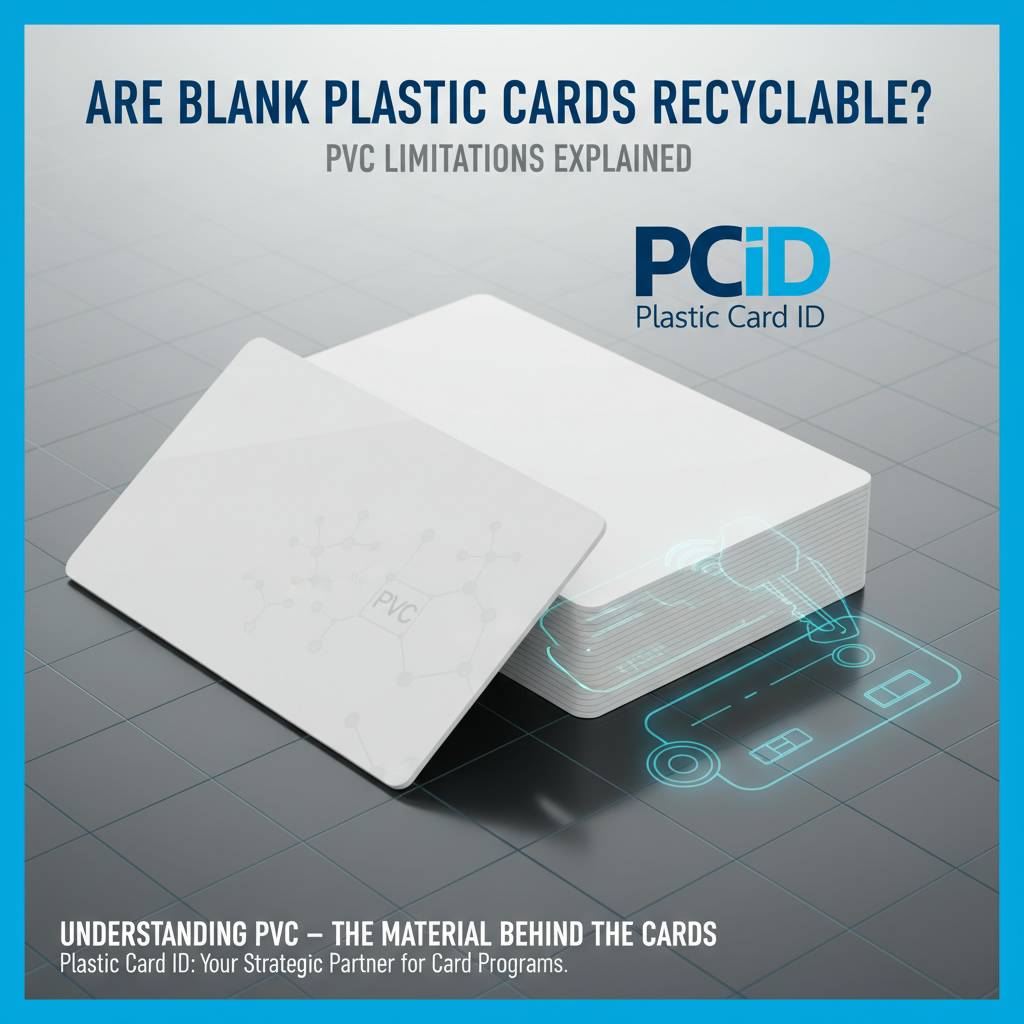 Polyvinyl chloride, or PVC, is the dominant material in the global plastic card industry for reasons that are hard to argue with. It is tough, dimensionally stable, and holds printed graphics exceptionally well - whether you are running cards through a thermal transfer printer or a dye-sublimation unit. The standard CR80 card, at 30 mil thickness and measuring 3.375 x 2.125 inches, meets the ISO 7810 specification used everywhere from hotel key systems to corporate access control.
What makes PVC excellent for cards is also what makes it complicated at end-of-life. PVC is classified as plastic resin code 3. Most municipal curbside recycling programs do not accept it. Why? Because PVC processing requires dedicated equipment to handle the chlorine content safely, and contamination of a mixed-plastic stream with PVC can actually degrade recyclability of other materials. This is not a flaw unique to card-grade PVC - it applies to the material category broadly.
Why PVC Outperforms Other Card Materials in Active Use
Before anyone draws premature conclusions about PVC, consider what the material actually does during its working life. A well-made PVC card can withstand years of daily use - repeated swiping, bending, contact with wallets, keychains, and the general abuse of everyday carry. Paper alternatives degrade in weeks. Cardstock punch cards become illegible and embarrassing. PVC endures.
For loyalty cards, membership cards, employee badges, and event credentials, durability directly correlates with program effectiveness. A card that holds up physically stays in the wallet. A card that stays in the wallet gets used. That relationship between material quality and program ROI is something CPE has observed consistently across every vertical it serves.
The Chlorine Issue Explained Simply
PVC contains chlorine atoms in its polymer backbone - that is what the "V" and "C" in PVC stand for chemically. When PVC is incinerated or processed improperly, that chlorine can produce harmful byproducts. This is why responsible disposal matters, and why standard recycling bins are not the right destination. It is also why specialty recyclers with appropriate processing equipment exist specifically for PVC waste streams.
The good news for businesses running card programs is that the volume of cards relative to overall plastic waste is modest. An organization issuing 500 cards per month generates roughly three to four pounds of PVC over the course of a year. That is a manageable volume for specialty recycling collection, particularly if cards are collected back at point of replacement rather than discarded individually by cardholders.
PVC Limitations That Card Program Managers Should Know
Every material has tradeoffs. PVC cards are not immune. They can warp slightly under sustained high heat - think cars left in summer sun or lamination done incorrectly. Ink adhesion on cards not designed for direct-to-card printing may be inconsistent. And as discussed, the recyclability limitations mean end-of-life planning should be a deliberate part of any card program lifecycle management.
None of these are reasons to avoid PVC cards. They are reasons to buy quality cards from a supplier who knows the specifications, work with appropriate printers, and think ahead about card retirement. That combination - quality materials, right equipment, thoughtful program design - is exactly where CPE adds value beyond just selling you cards in bulk.
Blank CR80 Cards - The Strategic Foundation of In-House Card Programs
If you are evaluating whether to produce cards in-house or outsource fully customized cards every time, the blank CR80 card is the pivot point of that decision. Blank cards give organizations total design control, faster turnaround on smaller runs, and meaningfully lower per-card costs over time. A quality card printer and a stock of blank PVC cards can produce employee badges in minutes, reprint lost credentials same-day, and adapt your loyalty card design without waiting on a full production run.
The CR80 standard is universal. Every card printer from Evolis, Zebra, and Fargo - all brands carried by Plastic Card ID - is designed around it. That interoperability means you are never locked into a proprietary format. Blank cards sourced today work with the printer you buy this year and the upgraded model you purchase five years from now.
What You Can Do With a Blank Card
The versatility of a blank PVC card is genuinely impressive when you lay out the use cases. Print a name and photo - you have an employee badge. Encode a magnetic stripe - you have a hotel key or loyalty card. Load a smart chip - you have a transit credential or access token. The blank card is a platform, not just a product.
- Employee ID and access badges with full-color photo printing
- Loyalty and rewards cards for retail, hospitality, and food service
- Membership cards for gyms, clubs, associations, and professional organizations
- Event credentials, conference passes, and VIP access cards
- Student ID cards for schools and universities
- Visitor management badges for secure facilities
- Library cards and municipal service cards
What ties all of these together is the underlying CR80 PVC card. One stock item, dozens of applications. That is the kind of operational efficiency that makes in-house card programs attractive to organizations of all sizes - from a 50-card-a-month gym to an enterprise issuing thousands of badges quarterly.
HiCo vs. LoCo Magnetic Stripe Cards - Choosing the Right Option
Not all magnetic stripe cards are equivalent. High-coercivity (HiCo) stripes require more magnetic force to encode and are significantly more resistant to accidental erasure from everyday magnets. HiCo cards are the right choice for long-term use cases - access control systems, durable loyalty cards, and employee credentials that need to survive a year or more of regular use.
Low-coercivity (LoCo) stripes are easier to encode and re-encode, which makes them appropriate for hotel key cards and short-duration event credentials where the card has a defined lifespan measured in days or weeks. They are also less expensive per card. The choice between HiCo and LoCo should be driven by your use case and how long each card needs to remain reliably functional, not by price alone.
Ordering Quantities and Cost Efficiency
One of the persistent misconceptions about professional-grade PVC cards is that they require enormous minimum orders. CPE serves businesses ordering as few as 50 cards per month with the same professionalism and product quality as clients ordering tens of thousands. There is no use case too small to run properly.
That said, per-card costs do improve meaningfully at volume. A startup gym issuing 100 membership cards pays more per card than a regional chain ordering 10,000. That pricing structure is standard across the industry - and planning your order quantities around your actual program needs, rather than over-ordering to chase a per-card price, is usually the smarter financial move for smaller organizations. Call 800.835.7919 to discuss the right quantity tier for your specific program.
Are Blank Plastic Cards Recyclable - The Direct Answer
 Let's be direct: standard blank PVC plastic cards are not recyclable through conventional municipal curbside programs. This is a limitation of the material class, not a defect of any particular card product. PVC requires specialty processing, and most communities simply do not have that infrastructure integrated into residential or commercial waste streams.
What this means practically for a business running a card program is that responsible disposal requires a different approach. Specialty plastic recyclers who accept PVC can process card-grade material appropriately. Some card printer manufacturers and industry organizations provide take-back or collection programs. And proactive businesses can build card collection into their program design - asking customers to return old loyalty cards when new ones are issued, for example.
What Makes PVC Hard to Recycle at Scale
The core challenge is contamination and sorting. PVC looks essentially identical to other clear or white plastics at the point of sorting in a recycling facility. Without sophisticated spectroscopic sorting equipment, PVC cards can end up mixed into PET or HDPE streams, where they degrade the quality of the recycled output. This is why the standard guidance is to keep PVC out of the general recycling bin entirely.
Additionally, cards that include magnetic stripes, embedded chips, or printed inks introduce layered material complexity. A magnetic stripe card is not purely PVC - it includes metallic oxide coatings and adhesive layers. A smart card adds a silicon chip and copper antenna. These composites require material separation before any constituent part can be meaningfully recycled - a process that is technically feasible but not yet widely available at consumer scale.
Specialty Recycling Pathways for PVC Cards
For businesses that want to handle card retirement responsibly, several pathways exist. TerraCycle and similar specialty recycling companies accept certain plastic types including PVC with appropriate program enrollment. Some regional industrial recyclers accept sorted PVC streams. And for organizations with significant card volumes, direct engagement with a PVC recycler for periodic bulk pickup is feasible.
The key is intention. A card program that plans for end-of-life from the start - building collection points into branches, offices, or retail locations - can manage this cleanly. A program that ignores it entirely is leaving cards to be discarded in general waste. The difference is not the card itself; it is the program design around the card.
Why This Does Not Undermine the Case for Plastic Cards
Here is the perspective that often gets lost: the alternative to a durable plastic card is usually a paper or cardstock version that degrades quickly and ends up in the same waste stream anyway - often more frequently, because it needs replacing far sooner. A PVC card used for three years and then responsibly disposed of represents a better resource profile than a paper card replaced every 90 days.
The conversation about recyclability should be held in context. Plastic cards drive real business results. Retailers switching from paper to plastic gift cards see sales increases of 35-50%. Loyalty cards in wallets outperform punch cards significantly. Membership cards signal credibility and permanence that no paper alternative can replicate. Recyclability limitations are worth understanding - but they do not negate the substantial value these cards create during their working life.
Advanced Card Options Beyond Standard PVC
The catalog at Plastic Card ID extends well beyond standard white CR80 cards. For organizations with specific technical requirements or brand ambitions that demand more than a basic card, the advanced options are worth knowing. From RFID-enabled access cards to hand-crafted metal cards, the right card can do significantly more than simply identify a cardholder.
RFID and proximity cards bring contactless functionality to access control, attendance tracking, and loyalty programs. Hotel key cards, casino player cards, and corporate access systems all increasingly rely on RFID technology. MIFARE DESFire chips bring encryption and multi-application capability to smart card programs - relevant for organizations managing sensitive access environments or complex loyalty architectures.
Clear, Frosted, and Custom-Shape Cards
Clear and frosted PVC cards offer a premium visual profile that standard white cards cannot match. A clear loyalty card with a minimalist printed design communicates brand sophistication in a way that a standard white card simply does not. For VIP programs, exclusive memberships, or high-end retail applications, the card itself becomes part of the brand experience.
Custom die-cut cards take this further - cards shaped to match a logo, product silhouette, or brand element create genuinely memorable physical touchpoints. These are not novelty items. They are strategic brand assets that increase retention rates and drive conversation. When a cardholder shows a uniquely shaped membership card to a friend, that is organic marketing that a standard card rarely generates.
Metal Cards for Luxury and VIP Programs
Stainless steel, brass, and gold metal cards represent the top tier of the physical card market. These are not primarily functional items - though they can carry magnetic stripes and functional printing - they are statements. A metal card communicates exclusivity, permanence, and value in a way that no plastic card, however premium, can fully match.
For luxury retail VIP programs, high-value membership clubs, or premium corporate gift applications, metal cards are increasingly popular. The tactile weight alone triggers a psychological response distinct from any paper or plastic alternative. CPE can help organizations evaluate whether metal cards align with their program goals and budget. Contact 800.835.7919 for consultation on metal card options and pricing.
Card Accessories and Program Support Products
Cards do not exist in isolation. A complete card program includes the accessories that make cards functional and presentable in the real world. Cardholders and sleeves protect cards and extend their useful life. Card carriers and mailers enable professional direct-mail distribution. Printer ribbons and cleaning kits keep in-house production running at peak output quality.
Plastic Card ID stocks the full range of accessories alongside cards and printers - making it genuinely possible to source an entire card program from a single supplier. That consolidation saves time, reduces vendor complexity, and ensures compatibility across every element of your program. From the blank card to the envelope it arrives in, the supply chain is covered.
Choosing the Right Card Printer for Your Program
A card printer is a long-term capital investment, and the right choice depends on your volume, the types of cards you produce, and the features you need. Plastic Card ID carries printers from three of the most respected names in the industry: Evolis, Zebra, and Fargo. Each brand has distinct strengths, and matching those strengths to your specific program requirements is where buying guidance genuinely matters.

Entry-level single-sided printers work well for organizations producing under 500 cards per month with relatively simple designs. Dual-sided printers with encoding capability are appropriate for moderate-volume programs requiring magnetic stripe or smart card encoding. High-throughput production printers serve large organizations needing thousands of cards per day with full lamination and multi-technology encoding.
Matching Printer Capability to Card Type
Not every printer handles every card type equally well. RFID encoding requires specific reader/writer modules that are present in some models and absent in others. Lamination overlays - which significantly extend card durability and resist tampering - are only available on certain units. If your program includes magnetic stripe encoding, ensure your printer ribbon type and encoder configuration are aligned from the start.
The cost of getting this wrong is not just a wasted purchase - it is reprinting hundreds of cards that failed quality checks, or discovering mid-program that your printer cannot produce the card type a new contract requires. Buying the right printer the first time, with guidance from a supplier who understands the full system, is almost always the more economical path.
Ribbons, Maintenance, and Total Cost of Ownership
Ribbon costs are the recurring operational expense that printer buyers sometimes underestimate. A printer that costs $400-$800 less at purchase may use proprietary ribbons priced significantly higher per panel than a competing model. Over thousands of cards, that ribbon cost differential can exceed the initial savings. Total cost of ownership matters more than sticker price when evaluating card printers.
Cleaning kits are not optional accessories - they are maintenance requirements. A poorly maintained printer produces inconsistent print quality, jams more frequently, and fails sooner. The investment in a cleaning routine, measured in minutes per week and a modest supply cost, protects a capital asset that should perform reliably for years. CPE stocks cleaning kits for all major printer brands alongside the cards and ribbons they complement.
Why Plastic Card ID Remains the Trusted Partner for USA Card Programs
Twenty-five years is a long time in any industry. The plastic card market has evolved substantially - new encoding technologies, new printer platforms, new form factors, new use cases that did not exist a decade ago. Through all of it, Plastic Card ID has maintained the same fundamental commitment: supply quality products, build real relationships, and help clients run card programs that actually work.
That means being honest about things like PVC recyclability limitations rather than ignoring the question. It means carrying advanced options like MIFARE DESFire smart cards and luxury metal cards alongside standard blank CR80 stock. And it means being accessible and knowledgeable whether you are ordering 50 cards for a small yoga studio or managing a national loyalty rollout of 50,000 units.
The Strategic Partner Difference
There is a meaningful difference between a supplier and a strategic partner. A supplier ships what you order. A partner helps you figure out what to order - and why. Over 100,000 businesses have worked with CPE not just because the cards are competitively priced and reliably delivered, but because the relationship adds value beyond the transaction. Program guidance, product matching, troubleshooting support - these are things a box-shipper does not provide.
Whether your program is simple or complex, just starting or well-established, the right cards and the right support structure make a measurable difference in outcomes. Loyalty programs that use quality plastic cards and smart program design consistently outperform those built on cheaper materials and less thoughtful execution. That correlation is not coincidence - it is the result of taking the physical card seriously as a strategic asset.
Serving Every Scale, Every Vertical
No program is too small to serve well, and no program is too large to handle. Plastic Card ID operates across verticals - retail, hospitality, healthcare, education, fitness, events, corporate, government, and more. The card needs of a regional hospital system differ from those of a boutique hotel loyalty program, which differ from those of a university student ID office. That breadth of experience across real-world use cases informs every recommendation made to every new client.
USA-based organizations benefit specifically from working with a domestic supplier who understands the regulatory environment, shipping realities, and industry norms that apply here. Cards ship quickly. Questions get answered by people who know the products. Programs get built on reliable supply chains rather than international shipping uncertainty.
Ready to build or upgrade your card program? Reach out today - the right card solution is closer than you think.
Get Started With Confidence
Starting a card program - or optimizing an existing one - does not have to be complicated. The key decisions are knowable: card type, quantity, encoding requirements, printer platform, and accessories. With the right supplier relationship in place, those decisions become straightforward rather than overwhelming. Plastic Card ID has helped over 100,000 businesses make exactly these decisions well.
Whether you are asking about blank PVC card recyclability, trying to choose between HiCo and LoCo magnetic stripes, or evaluating a luxury metal card for your VIP program, the answers are available and the products are in stock. The only step left is reaching out.
Contact Plastic Card ID today at 800.835.7919 to speak with a card program specialist and get your program moving in the right direction. Your cards should work as hard as your business does - and with Plastic Card ID in your corner, they will.
Previous Page