Blank Plastic Cards for Employee ID Badges
Table of Contents []
- Blank Plastic Cards for Employee ID Badges - Plastic Card ID
- Why Blank CR80 Cards Are the Backbone of Every Smart ID Program
- Magnetic Stripe Cards for Access Control and Time Tracking
- RFID and Smart Cards for Advanced Employee Identification
- Card Accessories and Supplies That Complete Your ID Program
- Frequently Asked Questions About Blank Plastic Cards for Employee ID Badges
- Ready to Build a Better ID Badge Program? Trust Plastic Card ID
Blank Plastic Cards for Employee ID Badges - Plastic Card ID
Walk into almost any workplace in America and you'll see them clipped to lanyards, tapped against readers, tucked into badge holders on desks. Employee ID badges are the silent infrastructure of modern organizations - and the blank plastic card sitting at the center of every badge program is more important than most people realize. Getting that foundation right matters enormously.
Plastic Card ID has spent over 25 years supplying businesses across the United States with precisely the blank and custom plastic cards they need to build ID programs that actually work. With more than 100,000 customers served and over 50 million cards sold, the experience here runs deep. Whether you're outfitting a 12-person startup or a multi-site corporation with thousands of employees, the right blank card stock is where everything begins.
| Card Type | Best For | Thickness | Standard |
|---|---|---|---|
| Blank White PVC CR80 | Employee ID, Membership | 30 mil | ISO 7810 |
| Magnetic Stripe (HiCo) | Access Control, Time Tracking | 30 mil | ISO 7810 |
| Proximity/RFID Cards | Contactless Access, Smart Buildings | 30-34 mil | ISO 14443 |
| Smart Chip Cards | Secure ID, Multi-Function | 30 mil | ISO 7816 |
| Clear/Frosted PVC | Premium Branding, VIP Badges | 30 mil | ISO 7810 |
Why Blank CR80 Cards Are the Backbone of Every Smart ID Program
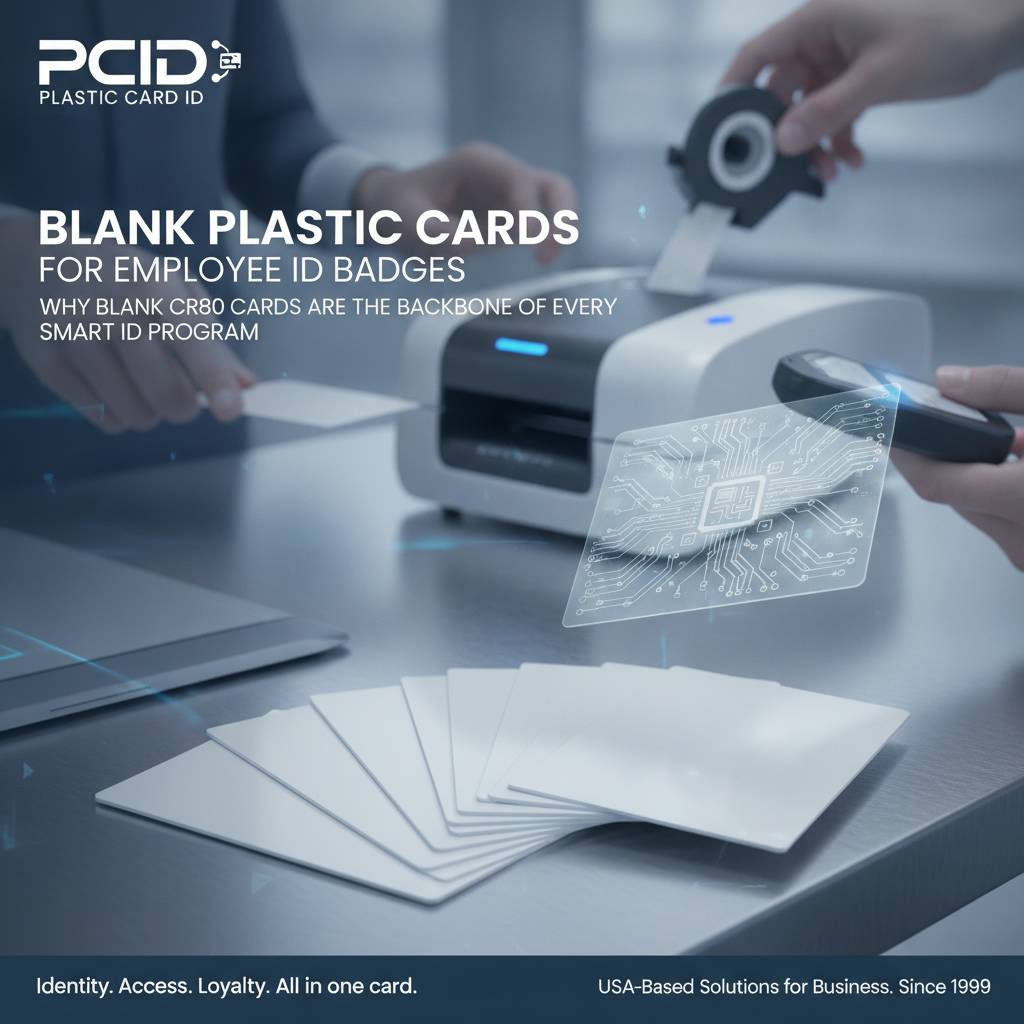 There's a reason the CR80 format - the same footprint as a standard credit card - has become the universal standard for employee identification. At 3.375 inches by 2.125 inches and 30 mil thick, these cards are durable enough to survive daily handling, slim enough for any badge holder or wallet slot, and compatible with every major card printer on the market. Starting with the right card stock eliminates headaches before they start.
Blank white PVC cards give organizations total control over their ID program. Print exactly what you need, when you need it - names, photos, job titles, barcodes, department codes. No waiting for a third party to produce custom cards in bulk before you can onboard a new hire. No wasted inventory when roles change or employees leave. The economics alone make the case, but the operational flexibility is what truly sets in-house printing programs apart.
CR80 Dimensions and the ISO 7810 Standard
ISO 7810 isn't just a number to drop in a spec sheet - it's the international standard that ensures your cards will work with any CR80-compatible printer, badge holder, lanyard clip, or card reader you encounter. Compliance with ISO 7810 means interoperability across your entire operation. When CPE supplies cards to your organization, they arrive sized and calibrated to that standard without exception.
The 30 mil thickness is equally important. Too thin and cards bend, crack, and look unprofessional. Too thick and they won't feed cleanly through card printers. At 30 mil, you get a card that feels solid and substantial in the hand - the kind of ID badge that signals your organization takes its security and professionalism seriously.
What Can You Print or Encode on a Blank Card?
The answer, perhaps surprisingly, is quite a lot. A blank CR80 card is essentially a canvas waiting for your card printer to bring it to life. Employee photos, full-color logos, names, departments, barcode or QR code identifiers, expiration dates - all of this can be printed in-house with a desktop card printer. Your blank card becomes whatever your program demands.
Beyond visual printing, blank cards can be ordered with built-in features: magnetic stripes for time-clock integration, RFID chips for contactless access control, or smart chips for multi-function identity applications. These aren't separate product lines so much as variations on the same core concept - a versatile, credit-card-sized credential that your organization controls entirely.
Volume Flexibility for Organizations of Every Size
One of the genuine advantages of working with CPE is the absence of artificially high minimums. Need 50 cards a month for a small business? Covered. Running a healthcare network that needs tens of thousands of badges across dozens of facilities? Also covered. Scalable ordering means your card supply grows with your organization rather than forcing you to choose between over-ordering and running out.
Card pricing improves meaningfully at higher volumes, which rewards organizations that consolidate their purchasing. Buying blank card stock in larger quantities - cases of 500 or 1,000 rather than packs of 100 - reduces per-card cost significantly, making in-house printing even more economical compared to outsourcing badge production every time a new employee joins.
Magnetic Stripe Cards for Access Control and Time Tracking
For employee ID programs that need to do more than just display a face and a name, magnetic stripe cards open up a world of functional capability. Swipe a card through a time clock and you've logged attendance. Run it through an access reader and you've granted or denied entry to a secure area. Magnetic stripe technology is proven, affordable, and widely compatible with existing infrastructure.
The choice between HiCo (High Coercivity) and LoCo (Low Coercivity) magnetic stripes matters more than many buyers initially realize. HiCo stripes require more magnetic force to encode but resist accidental erasure far better - making them the right choice for employee badges that will be used repeatedly, carried in wallets alongside other cards, and exposed to everyday magnetic fields. LoCo cards cost slightly less and work fine for short-term or low-security applications.
HiCo vs. LoCo: Choosing the Right Stripe
HiCo magnetic stripe cards are encoded at 4,000 Oe (oersteds) compared to LoCo's 300 Oe. That difference translates directly into durability and data reliability over time. For employee ID badges that see daily use, HiCo is almost always the correct choice. The slightly higher cost per card is easily justified by longer reliable service life and fewer failed reads.
LoCo cards have their place, particularly in applications like hotel key cards or short-term event credentials where the card's functional life is intentionally brief. But for a long-term employee ID program where reliability matters and badge replacement is an administrative inconvenience, HiCo stripes deliver the performance organizations need. CPE stocks both and can help you determine which specification fits your system requirements.
Contact Plastic Card ID at 800.835.7919 to discuss magnetic stripe specifications and find the right card for your access control or time-tracking infrastructure.
Integrating Magnetic Stripe Badges with Existing Systems
Most organizations adopting magnetic stripe employee badges are integrating with existing time-and-attendance systems, access control panels, or point-of-sale environments. The good news: the CR80 magnetic stripe format is so universally standardized that compatibility is rarely an issue. Your existing readers almost certainly work with standard HiCo or LoCo CR80 cards - no system overhauls required.
If you're building a new system from scratch, pairing a desktop card printer with magnetic stripe encoding capability alongside a supply of blank HiCo cards gives you a completely self-contained badging operation. Print the badge, encode the stripe, hand it to the employee - all in a matter of minutes. That kind of operational speed is invaluable during onboarding surges or after a security incident requiring rapid re-badging.
Card Printers for Magnetic Stripe Encoding
Plastic Card ID carries card printers from Evolis, Zebra, and Fargo - three of the most trusted names in the industry - many of which include built-in magnetic stripe encoding as a standard or optional feature. Selecting the right printer for your badge volume and encoding needs is part of the advisory relationship CPE provides. A printer that fits your workflow perfectly makes every other part of the program easier.
For low-to-medium volume operations (under 500 cards per month), a single-sided desktop printer with integrated HiCo encoding handles the job without breaking the budget. Higher-volume environments or programs requiring dual-sided printing and encoding simultaneously will want to look at mid-range or high-capacity models. The full Evolis, Zebra, and Fargo lineup covers every tier of that range.
RFID and Smart Cards for Advanced Employee Identification
 Modern workplaces increasingly demand more from an employee badge than a printed photo and a barcode. Contactless technology has transformed what an ID card can do - unlocking doors, logging into secure computer systems, authenticating identities without physical contact. RFID and smart chip cards bring all of that capability into the familiar CR80 format your existing badge holders and lanyards already accommodate.
Proximity cards use radio frequency to communicate with readers at distances typically ranging from a few inches to a couple of feet, depending on the reader and card type. Smart chip cards (contact or contactless) carry embedded integrated circuits capable of storing significantly more data and executing cryptographic functions that proximity cards cannot. Both types are available as blank cards ready for your printing and encoding process.
Proximity Cards and 125 kHz Technology
The 125 kHz proximity card remains one of the most widely deployed access control technologies in American commercial and institutional buildings. If your organization already has 125 kHz readers installed, ordering compatible proximity cards in bulk blank stock and printing your ID information directly onto them creates a seamless badge-plus-access solution. Proximity cards eliminate the need for separate ID badges and key fobs - consolidating functionality into one credential.
These cards are passive - they carry no battery and draw power wirelessly from the reader's electromagnetic field. That makes them extremely durable from a power standpoint; there's nothing to run out or fail over time. With proper handling, a proximity card issued to an employee today could still be functioning reliably several years from now, making them a highly cost-effective choice for organizations managing large workforces.
MIFARE DESFire and High-Security Applications
For organizations with genuinely sensitive security requirements - government contractors, financial institutions, healthcare networks, research facilities - MIFARE DESFire contactless smart cards offer a substantially higher level of cryptographic protection than traditional proximity technology. DESFire cards use AES-128 encryption and mutual authentication, making them resistant to cloning and eavesdropping attacks that can compromise legacy 125 kHz systems.
The transition from proximity to DESFire doesn't have to happen all at once. Many modern access control systems support both technologies simultaneously during transition periods. CPE supplies MIFARE DESFire cards suitable for encoding with your access control provider's programming tools, giving your security team the flexibility to upgrade at a pace that matches your budget and operational timeline.
Smart Chip Cards for Multi-Function Credentials
- Contact smart chips store employee data, access permissions, and digital certificates on a single card
- Dual-interface cards support both contact chip reading and contactless RFID in one card
- Smart cards can serve as logical access credentials for computer login, reducing password vulnerabilities
- Healthcare organizations use smart employee IDs for EHR access control and prescription management workflows
- Government and defense contractors often require FIPS 201-compliant smart card formats for federal facility access
- Multi-application chips allow a single badge to manage physical access, logical access, and even cafeteria payments
The versatility of smart chip employee ID cards makes them particularly valuable for organizations that want to consolidate multiple credential types into one card. Rather than issuing separate badges for building access, computer login, and department-specific permissions, a single smart card handles all of those functions. Operational simplicity and security strength are not mutually exclusive when you choose the right card technology.
Card Accessories and Supplies That Complete Your ID Program
Blank cards and a printer represent the core of an in-house badging operation, but a well-run program needs the supporting infrastructure to function smoothly day after day. Printer ribbons, cleaning kits, card carriers, lanyards, badge holders, and protective sleeves are the unsung heroes that keep everything working properly. Running out of ribbon mid-batch or neglecting printer maintenance leads to print quality problems and costly printer repairs.
Plastic Card ID operates as a true one-stop shop precisely because experienced badge program managers know how important these supporting supplies are. Ordering everything from one supplier - cards, printer consumables, accessories - simplifies procurement, ensures compatibility, and gives your team one phone number to call when you need something quickly.
Printer Ribbons and Cleaning Kits
Card printer ribbons are consumables that need regular replenishment, and using the correct ribbon for your specific printer model is not optional. The wrong ribbon produces poor color quality, card jams, and in some cases can damage the print head. Ribbons matched specifically to your Evolis, Zebra, or Fargo printer ensure optimal print quality and printer longevity. CPE carries ribbons for the full lineup of printers they sell.
Cleaning kits are arguably even more important and more frequently overlooked. Dust, PVC residue, and debris accumulate inside card printers over time, degrading print quality and shortening printer lifespan. Regular cleaning with manufacturer-approved cleaning cards and swabs - typically every 1,000 cards printed - keeps your printer performing at full specification. The cost of a cleaning kit is trivial compared to a printer repair or premature replacement.
Reach the Plastic Card ID team directly at 800.835.7919 to confirm ribbon and cleaning kit compatibility with your specific printer model before ordering.
Card Carriers, Sleeves, and Badge Holders
Employee ID badges change hands, get clipped to lanyards, and live in badge holders for years. Protecting the printed surface from scratching and fading extends the visual life of every badge you produce. Card sleeves and badge holders are inexpensive insurance against premature badge replacement. Clear vinyl sleeves are a simple solution; harder-shell badge holders provide more robust protection in industrial or outdoor environments.
Card carriers serve a different function - packaging individual cards for professional distribution or mailing. An employee badge mailed to a remote worker, or a membership card sent to a new program enrollee, needs to arrive in a carrier that protects it during transit and presents it professionally upon opening. First impressions matter, and the presentation of a new ID badge sets a tone about your organization's attention to detail.
Card Affixing and Mailing Services
Not every organization has the internal capacity to handle large card mailings. For businesses distributing employee badges to distributed workforces, or organizations launching new membership card programs, Plastic Card ID offers card affixing and mailing services that take the burden off your team. Professional card mailing at scale requires precision, speed, and reliable handling - exactly what a 25-year veteran in the card industry is positioned to provide.
Whether you're mailing 200 new employee badges to remote staff or sending a membership card refresh to thousands of program members, having a single partner handle production and fulfillment creates significant operational efficiency. Cards go out correctly packaged, on schedule, without tying up your internal team's time and resources.
Frequently Asked Questions About Blank Plastic Cards for Employee ID Badges
After serving more than 100,000 customers across the United States, CPE has heard virtually every question there is about setting up and running an employee ID badge program. The questions below represent the most common points of confusion - and the answers that help organizations make confident purchasing decisions.
What quantity should I start with?
There is no universally correct starting quantity - it depends on your current employee count, your expected turnover rate, and how frequently you anticipate needing to reprint badges. A general rule of thumb: order enough blank cards to cover your current workforce plus approximately 20% overage for new hires, replacements, and errors during printing setup. For most small to mid-size organizations, that means starting with 500-1,000 cards.
Larger organizations with significant hiring velocity or multiple locations should consider ordering by the case. Blank white PVC CR80 cards are stable in storage - kept in their original packaging away from heat and humidity, they retain full usability for years. There's no downside to having an adequate supply on hand, and the per-card cost savings at higher quantities are meaningful over time.
Can I order cards with pre-printed designs and still do in-house encoding?
Absolutely. Many organizations order cards with a pre-printed background - company colors, logo watermark, border design - and then use their in-house printer to add the variable data: employee name, photo, department, barcode. This approach combines the visual quality of offset or digital pre-printing with the operational flexibility of in-house badge production. Pre-printed blank cards are a popular middle ground between fully custom outsourced badges and plain white stock.
Plastic Card ID can supply cards with pre-printed designs in quantities that make sense for your program scale. Discuss your design requirements, volume, and budget directly with the team to find the configuration that delivers the best outcome for your specific operation.
What is the difference between blank cards and fully custom printed cards?
Blank cards arrive with no printing - white PVC stock, colored stock, or clear/frosted stock with no graphics or text applied. They require an in-house printer to become finished badges. Fully custom printed cards arrive from the manufacturer with your design already applied, ready to issue without additional printing steps. The choice between these two approaches comes down to volume, design consistency requirements, and how frequently your badge data changes.
In-house printing with blank card stock offers maximum flexibility and lower long-term cost for programs where individual data (names, photos) varies per badge. Custom pre-printed cards make more sense for programs where every card carries the same design and static information - event passes, membership cards without personalization, or department-specific access cards with no individual data requirements.
Ready to Build a Better ID Badge Program? Trust Plastic Card ID
Over 25 years. More than 100,000 customers. Upward of 50 million cards shipped to businesses and organizations across the United States. Plastic Card ID isn't just a card supplier - it's a strategic partner for organizations serious about running effective, professional, scalable ID badge programs. From the first blank card order to a full printer-and-supplies setup, the experience and inventory to support your program are here.
Whether you're starting a new employee ID program from scratch, upgrading from paper badges to professional plastic credentials, or scaling an existing operation to meet growth, the catalog here covers every card type, every technology, and every accessory your program requires. Blank plastic cards for employee ID badges are just the beginning - the full solution is whatever your program needs it to be.
Call Plastic Card ID today at 800.835.7919 and let the team help you find exactly the right blank cards, card printers, ribbons, and accessories to build an employee ID badge program that works reliably, looks professional, and serves your organization for years to come. The right card program starts with one conversation.
Previous Page