Cheap Blank Plastic Cards vs Quality: What to Look For
Table of Contents []
- Cheap Blank Plastic Cards vs. Quality: What Every Smart Buyer Should Know Before Ordering
- The Real Cost of Going Cheap on Blank PVC Cards
- CR80 Standards Explained: What the Numbers Actually Mean
- Magnetic Stripe Cards: HiCo vs. LoCo and Why It Matters
- RFID, Proximity, and Smart Chip Cards: Quality Is Non-Negotiable
- Specialty Cards: Clear, Frosted, Die-Cut, and Metal Options
- Buyer Tips: How to Evaluate Any Blank Card Supplier
- Partner With Plastic Card ID for Blank and Custom Plastic Cards You Can Trust
Cheap Blank Plastic Cards vs. Quality: What Every Smart Buyer Should Know Before Ordering
You've found a supplier offering blank plastic cards at a price that seems almost too good. Maybe it's $10 per 500 cards, or some similarly eye-catching number. Before you click "order," there are things happening inside that card - and inside that pricing - that can quietly wreck your card program before it ever gets started. This guide exists to help you cut through the noise.
Plastic Card ID has spent over 25 years supplying blank and custom plastic cards to businesses across every industry in the United States. More than 100,000 customers. More than 50 million cards. That kind of experience teaches you exactly where cheap cards fail, where quality pays off, and how to tell the difference before the cards arrive at your door.
| Feature | Cheap / Low-Quality Cards | Quality PVC Cards |
|---|---|---|
| Thickness | Under 30 mil, inconsistent | 30 mil CR80 ISO 7810 standard |
| Print Surface | Rough, uneven, causes streaking | Smooth, uniform, printer-ready |
| Magnetic Stripe | Unreliable encoding, high error rate | HiCo or LoCo, consistent encoding |
| Card Jams | Common, damages print heads | Rare with proper-spec cards |
| Durability | Cracks, fades, warps quickly | Long-lasting, wallet-tough |
| Long-Term Cost | Higher due to reprints and repairs | Lower total cost of ownership |
The Real Cost of Going Cheap on Blank PVC Cards
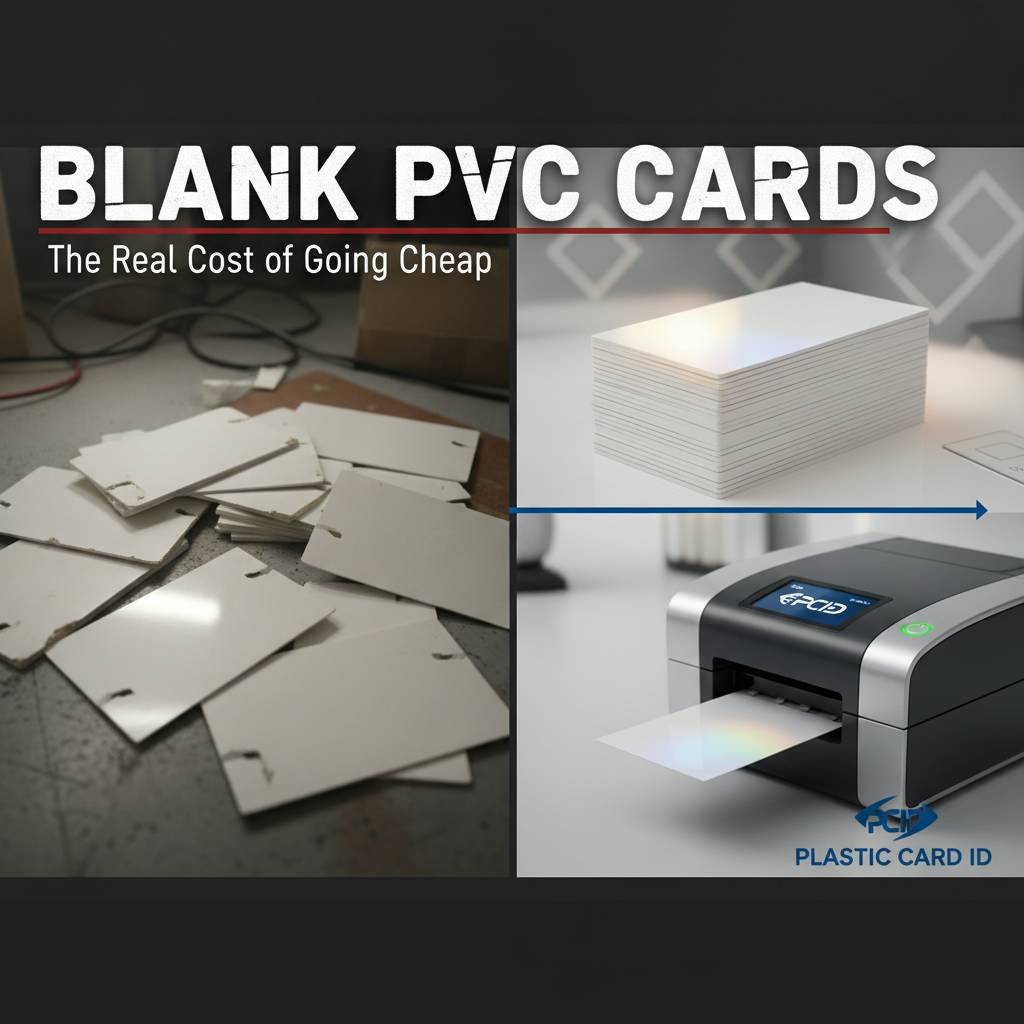 Let's talk numbers. A card that costs half as much but causes your printer to jam twice a week is not cheaper. A card with a surface coating that causes streaking means you're reprinting, wasting ribbon, and potentially reprinting an entire batch. The true cost of a blank card is not what you pay at checkout - it's what you spend running your card program over six months.
This matters especially for organizations printing in-house. Whether you're producing employee ID cards, loyalty cards for a retail program, or access credentials for a multi-location business, your printer and your cards form a system. Break one part of that system with off-spec cards, and the entire program suffers. CPE has seen this scenario play out countless times with buyers who came back after a frustrating experience with bargain-bin cards.
Hidden Fees That Make Cheap Cards Expensive
Low-cost cards often come with costs that aren't on the invoice. Ribbon waste from poor print adhesion. Cleaning kit consumption that doubles because card debris clogs print heads faster. Replacement cards for ones that crack, warp, or fail encoding. When you add those costs up across a 500-card run, the "cheap" option frequently costs more per successfully printed card than the quality option ever would.
Wasted ribbon alone can reverse your entire cost advantage. A single YMCKO ribbon from a top-tier brand might print 250 cards under ideal conditions. With sub-spec cards that cause excessive head contact or surface drag, you may get 180. That's a 28% loss in ribbon yield - on every roll, every print run, forever.
The Printer Damage Problem
Card printers from Evolis, Zebra, and Fargo are precision instruments. Their print heads, rollers, and transport mechanisms are calibrated for cards that meet CR80 ISO 7810 standards: 3.375 x 2.125 inches, 30 mil thickness, smooth surface finish. Feed a card that's 28 mil instead of 30, or has surface texture irregularities, and you create friction and alignment issues that add up to serious hardware damage over time.
Print head replacements are not cheap - they can run $150-$400 depending on the printer model. A single print head replacement can erase an entire year's savings from buying discounted cards. This is the conversation that nobody has when they're looking at a tempting low price per card online.
What Reprints and Staff Time Actually Cost
Staff time is real money. When a card program coordinator spends an extra 45 minutes per week dealing with jams, reprints, and failed encoding from poor-quality cards, that's roughly 39 hours a year. At even a modest hourly rate, that's a significant hidden labor cost attached directly to your card purchasing decision. The cards are not just a product - they are part of a workflow.
Every reprint also burns ribbon, which has a direct cost. Every jam requires cleaning. Every cleaning kit used unnecessarily represents a line item that never needed to exist. Quality blank cards are an investment in your operational efficiency, not just a consumable you grab from whatever supplier has the lowest list price this week.
CR80 Standards Explained: What the Numbers Actually Mean
When CPE talks about blank PVC cards, the terms CR80, 30 mil, and ISO 7810 come up constantly - and for good reason. These aren't marketing terms. They are dimensional and material specifications that define whether a card will work properly in standard card printers and readers. Understanding them is not optional for anyone running a serious card program.
CR80 is the standard card size: 3.375 x 2.125 inches. It's the same size as a credit card, a driver's license, a hotel key. It's the size that card printers are built around, that card holders and sleeves are designed for, and that your customers, employees, and members expect. Deviations from this standard - even small ones - cause real problems in card readers, printers, and cardholder products.
Thickness Matters More Than You Think
The 30 mil specification (0.030 inches) is not arbitrary. It's the thickness at which a PVC card is stiff enough to survive wallet use, flexible enough not to crack under normal handling, and dimensionally compatible with card printer transport mechanisms. Cards made slightly thinner to cut production costs will flex more than expected, feed inconsistently, and wear out faster in active use.
Some budget cards are sold at 20 mil or 25 mil as "standard." They are not standard. 30 mil is the industry standard, and anything less is a compromise that you will eventually pay for. Ask any supplier directly: what is the actual measured thickness of your blank PVC cards? A quality supplier will answer immediately and confidently.
Surface Finish and Print Adhesion
The printable surface of a blank card needs to accept dye-sublimation or thermal transfer printing cleanly and evenly. Quality cards have a surface coating that is engineered specifically for this purpose - tested for adhesion, uniformity, and compatibility with major ribbon manufacturers' formulations. Cheap cards may skip this coating or use inferior alternatives that cause fading, uneven color, or print that scratches off far too easily.
If you've ever printed a card and watched the image look dull, blotchy, or somehow less vibrant than the image file that produced it, the card's surface is frequently the culprit. A premium print surface unlocks the full capability of your card printer - it's not just about the printer itself.
Warping, Splitting, and Material Integrity
True PVC cards are constructed in layers - typically a multi-layer laminate that gives the card its final properties. Budget cards may use a single thinner layer or lower-grade PVC compound that warps in heat (cars, pockets, direct sunlight) or splits along edges with repeated use. For cards that will see daily handling - access cards, employee badges, loyalty cards - this is not an academic concern.
Material integrity also affects magnetic stripe encoding and chip embedding. A card that warps after encoding can cause read errors. A card whose material degrades can cause smart chip contact failures. These are not rare edge cases - they are predictable outcomes when material quality is sacrificed for price. Durability is a specification, not a bonus feature.
Magnetic Stripe Cards: HiCo vs. LoCo and Why It Matters
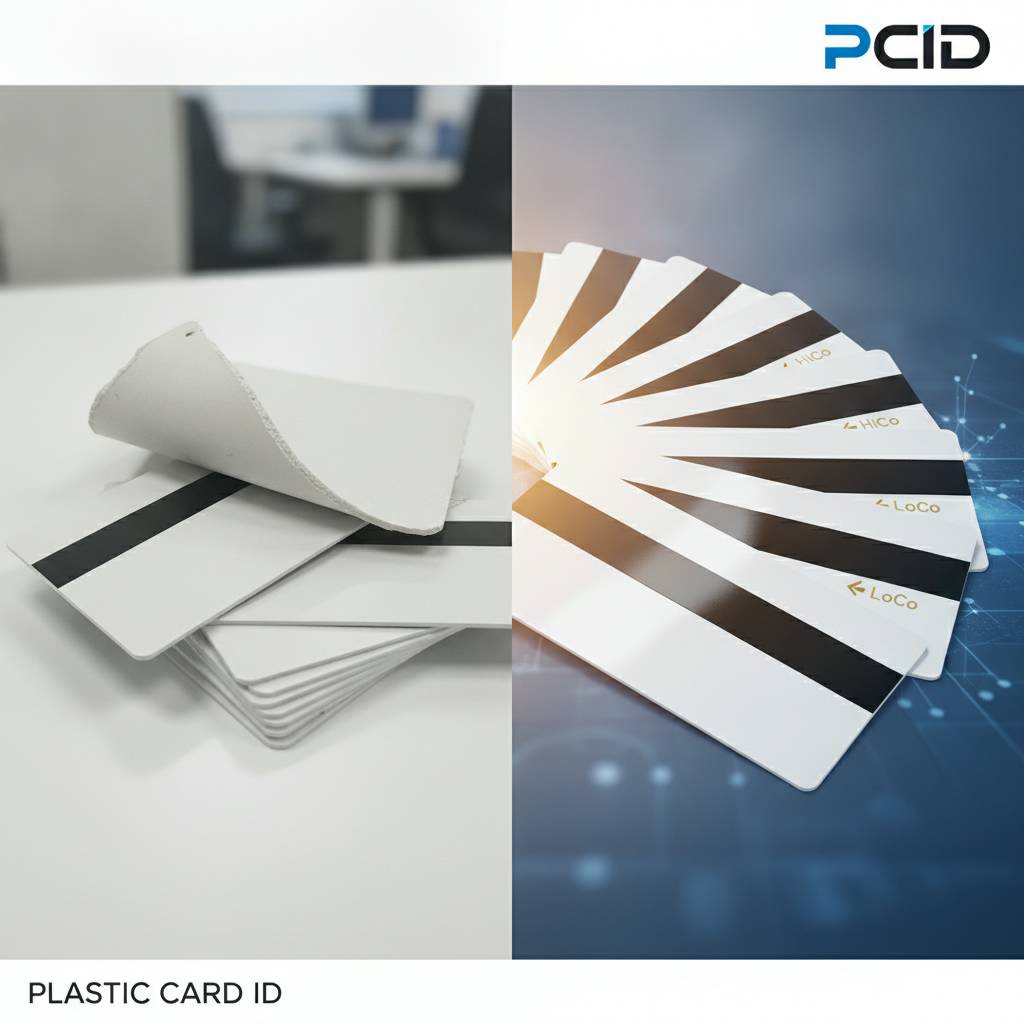 Blank magnetic stripe cards add a layer of complexity that many buyers underestimate. The stripe itself - that dark brown or black band on the back of the card - comes in two primary formats: High Coercivity (HiCo) and Low Coercivity (LoCo). Choosing the wrong one, or buying from a supplier who doesn't clearly specify which you're getting, creates a cascade of encoding and read reliability problems.
HiCo cards require a stronger magnetic field to encode and hold data more reliably against accidental erasure from proximity to other magnets. LoCo cards encode more easily but are more vulnerable to data loss over time and with casual exposure to magnetic fields. Hotel key cards typically use LoCo. Access control and loyalty cards where data permanence matters typically use HiCo. Knowing which format you need before you order is not optional - it's fundamental.
How to Verify Stripe Quality Before You Buy
A reputable supplier will specify the coercivity rating in oersteds: 2750 Oe for HiCo, 300 Oe for LoCo. If a listing simply says "magnetic stripe card" without specifying coercivity, that's a red flag. Cheap suppliers often mix stripe types within a batch, or use substandard stripe material that has inconsistent coercivity across the card's length - which causes intermittent read failures that are maddeningly difficult to diagnose.
Ask for specifications in writing. Ask whether their cards are tested against ISO/IEC 7811 standards for magnetic stripes. A supplier who can't answer these questions in specific technical terms is not a supplier you should trust with a card program that matters. CPE provides full technical specifications for every magnetic stripe card product in its lineup.
Encoding Compatibility With Your Printer
Your card printer's magnetic stripe encoding module is designed for a specific coercivity range. Using LoCo cards with a HiCo encoder, or vice versa, can produce cards that appear to encode correctly but fail at the point of use - in a door reader, a point-of-sale terminal, or a loyalty kiosk. This mismatch is one of the most common and costly mistakes in in-house card programs.
Verify your printer's encoding module specifications before ordering magnetic stripe cards. If you're not sure, contact CPE directly. Matching card specifications to printer capabilities is exactly the kind of guidance that separates a strategic partner from a box-shipper. Call 800.835.7919 to speak with someone who can walk you through compatibility before you commit to a card order.
RFID, Proximity, and Smart Chip Cards: Quality Is Non-Negotiable
When the card's function depends on embedded technology - an RFID antenna, a proximity chip, a contact smart card chip - the stakes around quality go up dramatically. A blank PVC card that prints badly is frustrating. A proximity access card that fails to read at the door of a secure facility is a security incident. These are different categories of failure, and they demand a different level of scrutiny when choosing a supplier.
Quality RFID and proximity cards have their antenna and chip precisely embedded within the card laminate during manufacturing, using processes that maintain consistent antenna geometry. Cheap cards with poorly embedded antennas have inconsistent read ranges - sometimes reading at 2 inches when your reader expects 4, or failing entirely when the card is held at a slight angle. Inconsistent read range is not a reader problem - it's a card problem.
MIFARE DESFire and Contactless Technology
For applications requiring encrypted contactless communication - casino player cards, advanced access control, transit credentials - MIFARE DESFire and similar advanced chip technologies require precise manufacturing tolerances. The cryptographic functions these chips perform depend on reliable power harvesting from the reader field, which depends entirely on antenna quality and embedding consistency. Cut corners on the card, and you compromise the security of the entire system.
Plastic Card ID supplies MIFARE DESFire and other advanced contactless card formats to organizations that require serious security and performance. These are not commodity products, and they are not priced like commodity products - nor should they be. When the card is a security credential, buying on price alone is a decision you may regret in very visible ways.
Proximity Cards for Access Control
Standard 125 kHz proximity cards are the workhorses of physical access control in office buildings, warehouses, schools, and campuses across the country. They look simple - but the quality of the embedded Wiegand coil and chip determines how reliably they read, how long they last, and how compatible they are with your access control hardware. Cheap proximity cards from unverified sources can have clone-quality chips that fail in weeks or fail to program correctly.
Always verify that proximity cards match your reader's frequency and protocol. Always buy from suppliers who can confirm technical specifications. Your access control system is only as reliable as the cards feeding it. A card that fails to read at 6 AM on a winter morning is not a minor inconvenience - it's a facilities management crisis.
Specialty Cards: Clear, Frosted, Die-Cut, and Metal Options
Beyond the standard white CR80, Plastic Card ID offers a range of specialty card formats that serve specific applications where standard cards won't create the right impression. Clear and frosted PVC cards, custom die-cut shapes, and luxury metal cards in stainless steel, brass, and gold are tools for organizations that understand the role a card plays in brand perception and customer experience.

Clear plastic cards are striking precisely because they're unexpected. When a loyalty card or membership card is crystal-clear, the design - printed in color - appears to float. That's a visual impact that a standard white card cannot replicate, and it's particularly effective for premium retail programs, high-end fitness clubs, VIP membership tiers, and any brand that wants its card to be kept rather than discarded.
Metal Cards: Luxury That Works
Luxury metal cards in stainless steel, brass, and gold occupy a different category entirely. These are statement pieces - membership cards and VIP credentials that communicate exclusivity before a single word is read. They have genuine weight and a tactile quality that plastic simply cannot match. Metal cards are kept, displayed, and talked about - which means they work as ongoing brand reinforcement in ways ordinary cards don't.
Casinos, private clubs, high-end hospitality brands, and premium loyalty programs use metal cards as part of a deliberate strategy to signal that membership has real value. If your program serves a segment that expects to be treated as premium, your card should reflect that expectation. CPE can help you evaluate whether a metal card program makes sense for your business model and customer base.
Custom Die-Cut Shapes
Standard card shapes are standard for good reason - they fit wallets, sleeves, and card holders. But for trade show credentials, event passes, promotional marketing cards, and novelty applications, a custom die-cut shape creates instant differentiation. A hotel's key card shaped like a door. A coffee brand's loyalty card shaped like a cup. These are memorable in a way that standard cards simply are not.
Die-cut cards succeed when the shape reinforces the brand rather than just being unusual for its own sake. Plastic Card ID works with clients to identify applications where custom shapes add genuine marketing value versus situations where a standard card with an exceptional design is the stronger choice. The goal is always a card program that performs - not just one that looks interesting.
Buyer Tips: How to Evaluate Any Blank Card Supplier
Whether you're buying from Plastic Card ID or evaluating other options, these questions will tell you quickly whether a supplier is worth your trust. A quality supplier answers all of these with specifics. A supplier who deflects, gives vague answers, or can't produce documentation is showing you exactly how much they actually know about what they're selling.
The card industry has no shortage of resellers who buy from low-cost overseas manufacturers without verifying specifications, then sell on price alone. They exist because many buyers don't know what to ask - yet. After reading this, you do. Use that knowledge to protect your card program.
Questions Every Buyer Should Ask
- What is the exact thickness of these cards in mil?
- Are these cards CR80 ISO 7810 compliant?
- What is the surface coating type and is it compatible with dye-sublimation printing?
- For magnetic stripe cards: what is the coercivity rating in oersteds?
- Are these cards tested against ISO/IEC standards for their respective features?
- What card printer brands and models are these cards tested with?
- What is your return or replacement policy for cards that cause printer jams or print defects?
- Can you provide a sample pack before a full order?
If a supplier hesitates on any of these, or offers answers like "they work with most printers" without specifics, treat that as a warning. Specificity is the hallmark of a supplier who actually knows their product. Vagueness is the hallmark of one who doesn't - or one who hopes you won't ask follow-up questions.
Volume, Pricing, and What to Expect
Blank CR80 PVC cards in quantity should range from roughly $15-$45 per 100 cards depending on volume, card type, and any encoded features like magnetic stripes or RFID. Mass production runs in the thousands drop per-card costs significantly. If a price seems dramatically lower than this range - say, $5 per 100 - ask hard questions about specifications before assuming you've found a deal.
Specialty cards command higher prices: magnetic stripe cards run $20-$65 per 100 depending on coercivity and quantity. Proximity cards range from $40-$120 per 100. Metal cards are priced individually for most programs. Knowing the realistic price range for what you need helps you identify anomalies - both the obvious overpricing and the suspicious underpricing that usually means something important has been left out.
The Partnership Model: More Than Just Buying Cards
The businesses that run the most successful card programs don't treat their card supplier as a commodity vendor. They treat them as a strategic partner - one who understands their printer fleet, their encoding needs, their program goals, and their growth trajectory. That's the model Plastic Card ID has built over 25 years and 100,000 customers. It's not an accident that clients come back again and again rather than chasing the next lowest price.
A good card program partner helps you avoid specification mistakes before they happen. They stock what you need so you're not waiting on lead times when a program deadline hits. They know when HiCo is right for your application and when it isn't. They can scale from a 50-card monthly order to tens of thousands without disrupting your program. That kind of operational reliability has real dollar value - value that cheap cards and fly-by-night suppliers will never deliver.
Partner With Plastic Card ID for Blank and Custom Plastic Cards You Can Trust
 Every card your organization issues is a physical representation of your brand, your program, and your commitment to the people who receive it. That card goes into a wallet, scans at a reader, prints at your facility, and lives in daily use. The quality of that card reflects directly on you. After 25 years and more than 50 million cards delivered, Plastic Card ID understands that better than anyone.
From standard blank CR80 white PVC cards to magnetic stripe, RFID, proximity, smart chip, clear, frosted, die-cut, and luxury metal cards - CPE has the card types, the technical expertise, and the scale to support card programs of any size, anywhere in the United States. Combine that with a full lineup of Evolis, Zebra, and Fargo card printers plus ribbons, cleaning kits, card sleeves, carriers, and card affixing and mailing services, and you have a genuine one-stop partner for every dimension of your card program.
Don't let cheap cards undermine a program that deserves to succeed. Call 800.835.7919 today and let Plastic Card ID help you get it right from the first card to the millionth.
Previous Page