Difference Between PVC and ABS Plastic Cards Explained
Table of Contents []
- What Sets Plastic Card ID Apart When It Comes to Plastic Card Materials
- Understanding the Core Chemistry: PVC vs. ABS
- PVC Cards: The Workhorse of Every Serious Card Program
- Real-World Applications: Where Material Choice Makes a Measurable Difference
- Choosing Your Card Printer: Matching Equipment to Material
- Buyer Tips: Making the Right Material Decision for Your Program
- Plastic Card ID: Your Strategic Partner in Plastic Cards Across the USA
What Sets Plastic Card ID Apart When It Comes to Plastic Card Materials
Ask ten businesses what kind of plastic card they need, and nine of them will say "just a regular plastic card" - not realizing that the material itself shapes everything from print quality and durability to how the card performs in a reader. At Plastic Card ID, we've spent over 25 years helping clients navigate exactly these decisions, and the question we hear more than almost any other is: what is the real difference between PVC and ABS plastic cards? It's a surprisingly loaded question with genuinely practical answers.
The material your card is made from determines how long it lasts, how well it accepts printing, whether it can carry a magnetic stripe, and how it holds up in wallets, card readers, and environments with heat or cold. Choosing the wrong substrate is one of the most common and costly mistakes organizations make when launching a card program - and it's almost entirely avoidable with the right guidance upfront.
CPE has served over 100,000 customers across the United States and sold more than 50 million cards. That kind of experience generates real insight into which material works best for which use case - and we're putting it all here, plainly, so you can make the right call for your program before you order a single card.
| Feature | PVC Cards | ABS Cards |
|---|---|---|
| Full Name | Polyvinyl Chloride | Acrylonitrile Butadiene Styrene |
| Flexibility | Flexible, wallet-friendly | Rigid, less pliable |
| Print Quality | Excellent, vibrant color | Good, slightly less vivid |
| ISO Standard Compatibility | Yes (ISO 7810 CR80) | Varies by grade |
| Magnetic Stripe Support | Yes | Limited |
| Heat Resistance | Moderate | Higher |
| Common Uses | ID cards, loyalty, gift, access | Industrial tags, embedded tech |
| Cost | Generally lower | Generally higher |
Understanding the Core Chemistry: PVC vs. ABS
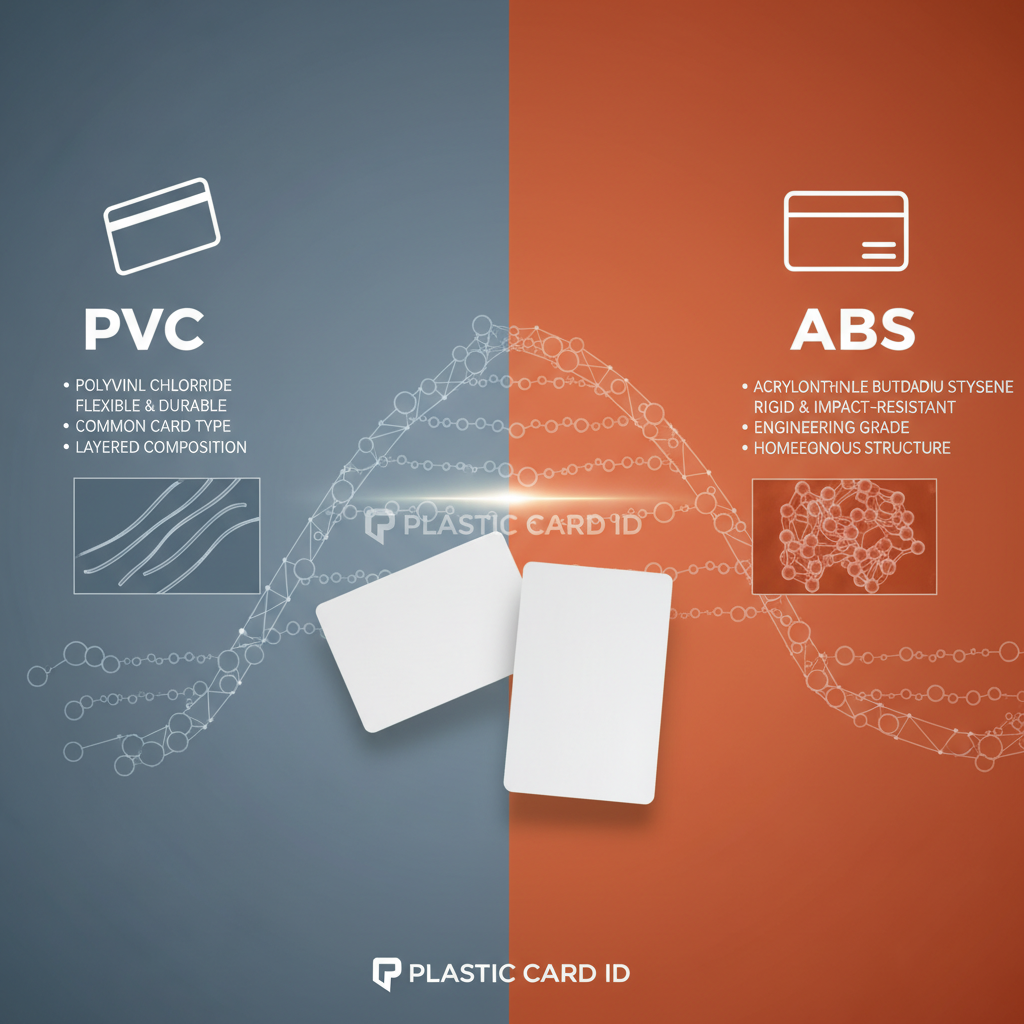 PVC - polyvinyl chloride - is the dominant material in the plastic card industry, and for good reason. It is flexible without being fragile, accepts dye-sublimation and direct-to-card printing exceptionally well, and bonds cleanly with magnetic stripes, smart chips, and RFID inlays. The material has been refined over decades specifically for card manufacturing, which means the tolerances are tight and the results are predictable. PVC is what almost every ID card, loyalty card, and membership card you've ever held is made from.
ABS - acrylonitrile butadiene styrene - is a different polymer entirely. It's harder and more rigid, which makes it excellent in industrial contexts and in applications where a card-shaped object needs to resist mechanical stress or higher temperatures. However, ABS is not the industry-standard material for card printing programs. It doesn't accept print ribbons the same way, it doesn't meet ISO 7810 CR80 standards as readily, and it behaves differently in card readers and printers. For most business card programs, ABS introduces complications without compensating benefits.
The Physical Properties That Actually Matter
When we talk about physical properties, we're talking about things like tensile strength, flex resistance, surface smoothness, and dimensional stability. PVC cards at 30 mil thickness (the standard CR80 size) are engineered to flex without cracking, maintain their shape in a wallet over years of daily use, and hold surface print without fading or peeling under normal conditions. These aren't accidental qualities - they're the result of a highly refined manufacturing process.
ABS cards are measurably harder and less flexible. In a straight pull test, an ABS card resists deformation better than PVC. But in a wallet, that rigidity becomes a liability - it cracks under repeated bending rather than flexing with use. For access control cards that live in a badge holder and are never bent, this may be acceptable. For loyalty cards, gift cards, or IDs carried in pockets and wallets, PVC's flexibility is a genuine functional advantage.
Print Receptivity and Surface Finish
Here's where the gap becomes most visible in real-world programs. PVC's surface chemistry is well-matched to the dye-sublimation and direct-to-card printing processes used by Evolis, Zebra, and Fargo printers. Ink bonds at the molecular level with a PVC surface, producing vivid, sharp images with accurate color reproduction. The result is a card that looks professional and retains that appearance through years of use - which is exactly what a brand needs from a physical card.
ABS surfaces, while printable, don't achieve the same vibrancy or bonding quality with standard card printing ribbons. Organizations sometimes report slightly duller colors, less precise edge definition, and faster visual wear on ABS-printed cards compared to equivalent PVC prints. If your card program includes branding, photography, or complex color graphics - and most do - PVC simply delivers better results with the standard card printing equipment most organizations already own or are considering purchasing.
Heat Tolerance and When ABS Has a Real Advantage
This is the honest case for ABS: it handles heat better. PVC cards can warp or deform if left in a hot car or exposed to sustained high temperatures. ABS, with its higher glass transition temperature, maintains its shape in environments that would stress PVC. If you're operating in a setting where cards are routinely exposed to heat - certain industrial environments, outdoor summer events in direct sun - ABS or composite materials may hold up better.
However, for the vast majority of business card programs - retail loyalty cards, employee ID badges, membership cards, hotel key cards, event credentials - heat exposure is not a material operational concern. The cards live in wallets, badge holders, and cardholders, not in ovens. Choosing ABS for heat resistance when heat isn't actually a factor in your use case means paying more and getting less in exchange for a benefit that never applies.
PVC Cards: The Workhorse of Every Serious Card Program
Blank CR80 PVC cards at 30 mil thickness are the foundation of in-house card printing programs across virtually every industry sector. The CR80 format - 3.375 inches by 2.125 inches - matches the ISO 7810 standard, which means these cards fit every standard card reader, badge holder, wallet slot, and card printer on the market. Start with a blank PVC card and you have a canvas that can become anything: an employee badge, a loyalty card, an access credential, an event wristband replacement, or a membership card - depending entirely on what you print or encode onto it.
The economics are equally compelling. Blank PVC cards purchased in volume represent one of the lowest per-card costs available for any card format. Organizations running their own card printing operation gain full design control, the ability to issue cards on demand, and meaningful cost savings over outsourcing every print run. CPE helps clients calculate the total cost of ownership - cards plus printer plus ribbons plus maintenance - so they can see exactly where in-house printing becomes the more cost-effective model versus ordering pre-printed cards in bulk.
Magnetic Stripe Cards: HiCo and LoCo on PVC
Magnetic stripe technology is a perfect example of PVC's versatility. Both High Coercivity (HiCo) and Low Coercivity (LoCo) magnetic stripes adhere cleanly and reliably to PVC card stock. HiCo stripes - with a coercivity of 2750 Oe - hold their encoded data under exposure to magnets and general environmental wear, making them the right choice for long-use cards like employee IDs, loyalty cards, and access control cards. LoCo stripes, at 300 Oe, are better suited to short-term applications like event access passes or hotel key cards that are frequently re-encoded.
Magnetic stripe reliability is directly tied to the substrate quality beneath the stripe. PVC's dimensional stability - its resistance to warping, expanding, or contracting - keeps the stripe in consistent contact with card readers over the card's useful life. This matters more than most people realize; a card that has warped even slightly will misread with frustrating regularity, and warping is more common on lower-quality or non-standard substrates including some ABS formulations.
RFID, Smart Chip, and Contactless Technology on PVC
The same qualities that make PVC ideal for magnetic stripe cards make it the preferred substrate for RFID and smart chip applications. Proximity access cards, contactless smart cards using MIFARE DESFire technology, and hotel key cards all rely on precisely laminated antenna structures embedded within - or adhered to - a card body. PVC's layering characteristics allow for clean, consistent lamination that protects the antenna and chip from physical stress and environmental exposure.
Casino player cards, loyalty programs with contactless tap-to-earn functionality, and corporate access control systems - these are all PVC-based in the overwhelming majority of real-world deployments. ABS simply doesn't offer the same lamination compatibility or the same antenna protection characteristics that these advanced card types require. When your card needs to do more than just look good, PVC's engineering versatility is what makes it possible.
Specialty PVC Options: Clear, Frosted, and Custom Die-Cut
Standard white PVC card stock is only the beginning of what's available. Clear plastic cards - fully transparent PVC - create a striking visual effect that sets a brand apart immediately. Frosted PVC cards offer a softer, premium look that works particularly well for high-end membership programs and VIP cards. Colored core PVC stock eliminates the white edge that appears on standard cards when they're cut, producing a more polished finished product for programs where appearance is a priority.
Custom die-cut shapes - cards in non-standard forms like rounded squares, house shapes, or branded silhouettes - are also produced on PVC stock. The material's workability allows for precision cutting without cracking or delaminating at the edges, a quality that ABS, with its greater rigidity, does not match. For luxury programs, metal cards in stainless steel, brass, and gold are available - but that's a separate category entirely from the polymer card discussion. The point is: PVC's versatility is genuinely unmatched across the full range of card types.
Real-World Applications: Where Material Choice Makes a Measurable Difference
 The difference between PVC and ABS isn't just a technical footnote - it has real consequences for program performance. Retailers who upgrade from paper-based gift card programs to plastic gift cards on proper PVC stock see sales increases of 35-50% on average. That's not a marketing claim; it reflects the fact that physical plastic cards are kept, used, and reloaded at dramatically higher rates than paper alternatives. A card that lives in a wallet is a card that drives repeat business.
Loyalty programs tell a similar story. Plastic loyalty cards that fit in a wallet outperform paper punch cards on every measurable metric: redemption rate, per-visit spend, and customer retention. Membership cards and employee ID cards printed on quality PVC signal organizational legitimacy in a way that laminated paper or thin ABS cards simply cannot replicate. The material your card is made from communicates something about your brand before anyone reads a single word on its surface.
Employee ID and Access Control Programs
For employee identification and access control, PVC cards strike the right balance between durability, printability, and reader compatibility. A PVC ID badge printed in-house with an Evolis, Zebra, or Fargo printer can carry a full-color photo, encoded magnetic stripe, and visual security elements - all on a single card that costs a fraction of outsourced alternatives. Organizations issuing as few as 50 cards per month can justify an in-house printer on cost alone within the first year.
Access control systems using proximity or RFID technology demand substrate precision. PVC's consistency across a production batch ensures that every card in a set of 500 behaves identically in the reader - no misreads, no range variations, no unexpected failures. That consistency is harder to guarantee with ABS, which exhibits more variability in formulation between manufacturers.
Loyalty and Membership Card Programs
A loyalty card program is only as good as the card that carries it. Programs using properly manufactured PVC loyalty cards report that customers are more likely to carry the card, more likely to use it, and more likely to associate the brand positively with the program. This isn't a soft benefit - it translates directly into transaction frequency and average ticket size. The right card material is genuinely part of your loyalty program's ROI calculation.
Membership organizations - gyms, clubs, professional associations, libraries - benefit similarly from PVC card stock's durability and printability. A membership card that holds its appearance over a 12-month membership cycle projects organizational quality. A card that fades, warps, or cracks within six months sends exactly the opposite message. PVC, properly printed and handled, maintains its appearance for years under normal use conditions.
Gift Cards and Event Credential Programs
Gift cards are one of the highest-ROI card program categories available to retail businesses. PVC gift cards on CR80 stock are compatible with virtually every gift card processing platform and point-of-sale reader. They display brand graphics with exceptional clarity, they survive the gift-giving process intact, and they fit naturally in card display racks and greeting card envelopes. The move from paper gift certificates to plastic gift cards is one of the most straightforward upgrades a retailer can make.
Event credential cards - VIP passes, media credentials, exhibitor badges, speaker identification - benefit from the same PVC qualities: crisp printing, badge holder compatibility, and durability through a multi-day event. For events issuing hundreds or thousands of cards, in-house printing on blank PVC stock using a desktop card printer is dramatically faster and more cost-effective than outsourced production, and it allows last-minute additions and changes that pre-printed runs cannot accommodate.
Choosing Your Card Printer: Matching Equipment to Material
The card printer you select should be matched to the card stock you intend to run through it. All major desktop card printers - including the Evolis Primacy, Zebra ZC300, and Fargo HDP5000 - are designed and calibrated for standard CR80 PVC card stock at 30 mil thickness. Using non-standard substrates, including some ABS cards, can cause feed errors, printing misregistration, and in some cases printer damage that voids manufacturer warranties. Protecting your printer investment starts with using the right card stock.
CPE carries a full lineup of printers across the Evolis, Zebra, and Fargo brands, along with the complete consumables ecosystem: printer ribbons, cleaning kits, and maintenance supplies. We help clients select the right printer for their volume, card type, and encoding requirements - and we stand behind those recommendations with ongoing support. Reach us at 800.835.7919 to discuss which printer and card stock combination fits your program's needs.
Single-Sided vs. Dual-Sided Printing on PVC
Most entry-level card printers print one side of a PVC card per pass. Dual-sided printing - printing both sides in a single automated operation - requires a printer with a built-in flipper unit, which is available on mid-range and professional-tier models. For ID card programs where the reverse side carries legal text, emergency contact information, or a magnetic stripe encoding summary, dual-sided printing capability is worth the investment.
The good news is that PVC accepts dual-sided printing identically to single-sided - there's no substrate difference or additional preparation required. The card feeds, flips, and receives print on the second side in the same pass without any manual intervention. This operational simplicity is part of what makes PVC the dominant card substrate for organizations running their own card programs.
Printer Ribbons, Cleaning Kits, and Consumables
A card printer running on proper PVC stock, with the correct ribbon for that printer model, is an exceptionally reliable piece of equipment. Ribbon selection - YMCKO for full color, KO for monochrome, resin for overprinting on encoded stripes - is matched to the PVC surface's print receptivity characteristics. Using off-brand or mismatched ribbons on any substrate increases the risk of poor print quality, head clogs, and premature ribbon failure.
Regular cleaning with manufacturer-specified cleaning cards and kits extends printer life significantly - often doubling the operational lifespan of the print head, which is the most expensive component in any desktop card printer. CPE stocks cleaning kits for all major printer brands alongside the card stock and ribbons, so clients can manage their entire card program supply chain from a single source.
Buyer Tips: Making the Right Material Decision for Your Program
After 25 years and more than 50 million cards, we've seen the full range of card program decisions - good and bad. The organizations that run the most successful programs share a common trait: they choose materials based on actual operational requirements rather than assumptions. Here's a practical guide to making the right call.
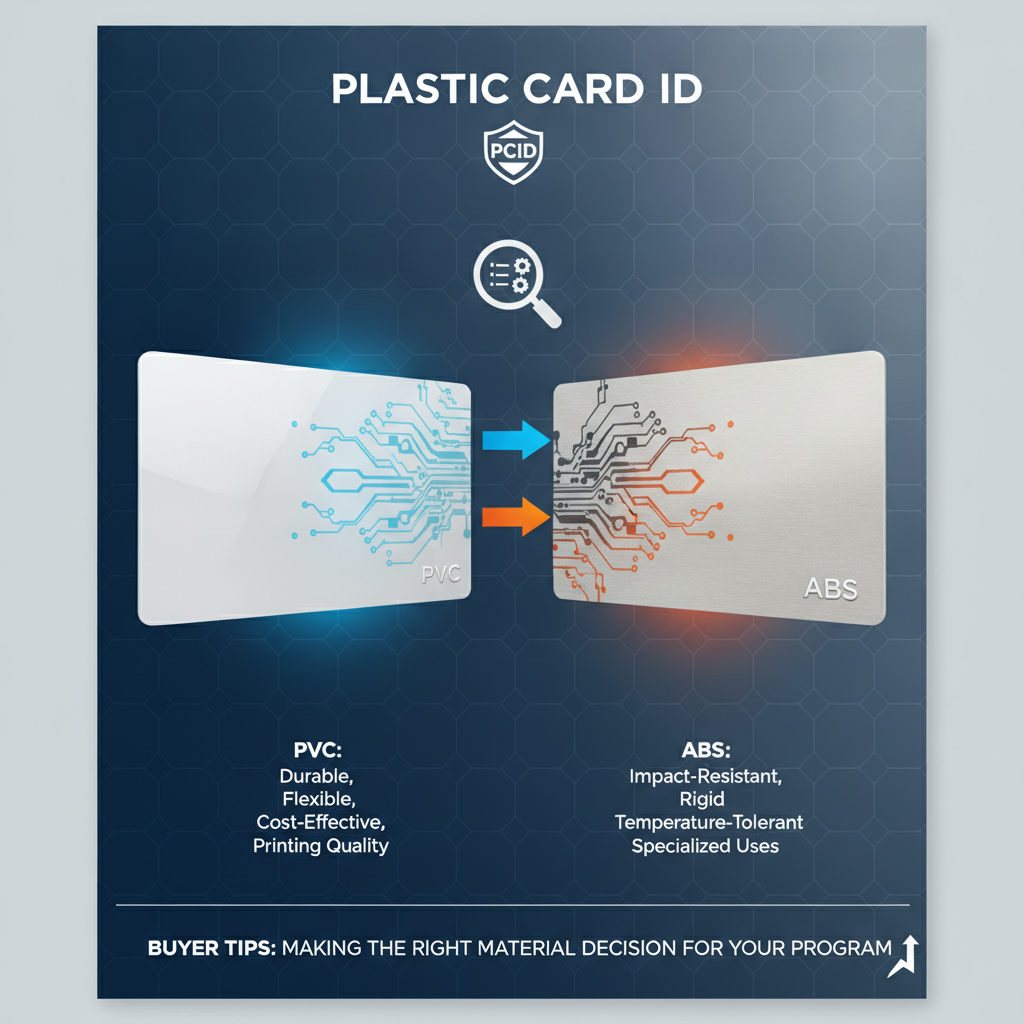
Most businesses asking about the difference between PVC and ABS end up confirming that PVC is the right choice for their needs. But the question itself reveals something useful: a buyer who is thinking carefully about material quality is a buyer who is going to run a better card program. That kind of due diligence, applied early, prevents the costly mid-program realizations that come from starting with the wrong substrate.
Questions to Ask Before You Order
- Will the card be carried in a wallet or badge holder? (Wallet use favors PVC's flexibility.)
- Does the card need a magnetic stripe, RFID chip, or smart chip? (PVC is the standard substrate for all three.)
- Will the card be printed in-house on a desktop card printer? (Desktop printers are designed for PVC CR80 stock.)
- Is heat exposure a genuine operational factor - not just a theoretical concern? (If not, ABS's heat resistance provides no real benefit.)
- How important is print quality and color vibrancy to your brand? (PVC delivers superior print results on standard printing equipment.)
- What is your monthly card volume? (Volume affects cost-per-card calculations and printer ROI timelines.)
- Do you need specialty formats like clear, frosted, colored core, or custom shapes? (All of these are available in PVC.)
Understanding Costs Across Card Types
Blank PVC CR80 cards represent the lowest entry cost in the plastic card category. As you add features - magnetic stripes, RFID inlays, smart chips, specialty finishes - unit costs increase, but so does the functional value each card delivers. Understanding that relationship prevents the common mistake of choosing a bare-bones card to save on unit cost when the program actually requires encoding or specialty features to function.
ABS cards, where available in card-grade formats, generally cost more than comparable PVC cards without delivering proportional benefits for standard card program use cases. Over a program's lifetime - often millions of cards for large organizations - that cost differential compounds significantly. Choosing the right material from the start is one of the clearest paths to long-term program cost efficiency.
Card Carriers, Sleeves, and Mailing Services
Once you've selected the right card stock and printed your cards, getting them into the right hands is the next operational challenge. CPE offers card carriers, protective sleeves, and card affixing and mailing services that complete the full card delivery cycle. A professionally presented card - arriving in a carrier with branded messaging - makes a stronger first impression than a card mailed loose in an envelope.
For membership programs, loyalty card rollouts, and new employee onboarding at scale, mailing services represent a genuine operational time savings. The alternative - printing, sorting, sleeving, and mailing cards in-house - is an underestimated labor cost that disappears when you work with a partner who handles it as a core service. True one-stop capability means you don't have to manage multiple vendors for a single card program outcome.
Plastic Card ID: Your Strategic Partner in Plastic Cards Across the USA
The difference between PVC and ABS plastic cards is, ultimately, the difference between a material engineered for card programs and a material engineered for something else. PVC has been refined over decades specifically because it works - it prints beautifully, encodes reliably, fits every standard reader and printer, and holds up under the daily demands of real-world use. For the overwhelming majority of business card programs, PVC isn't just the right choice; it's the obvious one.
Plastic Card ID is here to help you make every decision in your card program with the same clarity - from material selection and card type to printer choice, consumables, and fulfillment. Over 100,000 customers across the United States have trusted us with programs ranging from 50 cards a month to mass production in the tens of thousands. We know this business, we know the materials, and we know how to help you get the most out of every card you issue.
Ready to start your card program or upgrade what you're already running? Contact Plastic Card ID today at 800.835.7919 and speak with a card program specialist who will help you choose the right cards, the right printer, and the right services for exactly what your organization needs.
Previous Page