Blank Smart Chip Cards Overview: Types and Key Uses
Table of Contents []
- Blank Smart Chip Cards: What Every Business Needs to Know - Plastic Card ID
- RFID and Proximity Cards: The Foundation of Access Control Programs
- MIFARE DESFire and Advanced Smart Card Options
- Blank Smart Chip Cards vs. Magnetic Stripe: Knowing When Each Makes Sense
- Common Applications for Blank Smart Chip Cards Across Industries
- Card Printers, Ribbons, and the Complete Smart Card Program Ecosystem
- Frequently Asked Questions About Blank Smart Chip Cards
- Start Your Smart Card Program with Plastic Card ID Today
Blank Smart Chip Cards: What Every Business Needs to Know - Plastic Card ID
Walk into any modern organization running a serious card program and you will find something interesting: the cards doing the heaviest lifting are often the ones that look the simplest. Blank smart chip cards are quietly powering access control, loyalty systems, membership databases, and identity programs across every industry in the United States. They are unprinted, unencoded out of the box, and completely ready for your personalization workflow. That flexibility is exactly the point.
Whether you are building a brand-new card program from scratch or scaling an existing one, understanding what blank smart chip cards actually are, how they differ from standard PVC cards, and which type fits your application can save you significant time, money, and operational headache. This guide covers all of it, with practical insight drawn from decades of experience supplying card programs of every size.
What Makes a Card "Smart"?
The term "smart card" refers specifically to cards that contain an embedded integrated circuit, or chip. That chip can store and process data, communicate with card readers, and even perform cryptographic operations. Unlike a magnetic stripe, which simply holds static encoded data, a smart chip actively participates in the transaction or authentication event.
This distinction matters enormously in practice. A smart chip card can hold far more data than a magnetic stripe, and it can do so securely. For access control, that means more granular permission settings. For loyalty programs, it means richer customer data stored directly on the card. For membership applications, it means a card that can be updated in the field without being replaced.
Contact vs. Contactless: Two Distinct Technologies
Blank smart chip cards split into two major families. Contact smart cards require physical insertion into a reader, with metal contact pads on the card surface connecting directly to the reader's interface. These are common in secure ID programs and environments where physical verification is the standard protocol.
Contactless smart cards - including RFID and proximity cards - communicate wirelessly with a reader using radio frequency technology. Tap-to-authenticate workflows, hands-free access control, and high-throughput environments are where contactless cards genuinely shine. Hospitals, office buildings, hotels, and university campuses rely on contactless technology daily precisely because speed and convenience matter.
The Blank Advantage: Why Unprinted Cards Make Strategic Sense
Buying blank smart chip cards gives your organization full control over the personalization process. You decide what gets printed on the card surface, what gets encoded onto the chip, and when each card enters service. This is especially valuable for organizations with in-house card printing capabilities or those that batch-personalize cards on a regular schedule.
Per-card costs drop significantly when you buy blank stock in volume, and your card design can evolve without being locked into a pre-printed run. If your branding changes, your membership tiers shift, or your access permissions need restructuring, blank stock absorbs that flexibility far better than pre-printed inventory ever could.
| Card Type | Communication Method | Common Applications | Key Benefit |
|---|---|---|---|
| Contact Smart Card | Physical contact pads | Secure ID, healthcare, government | High security, tamper-resistant |
| RFID / Proximity Card | 125 kHz radio frequency | Access control, time and attendance | Reliable, widely compatible |
| MIFARE Classic | 13.56 MHz contactless | Loyalty, transit, campus ID | Established standard, broad support |
| MIFARE DESFire | 13.56 MHz contactless | Secure access, casino player cards, hotel keys | Advanced encryption, multi-application |
| Dual Interface | Both contact and contactless | Versatile enterprise programs | Maximum reader compatibility |
RFID and Proximity Cards: The Foundation of Access Control Programs
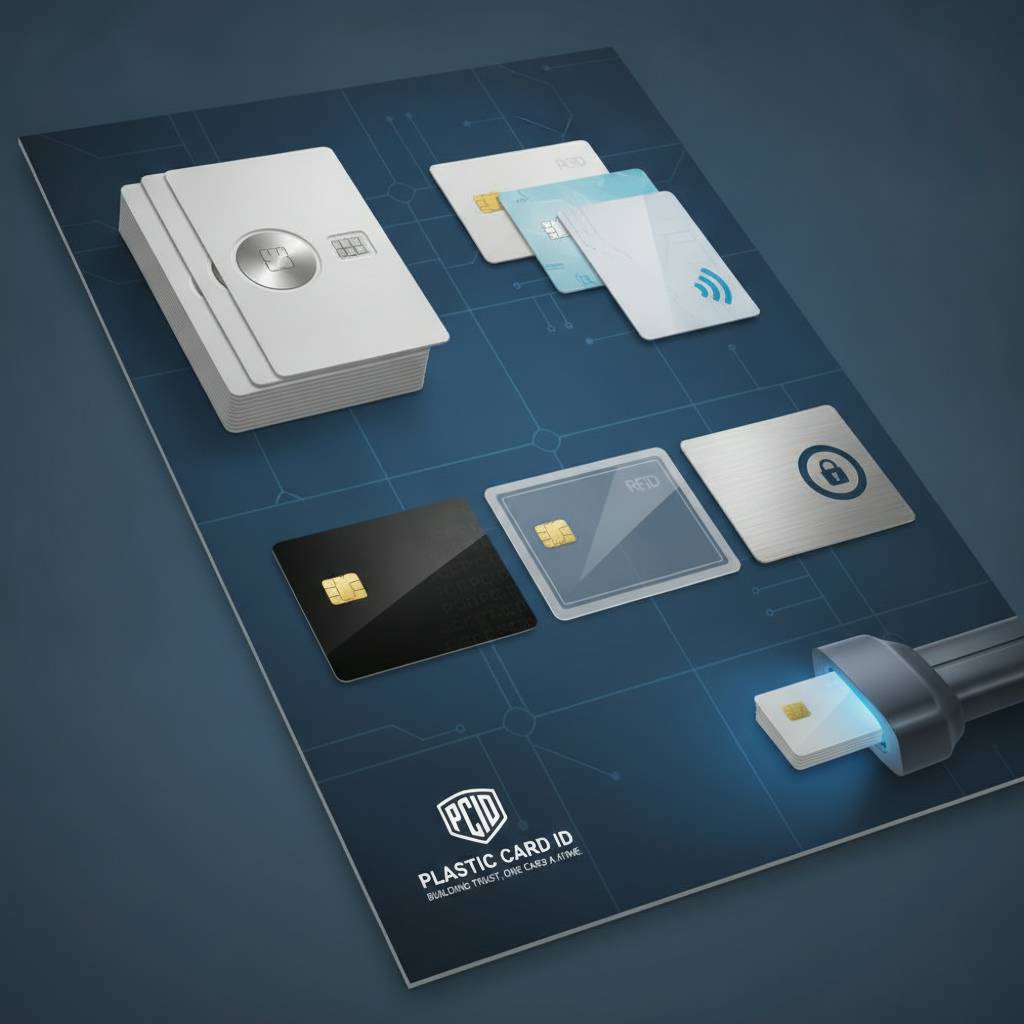 Proximity cards operating at 125 kHz have been the backbone of commercial access control for decades. They are robust, reader-compatible across a massive installed base of hardware, and extremely simple to program and manage. For organizations that need reliable, no-fuss card-based access, proximity cards remain one of the most cost-effective smart card solutions available in the market today.
RFID cards at 13.56 MHz offer higher data capacity and faster read speeds. This frequency range includes the widely adopted MIFARE family of chips, which you will find in everything from corporate office buildings to university dormitory systems. Selecting the right frequency tier for your application is one of the first decisions a card program manager should make, and CPE can help you navigate it.
How Proximity Cards Work in Practice
A proximity card contains an embedded antenna coil and a small chip. When the card moves within range of a compatible reader, the reader's electromagnetic field powers the card and triggers data transmission. The whole exchange happens in a fraction of a second, which is exactly what busy entrances, parking facilities, and turnstile-controlled areas require.
Because proximity cards operate passively, they require no battery. The card itself has no power source. That design choice contributes directly to the impressive lifespan of a well-maintained proximity card, which can remain in service for years of daily use without degradation in read performance.
Choosing Between HID-Compatible and Standard RFID Formats
One question that comes up consistently: do you need HID-compatible cards, or will standard 125 kHz proximity cards serve your system? The answer depends entirely on the brand of access control hardware already installed in your facility. HID is one of the most widely deployed access control standards in North America, and blank smart chip cards compatible with HID readers are a common request.
Standard EM4100 and similar 125 kHz formats work with a large number of access control systems that do not require HID-specific encoding. Always verify your reader specifications before ordering. Starting with a small test batch is a practical approach that can prevent expensive mismatches at scale.
Volume Ordering and Program Scalability
One of the genuine strengths of building a program around blank proximity or RFID cards is the scalability. Whether you are managing a 50-card employee badge program or running a 10,000-unit access credential rollout, blank card stock allows you to add new cardholders, replace lost cards, and expand to new locations without reordering a custom print run every time.
Contact CPE directly at 800.835.7919 to discuss volume pricing on RFID and proximity card stock. Programs of different sizes are handled with the same level of attention, from small businesses buying their first smart cards to large organizations managing enterprise-wide deployments.
MIFARE DESFire and Advanced Smart Card Options
MIFARE DESFire represents the high end of the contactless smart card spectrum. Built on AES encryption and offering a multi-application file structure, DESFire cards can serve simultaneously as an access credential, a loyalty card, a stored-value instrument, and an ID card - all on a single piece of plastic. For organizations that need serious security combined with genuine versatility, DESFire is frequently the right answer.
Casino player cards are one of the most demanding smart card applications in the United States, and DESFire technology is well-suited for it. Hotel key card programs, corporate campus multi-function credentials, and high-security government-adjacent applications also align strongly with DESFire capabilities. These are not entry-level cards, and their performance reflects that.
What DESFire Encryption Actually Means for Your Program
DES in DESFire stands for Data Encryption Standard - but the "fire" variants, particularly EV2 and EV3 generations, use AES-128 encryption, which is a substantially stronger standard. This level of cryptographic protection means that data on the card cannot be cloned or intercepted by casual skimming, a real-world vulnerability that affects lower-security contactless cards.
For programs where unauthorized card cloning would represent a meaningful security risk - casino gaming floors, data centers, pharmaceutical facilities, executive office suites - DESFire's encryption posture is not just a feature, it is a requirement. Understanding the threat model for your specific application is the starting point for choosing the right chip technology.
Multi-Application Architecture Explained
Standard MIFARE Classic cards store data in a simple sector structure. DESFire's architecture is different: it organizes data into discrete applications within a file system, each with its own encryption keys and access permissions. This means a single card can hold a door access application, a loyalty points application, and a cafeteria payment application, all without those applications interfering with each other.
That architectural flexibility is why enterprise card programs and hospitality operators find DESFire so compelling. One card, one cardholder, multiple business functions - and each function secured independently. The operational simplicity this creates for cardholders is matched by the administrative simplicity it creates for program managers.
Hotel Key Cards as a Smart Card Application
Hotel key cards are among the most visible smart card applications in everyday American life, yet most guests never think about the technology embedded in that small white card. Modern hotel key systems commonly run on RFID smart cards, with MIFARE being a prevalent standard. The card stores a room assignment and a validity period - nothing more complex is required for basic guestroom access.
However, increasingly sophisticated hotel programs are layering additional functions onto the guest card: fitness center access, parking garage credentials, spa reservation confirmation, and even point-of-sale identity for charging privileges. For hoteliers managing that complexity, blank smart chip cards ordered in volume provide the cost-effective foundation for a seamless guest experience from check-in through check-out.
Blank Smart Chip Cards vs. Magnetic Stripe: Knowing When Each Makes Sense
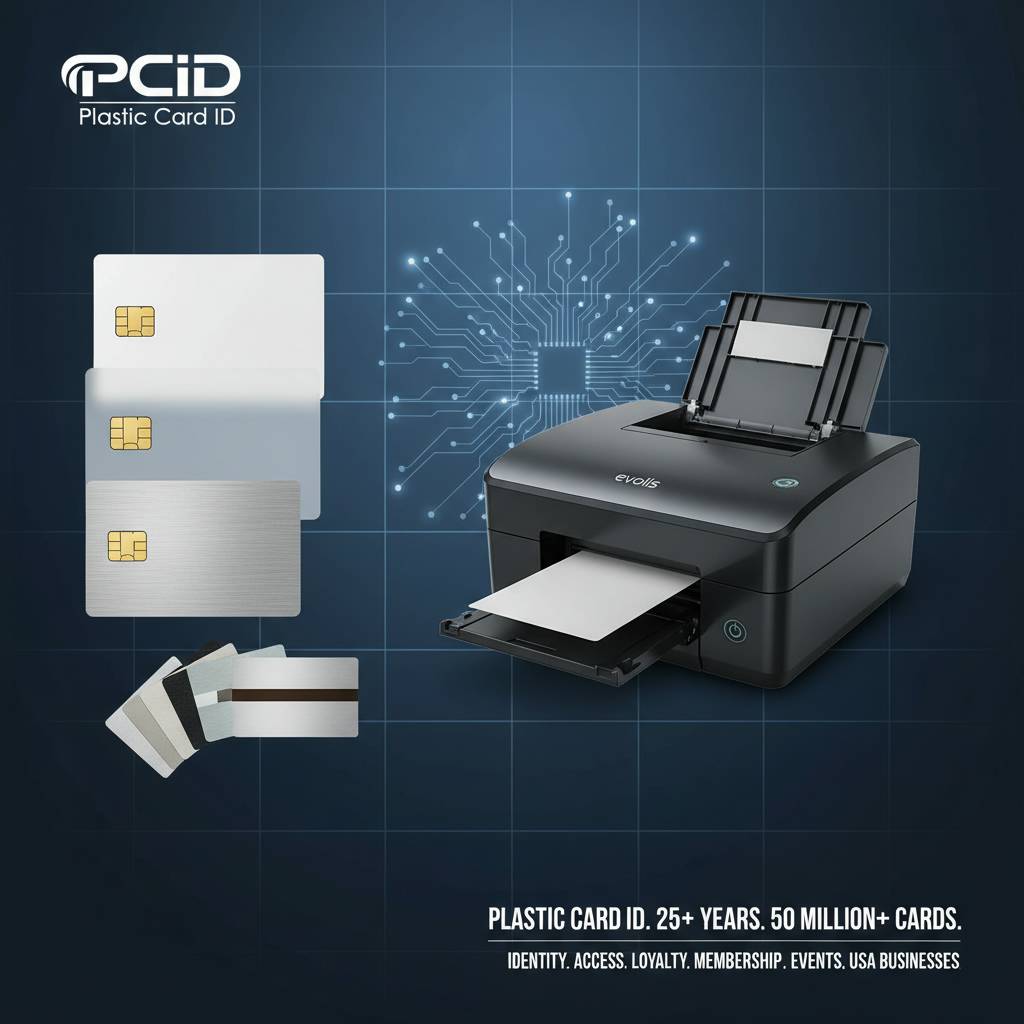 Magnetic stripe cards are not obsolete - they are simply best suited for specific applications. Loyalty programs with simple swipe-based point lookups, gift card programs tied to existing POS infrastructure, and access systems running legacy mag stripe readers all represent scenarios where a magnetic stripe card is still a reasonable solution. The key word is "legacy." New card programs built today generally benefit from smart chip technology unless budget constraints or existing hardware make magnetic stripe the practical choice.
The comparison is not purely about technology. It is about what your infrastructure supports, what your cardholders expect, and what your program needs to accomplish over the next three to five years. Buying blank magnetic stripe cards when your access control system already supports RFID means you are adding a layer of complexity (swipe readers, card orientation requirements) that contactless technology eliminates entirely.
When Magnetic Stripe Still Wins
Cost is a real factor. Magnetic stripe cards cost less per unit than smart chip cards. For very large programs that only need basic encoded data - a simple loyalty ID number, a gift card balance pointer, a membership number - high-coercivity (HiCo) or low-coercivity (LoCo) magnetic stripe cards remain a cost-effective, proven workhorse. HiCo cards resist magnetic field interference better and are the standard choice for cards that travel in wallets alongside other magnetic items.
LoCo cards work well in controlled environments where magnetic interference is not a concern - hotel keys, for instance, traditionally used LoCo encoding. The distinction matters when durability and read reliability are priorities for your card program's day-to-day performance.
Combining Technologies: Combo Cards
Nothing says a card must carry only one technology. Combo cards incorporate both a magnetic stripe and a smart chip on the same CR80 card. This is particularly valuable for organizations transitioning between infrastructure generations, or for programs that need backward compatibility with legacy mag stripe readers while also supporting newer smart card readers.
Combo cards can also include both contact chip pads and a contactless RFID antenna, creating a truly dual-interface card that works with virtually any reader in the market. If your organization spans multiple facilities with different reader generations, a combo card eliminates the need to carry multiple credentials or manage parallel card inventories.
Buyer Tips: Selecting the Right Card Technology
- Audit your existing readers first. Know the frequency and protocol your current hardware supports before ordering any smart card stock.
- Start with a small test batch - typically 100 to 500 cards - when introducing a new chip technology to your program.
- Consider your three-year roadmap. If facility expansion or access system upgrades are planned, invest in smart chip technology that will remain compatible.
- Verify encoding requirements with your access control or loyalty software vendor before finalizing card specifications.
- For large programs, explore volume pricing tiers - the per-card cost difference between 500 cards and 5,000 cards can be substantial.
- Never mix HiCo and LoCo magnetic stripe cards in the same program unless your readers are explicitly configured to handle both.
Common Applications for Blank Smart Chip Cards Across Industries
One of the things that makes blank smart chip cards genuinely interesting as a product category is the sheer range of industries and use cases they serve. The same CR80 form factor - 3.375 inches by 2.125 inches, 30 mil thick - that works as a hotel key card works equally well as a casino player card, a university ID, a corporate access badge, or a membership credential at a private club.
The blank card is a platform. What it becomes is entirely determined by how it is encoded and printed. That versatility is not accidental - the ISO 7810 standard exists precisely to ensure that cards from different manufacturers and programs are physically interchangeable in standard wallets, cardholders, and card printers.
Corporate and Enterprise Access Control
Large organizations with multiple facilities, contractor populations, and tiered access permission structures represent one of the highest-volume smart card use cases. An enterprise access program might manage thousands of active credentials at any given time, with regular additions, terminations, and permission modifications. Blank RFID and smart chip cards ordered as stock give facility managers the inventory flexibility to respond quickly to staffing changes without waiting on custom card orders.
Corporate cards frequently combine access control functionality with photo ID printing, making a full-color card printer an essential part of the program infrastructure. Card printers from Evolis, Zebra, and Fargo - all available through CPE - are designed to print directly onto smart card stock without damaging the embedded chip or antenna.
Loyalty and Membership Programs
Physical loyalty cards that live in a customer's wallet consistently outperform paper punch cards and even many digital alternatives in program engagement metrics. Retailers who have shifted from paper cards to plastic loyalty cards - including smart chip variants - report meaningful increases in repeat visit frequency and average transaction values. A loyalty card with a chip can store transaction history and tier status directly on the card, reducing dependency on real-time database lookups at the point of sale.
Membership organizations - gyms, private clubs, professional associations, alumni groups - also find smart chip cards appealing because the chip can be updated in the field. Membership renewal, for instance, can be handled at a kiosk or staffed desk by simply writing a new expiration date to the card's chip, eliminating the cost and friction of issuing a replacement card.
Casino Player Cards and Hospitality
Casino player cards occupy a specialized niche where security, durability, and data capacity all intersect. Player tracking programs generate enormous volumes of transaction data, and smart chip cards - particularly MIFARE DESFire - provide the secure, high-capacity platform these programs need. Casino environments are demanding: cards are handled repeatedly, exposed to a range of conditions, and represent real financial value in the form of accumulated points and rewards.
Hospitality applications extend well beyond casinos. Resorts, conference centers, and extended-stay hotels increasingly use smart chip cards to manage guest access across complex multi-building properties, connecting room keys to amenity access and loyalty recognition in a single credential that guests carry naturally throughout their stay. Call 800.835.7919 to discuss smart card solutions tailored for hospitality programs of any scale.
Card Printers, Ribbons, and the Complete Smart Card Program Ecosystem
Blank smart chip cards are the raw material of your card program. But the full ecosystem around those cards determines whether your program runs smoothly or struggles with operational friction. Card printers capable of printing on smart card stock are a non-negotiable requirement if you are personalizing cards in-house. Not every printer handles smart card stock reliably, and investing in the right hardware at program launch avoids expensive compatibility problems later.
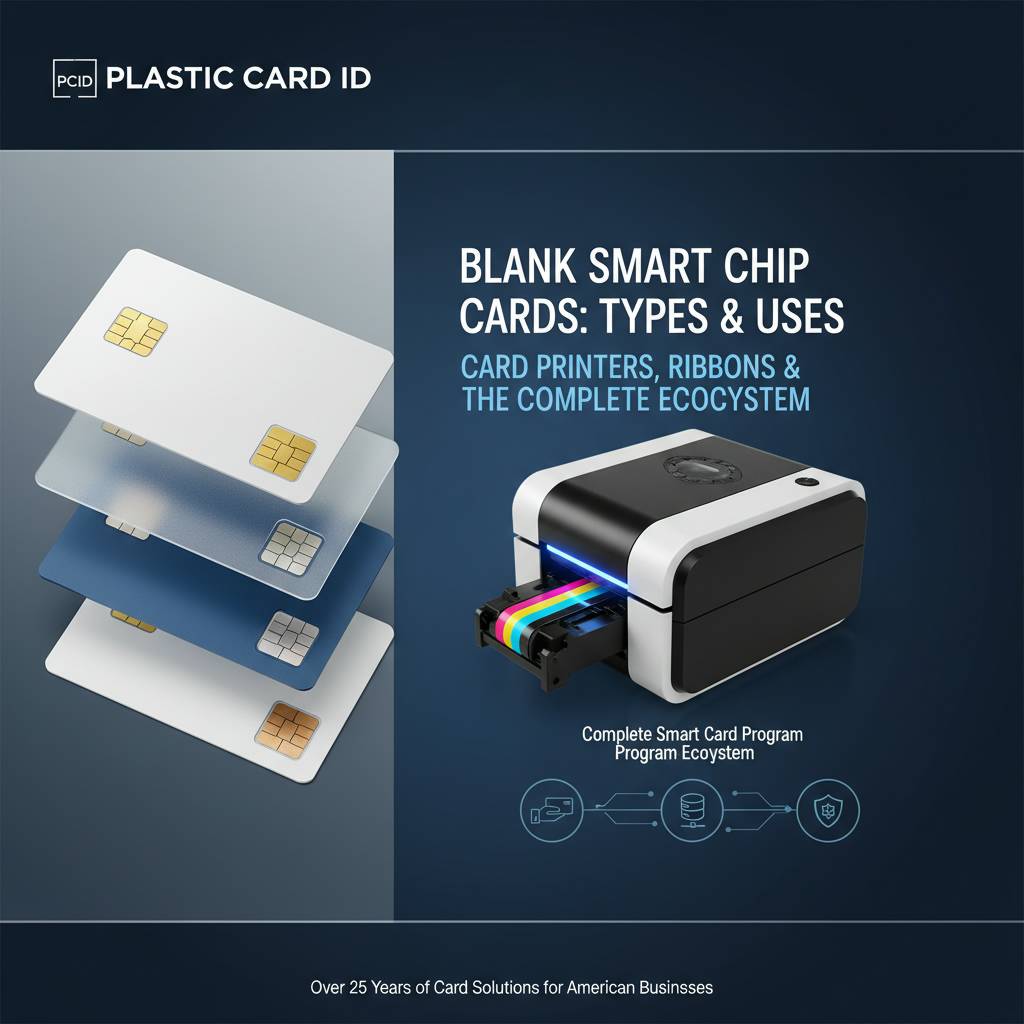
Evolis, Zebra, and Fargo offer card printers across a wide range of price and performance points, from desktop units suitable for small-batch personalization to high-volume production printers that can process thousands of cards per day. The right printer for your program depends on your daily card volume, your print quality requirements, and whether you need integrated chip encoding capability in the printing hardware itself.
Ribbons, Cleaning Kits, and Consumables
A card program without a reliable supply of printer ribbons is a card program waiting to fail at the worst possible moment. Ribbon inventory management is a genuine operational concern for programs running at scale, and sourcing ribbons from the same supplier as your cards simplifies procurement significantly. YMCKO and YMCKT ribbon types cover the majority of full-color card printing applications, with monochrome ribbons appropriate for text-only or single-color print runs.
Printer cleaning kits maintain print head performance and card transport reliability over the life of the printer. A cleaning routine performed on the recommended schedule prevents the gradual print quality degradation that results from debris accumulation inside the printer mechanism. Cleaning kits, card sleeves, card carriers, and other accessories complete the full card program supply chain available through CPE.
Card Affixing and Mailing Services
For organizations that need to distribute personalized smart chip cards by mail - new member welcome kits, annual renewal cards, credential replacement mailings - card affixing and mailing services transform a logistically complex process into a handled operation. Cards are affixed to personalized carriers and mailed directly to cardholders, removing the fulfillment burden from your internal team entirely.
This service is particularly valuable for membership organizations running annual renewal cycles, loyalty programs onboarding new members in volume, or any organization that regularly distributes cards to geographically dispersed recipients. Outsourcing fulfillment keeps your team focused on running your program rather than managing card packaging and postage logistics.
Frequently Asked Questions About Blank Smart Chip Cards
Program managers and procurement professionals new to smart card technology often share a common set of questions. The answers to those questions tend to accelerate the decision-making process and reduce the risk of ordering cards that do not match their actual application requirements. What follows addresses the questions that come up most consistently.
What Does "Blank" Actually Include?
A blank smart chip card arrives with the chip embedded and the antenna (for contactless cards) installed. What is not present: any printed graphics, any encoded data on the chip, and any personalization of any kind. The card surface is the same clean white PVC used in standard blank cards, ready for printing. The chip itself is in a factory default state, waiting for your encoding workflow to write the appropriate data to it.
It is worth clarifying that "blank" does not mean incomplete. The chip is fully functional. It simply contains no application-specific data until you or your encoding system programs it. This is exactly what most in-house card programs need: a card that can be enrolled in your specific system with the exact data your application requires.
How Are Smart Chip Cards Encoded?
Encoding a contactless smart chip card requires a compatible card reader/writer connected to encoding software, or a card printer with integrated smart card encoding capability. The encoding process writes data to the chip's memory sectors or application files, depending on the chip architecture. For contact smart cards, the encoding device interfaces through the gold contact pads on the card surface.
Most access control systems include the encoding hardware and software as part of their overall system package. Loyalty and membership platforms typically provide similar tools. If you are building a new program and are uncertain about encoding workflow, reaching out to CPE is a practical first step - the team can help match card specifications to your encoding environment.
What Quantities and Price Ranges Should I Expect?
Blank smart chip cards are available in quantities ranging from small startup orders to mass production volumes. Pricing varies based on chip type, quantity tier, and any additional features such as magnetic stripe combos or specialty finishes. As a general reference, entry-level RFID proximity cards start at modest per-card pricing that drops meaningfully at volume, while MIFARE DESFire cards with advanced encryption command higher per-card costs reflecting their sophisticated chip architecture.
Expect a range of approximately $0.50-$3.50 per card depending on technology tier and volume ordered, with DESFire and dual-interface cards at the higher end of that spectrum. Complete card program supply budgets - including printer hardware in the $500-$3,000 range for most desktop units, ribbons, and accessories - are best discussed directly to ensure you are building an accurate total cost picture. Call CPE at 800.835.7919 for a straightforward conversation about pricing for your specific program requirements.
Start Your Smart Card Program with Plastic Card ID Today
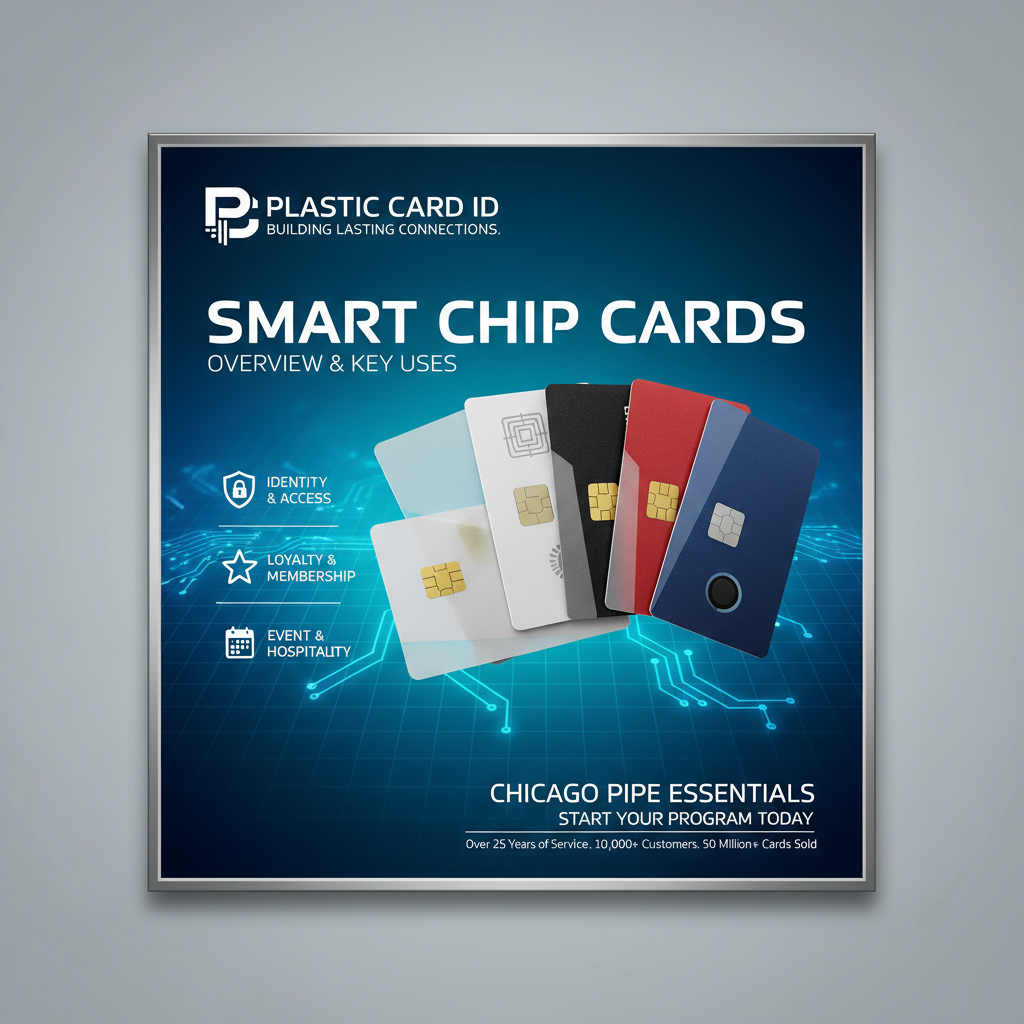 Twenty-five years and more than 50 million cards later, the core principle at CPE has not changed: blank smart chip cards are the starting point for card programs that work hard and last long. Whether you are launching a proximity access control system for a single facility, deploying MIFARE DESFire credentials across a casino operation, building a loyalty program that keeps customers coming back, or personalizing hotel key cards for a full property, the right card stock makes every downstream step cleaner and more reliable.
The catalog spans every smart card technology in active use across the United States - RFID, proximity, MIFARE Classic, MIFARE DESFire, contact smart cards, dual-interface combos - alongside the printers, ribbons, and accessories that complete a fully functional card program. Over 100,000 customers have trusted this supply chain. Yours can too.
Contact Plastic Card ID today at 800.835.7919 and speak directly with a card program specialist who can match you to the right blank smart chip cards, printer hardware, and accessories for exactly what your program needs. Do not build your card program on guesswork - build it on 25 years of expertise.
Previous Page