How Holographic Overlaminates Protect Plastic Cards
Table of Contents []
- How Holographic Overlaminates Protect Plastic Cards - Plastic Card ID
- Why Card Durability Is a Business Decision, Not Just a Technical One
- Choosing the Right Overlaminate for Your Card Printer
- Holographic Overlaminates and Anti-Counterfeiting Standards
- Practical Buyer Tips - Getting the Most From Holographic Overlaminates
- The Plastic Card ID Advantage - Cards, Printers, and the Supplies That Tie It All Together
How Holographic Overlaminates Protect Plastic Cards - Plastic Card ID
Walk into any serious card program and you will find one question surfacing faster than almost any other: how do you protect a card that has to survive real-world use? Wallets, back pockets, badge holders, point-of-sale terminals, card readers - cards endure a surprising amount of abuse before they are ever replaced. That is precisely where holographic overlaminates enter the conversation, and why understanding them can change the way you think about your entire card program.
Holographic overlaminates are thin laminate films applied over a printed plastic card's surface. They bond to the card substrate, creating a protective barrier that resists scratching, fading, peeling, and - critically - counterfeiting. The visual effect is unmistakable: a shifting, light-diffracting pattern that cannot be photocopied or replicated with standard printing equipment. For organizations issuing employee ID cards, membership credentials, loyalty cards, and access badges, that combination of physical durability and visual security is not a luxury. It is a baseline requirement.
What Holographic Overlaminates Actually Do
Think of a holographic overlaminate as a card's outer skin. Once heat-applied or pressure-bonded to the printed surface, it encapsulates the ink layer beneath. Scratches that would otherwise gouge printed artwork now hit the laminate first - and while the film may show minor wear over time, the underlying design stays intact and readable far longer than an unlaminated card ever would.
Beyond simple abrasion resistance, overlaminates protect against UV degradation. Cards exposed to sunlight - think parking passes, outdoor event credentials, or employee badges clipped to a lanyard near a window - can fade dramatically without a UV-blocking laminate. Holographic films often incorporate UV inhibitors that extend a card's functional lifespan by months or even years. That is real, measurable value for any organization running an ongoing card program.
The Security Dimension Most People Underestimate
Here is where holographic overlaminates earn their reputation in identity and access control. A standard printed card, however attractive, can be scanned, reprinted, and passed off as legitimate to an untrained observer. A card bearing a genuine holographic overlaminate cannot be duplicated with a desktop printer. The holographic pattern is manufactured at a level of precision that requires specialized equipment and materials - well beyond what a would-be fraudster can access through commercial channels.
For organizations issuing employee ID cards, casino player cards, or membership credentials, that tamper-evident quality is not just reassuring - it is operationally important. Staff at entry checkpoints can visually verify authenticity in under a second. No scanner required, no special training needed - just the unmistakable shimmer of a genuine holographic laminate. That speed and simplicity is why security-conscious card programs have used holographic overlaminates as a standard feature for decades.
Patch vs. Full-Surface Overlaminates
There are two primary formats to understand. A patch overlaminate covers only a specific area of the card - typically over a photo or a signature panel - while a full-surface overlaminate covers the entire card face from edge to edge. Each approach has its place. Patch laminates are often used when a card has a magnetic stripe or signature panel that must remain accessible, since laminate over those areas can cause functional problems.
Full-surface overlaminates provide the most comprehensive protection and the boldest visual security statement. If your card does not have components that require exposed surfaces, full-surface holographic lamination is the stronger choice. CPE can walk you through the right configuration based on your specific card construction and card printer model - because not all overlaminates are compatible with all printers, and getting the match right matters.
Why Card Durability Is a Business Decision, Not Just a Technical One
 Card programs cost money to run - not just in card stock and printing supplies, but in staff time, logistics, and the hidden cost of card replacement. Every time a card fails prematurely - fades beyond readability, cracks at the edges, or gets rejected by a card reader because the printed encoding has worn away - someone has to reprint it, re-encode it, and redistribute it. Multiply that across hundreds or thousands of cardholders and the numbers start to matter.
Holographic overlaminates directly reduce that replacement cycle. Cards protected with a quality laminate routinely outlast unprotected cards by a factor of two to three times in active use. For a loyalty program running 5,000 active cards, extending average card life from one year to two or three years represents real savings - savings that compound every cycle. That is the kind of return on investment that makes a decision easy to justify.
Loyalty Cards and the Wallet Test
Loyalty cards face a particularly punishing environment: jammed into overstuffed wallets alongside keys, coins, and other cards. The constant friction, pressure, and occasional moisture exposure degrades unprotected printed surfaces surprisingly quickly. A loyalty card with a holographic overlaminate survives that environment with its branding intact - which matters, because a damaged card reflects on the brand that issued it.
Retailers who have switched from paper-based loyalty systems to laminated plastic cards report dramatically higher program engagement. Cards that survive the wallet test stay in the wallet. A card that stays in a customer's wallet is a card that keeps working for you - as a redemption tool, a brand touchpoint, and a quiet reminder of your business every time your customer opens their wallet.
Employee ID and Access Badge Longevity
Employee ID cards endure a different kind of punishment. Badge reels, clip attachments, and constant handling create concentrated stress points. An unprotected card printed directly on PVC may look fine at first but will show corner wear, surface scratches, and fading within six to twelve months of daily use. A holographic overlaminate extends that functional life significantly - keeping photos recognizable, text readable, and magnetic or visual encoding intact.
For organizations where ID card integrity is tied to access control and security compliance, card degradation is not merely cosmetic. A worn badge that cannot be visually verified or electronically read creates workflow disruptions and potential security gaps. Investing in holographic overlaminates at the printing stage is far less expensive than managing the downstream consequences of card failure.
Event and Temporary Credential Applications
Event credentials present a different calculus. A multi-day conference badge does not need a five-year lifespan - but it does need to survive three days of consistent handling, exposure to outdoor weather, and presentation at multiple checkpoints without becoming unreadable or visually degraded. Holographic overlaminates provide exactly that level of short-term durability while adding the anti-duplication security that event organizers increasingly require.
Casino player cards and hotel key cards represent another category where the combination of durability and visual security is non-negotiable. Guest cards are handled constantly, inserted into readers repeatedly, and often exposed to temperatures and humidity that accelerate wear. A holographic overlaminate keeps these cards functional and visually credible for their intended lifespan - and signals to the cardholder that the issuing organization takes quality seriously.
| Card Type | Primary Threat | Overlaminate Benefit | Typical Lifespan Gain |
|---|---|---|---|
| Employee ID Badge | Daily handling, badge reels, friction | Surface protection, tamper evidence | 2-3x longer service life |
| Loyalty Card | Wallet compression, moisture, friction | Brand integrity, scratch resistance | 2x longer service life |
| Membership Card | Scanning, handling, UV exposure | UV blocking, visual security | 1.5-2x longer service life |
| Hotel Key Card | Reader insertion, humidity, heat | Encoding protection, durability | Full intended lifespan |
| Event Credential | Short-term intensive use | Anti-duplication, weather resistance | Full event duration |
Choosing the Right Overlaminate for Your Card Printer
This is where many card program managers make an avoidable mistake. Holographic overlaminates are not universal - they are manufactured to specific thicknesses and chemical compositions designed to work with particular card printer models and ribbon systems. Using the wrong overlaminate can result in poor adhesion, bubbling, incomplete coverage, or even printer damage. Compatibility is not optional - it is the foundation of a successful lamination setup.
Printers from Evolis, Zebra, and Fargo each handle overlaminates differently, with different heating elements, lamination roller pressures, and film feed mechanisms. Each manufacturer produces or certifies specific overlaminate products for their lamination-capable models. Working with a knowledgeable supplier who understands these compatibility requirements - rather than simply purchasing the lowest-cost film available - protects both your printer investment and your card output quality.
Evolis Printer Overlaminates
Evolis lamination-capable printers, including the Primacy 2 and Avansia lines, use retransfer and direct-to-card printing methods that pair with specific overlaminate thicknesses. The Evolis holographic overlaminate films are designed to bond cleanly with retransfer film output, producing sharp holographic patterns without distorting the underlying print. Proper Evolis overlaminate application results in a card that looks and feels genuinely premium - the kind of card a cardholder notices and respects.
For organizations running Evolis equipment, CPE stocks the appropriate overlaminate ribbons and films to keep production consistent. Getting the right supplies from the start prevents costly trial-and-error cycles and ensures every card that leaves your printer meets the same quality standard.
Zebra and Fargo Lamination Systems
Zebra's ZXP Series and ZC Series printers with lamination modules, along with Fargo's HDP series, are workhorses in mid-to-large card programs. Both brands offer holographic overlaminate options engineered for their specific lamination mechanisms. Fargo's HDP (High Definition Printing) retransfer process in particular produces exceptional holographic overlaminate results because the retransfer film itself provides an additional layer of card surface protection even before the overlaminate is applied.
Zebra lamination modules accept both patch and full-surface overlaminate formats, giving program managers flexibility based on card construction requirements. Call 800.835.7919 to speak with a specialist about which laminate format works best for your specific Zebra or Fargo model and the card types you are producing. The right recommendation can save hours of setup and testing time.
Overlaminate Thickness and Card Compliance
Standard CR80 cards measure 30 mil in thickness. Adding overlaminate layers - typically 0.5 to 1 mil per side - keeps finished cards within ISO 7810 compliance tolerances, which is important for cards that must pass through standard card readers, ATM-style slots, or access control terminals. Going too thick can cause reader jams. Going too thin may not provide adequate protection.
Most certified overlaminates from reputable manufacturers are engineered to maintain compliance when applied correctly. This is another reason why sourcing overlaminates through a knowledgeable supplier matters - you get products that have already been tested and verified rather than unknown third-party films that may create compliance headaches down the line.
Holographic Overlaminates and Anti-Counterfeiting Standards
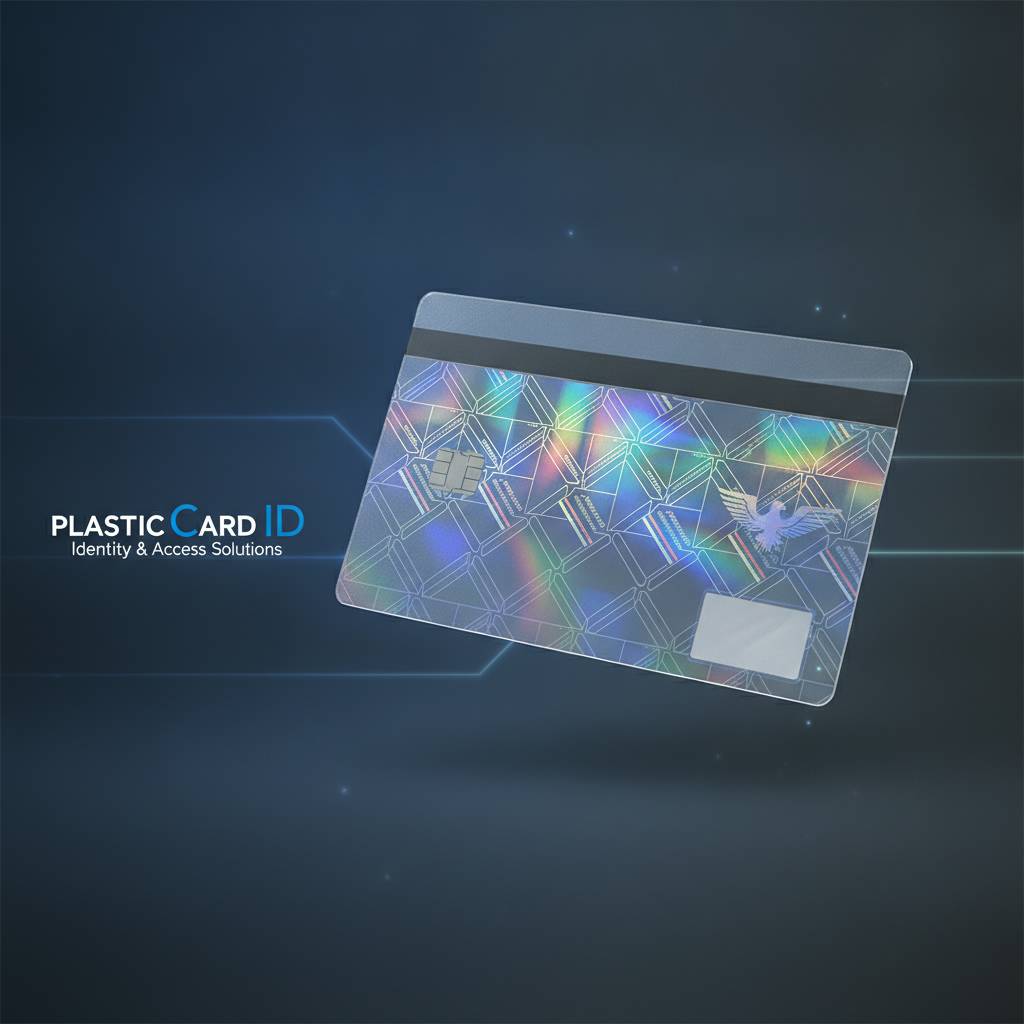 The anti-counterfeiting value of holographic overlaminates is not incidental - it is by design. Holographic film manufacturing involves precision mastering processes that create the diffractive patterns responsible for the characteristic color shift and visual depth. These patterns cannot be reproduced by scanning and reprinting, by photography, or by conventional commercial printing methods. That manufacturing complexity is the entire point - it creates a security feature that is easy to verify and nearly impossible to fake.
For organizations that issue cards carrying access privileges, financial value (such as gift card balances), or identity credentials, the anti-counterfeiting properties of holographic overlaminates are a meaningful security layer. They do not replace electronic security measures like RFID encoding or magnetic stripe encryption, but they provide a critical first line of defense that requires no equipment to verify - just a trained eye and a light source.
Custom Holographic Patterns for Enhanced Security
Standard holographic overlaminates use generic patterns - often referred to as "rainbow" or "dove" patterns - that are widely available and recognizable as holographic, but not unique to any specific issuer. Custom holographic patterns, by contrast, incorporate a specific design, logo, or text element into the holographic master, creating a pattern that is exclusive to a single organization. Counterfeiting a custom holographic overlaminate requires not just specialized equipment, but the specific master pattern - a barrier that defeats all but the most sophisticated threats.
Custom holographic overlaminates are typically available for larger volume orders and carry a higher per-card cost than standard patterns. For organizations where card fraud has real operational or financial consequences - government-adjacent ID programs, casino player cards, high-value loyalty cards - that incremental cost is a defensible investment. The question is never whether security is worth the cost - it is whether the risk of inadequate security costs more.
Visual Verification in Access Control Workflows
Access control systems that rely on electronic verification - RFID proximity cards, smart chip cards, magnetic stripe swipes - are robust but not infallible. Cards can be cloned, credentials can be spoofed, and electronic systems can fail. A holographic overlaminate provides a visual checkpoint that does not depend on any electronic infrastructure. A security officer at a checkpoint can verify card authenticity in a glance, without relying on a working reader terminal.
This layered approach - electronic encoding plus visual security features - is standard practice in high-security card programs for good reason. Each layer addresses a different attack vector, and together they create a significantly more resilient credential than either layer alone. Organizations designing serious card programs should treat holographic overlaminates not as an add-on but as a standard component of the security architecture.
Practical Buyer Tips - Getting the Most From Holographic Overlaminates
Choosing to add holographic overlaminates to your card program is the easy part. Getting the implementation right requires a bit more attention to detail. The following tips reflect what experienced card program managers have learned over years of in-house card production - and the kinds of guidance CPE provides as a matter of course to customers setting up or upgrading their programs.
- Always verify printer compatibility first. Confirm your printer model supports lamination before purchasing overlaminate supplies. Not all card printers have lamination modules, and not all lamination modules accept holographic films.
- Match overlaminate format to your card design. If your card has a magnetic stripe, signature panel, or other feature requiring an exposed surface, choose a patch overlaminate rather than full-surface. Covering these areas with laminate film will impair their function.
- Store overlaminate ribbons and films properly. Overlaminates are sensitive to heat and humidity. Store them in a cool, dry environment and in their original packaging until use to prevent pre-bonding or moisture contamination.
- Run a test batch before committing to full production. Even with certified compatible supplies, print a small batch to confirm adhesion quality, coverage uniformity, and visual output before scaling up.
- Order consistent brands across your supply chain. Mixing overlaminate brands or changing suppliers mid-program can introduce subtle variations in output quality. Consistency matters in professional card programs.
- Factor laminate cost into your per-card budget. Holographic overlaminates add cost per card, but when calculated against reduced replacement frequency and improved card program credibility, the math generally favors lamination for any card expected to last six months or more.
Common Questions About Holographic Overlaminates
Can holographic overlaminates be applied to both sides of a card? Yes, many card programs laminate both the front and back surfaces for maximum protection. Dual-sided lamination is particularly common in employee ID programs where both sides carry printed information. The added thickness must remain within ISO 7810 compliance, so consult your printer specifications and supplier before configuring a dual-sided lamination workflow.
Does holographic lamination interfere with card readers? When applied correctly with compatible products, holographic overlaminates do not affect magnetic stripe readability, barcode scanning, or RFID performance. The laminate sits atop the printed surface and does not interact with encoded data at the frequencies used by standard card readers. Interference issues almost always trace back to incompatible products or incorrect application - not to the laminate itself.
When Overlaminates Are Not Necessary
Not every card program requires holographic overlaminates. Short-use temporary badges, single-event credentials, or internal-use cards with very low security requirements may not justify the additional cost and setup complexity. Blank PVC cards printed in-house for low-stakes applications - visitor badges used for a single day, for instance - typically do not need lamination. The card's expected service life and security requirements should drive the decision.
The calculus changes when cards carry financial value, access privileges, or brand significance. In those cases, the question is not whether to laminate but which overlaminate to choose and how to integrate it cleanly into your production workflow. That is exactly the kind of decision CPE helps customers navigate every day.
The Plastic Card ID Advantage - Cards, Printers, and the Supplies That Tie It All Together
Sourcing a complete card program from a single knowledgeable supplier is not just convenient - it is strategically smart. When your blank card stock, your card printer, your holographic overlaminate ribbons, your cleaning kits, and your card carriers all come from a supplier who understands how those components interact, you eliminate the compatibility guesswork and conflicting vendor advice that plague fragmented supply chains. Plastic Card ID has spent over 25 years building exactly that kind of comprehensive supply capability for businesses across the United States.
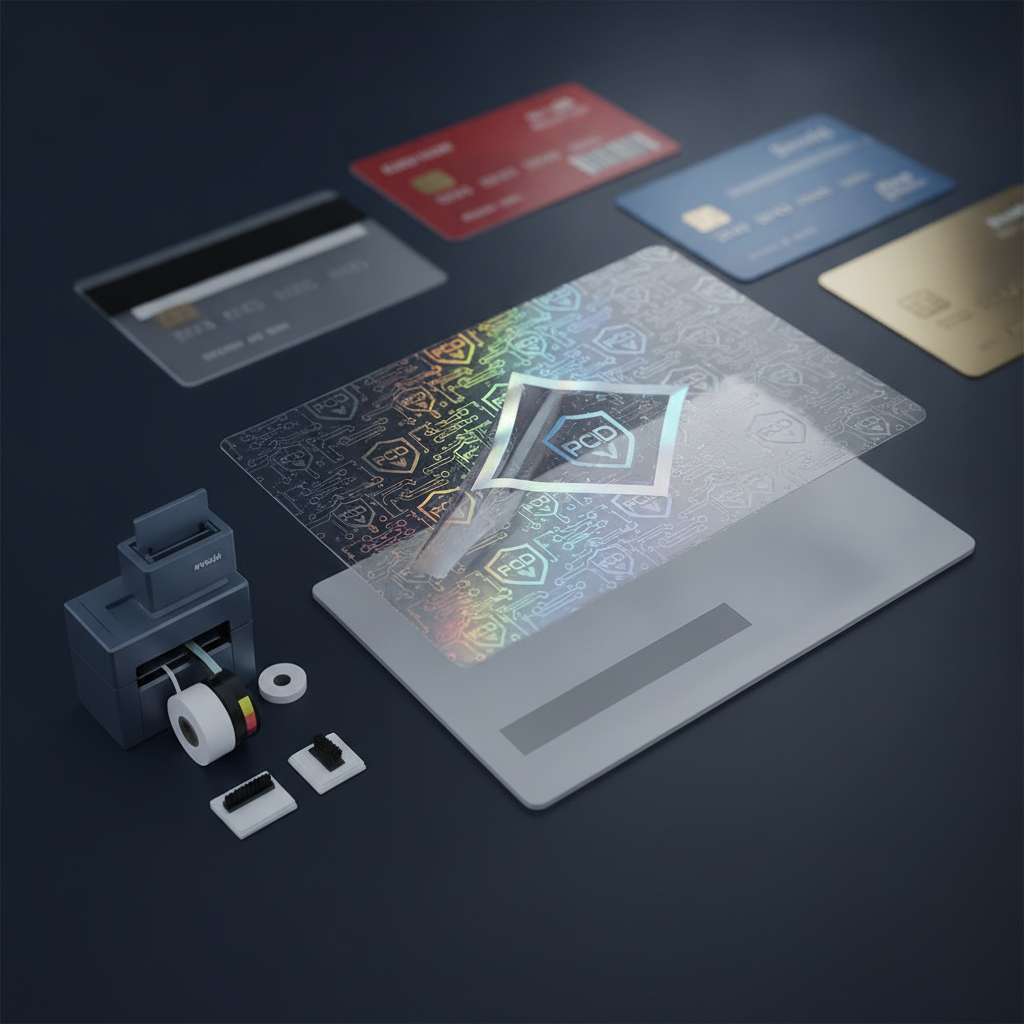
From blank CR80 PVC cards in standard white, colored stock, clear, and frosted formats to magnetic stripe cards in HiCo and LoCo configurations, RFID and proximity cards, smart chip cards, and specialty options including custom die-cut shapes and luxury metal cards in stainless steel, brass, and gold - the catalog reflects the full breadth of what real card programs actually need. Printers from Evolis, Zebra, and Fargo are stocked alongside the ribbons, overlaminates, cleaning kits, and card accessories that keep those printers running at full capability.
Value-Added Services That Complete the Program
Card affixing and mailing services mean organizations that need to distribute cards at scale do not have to manage that logistics in-house. Card carriers, sleeves, and presentation packaging turn a simple card issuance into a professional, branded experience. Every element of a card program - from raw card stock through finished card distribution - can be handled through a single source. That is not a marketing claim; it is the operational reality of what CPE delivers to more than 100,000 customers across the country.
Specialty programs including casino player cards, hotel key cards, and RFID smart cards with contactless technology - including MIFARE DESFire configurations - receive the same dedicated expertise as straightforward loyalty or ID card orders. Scale does not determine service quality at Plastic Card ID. Whether you are printing 50 cards a month or tens of thousands, the guidance and supply quality remain consistent.
Speaking With a Real Expert
Card program decisions involve more variables than most buyers anticipate before their first program launch. Printer selection, card substrate choice, overlaminate compatibility, encoding specifications, batch sizing - getting these decisions right at the start saves significant time and money over the life of the program. That is why having a knowledgeable point of contact makes such a practical difference.
Reach the team directly at 800.835.7919 for guidance on holographic overlaminates, printer selection, card stock options, or any aspect of your card program. No pressure, no upselling - just straightforward expertise from a supplier that has been helping businesses run successful card programs for more than a quarter century.
Your card program deserves supplies and support that match its importance. Contact Plastic Card ID today at 800.835.7919 and put 25 years of card program expertise to work for you.
Previous Page