Blank Plastic Card Pricing Guide: What to Expect
Table of Contents []
- Your Complete Blank Plastic Card Pricing Guide from Plastic Card ID
- Understanding CR80 Blank PVC Cards and Their Core Pricing
- Magnetic Stripe Cards: HiCo vs. LoCo Pricing Explained
- RFID, Proximity, and Smart Chip Card Pricing
- Specialty Card Options and Their Pricing Considerations
- Card Printers, Ribbons, and the True Cost of In-House Printing
- Buyer Tips: Getting the Best Value from Your Blank Plastic Card Order
- Get Started with Plastic Card ID - Your Trusted Card Supplier
Your Complete Blank Plastic Card Pricing Guide from Plastic Card ID
Budgeting for a card program starts with one honest question: what does a blank plastic card actually cost? The answer is more nuanced than a single number - it shifts based on card type, quantity, encoding, and a handful of specifications that most buyers don't think about until they're already mid-order. This guide cuts through the confusion and gives you the real numbers, the real trade-offs, and the context to make a confident purchase decision.
Plastic Card ID has supplied blank and custom plastic cards to businesses across the United States for over 25 years, serving more than 100,000 customers and shipping over 50 million cards. That kind of volume translates into pricing intelligence you simply won't find on a generic product listing page. Whether you're running 50 cards a month for a boutique loyalty program or scaling into tens of thousands for a regional rollout, understanding cost structure upfront saves money and prevents missteps.
| Card Type | Typical Quantity Range | Approximate Price Per Card | Best Use Case |
|---|---|---|---|
| Blank CR80 PVC (White) | 500 - 5,000 | $0.08 - $0.20 | Employee badges, loyalty, ID cards |
| HiCo Magnetic Stripe | 500 - 5,000 | $0.15 - $0.35 | Gift cards, membership, access control |
| LoCo Magnetic Stripe | 500 - 5,000 | $0.12 - $0.28 | Hotel keys, short-term credentials |
| RFID / Proximity Cards | 250 - 2,500 | $0.85 - $2.50 | Access control, contactless systems |
| Smart Chip Cards | 250 - 2,500 | $1.20 - $4.00 | Secure ID, campus credentials |
| Clear / Frosted PVC | 250 - 2,500 | $0.35 - $0.75 | Premium loyalty, specialty branding |
| Colored Stock Cards | 500 - 5,000 | $0.12 - $0.30 | Color-coded departments, events |
| Luxury Metal Cards | 50 - 500 | $4.00 - $12.00 | VIP membership, premium brand identity |
Understanding CR80 Blank PVC Cards and Their Core Pricing
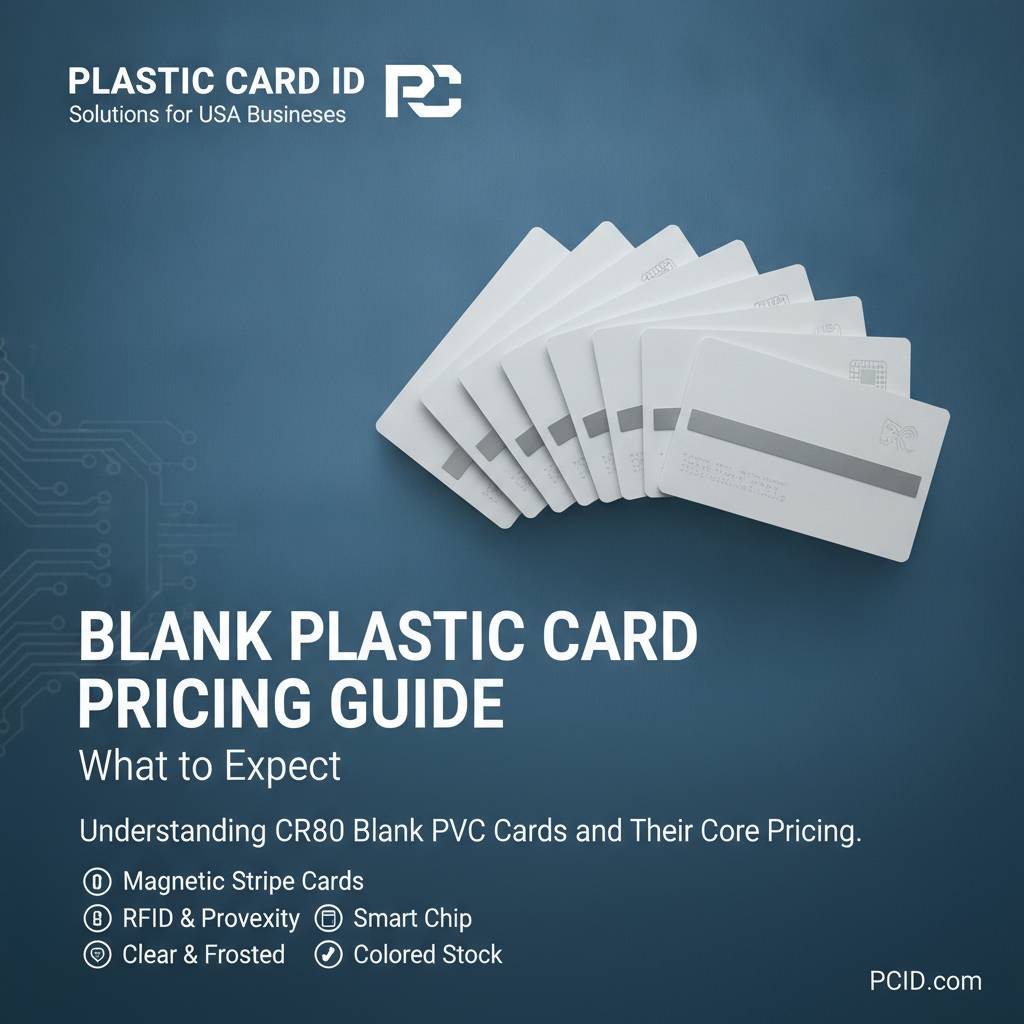 The CR80 standard - measuring 3.375 inches by 2.125 inches at 30 mil thickness - is the backbone of virtually every in-house card program in the country. It is the same physical footprint as a standard credit card, which means it fits wallets, cardholders, badge clips, and every card printer on the market without modification. Blank CR80 cards represent the most cost-effective entry point into plastic card programs, and understanding their pricing tier is foundational to everything else on this page.
At the 500-card level, white PVC blanks typically run in the $0.15 - $0.20 per-card range. Push that order to 2,500 cards and the per-card cost drops noticeably, often settling below $0.12. Order 10,000 and you are operating in bulk territory where the economics genuinely shift in your favor. The savings compound over time when you factor in that a blank card - printed in-house - gives you complete design control without paying for pre-printed runs every time your artwork changes.
What Makes a CR80 Card Worth Its Price
Not all blank PVC cards are equal. Card thickness, laminate quality, and surface finish all influence how a card performs in a printer, how long it lasts in daily use, and how cleanly it accepts dye-sublimation or thermal printing. A 30 mil card that meets ISO 7810 standards is engineered to tight tolerances - that precision matters when you are running hundreds of cards through a card printer and need consistent results without jams or misprints.
Surface texture is another pricing variable worth noting. Glossy-finish blanks produce vibrant, photo-quality prints. Matte or frosted surfaces create a more subdued premium look. Both have their place. The choice affects ink adhesion, scratch resistance, and visual impact - which is why CPE stocks multiple surface options rather than a one-size-fits-all blank.
Volume Tiers and What They Mean for Your Budget
Pricing tiers for blank cards are not arbitrary. They reflect real economies in production, packaging, and shipping logistics. When you buy 500 cards, you are covering setup costs that don't scale linearly. At 5,000 units, those fixed costs are spread thin and the per-card savings become immediately tangible. Understanding where the price breaks occur lets you time your orders strategically rather than paying a premium every month for smaller batches.
A practical approach many CPE clients use: order quarterly instead of monthly. If your program consumes 200 cards per month, a 600-card quarterly order versus three 200-card monthly orders can meaningfully reduce your annual card cost. It is a small operational shift with a real budget impact.
When White Blank Is Not the Right Card
White is the default - but it is not always the smartest choice. If your card program involves multiple departments, access tiers, or event types, colored stock cards give you instant visual differentiation without printing a single thing. A blue card goes to staff, red to contractors, green to visitors. Color-coded card programs reduce human error and speed up credential checks in high-traffic environments.
Colored stock cards price similarly to white blanks at most quantity tiers, making this an essentially free upgrade in terms of cost when the organizational benefit is real. The per-card difference is minimal; the operational clarity gained can be substantial.
Magnetic Stripe Cards: HiCo vs. LoCo Pricing Explained
Adding a magnetic stripe to a blank card introduces encoding capability - and adds to the per-card cost. The key distinction buyers need to understand is the difference between High Coercivity (HiCo) and Low Coercivity (LoCo) stripes. This is not just a technical detail; it directly affects how long the card functions reliably in the field, and it influences pricing accordingly.
HiCo cards, measured at 2750 Oe (oersteds), are harder to accidentally demagnetize. They stand up to wallet magnets, electronic interference, and general abuse far better than their LoCo counterparts. Gift card programs, membership cards, and loyalty applications where the card will be used repeatedly over months or years belong on HiCo. LoCo cards, at 300 Oe, are cost-effective for short-term applications like hotel room keys, event passes, and temporary access credentials where the card's functional lifespan is measured in days or weeks rather than years.
Real Cost Difference Between HiCo and LoCo
The price gap between HiCo and LoCo blanks is relatively modest - often $0.03 - $0.08 per card at standard quantities. For programs where card longevity matters, paying slightly more for HiCo is an obvious call. Replacing cards because they demagnetize prematurely always costs more than buying the right specification upfront. The math is simple and consistently favors the upgrade for any program running beyond short-term use.
When you factor in the cost of re-issuing demagnetized cards - staff time, reprint supplies, customer frustration - the HiCo premium evaporates entirely. CPE consistently recommends HiCo as the default for any program where cards will live in a wallet, be swiped repeatedly, or be expected to function reliably over six months or more.
Track Configuration and Its Pricing Impact
Magnetic stripe cards come in multiple track configurations: Track 1, Track 2, Track 3, and combinations thereof. Most standard applications use Track 2. Track 1 and 3 add encoding capacity, which is relevant for complex data storage needs. The track configuration affects what your card can hold and whether it interfaces correctly with your existing reader hardware.
From a pricing standpoint, multi-track cards price modestly higher than single-track. The more significant cost factor is encoding - whether you are buying blank striped cards to encode in-house (via your card printer) or ordering pre-encoded cards. In-house encoding with a desktop card printer is almost always more economical at scale, which is one reason printer ownership tends to pay for itself quickly in active card programs.
Gift Card Programs and the Magnetic Stripe Advantage
Retailers who have made the switch from paper gift certificates to plastic gift cards with HiCo magnetic stripes report sales increases in the 35-50% range. That is not a small delta. Plastic gift cards get saved, shared, and spent - they function as both a transaction instrument and a low-cost marketing vehicle that lives in a customer's wallet until the balance is used.
The per-card cost for a HiCo blank suitable for a gift card program is genuinely modest, especially when measured against the incremental revenue a well-run gift card program generates. For businesses still issuing paper gift certificates, the cost-of-inaction analysis almost always points toward making the switch.
RFID, Proximity, and Smart Chip Card Pricing
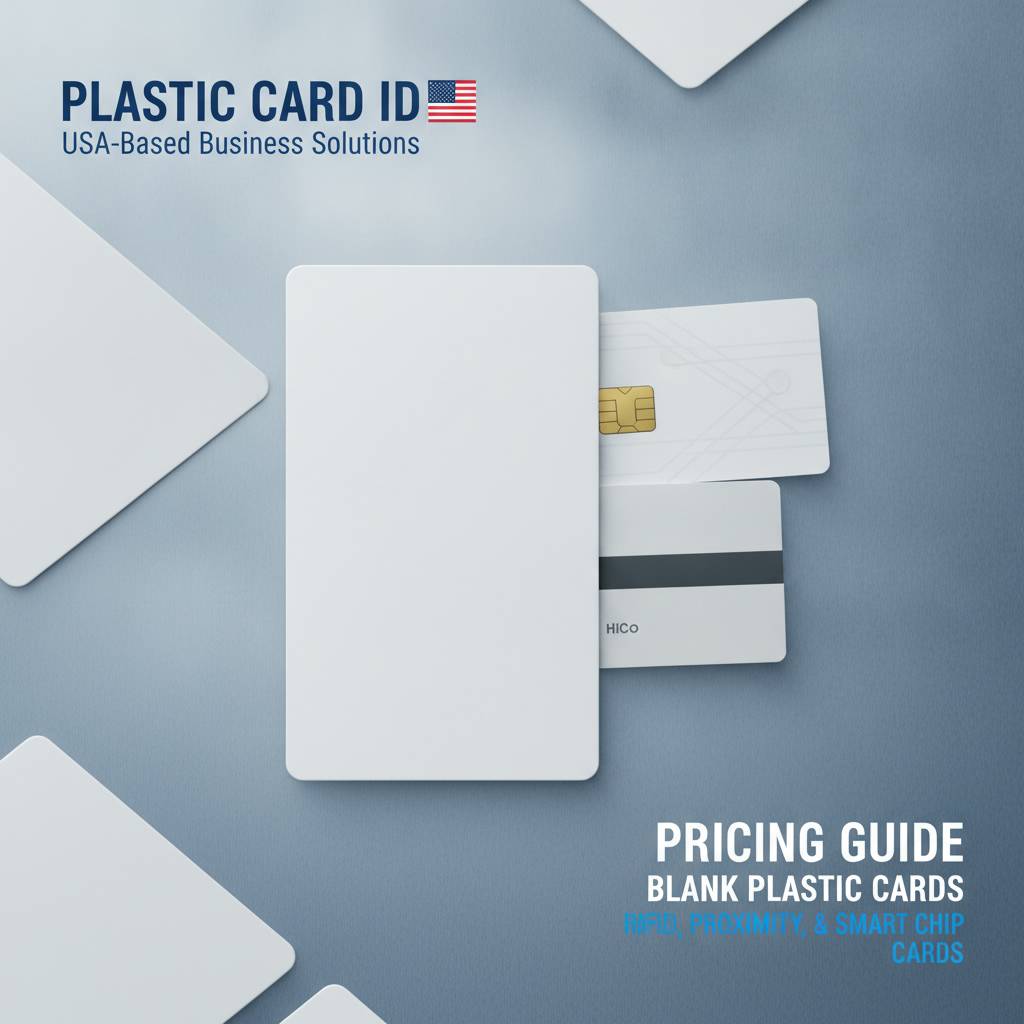 Technology-embedded cards occupy a different price tier entirely - and with good reason. RFID cards, proximity cards, and smart chip cards contain internal components: antenna coils, embedded chips, and in some cases advanced cryptographic processors. The manufacturing complexity drives cost, but what you get in return is access control capability, contactless operation, and security architecture that passive PVC blanks simply cannot provide.
Proximity cards (125 kHz) are the workhorse of basic access control - door readers, parking gates, time and attendance terminals. They price in the $0.85 - $1.50 range at moderate quantities. Higher-frequency RFID cards operating at 13.56 MHz, including MIFARE DESFire and similar standards, run $1.50 - $4.00 depending on chip type and memory. The price is justified by what these cards can do: contactless reading at distance, encrypted data storage, and multi-application capability on a single card.
Proximity Cards: Price vs. Performance
For organizations running straightforward door access - office buildings, fitness centers, schools, storage facilities - proximity cards deliver reliable performance at the most accessible price point in the technology-enabled card category. 125 kHz technology is proven, widely compatible, and supported by an enormous ecosystem of readers and control panels across every major brand.
Per-card cost drops meaningfully as quantity increases. An organization buying 250 proximity cards pays noticeably more per card than one ordering 2,500. If your access control program is growing, ordering ahead of need rather than in reactive batches almost always saves money over a 12-month window.
- 125 kHz proximity cards are compatible with HID, Indala, EM4100, and most standard access control readers
- 13.56 MHz smart cards support MIFARE Classic, MIFARE DESFire, and ISO 14443 standards
- Contactless technology enables tap-to-enter functionality without physical wear on the card or reader
- Multi-application RFID cards can handle access control, time tracking, and cashless vending from a single card
- Order volume directly impacts per-card cost - the pricing curve for technology cards is steeper than standard PVC
Smart Chip Cards and Campus or Secure ID Programs
Universities, hospitals, corporate campuses, and government facilities increasingly rely on smart chip cards for identity and access management. These programs demand more from a card than a simple magnetic stripe can provide. Smart chip cards store encrypted credentials, support multi-factor authentication workflows, and can be revoked or updated without reissuing physical cards in many implementations.
Pricing for smart chip blanks reflects the embedded chip cost. At 250 units, expect $2.00 - $4.00 per card for standard configurations. Volume orders in the thousands bring this down considerably. For large institutional programs, the per-card cost over the program lifetime - accounting for the card's multi-year functional lifespan - is often more economical than it initially appears.
Hotel Key Cards and Specialty Hospitality Applications
Hotel key cards sit at an interesting intersection: they need RFID or magnetic stripe encoding, they must be produced in quantity, but they are also short-lifecycle cards that rarely need to survive more than a few days of use per guest. LoCo magnetic stripe and lower-cost 13.56 MHz RFID options both serve this segment well. The pricing calculus favors high-volume, lower-per-card-cost specifications for hospitality programs where card churn is built into the business model.
Blank hotel key cards also offer branding opportunities. A card bearing your property's logo and design is part of the guest experience from check-in to checkout. Even at modest print runs, the branding value of a well-designed room key card is a tangible differentiator. CPE supplies both the blank card stock and the card printers to make in-house production of branded hotel keys entirely feasible.
Specialty Card Options and Their Pricing Considerations
Beyond the standard CR80 white PVC landscape, a range of specialty card formats serves specific program needs - each with its own pricing structure and use case logic. Clear and frosted cards, colored stock, custom die-cut shapes, and luxury metal cards all occupy niches where the standard white plastic simply doesn't deliver the right visual or functional result.
Understanding when to invest in specialty formats versus sticking with standard stock is a judgment call that depends on your program's goals, your audience, and your brand positioning. Premium card formats command attention in ways that standard white cards cannot - and in the right context, that attention translates directly into perceived value and program engagement.
Clear and Frosted Card Pricing
Clear and frosted PVC cards price in the $0.35 - $0.75 range at standard quantities - a meaningful step up from white blanks, but well within reason for programs where visual differentiation matters. A clear card with a printed design creates a layered visual effect that is impossible to replicate on opaque stock. Frosted cards convey premium texture and light diffusion that signals quality before the card is even read. Specialty surface cards are consistently popular in loyalty and membership programs where the card itself is meant to feel like a reward.
One consideration specific to clear and frosted cards: printing requires calibration adjustments on many desktop card printers. The opacity difference affects color saturation and registration. CPE can advise on compatible printer and ribbon combinations to ensure your specialty card prints cleanly and consistently.
Luxury Metal Cards: Stainless Steel, Brass, and Gold
At the premium end of the spectrum sit luxury metal cards in stainless steel, brass, and gold finishes. These are not novelty items - they are serious VIP membership instruments, high-tier loyalty differentiators, and brand identity statements. The weight, sound, and feel of a metal card is instantly distinct from any plastic alternative. When you hand someone a metal card, the message is unmistakable: this program values them, and this organization means business.
Metal card pricing reflects materials and manufacturing: expect $4.00 - $12.00 per card depending on metal, finish, and any custom engraving or cutouts. Minimum quantities are typically lower than standard PVC programs - 50 to 100 cards is often a viable starting point. For VIP tiers, private clubs, luxury hospitality, and high-value B2B relationship programs, metal cards represent a compelling cost-per-impression investment.
Custom Die-Cut and Non-Standard Shapes
Standard CR80 is the default, but it is not the only shape on the table. Custom die-cut cards in non-rectangular shapes - key fob format, rounded-corner variants, shaped to echo a brand logo - create immediate visual novelty and are memorable in ways that a standard rectangle is not. Die-cut cards are popular for event credentials, promotional campaigns, and specialty loyalty tiers where standing out in a wallet matters.
Pricing for custom shapes varies based on die tooling, material, and minimum quantity requirements. Setup costs are front-loaded, which means custom die-cut is a better investment for larger runs than for one-time small batches. Call 800.835.7919 to discuss current tooling costs and minimums for specialty shape programs.
Card Printers, Ribbons, and the True Cost of In-House Printing
Blank cards are only half the equation for organizations running their own card programs. The other half is the printing infrastructure - card printers, ribbons, cleaning kits, and consumables. Understanding the total cost of card production, not just the card stock, is what separates organizations that run card programs profitably from those that absorb unnecessary overhead.
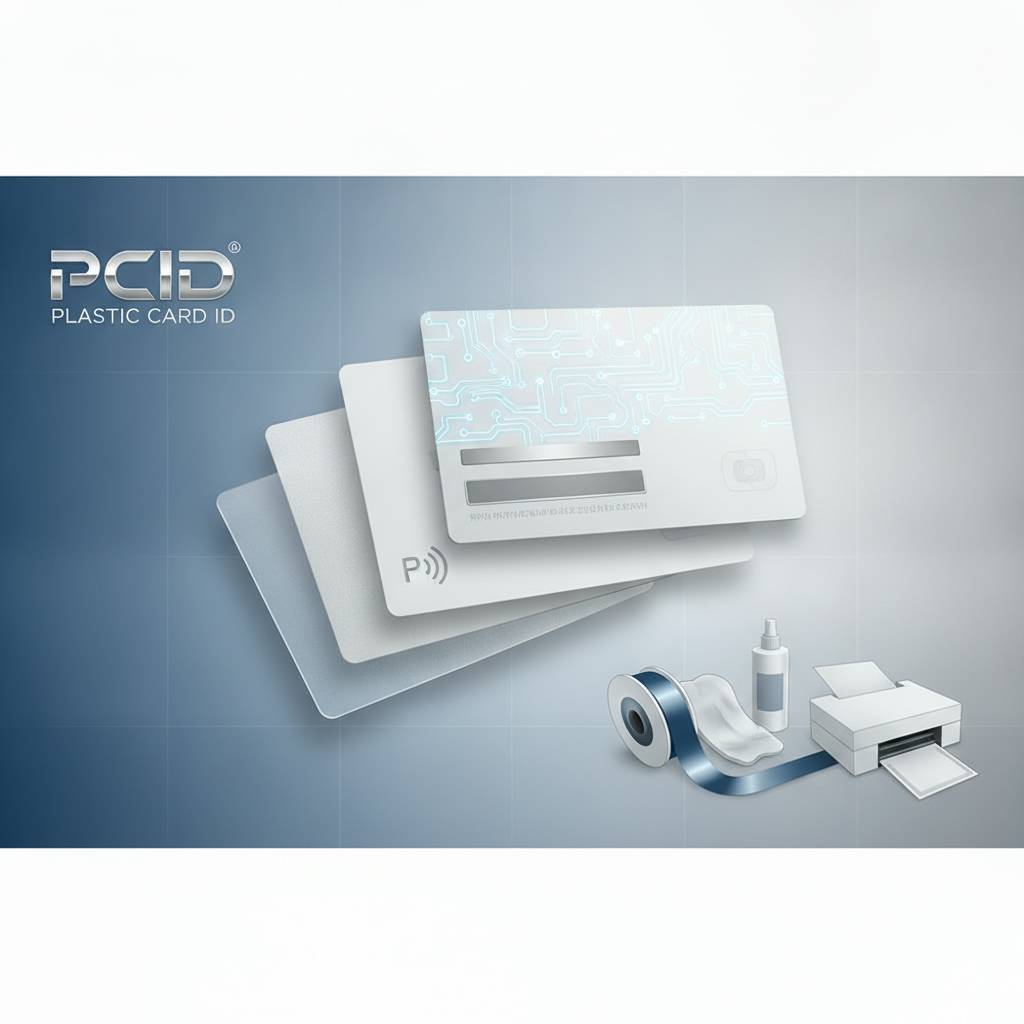
Plastic Card ID carries card printers from Evolis, Zebra, and Fargo - three of the most trusted names in the industry. Each brand has its own ribbon ecosystem, and ribbon cost per print is a number every in-house program manager should know. A full-color YMCKO ribbon that yields 250 prints at $45 translates to $0.18 per card in ribbon cost alone, before counting card stock, labor, and printer amortization.
Calculating Your True Per-Card Production Cost
To calculate a genuine per-card cost for in-house production, add together: blank card cost, ribbon cost per print, a prorated fraction of printer purchase price over its expected lifespan, and any encoding consumable costs. For a mid-range program running 500 cards per month on a $600 printer expected to last five years, the printer amortization adds roughly $0.02 per card. The numbers add up to a production cost that is still far below outsourcing custom-printed cards for most programs at sustained volume.
In-house printing also delivers something pricing alone can't capture: immediacy. An employee badge printed on-site takes minutes. A card ordered from an external print shop takes days. For dynamic programs - new hires, event registrations, replacing lost cards - the operational value of in-house printing is significant and real.
Ribbons, Cleaning Kits, and Ongoing Consumable Costs
Printer ribbons are a recurring line item in every in-house card program budget. Color ribbons (YMCKO) run more per print than monochrome options. If your program only needs to print a name and ID number on a pre-printed or colored card, a monochrome black ribbon at $0.04 - $0.06 per print can dramatically reduce consumable costs. Matching ribbon type to your actual printing needs is one of the simplest ways to manage ongoing production costs without sacrificing output quality.
Cleaning kits are a separate but essential cost. Printer manufacturers recommend cleaning every 500-1,000 prints to maintain print quality and extend printer lifespan. Neglecting this shortens the life of a $600-$1,500 printer - making the $15-$25 cleaning kit investment one of the highest-return maintenance actions in any card program.
Card Carriers, Sleeves, and Mailing Services
For organizations distributing cards by mail - membership programs, loyalty rollouts, remote employee onboarding - card carriers and envelopes are a necessary accessory cost. Sleeves protect cards in transit and add a presentation layer that reinforces program quality. Card affixing and mailing services from CPE remove the fulfillment burden entirely for organizations that would rather focus on program strategy than logistics.
Per-piece mailing costs vary based on carrier type, volume, and destination count. For high-volume distributions, professional mailing services almost always price competitively against in-house fulfillment when staff time is honestly accounted for. Reach the team at 800.835.7919 to discuss volume pricing for card mailing and carrier services specific to your program size.
Buyer Tips: Getting the Best Value from Your Blank Plastic Card Order
Buying blank plastic cards is not complicated, but a few strategic decisions made before placing an order can meaningfully reduce your cost per card and improve program performance. The following buyer tips are drawn from real program experience across thousands of clients in retail, hospitality, healthcare, education, and corporate settings.
The single most impactful decision is quantity timing. Most buyers default to ordering for immediate need - which means repeatedly landing in smaller quantity tiers with higher per-card pricing. Shifting to quarterly or semi-annual orders, sized around your actual consumption, is the simplest path to meaningful cost reduction without changing anything else about your program.
Matching Card Specification to Program Requirements
Over-specifying costs money. Under-specifying costs more. A proximity card for a door that only needs basic read access does not need to be a MIFARE DESFire card with 8KB of encrypted storage. A basic loyalty card that will only ever be scanned optically does not need a magnetic stripe. Right-sizing your card specification to your actual functional requirements is where real savings live - especially for larger programs where a $0.30 per-card difference across 5,000 cards is $1,500 annually.
If you are unsure what specification your application requires, the CPE team has seen enough programs to steer you to the right answer quickly. Matching card to reader, card to printer, and card to use case is exactly the kind of guidance that separates a strategic supplier from an order-taking website.
Consolidating Your Card Supply and Printer Needs
- Order card stock and ribbon in the same transaction to consolidate shipping costs and ensure compatibility
- Match your blank card surface finish (gloss, matte, frosted) to your printer and ribbon type before ordering in bulk
- Test new card specifications with a sample order before committing to large-quantity production runs
- Track your monthly card consumption for three months before committing to a quantity tier to right-size your order
- Ask about bundle pricing when ordering cards, ribbons, and cleaning kits together
- Consider printer replacement ribbons inventory when calculating total program cost to avoid production interruptions
Consolidating card supply and printer consumables through a single source is a logistical simplification that also creates accountability. When cards and printers come from the same supplier, compatibility troubleshooting is straightforward and support is consolidated. CPE stocks everything a card program needs under one roof precisely because program managers should not have to manage five different vendor relationships to run a single card operation.
Loyalty and Membership Cards: The ROI Case
For retail and hospitality operators still on the fence about investing in plastic loyalty or membership cards, the return-on-investment case is well-established. Loyalty cards that live in wallets outperform paper punch cards on every metric that matters: redemption rate, visit frequency, and average transaction value. A plastic card is a physical brand touchpoint that travels with your customer everywhere their wallet goes.
The cost difference between a paper punch card and a blank PVC loyalty card is, in most programs, measured in fractions of a dollar per card. The revenue difference between a wallet-resident plastic card and a crumpled paper card in a junk drawer is measured in dollars per customer per year. The math is not subtle, and it consistently favors the investment in plastic.
Get Started with Plastic Card ID - Your Trusted Card Supplier
 Whether you are building a new card program from scratch, scaling an existing one, or simply looking to sharpen the cost efficiency of your current supply chain, Plastic Card ID has the inventory, experience, and category depth to be a genuine strategic partner. With over 25 years serving businesses across the United States, a catalog spanning every major card type and format, and a team that understands programs of every scale, CPE is built for exactly this work.
Blank cards are where card programs begin - and pricing clarity is where smart programs are built. Use this guide as your foundation, match your specification to your application, and order in quantities that reflect your program's actual consumption. The savings are real, the process is straightforward, and the right partner makes all the difference.
Ready to discuss your program specifics, get a volume quote, or work through a specification question? Contact Plastic Card ID today at 800.835.7919 - and let's build something that works.
Previous Page