ISO Standard Plastic Card Thickness: 30 Mil vs 20 Mil
Table of Contents []
- The Card Thickness Question Every Buyer Eventually Asks: Plastic Card ID
- 30 Mil Cards: The Workhorse of Professional Card Programs
- Where 20 Mil Cards Actually Fit: Honest Assessment
- Frequently Asked Questions: Card Thickness for Business Buyers
- Building a Complete Card Program: Beyond Just the Cards
- What Sets Plastic Card ID Apart as Your Long-Term Card Supplier
The Card Thickness Question Every Buyer Eventually Asks: Plastic Card ID
Walk into any business that runs a card program - a gym handing out membership cards, a hotel managing key cards, a retailer distributing gift cards - and somewhere behind the scenes, someone made a decision most customers never think about: how thick should these cards be? It sounds like a minor detail. It is not. Card thickness shapes durability, printer compatibility, perceived quality, and long-term program cost in ways that catch unprepared buyers off guard. Understanding ISO standard plastic card thickness, specifically the 30 mil versus 20 mil distinction, is one of the most practical things a card program manager can learn before placing an order.
At Plastic Card ID, this question comes up constantly - from first-time buyers trying to launch a small loyalty program to enterprise operations scaling up to tens of thousands of cards per month. After 25 years in the industry and more than 50 million cards shipped to businesses across the United States, the team has a clear, experience-backed answer. But the answer is not the same for every use case, and that nuance is exactly what this guide addresses.
Why Card Thickness Matters More Than People Expect
A card that feels flimsy undermines the entire message your brand is trying to send. Customers feel it the moment they hold it. Employees notice when a badge bends and curls after a few weeks of clip use. Retailers see the difference when a gift card survives a wallet for two years versus cracking in six months. Thickness is the invisible backbone of card quality, and getting it wrong costs more in reprints, returns, and reputation than the few cents per card you might save by going thinner.
The measurement itself - expressed in "mil," which is thousandths of an inch - seems technical but is straightforward in practice. A 30 mil card is 0.030 inches thick. A 20 mil card is 0.020 inches thick. That 10-mil difference translates into about a 33 percent reduction in material, which you can actually feel when you hold both side by side. The feel, the rigidity, the weight - all noticeably different. And when you factor in how a card interacts with a printer, an RFID reader, or a wallet slot, those differences become operationally significant.
How ISO 7810 Sets the Global Standard
ISO 7810 is the international standard that governs identification card dimensions, and it is the reason a credit card from one bank fits in the same wallet slot as a loyalty card from a coffee shop. The standard CR80 size - 3.375 inches wide by 2.125 inches tall - is what virtually every card printer and card holder in the world is designed around. The ISO-standard thickness for a full-size CR80 card is 30 mil (approximately 0.76mm), and this specification matters enormously for printer compatibility, reader accuracy, and professional consistency.
When buyers encounter 20 mil cards, they are working with a non-standard thickness that falls outside this specification. That does not make 20 mil cards wrong for every purpose - but it does mean buyers need to understand where they fit and where they absolutely do not. Using a 20 mil card in a printer designed for 30 mil stock, for example, can cause feed errors, roller damage, and card jams that interrupt production and void printer warranties. CPE addresses this with customers every week because the consequences of getting it wrong are real.
Who Actually Sets These Specifications?
The International Organization for Standardization (ISO) developed ISO 7810 in collaboration with card manufacturers, financial institutions, and technology companies to ensure global interoperability. When you carry a hotel key card, a library card, or a corporate ID badge, every one of those fits a standard wallet because ISO 7810 said they should. The 30 mil specification became the norm because it offers the right balance of flexibility, durability, and mechanical reliability for the widest range of uses and machines.
Beyond ISO, individual printer manufacturers - including the brands Plastic Card ID carries, such as Evolis, Zebra, and Fargo - publish card stock specifications in their documentation. These specs typically confirm compatibility with 30 mil cards and may explicitly note limitations around thinner stock. Buyers who skip this step sometimes discover compatibility issues only after purchasing several boxes of cards, which is a costly and entirely avoidable mistake.
| Feature | 30 Mil (ISO Standard) | 20 Mil (Lightweight) |
|---|---|---|
| Thickness (inches) | 0.030" | 0.020" |
| ISO 7810 Compliant | Yes | No |
| Card Printer Compatibility | Universal (Evolis, Zebra, Fargo, etc.) | Limited - verify before ordering |
| Durability / Longevity | High - wallet-ready, long-term use | Moderate - suited for short-term use |
| Perceived Card Quality | Professional, substantial feel | Lighter, less premium feel |
| Best Use Cases | ID badges, loyalty, membership, access, key cards | Mailer inserts, temporary passes, bulk promos |
| Per-Card Cost | Slightly higher | Slightly lower |
| Print Quality Consistency | Excellent - stable feed and print alignment | Variable - may shift under print head |
30 Mil Cards: The Workhorse of Professional Card Programs
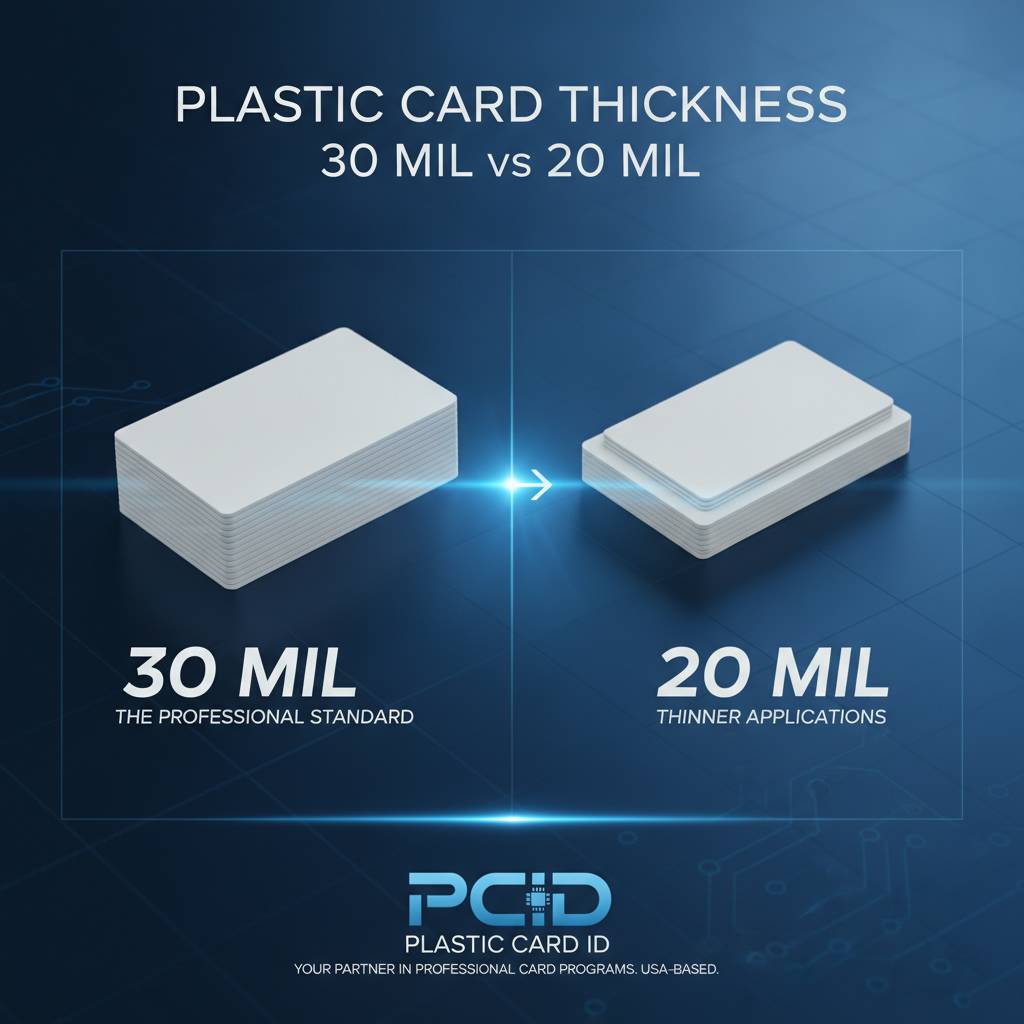 There is a reason the 30 mil CR80 card has been the default format for professional card programs across every industry for decades. It works. It works in printers, in wallets, in magnetic stripe readers, in RFID systems, in smart card readers. It survives daily handling, accidental bending, wallet compression, and repeated swipes. The 30 mil card is not the default because it is the cheapest option - it is the default because it is the most reliable option, and for businesses running programs that depend on card performance day after day, reliability has real dollar value.
Plastic Card ID moves more 30 mil blank PVC cards than any other product category, and for good reason. Whether a customer is printing employee ID badges with a desktop Fargo printer, loading loyalty cards with a magnetic stripe encoder, or creating access credentials with embedded RFID technology, the 30 mil CR80 format handles all of it. The consistency of the format across all those applications is what makes card program management scalable and predictable.
Blank 30 Mil PVC Cards: Design Freedom at Scale
A blank 30 mil white PVC card is the ultimate starting point for any in-house card program. Your design team has total control. Your organization decides exactly what gets printed, encoded, and personalized - no minimum artwork runs, no waiting on a third-party print shop, no setup fees every time you update a design. In-house printing with quality blank cards dramatically reduces per-card cost over time, and the 30 mil format ensures that every card you print looks and feels consistent, batch after batch.
Organizations that print their own cards - schools, hospitals, corporate campuses, hotels, gyms, retailers - understand this math intuitively. The upfront investment in a printer pays back relatively quickly at volume, and the ongoing cost of blank 30 mil stock is significantly lower than ordering pre-printed cards every time a design changes. CPE supplies both the cards and the printers to make that transition smooth, with knowledgeable staff who can match equipment to card volume and application requirements.
Magnetic Stripe Cards: HiCo vs LoCo on 30 Mil Stock
Magnetic stripe technology remains one of the most widely deployed card technologies in the United States, and it lives almost exclusively on 30 mil card stock. The magnetic stripe - that brown or black band on the back of the card - is embedded into the card during manufacturing and must sit at a precise, consistent height to read reliably in card readers. Card thickness directly affects magnetic stripe read reliability, which is why ISO 7810's 30 mil specification was developed partly around ensuring consistent reader performance across all compliant cards.
Plastic Card ID supplies both High Coercivity (HiCo) and Low Coercivity (LoCo) magnetic stripe cards on 30 mil stock. HiCo stripes, measured at 2750 Oersted, offer stronger magnetic properties and greater resistance to accidental erasure from proximity to everyday magnets - ideal for hotel key cards, access cards, and high-use loyalty cards. LoCo stripes, at 300 Oersted, are more suitable for short-term applications like event passes or disposable access credentials where longevity is less critical. Both are manufactured to 30 mil ISO standard to ensure universal reader compatibility.
RFID and Smart Chip Cards at Standard Thickness
When a card needs to do more than carry a printed design or a magnetic stripe - when it needs to store data, communicate wirelessly, or authenticate against a secured system - the complexity inside the card increases substantially. RFID cards, proximity cards, and smart chip cards all contain internal components: antennas, chips, inlays. Maintaining ISO 7810's 30 mil standard in these cards is an engineering achievement that ensures these high-tech cards still fit in standard readers, wallets, and printers designed around the universal card size.
Plastic Card ID offers a range of contactless and contact card technologies at ISO standard thickness, including MIFARE DESFire cards for high-security applications, proximity access cards for building security, hotel key cards compatible with major lock systems, and casino player cards for gaming environments. Each of these operates within the 30 mil form factor, meaning they integrate seamlessly into existing card program infrastructure without requiring special hardware accommodations.
Where 20 Mil Cards Actually Fit: Honest Assessment
Not every card program needs maximum durability. Some applications are by nature temporary, low-stakes, or designed for single-use scenarios where paying for 30 mil card stock is genuinely unnecessary. Understanding where 20 mil cards make practical sense - rather than dismissing them entirely or misapplying them - is part of making smart, cost-effective purchasing decisions. The key is knowing the use case before ordering, not after.
The most common legitimate applications for 20 mil cards involve situations where the card will be used once or a handful of times before being discarded. Think of short-duration event credentials, temporary visitor passes that never leave a front desk area, mailer inserts that a customer activates online rather than swiping in a reader, or promotional cards bundled with printed marketing materials. In these scenarios, the lightweight feel is not a disadvantage - it is appropriate to the purpose, and the marginally lower cost per card adds up meaningfully at high volumes.
Printer Compatibility: The Critical Warning for 20 Mil Stock
This point deserves emphasis because it is the most common source of expensive mistakes. Most professional card printers - including desktop models from Evolis, Zebra, and Fargo - are calibrated for 30 mil card stock. Their card feed mechanisms, pressure rollers, and print head positioning assume a specific card thickness. Loading 20 mil cards into a printer designed for 30 mil stock can result in misfeeds, print head crashes, and mechanical damage that voids the printer's warranty. Before purchasing any non-standard thickness card, verify explicitly with your printer's documentation or manufacturer that the thickness is supported.
When customers call Plastic Card ID after encountering feed issues, the diagnosis often comes back to card thickness mismatch. The fix is straightforward once identified, but the frustration and potential repair costs in the interim are real. If you are running a card printer for the first time and are unsure which card stock to order, the safe and correct answer is always 30 mil ISO standard CR80 unless your specific printer documentation explicitly supports alternatives. Call 800.835.7919 and a product specialist can walk you through compatibility before you order a single box.
Cost Comparison: Calculating the Real Difference
The per-card price difference between 30 mil and 20 mil stock is real, but smaller than many buyers initially assume. At large volumes, a price difference of a few cents per card does accumulate - but that calculation has to be set against the full picture. If 20 mil cards require reprinting because they fed incorrectly, or if they generate customer complaints because they feel cheap, or if they fail in readers before the program period ends, the apparent savings evaporate quickly.
For any card that will be handed to a customer or carry your organization's brand, 30 mil is the investment that pays for itself. For genuinely temporary internal uses where the card never represents your brand to an end user, 20 mil can be a sensible choice. The decision tree is simple: ask whether the card will leave your building and whether it will be used more than a few times. If the answer to either is yes, go with 30 mil.
Specialty Applications and Non-Standard Thicknesses
Beyond the 30 mil versus 20 mil discussion, there are specialized card applications that operate outside standard PVC thickness entirely. Luxury metal cards - available from Plastic Card ID in stainless steel, brass, and gold - have their own thickness and weight profiles that are categorically different from PVC stock. Clear and frosted PVC cards, custom die-cut shapes, and dual-interface cards with both contact and contactless chip capabilities each have specific thickness parameters that are documented at the product level.
These specialty options exist because different programs have different needs, and a one-size-fits-all approach to card selection would underserve a lot of legitimate use cases. A VIP membership card that is meant to communicate exclusivity and value carries different requirements than a high-volume loyalty card designed for mass distribution. Plastic Card ID carries the full spectrum and can help buyers navigate which format and thickness best serves each specific program goal.
| Use Case | Recommended Thickness | Card Type |
|---|---|---|
| Employee ID Badges | 30 Mil | Blank PVC or Pre-printed |
| Retail Gift Cards | 30 Mil | Magnetic Stripe (HiCo) |
| Loyalty / Rewards Cards | 30 Mil | Magnetic Stripe or Barcode |
| Hotel Key Cards | 30 Mil | RFID / Magnetic Stripe |
| Access Control / Security | 30 Mil | Proximity / RFID |
| Temporary Visitor Passes | 20 Mil or 30 Mil | Blank PVC |
| Mailer Insert Promotions | 20 Mil | Blank PVC |
| VIP / Luxury Membership | Metal Card | Stainless Steel / Brass / Gold |
Frequently Asked Questions: Card Thickness for Business Buyers
 Buyers who are new to card programs often arrive with versions of the same questions. The following FAQ captures the most common inquiries Plastic Card ID receives around card thickness, standard specifications, and how to make smart choices for different program types. These answers reflect more than two decades of real-world customer experience, not theoretical specifications.
Common Card Thickness Questions Answered
- Q: Will a 20 mil card work in my Evolis, Zebra, or Fargo printer? A: Almost certainly not without risking mechanical damage. These printers are designed for 30 mil ISO standard stock. Always verify with your printer's specification sheet before loading non-standard thickness cards.
- Q: Can I mix 30 mil and 20 mil cards in the same printer hopper? A: No. Mixing thicknesses in a card printer hopper causes misfeeds, jam errors, and inconsistent print quality. Always use a single consistent thickness per print run.
- Q: Is 30 mil thickness the same across all card types - blank, magnetic, RFID? A: Yes. ISO 7810 applies across card types. Whether you are ordering blank PVC, magnetic stripe, RFID, or smart chip cards, the finished card should measure 30 mil (0.76mm) in total thickness, with internal components engineered to fit within that specification.
- Q: Do thicker cards cost significantly more per unit? A: The per-card price difference between 20 mil and 30 mil is modest - often a matter of cents at volume. For most programs, the durability and compatibility benefits of 30 mil stock make it the clearly better value over the program lifecycle.
- Q: What about clear or frosted cards - are those also 30 mil? A: Yes. Plastic Card ID's clear and frosted PVC cards are manufactured to ISO 7810 standard thickness, ensuring full compatibility with standard card printers and card holders.
- Q: Where can I order 30 mil cards in bulk for a large program? A: Plastic Card ID handles orders from 50 cards to tens of thousands, with consistent quality across all quantities. Reach out to the team to discuss volume pricing and program support.
Tips for First-Time Card Program Buyers
If this is your first time setting up a card program, the number of decisions can feel overwhelming: which card type, which printer, which encoding, which thickness. The good news is that most of these decisions converge on a single starting point. Start with 30 mil blank white CR80 PVC cards and a compatible desktop card printer, and you have a foundation that supports virtually every common card application - ID badges, loyalty cards, membership cards, event credentials - without any additional complexity.
Once your base program is running, you can layer in additional functionality: add a magnetic stripe for point-of-sale integration, add RFID for access control, upgrade to custom stock for a premium brand look. The 30 mil CR80 platform accommodates all of it, which is exactly why it became the industry standard in the first place. Call CPE at 800.835.7919 early in the planning process - getting card stock and printer selection right from the start saves real money and real headaches down the line.
Understanding Card Stock Inventory and Reorder Planning
Card programs that run out of stock at the wrong moment create real operational disruptions. A hotel that runs out of key cards cannot check guests in. A corporate campus that runs out of blank ID badges cannot onboard new employees. Building a consistent reorder cadence based on your monthly card volume is one of the simplest ways to keep a card program running smoothly, and it is something experienced buyers develop almost by instinct after a few program cycles.
Plastic Card ID supports customers across the full range of order volumes, from organizations that order 50 cards a month to those ordering in the tens of thousands. Volume pricing tiers reward larger orders, and the team can help customers project their usage and identify the ordering frequency that balances inventory cost against the risk of stockouts. The goal is a program that runs without interruption, and that starts with reliable, on-spec card stock ordered before you actually need it.
Building a Complete Card Program: Beyond Just the Cards
Card thickness and stock selection are foundational, but a successful card program involves more than just the cards themselves. The printers, the ribbons, the encoding equipment, the card carriers, the sleeves - all of these components interact with the cards and affect the overall program experience. Buying from a single supplier who understands how all these components work together is dramatically simpler than assembling a program from multiple vendors who may not have visibility into the compatibility challenges their products create for each other.
Plastic Card ID is structured as exactly that kind of one-stop partner. The product catalog spans the complete card program ecosystem: blank and specialty card stock in all configurations, card printers from Evolis, Zebra, and Fargo, printer ribbons and cleaning kits matched to each printer model, card carriers for mailer programs, protective sleeves, and card affixing and mailing services for programs that need turnkey fulfillment. When everything comes from the same supplier with 25 years of program experience, the compatibility and support equation becomes straightforward.
Card Printers and Ribbon Selection
The relationship between card stock thickness and printer ribbon is more intertwined than many buyers initially realize. A printer calibrated for 30 mil cards uses ribbon tensioning and print head pressure settings optimized for that card thickness. When the card stock is consistent with the printer's design parameters, ribbon consumption is predictable, print quality is consistent, and head life is extended. Using the correct ribbon for your specific printer model and card stock is not optional - it is essential for print quality and printer longevity.
Printer ribbons from Plastic Card ID are sourced to match the Evolis, Zebra, and Fargo printers the company carries, ensuring genuine compatibility rather than the degraded performance and potential warranty complications that come from third-party ribbon substitutes. Cleaning kits, often overlooked until a print quality issue emerges, are equally important: regular cleaning cycles remove debris that accumulates from card stock and ribbon residue, protecting print heads and maintaining consistent output quality over the life of the printer.
Card Carriers, Sleeves, and Mailing Services
For programs that distribute cards by mail - gift card programs, loyalty card acquisitions, membership renewals - the physical packaging of the card matters almost as much as the card itself. A 30 mil card arriving in a quality card carrier communicates attention to detail that a loose card in an envelope does not. Card carriers protect cards in transit and create a branded first-touch experience for the recipient, turning a functional piece of plastic into a brand touchpoint before the card is ever used.
Plastic Card ID supplies card carriers and protective sleeves sized for standard CR80 card stock, as well as card affixing and mailing services for programs that need complete fulfillment handled externally. This is particularly valuable for organizations that want to run card programs at scale without building internal fulfillment infrastructure. The combination of quality 30 mil card stock, professional card carriers, and reliable mailing services creates a program that looks and operates at a level customers recognize and respond to.
Program Scaling: From 50 Cards to 50,000
One of the persistent misconceptions about professional card programs is that they require large minimum orders or enterprise-level infrastructure to get started. Plastic Card ID serves customers at both ends of the volume spectrum and everywhere in between - organizations ordering 50 cards a month get the same card quality and program expertise as operations scaling into the tens of thousands. The 30 mil ISO standard format scales linearly: the same card stock that works in a desktop printer works in high-volume production environments without modification or compromise.
As programs grow, the economics shift in favor of higher volumes through natural price tiering. A business that starts with 200 loyalty cards a month and grows to 2,000 will see per-card costs decrease meaningfully at volume, while maintaining consistent quality because the card specification never changes. This is one of the underappreciated advantages of building on the ISO standard: the program infrastructure you establish at small scale is directly transferable to large scale without reinvesting in new card formats, new printer tooling, or new reader compatibility testing.
What Sets Plastic Card ID Apart as Your Long-Term Card Supplier
A quarter century in the card business produces something that cannot be replicated by a new supplier or a generic online storefront: deep, practical knowledge of what actually works in real card programs, across real industries, at every scale. Plastic Card ID has worked with more than 100,000 customers across the United States, and that breadth of experience informs every product recommendation, every compatibility guidance call, and every order fulfillment decision the team makes.
The company's catalog reflects that experience directly. The blank cards Plastic Card ID stocks, the printers it carries, the ribbons and accessories it sources - all of it is selected based on proven performance in actual customer programs, not theoretical specifications. When a product does not perform consistently for customers, it does not stay in the catalog. When a new card technology proves its value in real-world deployments - MIFARE DESFire smart cards, contactless RFID, luxury metal card formats - it gets added because customers need it and it works.
Industries Served Across the United States
The range of industries that depend on plastic card programs - and specifically on ISO standard 30 mil card stock - is broader than most people realize until they start looking. Retail, hospitality, healthcare, education, corporate security, gaming, fitness, and government all run card programs that share the same fundamental card format even while their applications differ dramatically. A casino player card and a school ID badge and a hotel key card are all built on the same 30 mil CR80 foundation, differentiated by what is encoded on or in them.
Plastic Card ID serves all of these verticals with dedicated product lines and program expertise tuned to each industry's specific requirements. Hotel operators get key card solutions compatible with major lock system brands. Retailers get gift and loyalty card stock proven to increase sales measurably - research consistently shows retailers switching from paper to plastic gift cards see sales increases in the 35-50 percent range. Corporate security teams get access control card solutions at standard 30 mil thickness that integrate with existing reader infrastructure without modification.
Value-Added Services That Complete the Program
Buying cards from Plastic Card ID is rarely just a transaction. The team functions as a program partner, available to help customers navigate card type selection, printer compatibility questions, encoding requirements, volume planning, and reorder scheduling. This consultative approach to card supply is what distinguishes a strategic partner from a commodity vendor, and it is reflected in the long-term relationships Plastic Card ID maintains with customers who have been ordering for years or even decades.
Value-added services extend to physical program support: card affixing and mailing for turnkey distribution, custom card carrier design for branded fulfillment, cleaning kit and maintenance supply for printer upkeep, and specialty card options including clear, frosted, die-cut, and metal cards for programs where standard white PVC does not serve the brand vision. Whatever the program requires, the starting point is a conversation - and that conversation is always available by reaching out directly.
Getting Started: What to Have Ready Before You Call
If you are ready to launch or upgrade a card program and want to make the most of your first conversation with Plastic Card ID, having a few basic facts on hand will accelerate the process considerably. Know approximately how many cards you expect to use per month, what the cards will be used for (loyalty, ID, access, gift, membership), whether you need encoding (magnetic stripe, RFID, barcode), and whether you plan to print cards in-house or need pre-printed or blank stock only.
You do not need to have all the answers before you reach out - that is what the product specialists are there to help with. But knowing your approximate volume and primary use case allows the team to get to a useful recommendation faster and helps avoid the common mistake of ordering equipment or stock that does not match the program's actual requirements. The goal is always a card program that works correctly the first time, runs smoothly at scale, and represents your organization exactly as you intend.
Ready to launch or upgrade your card program with the right stock, the right printers, and the right support? Contact Plastic Card ID today at 800.835.7919 - your program deserves a partner who gets the details right from day one.
Previous Page