Custom vs Pre-Printed Blank Cards: Which Is Better
Table of Contents []
- Custom vs Pre-Printed Blank Cards: Which Is Better for Your Business? Plastic Card ID
- Understanding the Core Difference Between These Two Card Types
- Breaking Down the Cost Math: What You Actually Pay Over Time
- Which Card Types Work Best in Each Format
- The In-House Printing Advantage: Control, Speed, and Scale
- Frequently Asked Questions: Choosing Between Custom and Blank Cards
- Making the Final Call: A Framework for Your Decision
Custom vs Pre-Printed Blank Cards: Which Is Better for Your Business? Plastic Card ID
Here's a question that lands on desks more often than most card program managers expect: should you order cards pre-printed with your branding, or buy blank cards and print them yourself? It sounds simple. It is not. The answer shifts depending on your volume, your timeline, your budget cycle, and honestly, how much control you want over the final product. Let's unpack this properly.
Plastic Card ID has worked alongside over 100,000 businesses and organizations across the United States, and after more than 25 years in the card supply industry, one truth holds consistently: there is no single right answer - only the right answer for your situation. What follows is a thorough breakdown designed to help you make that call with confidence.
| Factor | Custom Pre-Printed Cards | Blank PVC Cards |
|---|---|---|
| Upfront Cost | Higher per order | Lower per unit in bulk |
| Print Quality | Professional offset/digital | Depends on in-house printer |
| Turnaround Time | Days to weeks | Immediate (cards on hand) |
| Personalization | Fixed design at order time | Fully variable per card |
| Design Flexibility | Locked after print | Update anytime |
| Best For | Large static runs, gift cards | ID programs, ongoing issuance |
Understanding the Core Difference Between These Two Card Types
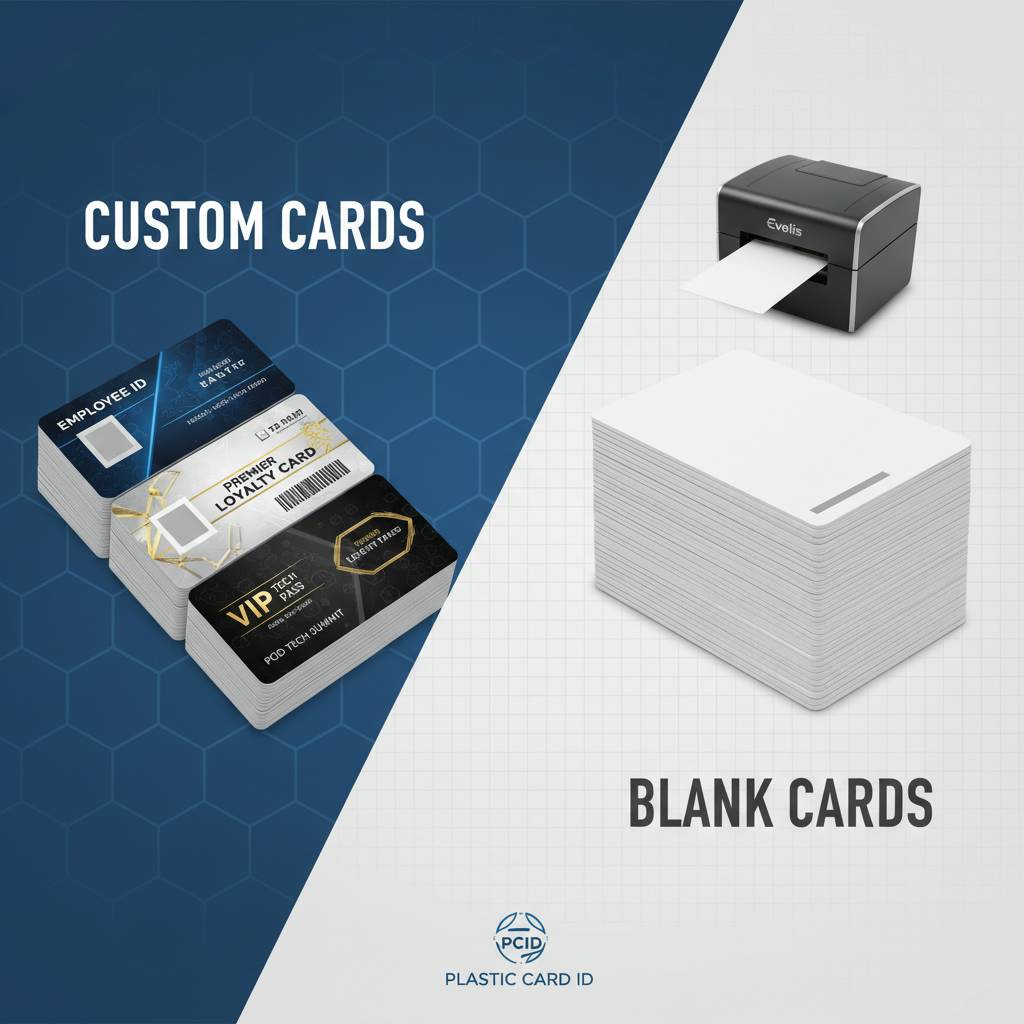 At the most fundamental level, this decision is about where the printing happens and who controls it. Custom pre-printed cards arrive at your door fully designed - your logo, colors, promotional text, and any static visual elements already applied using professional commercial printing methods. Blank PVC cards, by contrast, arrive as clean white (or clear, or colored) substrates ready for your in-house card printer to work with.
Neither approach is inherently superior. Both have delivered exceptional results for CPE clients ranging from single-location boutiques to regional hospital networks. The distinction becomes meaningful only when you start mapping each option against your operational realities - your volume, your staff, your hardware situation, and the nature of what gets printed on each card.
What Blank CR80 Cards Actually Are
Blank CR80 cards conform to the ISO 7810 standard - 3.375 inches by 2.125 inches, 30 mil thick. That is the same physical footprint as a standard credit card, which means they slot perfectly into wallets, badge holders, card readers, and printers designed for the format. They are the workhorse of virtually every in-house card issuance program in the country.
The blank surface is the point. A blank card is a canvas with no constraints. Print an employee photo ID today, a temporary visitor badge tomorrow, and a loyalty card for a new program next month - all from the same card stock, using the same printer. That flexibility is enormously valuable for organizations managing multiple card types simultaneously.
What Custom Pre-Printed Cards Deliver
Custom pre-printed cards come out of commercial card printing with full-bleed graphics, rich color depth, and design elements that in-house desktop card printers simply cannot replicate at the same fidelity. Gradient backgrounds, photographic imagery, intricate patterns, metallic overlays - these are the domain of professional printing presses running in controlled environments.
For static programs - gift cards, loyalty cards with a fixed design, membership cards that do not require individual personalization - the visual quality of a professionally pre-printed card is genuinely hard to beat. Retailers who have switched from paper-based gift programs to pre-printed plastic gift cards have reported sales lifts of 35-50%, and the card quality is a meaningful part of that equation.
The Hybrid Approach Many Organizations Miss
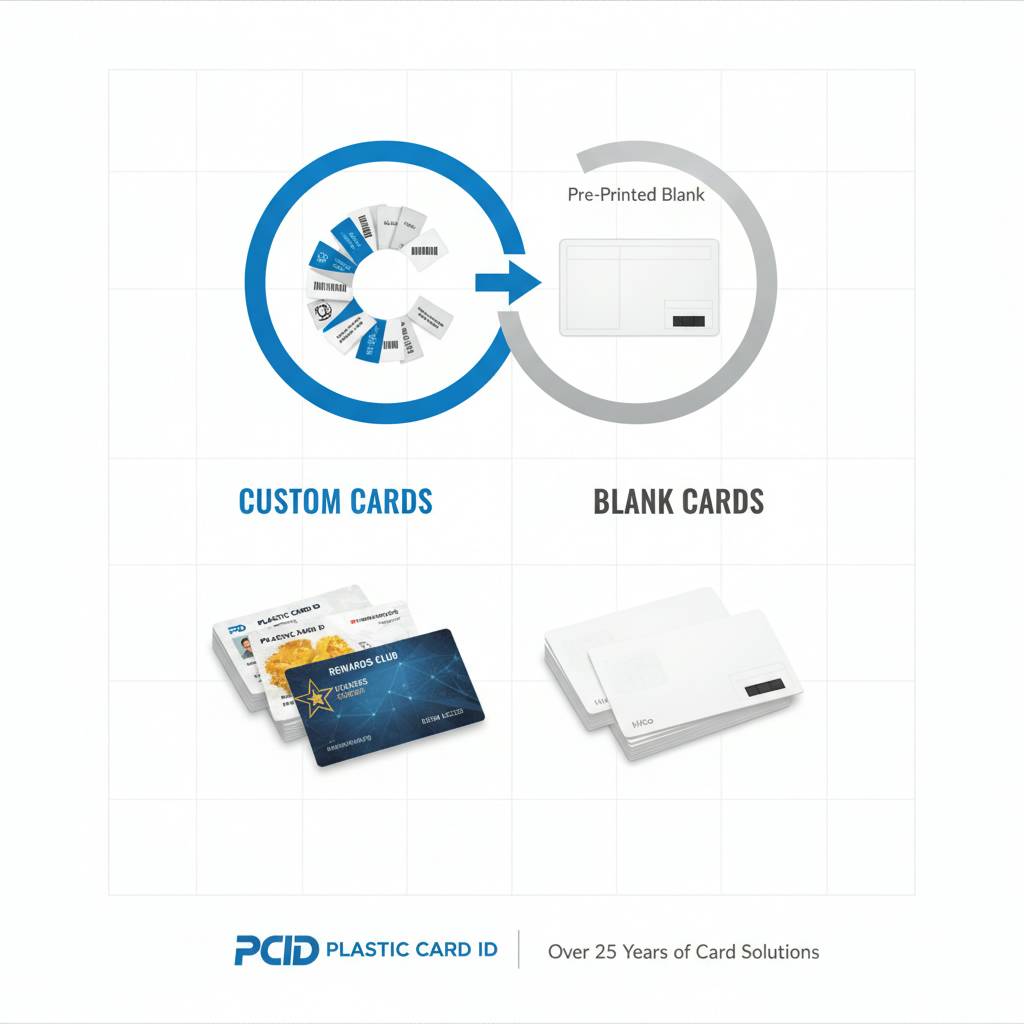
Here is what catches a lot of buyers off guard: these two options are not mutually exclusive. Many sophisticated card programs use pre-printed cards as the base - with branding, background graphics, and static design elements applied commercially - and then run those cards through an in-house printer to add variable data: names, employee numbers, photos, barcodes, or magnetic stripe encoding.
This hybrid method gives you the best of both worlds. You get professional visual design on the card face while retaining the ability to personalize each card individually at the point of issuance. Plastic Card ID supplies both the pre-printed card stock and the card printers that complete this workflow, making it a natural fit for organizations that want high production value without sacrificing flexibility.
Breaking Down the Cost Math: What You Actually Pay Over Time
Cost comparisons between these two approaches are almost always more complicated than they first appear. The per-card price of blank stock is typically lower than custom pre-printed cards - sometimes dramatically so at scale. But that calculation ignores the cost of the printer, ribbons, maintenance, and staff time required to run an in-house operation. Total cost of ownership matters more than the price on any single line item.
Consider a mid-sized hotel chain issuing 2,000 key cards per month. At that volume, the per-card cost of blank cards plus ribbon consumption might land lower than ordering pre-printed cards monthly. But a small fitness studio issuing 50 membership cards per month faces a completely different math - and in that case, pre-printed cards ordered in bulk might actually be more economical when printer amortization is factored in.
Upfront Investment vs Ongoing Operational Cost
Card printers from trusted manufacturers like Evolis, Zebra, and Fargo represent a real upfront investment. Entry-level single-sided printers start in the $300-$600 range; dual-sided models with encoding capabilities run $800-$1,500 or more. That investment pays off over time, but it belongs in your cost model from day one.
Pre-printed cards have no hardware requirement on your end - the commercial printer absorbs that cost and folds it into per-card pricing. For organizations that do not yet have a card printer, and whose card programs do not require individual personalization, pre-printed cards can get a program launched faster and cheaper initially. The trade-off is long-term flexibility.
Volume Thresholds That Change the Equation
As a general rule of thumb, organizations issuing fewer than 200 cards per month often find pre-printed cards more cost-effective when printer ownership is factored in. Between 200 and 500 cards per month, the math starts to tip depending on design complexity and personalization needs. Above 500 cards monthly, blank card programs with in-house printing almost always win on cost - and win on speed.
These thresholds shift when encoding is involved. Magnetic stripe encoding, RFID programming, or smart chip initialization may require specialized equipment regardless of whether the card was pre-printed or blank. CPE carries the full range of cards with these technologies built in - HiCo and LoCo magnetic stripe, proximity cards, MIFARE DESFire and other RFID variants - all compatible with the appropriate encoding-capable printers in the catalog.
Hidden Costs Worth Accounting For
- Ribbon consumption: Full-color YMCK ribbons cost more per card than monochrome; factor this into in-house print economics.
- Cleaning kits: Printer maintenance isn't optional - skipping it shortens printer life and degrades print quality.
- Card carriers and sleeves: If your cards are mailed or distributed with packaging, these add to total program cost.
- Design revision cycles: Pre-printed cards lock your design; reordering after a rebrand means absorbing new setup fees.
- Storage and inventory: Pre-printed cards in bulk require dedicated storage; blank cards are generic and easier to manage across programs.
Which Card Types Work Best in Each Format
 Not all card programs are created equal. The nature of the card - what it does, who carries it, how it is issued - should heavily influence which production format makes sense. Let the use case drive the format decision, not the other way around.
This is an area where CPE's depth of catalog becomes genuinely useful. With blank PVC cards, magnetic stripe cards, RFID and proximity cards, smart chip cards, clear and frosted cards, and specialty formats like custom die-cut shapes and luxury metal cards in stainless steel, brass, and gold - the right card for any program exists somewhere in the lineup.
Employee ID and Access Control Cards
For employee ID programs, blank cards with in-house printing are almost always the right choice. Why? Because every card is different. Photo, name, department, employee number, access level - these vary per person. Pre-printing these cards commercially is impractical and eliminates the ability to issue cards on-demand when someone is hired, transferred, or loses their badge.
Access control adds another layer. Proximity cards and RFID smart cards need to be programmed individually to match your access control system. That programming happens at issuance, reinforcing the case for in-house capability. Many organizations use pre-printed card stock as the visual base (with logo and design already applied commercially) and then encode and photo-print in-house - that hybrid workflow described earlier.
Gift Cards and Retail Loyalty Programs
Gift cards are a natural fit for pre-printed production. The design is static - your logo, brand colors, and seasonal artwork applied once in a professional print run. Individual card activation happens at the point of sale through your gift card system, not through physical printing. The visual quality of a professionally printed gift card directly influences customer perception of its value.
Loyalty cards occupy interesting territory. A simple punch-card replacement with no personalization is an obvious candidate for pre-printed production. But a loyalty program that includes member names, tier levels, or barcodes unique to each account needs blank card infrastructure with in-house personalization - or the hybrid pre-print-then-personalize approach that Plastic Card ID supports from end to end.
Membership, Event, and Credential Cards
Membership cards for gyms, clubs, associations, and professional organizations often benefit from a pre-printed base that communicates quality and permanence. Members notice when their card feels substantial and looks professionally produced - it signals that the organization behind it takes itself seriously. Plastic membership cards that live in wallets outperform paper punch cards in retention metrics consistently.
Event credentials, conference badges, and temporary access cards flip the calculus. These are often issued on-site or on-demand, require individual identification, and have short life cycles that make investing in professional pre-printing unnecessary. Blank cards run through a badge printer at the event registration desk is the pragmatic, flexible solution - and exactly the use case blank card stock was built for.
| Card Program | Recommended Format |
|---|---|
| Employee ID / Photo Badge | Blank (in-house print) |
| Gift Card | Custom Pre-Printed |
| Loyalty Card (no personalization) | Custom Pre-Printed |
| Loyalty Card (with member data) | Hybrid or Blank |
| Hotel Key Card | Pre-Printed Encoded |
| Event Credential | Blank (on-demand print) |
| Casino Player Card | Custom Pre-Printed Encoded |
The In-House Printing Advantage: Control, Speed, and Scale
When an organization invests in an in-house card printer and a stock of blank PVC cards, something changes in how card programs operate. The ability to issue a card in minutes rather than days is genuinely transformative - for HR departments managing new hires, for event teams running on-site registration, and for IT security teams revoking and reissuing access credentials rapidly.
Speed matters more in card programs than most organizations realize until they experience a gap in it. A new employee who waits four days for an ID badge is an operational friction point. A customer who signed up for a loyalty program but has to wait two weeks for their card may not remember why they signed up by the time it arrives. In-house printing eliminates these gaps entirely.
Card Printers That Power Blank Card Programs
Plastic Card ID carries an extensive lineup of card printers from Evolis, Zebra, and Fargo - three of the most respected names in the direct-to-card and retransfer printing industry. Whether you need a compact single-sided printer for low-volume badge issuance or a high-throughput dual-sided model with built-in magnetic stripe encoding and smart card programming, the right hardware exists in the catalog.
Choosing the right printer is as important as choosing the right cards. An underpowered printer running at high volume will wear prematurely and compromise print quality. An overspecified printer purchased for a 50-cards-per-month program represents an unnecessary capital expenditure. Matching printer capability to actual program demands is something CPE knows how to help with - it is exactly the kind of strategic guidance that comes from 25 years in the field.
Ribbons, Supplies, and the Cost of Consistency
An in-house card printer is only as good as the consumables running through it. Using incorrect or off-brand ribbons introduces color consistency problems, increases jam rates, and can void printer warranties. Plastic Card ID supplies the full range of OEM-compatible ribbons - YMCK full-color, monochrome, and specialty panel ribbons - matched to the specific printer models in the catalog.
Cleaning kits are not optional accessories. Dust, debris, and residual ribbon particles accumulate inside card printers and degrade output quality measurably over time. Regular cleaning cycles extend printer life, protect print heads, and keep card quality consistent from the first card printed to the thousandth. Building cleaning kit replenishment into your supply orders is one of the simplest ways to protect your card printing investment.
On-Demand Issuance and Program Agility
Perhaps the most underrated advantage of blank card infrastructure is program agility. When your organization launches a new initiative - a referral card campaign, a temporary contractor badge category, a new membership tier - you can begin issuing cards the same day using the blank stock already on hand. There is no minimum order, no lead time, no design revision queue to navigate.
This agility has real dollar value. Organizations that move quickly on card-based programs capture engagement at the moment of peak motivation. A new member who receives their card at signup is more likely to use it than one who receives it two weeks later. In-house printing converts intent into action at the moment it matters most.
Frequently Asked Questions: Choosing Between Custom and Blank Cards
After decades of working with businesses across every industry imaginable, a handful of questions come up again and again when organizations are working through this decision. Here are the most common ones - answered directly, without the runaround.
Can I switch formats mid-program?
Yes, and organizations do it more often than you might expect. A business might launch a loyalty program with pre-printed cards and later add personalization features - at which point they transition to a hybrid or fully in-house model. The blank cards and printers Plastic Card ID supplies are compatible with virtually any card program structure, so switching does not mean starting from zero.
The main consideration when switching is inventory. If you have pre-printed cards on hand, use them out before transitioning - there is no reason to waste stock. Plan the transition around your natural reorder point, and use that window to get your in-house printer set up and tested before the old stock runs out.
What is the minimum order for each format?
Plastic Card ID supplies blank cards in quantities from small starter packs to bulk orders in the tens of thousands. Pre-printed custom cards typically require minimum runs that vary by card type and printing complexity. Call 800.835.7919 to discuss your specific volume requirements - the team will give you honest guidance on what makes sense at your scale rather than pushing you toward an order size that doesn't fit your program.
For very small programs - say, fewer than 100 cards total - pre-printed cards may not be economical due to setup costs spread across a small quantity. Blank cards with an entry-level printer often serve micro-volume programs better from both a cost and operational standpoint. There is no shame in starting small and scaling as your program grows.
Do blank cards work with all card printers?
Standard CR80 30 mil blank PVC cards are compatible with the vast majority of direct-to-card printers on the market, including all models sold by Plastic Card ID. Specialty cards - clear, frosted, or thicker stock - may have compatibility constraints with certain printer models, and it is worth confirming compatibility before ordering large quantities of either the cards or the printer.
Cards with pre-embedded magnetic stripes, RFID chips, or smart card contacts require printers with the corresponding encoding hardware. A standard dye-sublimation card printer without an encoding module cannot program a magnetic stripe or initialize an RFID chip - the right printer for your card technology matters as much as the card itself.
Making the Final Call: A Framework for Your Decision
After everything above, here is a clean framework to bring clarity to your specific situation. Ask yourself four questions: How many cards do I need per month? Does each card need unique variable data? How quickly do I need to issue cards? And how often does my design change? The answers will point you toward the right format without ambiguity.
High volume, variable data, fast issuance, frequently changing design - that is a blank card with in-house printing scenario. High volume, static design, no individual personalization, infrequent design changes - that is a custom pre-printed card scenario. Everything in between is a candidate for the hybrid approach, and Plastic Card ID is equipped to support all three.
Signs You Should Choose Blank Cards
- Your card program requires individual names, photos, or unique numbers on each card.
- You issue cards on-demand or on a daily basis rather than in periodic batches.
- Your organization runs multiple card types that share the same blank stock.
- You anticipate design changes or program updates within the next 12 months.
- Your volume exceeds 300-500 cards per month and you want to control per-card cost over time.
Signs You Should Choose Custom Pre-Printed Cards
- All cards in your program carry identical static design with no individual variation.
- You need the highest possible print quality for branded consumer-facing cards.
- Your card design is stable and unlikely to change for at least 12-18 months.
- You do not currently have a card printer and do not intend to invest in one.
- Your program is a one-time or infrequent run rather than an ongoing issuance operation.
Building a Long-Term Card Program Strategy
The most successful card programs CPE has seen over the years are the ones built with intentionality - where the format decision, the card technology, the printer selection, and the supply chain are all aligned from the start rather than assembled reactively. A card program that is patched together under pressure tends to cost more and perform worse over time than one that was designed with the end state in mind.
This is why Plastic Card ID functions as a strategic partner rather than simply a card vendor. Whether you are launching your first card program or optimizing one that has been running for years, the depth of experience and catalog breadth here means you can build the program right once - and scale it confidently as your organization grows. The right card, in the right format, issued through the right process, is a business asset that pays dividends far beyond its modest per-unit cost.
Ready to figure out which approach is right for your organization? Plastic Card ID is here to help you think it through from every angle - reach out today and let's build your card program the right way from the start. Call 800.835.7919 now.
Previous Page