Blank Plastic Cards for Security Access Control Systems
Table of Contents []
- Blank Plastic Cards for Security Access Control - Powered by Plastic Card ID
- Understanding the Card Types That Power Modern Access Control
- Blank PVC Cards - The In-House Credential Program Foundation
- Access Control Applications Across Industries
- Frequently Asked Questions About Blank Access Control Cards
- Value-Added Services That Complete Your Card Program
- Partner with Plastic Card ID for Your Access Control Card Program
Blank Plastic Cards for Security Access Control - Powered by Plastic Card ID
Walk into nearly any modern office building, hospital, university, or government facility and you will notice something consistent: people carry plastic cards that do more than identify them. Those cards open doors, grant system access, track attendance, and communicate authority - silently, instantly, and reliably. The card in someone's badge holder is not just a piece of plastic. It is a credential. And the quality of that credential says everything about the organization behind it.
Blank plastic cards for security access control are the foundation of in-house card programs across the United States. Rather than outsourcing credential production entirely, thousands of organizations - from corporate campuses to school districts to data centers - choose to print and encode cards on-site, on demand. That decision starts with sourcing the right blank card stock. And for over 25 years, Plastic Card ID has been the trusted source for exactly that.
Why Blank Cards Make Strategic Sense
When you control the card stock, you control the program. Blank CR80 PVC cards allow your team to issue credentials in-house, update photos or access levels immediately, and avoid the delays that come with third-party fulfillment. For high-turnover environments or rapidly changing access needs, that speed is not a luxury - it is a necessity.
The per-card cost of blank stock is dramatically lower than pre-printed alternatives, especially at volume. Over months and years, organizations running active badge programs save considerably. More importantly, they gain the flexibility to reprint, re-encode, or revise credentials without waiting on external vendors.
The CR80 Standard - What It Means for You
CR80 is the ISO 7810 standard card size - the same dimensions as a credit card (3.375" x 2.125"), and 30 mil thick. Every card printer on the market is designed around this format. When you source CR80 blank cards from CPE, you are starting with stock that is dimensionally precise, compatible with all major printer brands, and consistent from order to order.
Thickness matters in access control. A card that warps, bends easily, or feeds inconsistently through a printer creates production headaches and credential failures. Premium 30 mil PVC stock maintains its rigidity across environments - in wallet pockets, badge holders, and card readers - delivering the durability that security applications demand.
Serving USA Businesses of Every Scale
Whether your organization issues 50 cards a month or manages a badge program producing tens of thousands of credentials, Plastic Card ID scales with you. Small non-profits printing volunteer badges and large enterprise campuses managing multi-location access programs are both well-served by the same catalog of blank card options and printer solutions.
With over 100,000 customers served and more than 50 million cards sold, CPE understands that no two card programs are identical. The team functions as a strategic partner, helping clients select the right card substrate, encoding format, and printer configuration to match their specific access control infrastructure.
| Card Type | Best Use Case | Encoding Option | Compatibility |
|---|---|---|---|
| Blank PVC CR80 | General employee badges | Print only | All card printers |
| HiCo Magnetic Stripe | High-security access systems | Magnetic stripe encoding | Stripe readers and printers |
| LoCo Magnetic Stripe | Short-term credentials, hotel keys | Low-coercivity encoding | LoCo-compatible readers |
| Proximity (Prox) Cards | Contactless door access | 125 kHz RFID | HID-compatible readers |
| RFID Smart Cards | Multi-application access | 13.56 MHz contactless | MIFARE, DESFire readers |
Understanding the Card Types That Power Modern Access Control
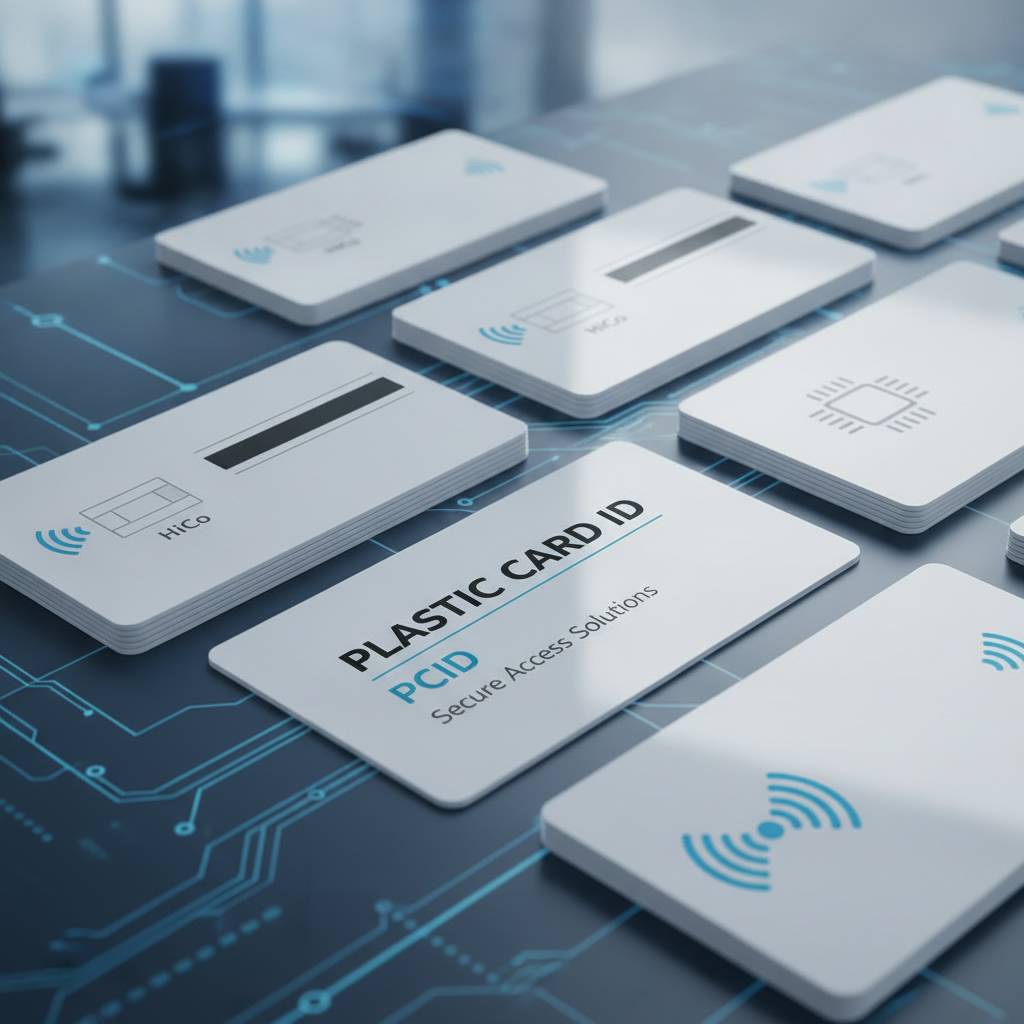 Security access control is not a one-size-fits-all category. A manufacturing plant securing tool storage has different needs than a hospital managing access to pharmaceutical areas or a university controlling dormitory entry. The blank card you select - its encoding capability, substrate, and form factor - must align with your existing reader infrastructure and your security objectives.
The good news: Plastic Card ID stocks every major card type used in access control today. Understanding the differences between them helps you make the right sourcing decision the first time, avoiding compatibility headaches and costly reprints down the road.
Magnetic Stripe Cards - HiCo vs. LoCo
Magnetic stripe cards encode data on a ferromagnetic band running across the back of the card. The distinction between High Coercivity (HiCo) and Low Coercivity (LoCo) comes down to the magnetic field strength required to write and read data. HiCo cards are significantly more resistant to accidental erasure from everyday magnets - making them the preferred choice for long-term employee credentials and high-traffic access points.
LoCo cards, by contrast, are easier to encode and re-encode, which suits short-duration use cases like hotel room keys or temporary visitor passes. Both are available as blank stock, ready for your card printer's encoding module to write access data directly during the printing process. Most enterprise-grade card printers from Zebra, Fargo, and Evolis support both formats.
Proximity Cards - The Contactless Workhorses
Proximity cards operate at 125 kHz and are among the most widely deployed access control credentials in North America. They communicate with readers without physical contact - a cardholder simply holds the card near a reader panel and the door responds. No swiping, no insertion, no friction. For high-traffic entryways or environments where hygiene matters, proximity is a compelling format.
Because proximity cards contain a factory-programmed chip, they arrive with a unique facility code and card number embedded. Blank proximity cards from CPE are available in standard CR80 format, compatible with HID-compatible reader systems. These are an excellent choice for organizations already operating on a proximity-based platform who need to expand their card inventory without changing infrastructure.
RFID Smart Cards - Advanced Security at Your Fingertips
RFID smart cards operating at 13.56 MHz represent the premium tier of contactless access credentials. Formats like MIFARE Classic, MIFARE DESFire EV2, and DESFire EV3 support encrypted communication, multiple application storage, and sophisticated anti-cloning protections. These are the cards securing pharmaceutical cold storage rooms, data center server floors, and government facilities - environments where basic proximity simply is not enough.
MIFARE DESFire EV2 and EV3 cards, in particular, offer mutual authentication and encrypted data exchange, making them extremely difficult to duplicate or intercept. Plastic Card ID supplies these cards as blank stock ready for encoding by your access control system, as well as in configurations pre-tested for compatibility with leading physical security platforms.
Blank PVC Cards - The In-House Credential Program Foundation
There is something quietly powerful about walking into a card production room, loading blank CR80 stock into a printer, and emerging ten minutes later with professional, photo-ID credentials for new hires or event attendees. That capability - fast, in-house, fully controlled - is what blank PVC cards make possible. Organizations that invest in this infrastructure find that the per-card economics improve rapidly, and the operational flexibility is transformative.
Blank cards are not just a commodity. The quality of the PVC substrate, the consistency of the card surface finish, and the dimensional accuracy of each card all affect print quality, laminate adhesion, and long-term durability. Plastic Card ID sources only cards that meet or exceed ISO 7810 specifications, ensuring your printed credentials look sharp and last.
Clear and Specialty Card Options
Standard white PVC is not the only option. Clear plastic cards - both fully transparent and frosted - create striking visual effects when printed, allowing card designs to use the card's transparency as a design element. Clear cards signal premium quality and are popular for executive access credentials, VIP event passes, and membership cards where appearance matters as much as function.
Frosted cards diffuse light beautifully, giving printed colors a softer, upscale appearance. For organizations that want their access credentials to also reflect brand quality, specialty substrates offer a meaningful upgrade without requiring a custom card order. These are available as blank stock in standard CR80 dimensions, compatible with most dye-sublimation card printers.
Colored Stock Cards
Color-coded card programs are a practical access control tool. When cards are visibly color-coded by department, access tier, or employee classification, security teams can identify credential status at a glance - without reading card text or scanning a reader. Colored blank stock cards simplify visual security monitoring dramatically.
Red for contractors, blue for full-time staff, yellow for visitors - the system is intuitive, fast to implement, and requires no additional technology. CPE offers colored blank card stock in multiple colors, enabling organizations to build visual access tier systems that work alongside their electronic credentialing infrastructure.
Card Printers That Complete Your Program
A blank card program without a reliable card printer is incomplete. Plastic Card ID carries a full lineup of card printers from three industry-leading brands: Evolis, Zebra, and Fargo (HID Global). Each offers models suited to different production volumes, encoding requirements, and budget ranges - from single-sided desktop printers for small offices to dual-sided retransfer printers for high-definition photo ID production.
Matching the right printer to your blank card stock is something CPE helps clients navigate as part of the partnership, not as an afterthought. When your card stock and printer are aligned in quality and specification, the result is sharper prints, more consistent output, and fewer rejected cards - saving time and supply costs at every print run.
| Printer Brand | Best For | Notable Feature |
|---|---|---|
| Evolis | Small to medium volume programs | Compact design, easy ribbon loading |
| Zebra | Enterprise and high-volume programs | Robust build, ZXP retransfer models |
| Fargo (HID Global) | Government, healthcare, high security | HDP retransfer, lamination modules |
Access Control Applications Across Industries
 Security access control card programs span virtually every industry sector. The specific card format may differ - a hospital may prefer smart cards while a logistics company relies on HiCo magnetic stripe - but the underlying need is consistent: organizations need a reliable, fast, and scalable way to credential their people and control who goes where.
Understanding how different industries deploy blank access control cards helps procurement teams make informed purchasing decisions. The applications below represent common real-world deployments that Plastic Card ID has supported across the United States.
Corporate Campuses and Office Buildings
Large corporate environments with multiple buildings, parking structures, server rooms, and executive floors depend on layered access control. Blank HiCo magnetic stripe cards and proximity cards are the most common formats, with different card zones encoded with different access permissions. New employee onboarding becomes fast and frictionless when HR teams can print and encode a credential in minutes on-site.
Multi-site organizations often standardize on a single card format to simplify reader infrastructure while still differentiating access by role through encoding. CPE supports procurement teams managing centralized card inventories that serve multiple locations from a single card stock SKU.
Healthcare and Pharmaceutical Facilities
Hospitals, clinics, and pharmaceutical manufacturing sites have some of the most demanding access control requirements in any sector. Medication storage, laboratory areas, patient records rooms, and server infrastructure all require distinct access credentials - often with audit trail requirements that make smart cards the preferred format.
MIFARE DESFire cards support encrypted transaction logging, enabling facility managers to track exactly who accessed which area and when. Blank smart card stock from Plastic Card ID can be issued and encoded on-site, integrated directly into the facility's physical security management platform, and reprinted or deactivated instantly when staff roles change.
Educational Institutions and Universities
University campuses represent some of the most complex access control environments in existence. Dormitory entry, library access, computer lab credentials, athletic facilities, and faculty office buildings all require credentialing - often for populations that change dramatically every semester. The ability to print and encode access credentials in-house is not just convenient for universities; it is operationally essential.
Blank proximity and smart card stock allow campus card offices to issue credentials quickly during orientation periods, handle replacements without delays, and retire access for departed students or faculty instantly. CPE supports university card programs at all scales, from small liberal arts colleges to multi-campus state university systems.
Government and High-Security Facilities
Government facilities - federal, state, and municipal - operate access control programs under strict security requirements. The cards in use at these locations must support strong authentication, resist duplication, and meet specific technical standards. RFID smart cards using DESFire EV2 or EV3 technology are increasingly the credential of choice for government deployments requiring elevated security posture.
Metal cards - available from Plastic Card ID in stainless steel, brass, and gold finishes - are sometimes used for executive or high-security credential programs where both security and prestige are priorities. These luxury format cards carry the same encoding options as standard PVC stock while projecting an unmistakable authority and permanence.
Frequently Asked Questions About Blank Access Control Cards
Organizations evaluating blank card programs for the first time - or expanding existing programs - often have practical questions about compatibility, ordering, and program setup. The following answers address the most common inquiries Plastic Card ID receives from procurement managers and IT security teams across the United States.
What Card Format Should I Order?
The right card format depends entirely on your existing reader infrastructure. If your access control panels use HID-compatible proximity readers, you need 125 kHz proximity cards. If your system uses 13.56 MHz smart card readers, you need MIFARE-format smart cards. If your access control software encodes data onto magnetic stripes, you need HiCo or LoCo magnetic stripe cards.
- Check your existing readers for the operating frequency before ordering
- Confirm whether your card printer supports magnetic stripe encoding or smart card encoding modules
- HiCo cards are recommended for long-term employee credentials; LoCo for short-term visitor passes
- Proximity cards are typically pre-programmed at the factory with a unique facility code
- Smart cards can often store multiple applications on a single card
How Do I Know My Printer Is Compatible?
Card printers from Evolis, Zebra, and Fargo are designed to accept standard CR80 card stock. Compatibility issues most commonly arise when encoding modules are involved - not all printers include magnetic stripe encoding or smart card encoding as standard features. Some require upgrade modules. Selecting the right printer configuration at purchase prevents costly retrofits later.
The team at CPE can assist in matching your blank card selection to a compatible printer configuration. Reach out at 800.835.7919 to discuss your program requirements with a card specialist who understands the technical landscape of access control card printing.
What Quantities Can I Order?
Blank card stock is available from Plastic Card ID in quantities that serve programs of any size. Small organizations just starting an in-house badge program can order modest quantities to test their workflow before committing to bulk inventory. High-volume programs requiring tens of thousands of cards benefit from volume pricing that substantially reduces per-card cost.
Most blank PVC card orders are available at price ranges starting well below $0.50 per card at quantity, with bulk pricing reaching even lower for very large orders. Specialty formats like proximity cards and smart cards carry higher per-card costs due to the embedded technology, but remain highly competitive compared to outsourced credential production at comparable security specifications.
Value-Added Services That Complete Your Card Program
A blank card program involves more than just card stock. Ribbons, cleaning kits, card carriers, badge holders, sleeves - the supporting supplies that keep a card program running smoothly matter more than most organizations realize until a ribbon runs out during a busy onboarding week or a dirty printer head starts degrading print quality. Plastic Card ID stocks the full ecosystem of card program supplies, ensuring clients never have to source from multiple vendors.
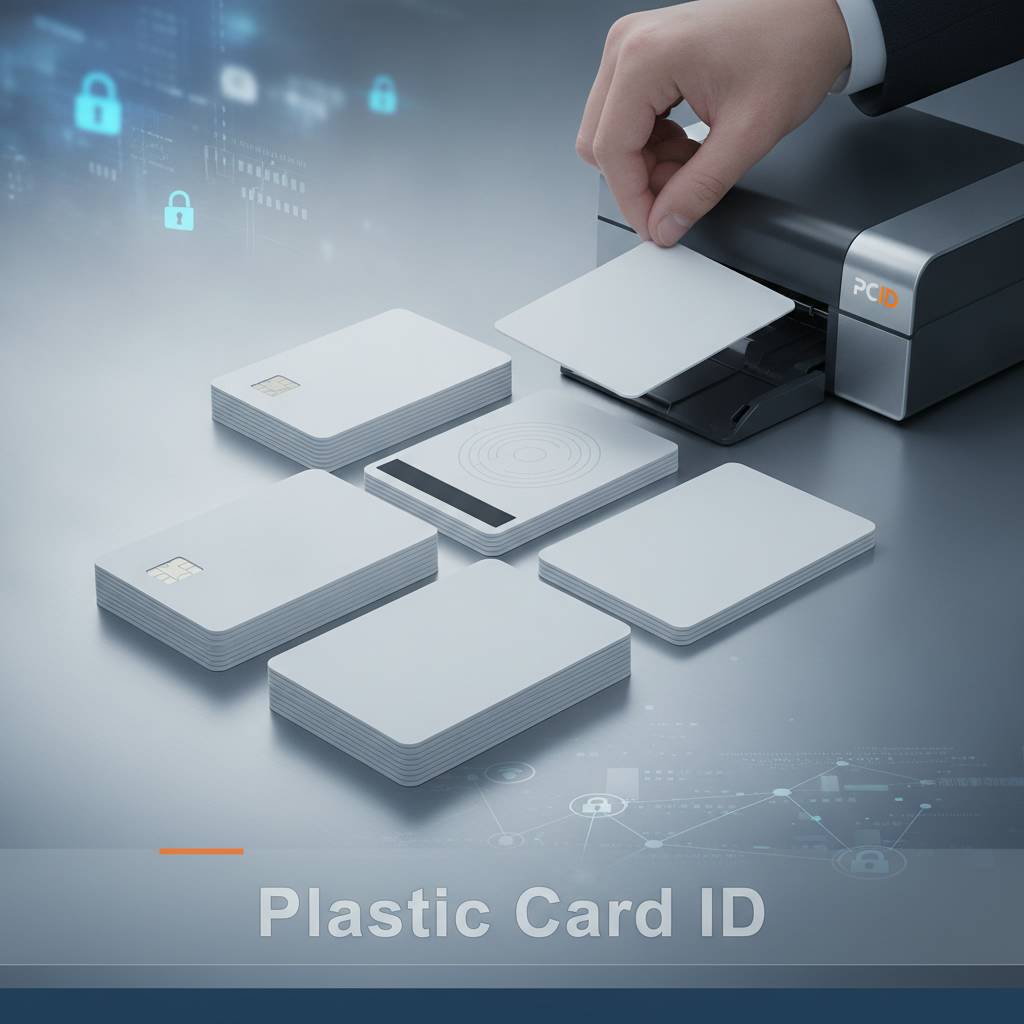
A one-stop supply relationship simplifies procurement, reduces administrative overhead, and ensures supply compatibility. Ribbons from the same source as your card stock means no guessing about whether a third-party ribbon will perform correctly with your printer model or card substrate.
Printer Ribbons and Cleaning Kits
Card printer ribbons are consumable, and their quality directly affects print output. Dye-sublimation ribbons from CPE are matched to specific printer models, ensuring correct ribbon formulation for your Evolis, Zebra, or Fargo printer. Using the correct ribbon preserves print head life and delivers the color accuracy and durability that security credentials require.
Cleaning kits - cleaning cards, cleaning swabs, and cleaning rollers - are essential for maintaining print quality and preventing card jams. Most printer manufacturers recommend cleaning cycles every 250-500 cards. Organizations that follow cleaning schedules consistently report significantly longer printer head life and fewer print defects.
Card Carriers, Sleeves, and Badge Holders
After a card is printed and encoded, it needs to be protected and presented. Card sleeves protect credentials from surface scratches during everyday carry. Badge holders and lanyards allow credentials to be worn and displayed as required by security policy. Card carriers enable mailed or distributed credentials to reach their recipients in pristine condition.
Plastic Card ID stocks a complete range of card accessories, from simple clear sleeves to professional badge holder configurations. Presenting credentials correctly reinforces the professionalism and authority that security access card programs are designed to project.
Card Affixing and Mailing Services
For organizations distributing large volumes of credentials by mail - membership cards, access cards for remote facilities, or event credentials - card affixing and mailing services eliminate significant internal labor. CPE offers card affixing services that adhere cards to mailers or card carriers, and mailing support that handles distribution logistics on your behalf.
This service is particularly valuable for organizations running seasonal credentialing programs, annual membership renewals, or access card distribution across multiple locations. Rather than staffing an internal mail operation during peak periods, the entire fulfillment process can be handled externally - accurately and efficiently.
Partner with Plastic Card ID for Your Access Control Card Program
Twenty-five years in the card business is not an accident. It is the result of consistent service, technical expertise, and a genuine commitment to helping organizations build card programs that work - reliably, professionally, and cost-effectively. Plastic Card ID has served over 100,000 customers and shipped more than 50 million cards because the approach has always been partnership, not just transaction.
From the first conversation about card format compatibility to the ongoing supply relationship that keeps your printer running and your credential program operating without interruption, CPE is built to support the full lifecycle of your access control card program. No matter your industry, your scale, or your technical infrastructure, the catalog, the expertise, and the commitment to your success are here.
Get Started Today
Ready to establish or expand your in-house security access control card program? The process starts with a conversation about your existing infrastructure, your credentialing volume, and your access control objectives. From there, the right card format, printer, and supply configuration becomes clear quickly.
Reach out to the team at 800.835.7919 to speak with a card program specialist who can walk you through options, answer technical questions, and help you place your first order with confidence. There is no obligation - just expertise and a genuine interest in helping your program succeed.
Why Organizations Choose Plastic Card ID Over Generic Suppliers
Generic card stock suppliers offer cards. Plastic Card ID offers a card program partnership. The difference is real and measurable - in the quality of guidance received when selecting card formats, in the reliability of supply that keeps programs running without interruption, and in the breadth of a catalog that covers every card type, printer brand, and accessory category a modern access control program requires.
- Over 25 years of specialized experience in plastic card supply
- 100,000 customers served across the United States
- 50 million cards sold with consistent quality standards
- Full catalog: blank cards, specialty cards, printers, ribbons, accessories
- Scalable ordering from small monthly quantities to mass production
- Strategic partnership approach - not just a supplier relationship
A Commitment to Card Program Excellence
Every card that leaves a CPE shipment and enters your card program becomes part of your organization's security infrastructure. That is a responsibility taken seriously. The card stock is quality-verified, the printer recommendations are technically sound, and the supply relationship is designed to be long-term and low-friction - because your access control program does not stop, and neither should your card supply.
Security starts at the credential. Make sure yours are built on the right foundation. Partner with Plastic Card ID - call 800.835.7919 today and take the first step toward a more professional, more efficient, and more secure access control card program for your organization.
Previous Page