What Is a LoCo Magnetic Stripe Card? Full Breakdown
Table of Contents []
- What Is a LoCo Magnetic Stripe Card? Your Complete Guide from Plastic Card ID
- Understanding LoCo Magnetic Stripe Technology
- Common Applications for LoCo Magnetic Stripe Cards
- Technical Specifications: What to Know Before You Order
- Choosing the Right Card Printer for LoCo Encoding
- Frequently Asked Questions About LoCo Magnetic Stripe Cards
- Why Over 100,000 Businesses Trust Plastic Card ID for Their Card Programs
- Start Your LoCo Magnetic Stripe Card Program with Plastic Card ID Today
What Is a LoCo Magnetic Stripe Card? Your Complete Guide from Plastic Card ID
Magnetic stripe cards are everywhere - hotel rooms, gyms, retail counters, employee break rooms. But most people have never stopped to ask: what actually separates one stripe from another? The answer matters more than you might expect, especially if you're building a card program from scratch or upgrading an existing one. LoCo, HiCo, and everything in between - understanding these distinctions can save you money, protect your data, and determine whether your cards survive six months of real-world use or six years.
At Plastic Card ID, we've supplied magnetic stripe cards to businesses across every industry imaginable. Gift card programs, loyalty programs, access control setups, membership clubs - the questions about LoCo cards come up constantly. So let's answer them thoroughly, practically, and without the technical fog that usually surrounds this topic.
| Feature | LoCo (Low Coercivity) | HiCo (High Coercivity) |
|---|---|---|
| Coercivity Level | 300 Oersteds | 2750 Oersteds |
| Stripe Color | Typically brown/tan | Typically black |
| Erasure Risk | Higher (easily demagnetized) | Lower (more resistant) |
| Common Uses | Hotel keys, gift cards, loyalty | ID cards, access control, long-term use |
| Rewrite Friendly | Yes - easy to re-encode | Requires HiCo-capable encoder |
| Typical Lifespan | Shorter, reusable cycles | Long-term, repeated use |
Understanding LoCo Magnetic Stripe Technology
 A LoCo magnetic stripe card - short for "low coercivity" - stores data on a stripe made of magnetic particles that require relatively little energy to magnetize or alter. The coercivity rating, measured in Oersteds, sits around 300 Oe for LoCo cards compared to the 2750 Oe rating of a HiCo card. That difference is not trivial. Coercivity determines how resistant the stripe is to accidental erasure, and it shapes the entire performance profile of the card in your application.
The stripe on a LoCo card is typically brown or tan in color, which makes them visually distinguishable from the black stripes you'll find on HiCo cards. This matters when you're ordering or programming cards - a LoCo encoder writes at low magnetic field strength, and if you accidentally try to encode LoCo cards with HiCo settings, the data won't write properly. Matching your encoder to your card type is a fundamental step that CPE helps clients get right every time.
How LoCo Data Encoding Works
The magnetic stripe contains iron oxide particles suspended in a binder. When the card passes through an encoder, a write head generates a precise magnetic field that aligns those particles in patterns representing binary data. For LoCo cards, that field is intentionally weaker - sufficient to encode the data, but not so strong that the stripe becomes resistant to future re-encoding.
This is exactly why LoCo cards shine in hotel and hospitality settings. A hotel room key gets programmed for a guest's stay, then wiped and re-encoded for the next guest. Easy re-encoding is a feature, not a flaw - it's built into the LoCo design intentionally. Systems that cycle cards through many short-lived programs benefit enormously from this characteristic.
The Three Tracks of a Magnetic Stripe
Standard magnetic stripe cards carry three data tracks. Track 1 holds up to 79 alphanumeric characters, Track 2 holds 40 numeric characters, and Track 3 holds 107 numeric characters. LoCo cards typically write to Tracks 1 and 2 in most commercial applications, though Track 3 remains available for programs that need additional data storage capacity.
Understanding which tracks your system reads is important before ordering. Most retail point-of-sale readers and basic loyalty system readers focus on Track 2, which stores a primary account or membership number. Plastic Card ID stocks LoCo cards ready for single-track or dual-track encoding configurations, making it easy to match your card inventory to your actual system requirements.
LoCo vs. HiCo - When Does the Difference Actually Matter?
For a gift card program where cards change hands frequently and balances update with every transaction, LoCo's easy re-encoding capability is a genuine operational advantage. For an employee ID card that someone carries daily through environments with random magnetic interference, HiCo's resilience is the smarter call. The wrong choice doesn't just cost money - it creates frustrated users and broken programs.
Proximity to strong magnets, magnetic clasps on bags, and even some phone cases can demagnetize a LoCo stripe in circumstances where a HiCo stripe would survive without issue. This isn't a knock against LoCo - it's context. LoCo cards are designed and priced for scenarios where that tradeoff is acceptable, and in many cases, preferable.
Common Applications for LoCo Magnetic Stripe Cards
The range of businesses that rely on LoCo magnetic stripe cards is broader than most people expect. They're not a niche product for specialists - they're the workhorse of dozens of common card programs across retail, hospitality, recreation, and healthcare. What they all share is a need for a readable, re-encodable, cost-effective card solution that doesn't require the maximum-durability spec of a HiCo card.
When CPE talks with clients about building or scaling a card program, LoCo cards come up in practically every conversation about gift programs, loyalty tracking, and short-term access credentials. They hit the right balance of functionality and economy for programs where cards move, cycle, and get updated regularly.
Hotel Key Cards and Hospitality
Hotel key cards are the classic LoCo application. A guest checks in, the front desk encodes a card with their room number, access permissions, and stay dates. They check out. The card gets re-encoded for the next guest. This cycle might repeat hundreds of times before a card shows any wear. LoCo's re-writeable nature makes this economically practical at scale.
Beyond room access, hospitality operators use LoCo cards for spa and fitness access, dining credits, parking validation, and resort amenity tracking. The entire guest experience can be centralized on a single card that costs pennies to program and re-program. Plastic Card ID supplies hotel-format LoCo cards in standard CR80 dimensions, ready for immediate use with property management system encoders.
Gift Cards and Retail Loyalty Programs
Retailers that move from paper punch cards or basic paper gift certificates to plastic LoCo magnetic stripe cards consistently report significant program improvements. The statistic bears repeating: retailers switching to plastic gift cards routinely see sales increases of 35-50%. A card that lives in a wallet gets used. Paper gets lost, forgotten, or destroyed.
Loyalty programs built on LoCo cards give businesses the ability to track customer behavior, reward repeat visits, and build genuine retention - not just transactional discounts. The stripe holds the account identifier that connects the card to your POS or loyalty software. Every swipe is a data point that makes your program smarter over time. CPE can help you configure blank LoCo card stock that works seamlessly with your existing reader infrastructure.
Membership Cards and Club Access
Gyms, country clubs, private associations, libraries, and recreational centers all benefit from LoCo magnetic stripe membership cards. Unlike paper membership cards that tear, fade, or get laminated awkwardly by the member at home, a plastic LoCo card signals that your organization takes its membership program seriously. It carries a legitimacy that paper simply cannot replicate.
When membership status changes - an upgrade, a renewal, a temporary freeze - LoCo's easy re-encoding means you can update the card without issuing a new one. For organizations managing hundreds or thousands of active members, that operational flexibility translates directly into cost savings and reduced administrative friction.
Technical Specifications: What to Know Before You Order
 Ordering magnetic stripe cards without understanding the basics is a common mistake that creates real operational headaches. Cards arrive, they won't encode properly, the encoder throws errors, and suddenly a simple procurement decision becomes a troubleshooting crisis. A few minutes of technical clarity upfront eliminates all of that.
Plastic Card ID has fielded these questions for over 25 years, and the same issues come up repeatedly. Here's what to have confirmed before placing your order.
Card Format and ISO Standards
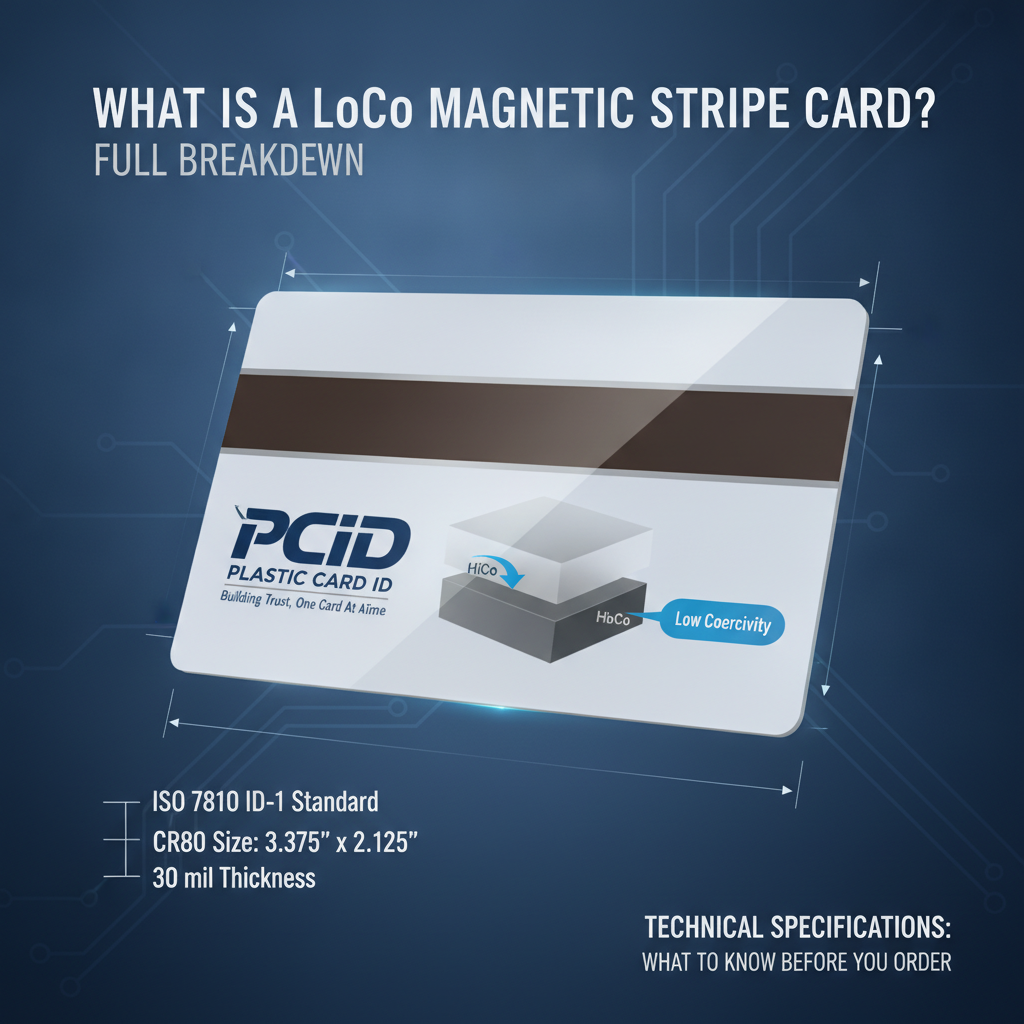
Standard LoCo magnetic stripe cards are produced in CR80 format - 3.375 inches by 2.125 inches, 30 mil thick. This is the ISO 7810 standard, the same dimensions as a credit card. CR80 compatibility means your cards will work with virtually every card printer, encoder, and reader on the market. Non-standard sizes create compatibility headaches that aren't worth the novelty.
The magnetic stripe on a CR80 LoCo card runs along the back of the card, positioned according to ISO 7811 specifications that define stripe placement, track locations, and recording density. Complying with these standards ensures interoperability - your cards will work with off-the-shelf readers without custom hardware configurations.
Encoder Compatibility Requirements
Your card printer or standalone encoder must support LoCo writing to use LoCo cards properly. Most modern card printers from Evolis, Zebra, and Fargo - the brands Plastic Card ID stocks and supports - offer magnetic stripe encoding modules that handle both LoCo and HiCo cards, with a simple setting change between them. Older or basic encoders may only support one format.
Confirm your encoder's coercivity setting before ordering cards. Using a HiCo encoder to write LoCo cards will result in improperly encoded data that may not read reliably. The reverse - using a LoCo encoder on HiCo cards - simply won't write at all. Matching card type to encoder capability is the single most important technical step in setting up a magnetic stripe card program.
Key Specifications to Confirm Before Ordering
- Coercivity requirement: 300 Oe for LoCo, 2750 Oe for HiCo
- Number of tracks needed: Track 1 only, Track 2 only, or Tracks 1 and 2
- Card quantity per order: Plastic Card ID serves programs from 50 cards per month to tens of thousands
- Printer/encoder brand and model: critical for confirming encoding module compatibility
- Card finish: standard gloss, frosted, or clear options available
- Pre-printing requirements: blank stock vs. custom-printed cards
- Software integration: what POS, access control, or loyalty platform will read the encoded data
Getting these details confirmed before ordering prevents mismatches and delays. The CPE team is available to walk through this checklist with any client - new or established - to make sure the right product ships the first time.
Choosing the Right Card Printer for LoCo Encoding
A LoCo magnetic stripe card is only as useful as the system encoding it. The card itself is a blank data vessel - what matters is the printer and encoder that loads it with meaningful information. Selecting the right printer for your program volume, card design complexity, and encoding needs is a decision that pays dividends for years.
Plastic Card ID carries card printers from three industry-leading manufacturers: Evolis, Zebra, and Fargo. Each brand offers models suited to different program scales, from desktop single-card printers for small operations to high-volume batch printers for large organizations running card programs at serious scale.
Evolis Printers for LoCo Card Programs
Evolis printers are known for their clean design, user-friendly software, and reliable encoding modules. Models like the Evolis Primacy and Evolis Avansia offer magnetic stripe encoding as a built-in option, supporting both LoCo and HiCo configurations. For small to mid-size card programs, Evolis delivers professional results without requiring a dedicated card production technician.
The Evolis product line also integrates well with card design software, making it straightforward to print custom card designs and encode magnetic stripe data in a single pass. Single-pass printing and encoding dramatically speeds up card issuance compared to separate print and encode steps, which matters when you're issuing cards at an event, a busy retail counter, or a member services desk.
Zebra and Fargo for Higher-Volume Applications
Zebra card printers, particularly the ZC series, are built for environments where cards are issued continuously and durability of the printer itself is as important as the card output quality. Fargo printers - part of the HID Global family - bring advanced encoding options including magnetic stripe, smart card, and RFID in combination, useful for organizations that need multi-technology cards in a single program.
For programs printing and encoding thousands of cards monthly, the investment in a Zebra or Fargo unit with high-capacity ribbon cartridges and robust card hoppers pays off quickly in per-card cost reduction and reduced maintenance downtime. Plastic Card ID stocks ribbons, cleaning kits, and supplies for all three brands, ensuring your printer stays in peak operating condition between card runs.
Supplies and Accessories That Keep Programs Running
A card program is more than just cards and printers. Printer ribbons need to match your card type and printer model precisely. Cleaning kits extend encoder lifespan and prevent read errors caused by debris on the magnetic read/write heads. Card carriers and sleeves protect finished cards during mailing or bulk distribution. Running out of supplies mid-program is a preventable crisis with the right inventory planning.
Plastic Card ID offers card affixing and mailing services for organizations that need finished cards sent directly to members, employees, or customers - removing an entire fulfillment step from your internal operations. Whether your program issues 50 cards a month or 50,000, the support infrastructure available through CPE scales with your needs.
Frequently Asked Questions About LoCo Magnetic Stripe Cards
After 25 years and over 100,000 customers served, certain questions come up again and again. Here are the most common questions Plastic Card ID receives about LoCo magnetic stripe cards - answered directly and practically.
Can LoCo Cards Be Damaged by Everyday Items?
Yes - and this is one of the most important practical points about LoCo cards. Because they magnetize at low field strength, they're also susceptible to demagnetization from everyday magnetic sources. Strong refrigerator magnets, magnetic bag clasps, some phone cases, and proximity to certain electronics can erase or corrupt LoCo stripe data in a way that wouldn't affect a HiCo card.
This doesn't mean LoCo cards are fragile or unreliable for their intended uses - hotel key cards, gift cards, and short-cycle loyalty cards are rarely in those environments long enough for it to matter. But for a card that someone carries daily in a wallet alongside phones, keys, and other items, HiCo may be the smarter, more resilient choice. The CPE team can help assess which format is right for your specific use case.
How Much Do LoCo Magnetic Stripe Cards Cost?
Per-card pricing depends on quantity, any custom printing requirements, and whether you're ordering blank stock or pre-printed custom cards. Blank LoCo magnetic stripe cards are among the most cost-effective card options available, with pricing that becomes more favorable at higher quantities. Custom printed LoCo cards - featuring your logo, brand colors, and design - carry additional per-card cost that varies based on complexity and run size.
For context, basic programs ordering in moderate quantities can expect per-card costs well under a dollar for blank stock. The real value calculation includes the lifetime of the program, not just the per-card price - a card that drives loyalty visits, gift card redemptions, or efficient access control pays for itself many times over. Contact Plastic Card ID directly at 800.835.7919 for a quote tailored to your program's specific volume and configuration.
Can I Order LoCo Cards Pre-Encoded?
In most in-house card programs, encoding happens at point of issuance using your own printer and encoder - that's the flexibility model that gives you real-time control over your card data. However, for certain applications where data is static or pre-determined, pre-encoding is a viable option. Plastic Card ID can discuss the specifics of your program to determine whether in-house encoding or pre-encoded card stock makes more operational sense.
The more common path for most businesses is ordering blank LoCo card stock - either blank white or custom-printed with your branding - and encoding on demand using an in-house printer. This keeps your program agile, allows for real-time updates to encoded data, and gives you complete control over the card issuance process without dependency on a third-party encoding schedule.
Why Over 100,000 Businesses Trust Plastic Card ID for Their Card Programs
Trust in a card supplier isn't built on a single transaction - it's built over years of consistent product quality, accurate order fulfillment, and expert guidance when questions arise. Plastic Card ID has been in this business for over 25 years, shipping more than 50 million cards to businesses of every size across the United States. That history matters when you're building a card program that your customers, members, or employees will interact with every day.
From the first conversation about LoCo vs. HiCo to the ongoing supply of ribbons, cleaning kits, and card stock that keeps your program humming - CPE operates as a genuine strategic partner, not just a vendor filling orders. When your program grows, when your encoding needs change, when you're ready to add RFID or smart chip capabilities to your card lineup, the expertise and catalog are already there waiting.
A Full Catalog Built for Every Stage of Your Card Program
The Plastic Card ID catalog spans the full spectrum of plastic card technology. Blank white PVC cards in CR80 format. LoCo and HiCo magnetic stripe cards. RFID and proximity cards. Smart chip cards with contact and contactless configurations including MIFARE DESFire. Clear and frosted cards for specialty design applications. Colored card stock. Custom die-cut shapes. Even luxury metal cards in stainless steel, brass, and gold for premium membership and VIP programs.
No matter where your program starts, there's room to grow within the CPE ecosystem. A business launching with basic blank LoCo card stock and a desktop printer today can seamlessly scale to a high-volume custom-printed program with smart card technology tomorrow - without changing suppliers, retraining staff on new vendor relationships, or losing the institutional knowledge that comes from a long-term partnership.
Serving USA Businesses Across Every Industry
Identity, access control, loyalty, membership, marketing, events - these are the card program categories Plastic Card ID specializes in for USA-based businesses and organizations. Hotels and resorts. Retailers and restaurant groups. Gyms and wellness clubs. Private associations and professional organizations. Casinos with player card programs. Healthcare facilities with staff ID systems. Event venues with credential programs.
Every industry that issues plastic cards has found a home with CPE, and that breadth of experience translates into practical guidance that suppliers without that history simply can't offer. When you call to discuss your LoCo magnetic stripe card needs, you're talking to people who have helped thousands of programs just like yours get up and running the right way.
Ready to Get Started?
Whether you're launching a new card program or scaling an existing one, the right LoCo magnetic stripe card solution is one conversation away. The Plastic Card ID team is ready to help you identify the right cards, the right printer, and the right supplies to make your program successful from day one.
Call 800.835.7919 to speak with a card program specialist who can answer your specific questions, provide a tailored quote, and help you avoid the common pitfalls that slow down new programs. With more than 25 years of experience and over 50 million cards shipped, we know what it takes to build a card program that works.
Start Your LoCo Magnetic Stripe Card Program with Plastic Card ID Today
 LoCo magnetic stripe cards are a proven, practical, cost-effective foundation for gift card programs, loyalty programs, hotel key systems, and membership applications across virtually every industry. Understanding what they are, how they work, and where they fit versus HiCo alternatives puts you in a position to make smart decisions - and smart decisions at the card program level have measurable downstream effects on customer engagement, operational efficiency, and revenue.
Plastic Card ID has the cards, the printers, the supplies, and the expertise to support your program at every stage. From 50 cards a month to tens of thousands, from basic blank stock to fully custom-printed and pre-configured card solutions, the infrastructure is in place and ready to serve your business. Don't leave your card program to chance or to suppliers without the depth of experience to back up their catalog.
Call Plastic Card ID today at 800.835.7919 - and let's build something that works.
Previous Page