Minimum Order Quantities for Blank Plastic Cards
Table of Contents []
- What Plastic Card ID Wants You to Know About Minimum Order Quantities for Blank Plastic Cards
- Understanding the CR80 Standard and Why Blank Cards Are the Smart Starting Point
- Minimum Order Quantities Explained Across Card Categories
- Buyer Tips: How to Calculate the Right Order Quantity for Your Program
- The Full Card Catalog: What Comes With Your Order
- Specialty Cards and Advanced Applications: What Is Possible at Any Scale
- Frequently Asked Questions About Minimum Orders for Blank Plastic Cards
- Work With Plastic Card ID and Build a Card Program That Actually Delivers
What Plastic Card ID Wants You to Know About Minimum Order Quantities for Blank Plastic Cards
Here is a question that comes up constantly: how many cards do I actually have to buy? It sounds simple, but the answer shapes your entire card program - your budget, your timeline, your storage needs, and how quickly you can get started. Whether you are running a boutique fitness studio or managing credentials for a regional hospital network, the minimum order quantity for blank plastic cards is one of the first decisions you will make.
Plastic Card ID has spent over 25 years navigating exactly this conversation with more than 100,000 customers across the United States. What they have learned is that minimum order quantities are not just a logistical detail - they are a strategic lever. Get this right and you gain flexibility, cost efficiency, and the ability to scale without waste. Get it wrong and you are sitting on thousands of unused cards or, worse, running out at the worst possible moment.
This page breaks down everything you need to understand about blank plastic card minimums, from small-batch orders for startups to high-volume runs for enterprise-level programs. CPE makes this process straightforward, transparent, and genuinely useful for businesses of every size.
| Card Type | Common Minimum Qty | Best For | Typical Use Case |
|---|---|---|---|
| Blank PVC CR80 Cards | 100-500 | Startups, small businesses | ID badges, loyalty cards |
| Magnetic Stripe (HiCo/LoCo) | 250-500 | Retailers, hospitality | Gift cards, hotel keys |
| RFID / Proximity Cards | 50-100 | Offices, facilities | Access control |
| Smart Chip Cards | 100-250 | Enterprises, casinos | Secure credentials, player cards |
| Clear / Frosted Cards | 100-500 | Luxury brands, VIP programs | Membership, marketing |
| Colored PVC Stock | 100-500 | Events, clubs, schools | Event passes, student IDs |
Understanding the CR80 Standard and Why Blank Cards Are the Smart Starting Point
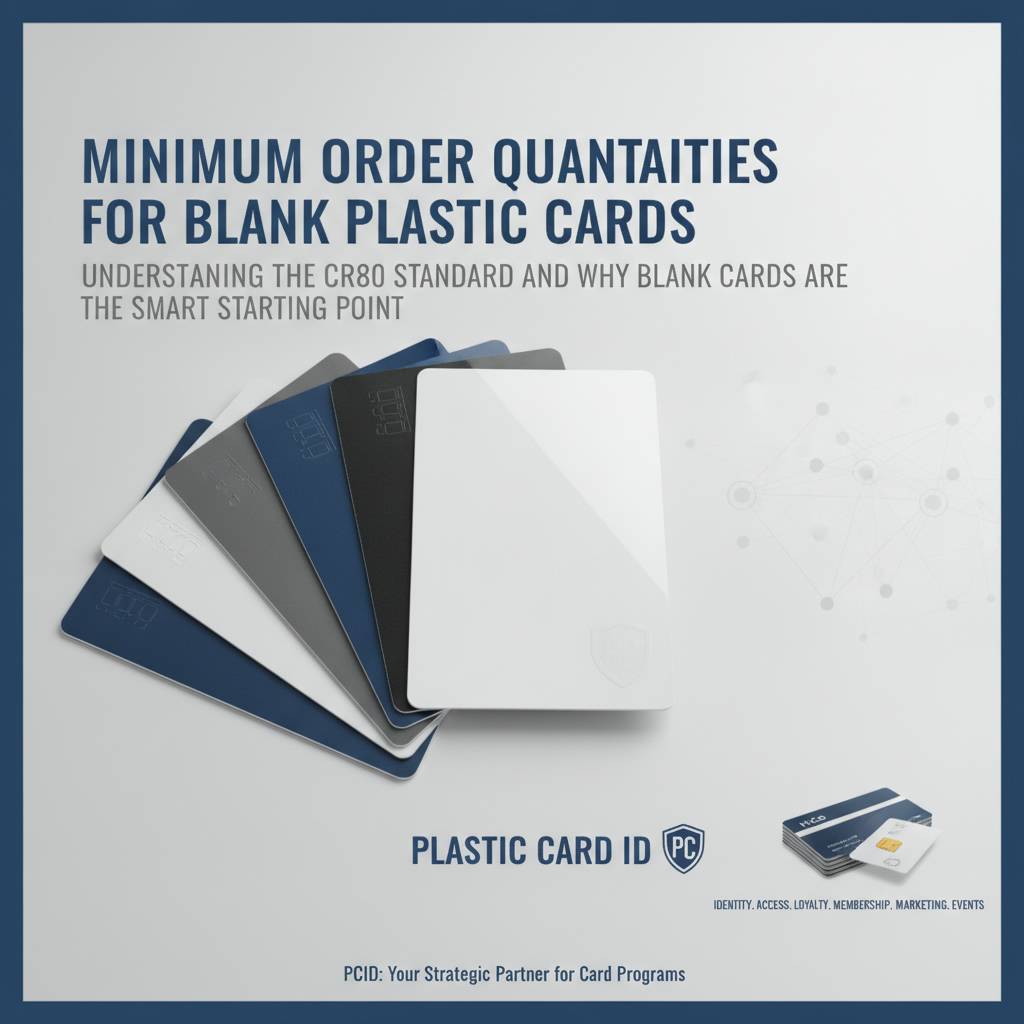 The CR80 card - 3.375 inches by 2.125 inches, 30 mil thick - is the global standard. It is the same size as a credit card, which means it fits perfectly in any wallet, cardholder, or badge slot your operation relies on. Blank CR80 PVC cards are the workhorses of in-house card programs, and they give organizations something that pre-printed cards simply cannot: total design control at the point of production.
Think about what that means in practice. A blank card does not commit you to a design that may change next quarter. It does not lock you into a vendor's timeline. When you print in-house using an Evolis, Zebra, or Fargo printer - all available through CPE - you print on demand, you print exactly what you need, and you maintain the ability to update fields like employee names, photos, and expiration dates without reordering your entire card inventory.
The Per-Card Economics of Ordering Blank Stock
Cost per card drops significantly as volume increases. A 500-card order of standard white PVC CR80 cards might run you $0.20-$0.40 per card, while a 10,000-card order can bring that number down well below $0.10 per card. The math compounds quickly when you factor in that blank cards eliminate custom printing lead times and allow you to respond to immediate staffing, event, or operational needs.
For organizations running ongoing programs - gyms, medical facilities, corporate campuses - maintaining a blank card buffer stock is genuinely one of the most cost-effective infrastructure decisions available. Instead of ordering small batches of pre-printed cards under time pressure, you stock blanks and print to need. The savings in rush fees alone can pay for multiple card orders over the course of a year.
ISO 7810 Compliance and Why It Matters
Every blank card sold by CPE meets ISO 7810 ID-1 standards, which governs card dimensions and material thickness. This compliance ensures your cards will work seamlessly with card printers, lamination systems, badge holders, and magnetic stripe readers that are designed around that standard. Compliance is not a luxury - it is a compatibility guarantee.
Non-compliant cards - often found at suspiciously low prices online - can jam printers, cause uneven printing, or fail to encode properly. The cost of a single printer jam (in time, in wasted ribbon, in potential printer damage) can easily exceed the per-card savings from cutting corners. ISO-compliant blanks from a trusted source protect your equipment investment.
Card Thickness Options and What to Choose
Standard 30 mil cards are the industry default, but 20 mil cards exist for specific applications like lamination overlays or multi-layer constructions. For most business uses - employee badges, loyalty programs, membership cards, event credentials - the 30 mil thickness is correct. It has the right rigidity, the right feel, and the right durability for cards that live in wallets and on lanyards.
Thinner cards are sometimes used in mailer programs where cards are affixed to paper inserts. CPE offers card affixing and mailing services that account for these differences, helping you choose the right card specification for your delivery method. Getting the thickness right the first time prevents waste and reprints.
Minimum Order Quantities Explained Across Card Categories
Not all plastic cards carry the same minimums, and understanding why helps you plan your program more accurately. Simple blank PVC cards have low production complexity, which means suppliers can offer smaller minimums without significant cost penalties. More specialized cards - those with embedded chips, RFID inlays, or magnetic stripes - involve additional manufacturing steps, and minimums tend to reflect that.
The good news is that Plastic Card ID serves businesses starting at 50 cards per month, which puts professional plastic card programs within reach of organizations that once believed they were too small to justify the investment. That is not a marketing claim - it is a genuine commitment to serving businesses at every stage of growth.
Blank PVC Cards: Where Small Orders Make Sense
For standard white PVC CR80 cards, small orders in the range of 100-500 cards are entirely reasonable. A small business setting up its first employee ID program, a nonprofit issuing volunteer credentials, or a school launching a student ID initiative - all of these are viable at modest quantities. The cards themselves are simple to stock, easy to store, and compatible with every major desktop card printer on the market.
Ordering 500 cards might feel like a lot if you have never run a card program before, but consider: a company with 50 employees will go through that supply as badges are replaced, new hires join, and cards are lost or damaged. A loyalty program that issues a card at every new customer registration can burn through 500 cards in a single busy season. Plan for growth, not just your current headcount.
Magnetic Stripe Cards and Why Minimums Are Slightly Higher
HiCo (high coercivity) and LoCo (low coercivity) magnetic stripe cards require an additional manufacturing step to embed the stripe material. HiCo cards, which resist accidental erasure and are preferred for most business applications, typically start at 250-500 unit minimums. LoCo cards, often used for short-term applications like hotel key cards, carry similar minimums.
For retailers launching gift card programs, CPE has the data to back up the investment: retailers switching from paper gift certificates to plastic gift cards consistently see sales increases of 35-50%. That single statistic reframes the conversation about minimums entirely. You are not debating whether to buy 500 cards - you are deciding whether to capture a measurable revenue lift.
RFID, Proximity, and Smart Chip Cards: Technology-Driven Minimums
Cards with embedded technology - RFID inlays, proximity chips, or contact smart chip cards - carry minimums that typically start at 50-100 units for proximity access cards and 100-250 for more advanced smart card formats including MIFARE DESFire. These are not arbitrary numbers; they reflect real production economics tied to chip sourcing and programming overhead.
For facilities managers considering access control upgrades, or casino operations evaluating player card programs, these minimums are rarely a barrier. The more relevant question is system compatibility - ensuring the card frequency and chip format match your existing readers. CPE can guide that conversation with specificity and experience built over 25 years of serving USA-based businesses.
Buyer Tips: How to Calculate the Right Order Quantity for Your Program
 Ordering too few cards means rush reorders at higher per-unit costs, potential program gaps, and administrative headaches. Ordering too many ties up capital in inventory that may need updating before it gets used. The goal is a smart buffer - enough to run smoothly, not so much that you are managing a warehouse. Here is a practical framework for getting it right.
The calculation should factor in your current active cardholders, your estimated monthly issuance rate, your typical card lifespan, and your replacement rate. Most organizations see 10-15% annual card replacement from loss, damage, and turnover. A program with 300 active cardholders issuing 20 new cards per month and carrying a 12% replacement rate needs roughly 560 cards per year - which argues for ordering 500-750 cards to maintain a healthy buffer without overstocking.
Questions to Ask Before You Place Your First Order
- How many active cardholders will your program have at launch?
- How many new cardholders do you expect to add per month?
- What is your estimated card replacement rate due to loss or damage?
- Will your card design change within the next 12-18 months?
- Do your cards need encoding, or are they print-only?
- Are you printing in-house or outsourcing card production?
- What is your storage capacity for card inventory?
Answering these questions before you call gives you the data to have a productive conversation with CPE about the right quantity, the right card type, and the right supporting equipment. The team at Plastic Card ID has helped clients navigate this exact process tens of thousands of times.
Scaling Up: When to Move from Small Batch to Volume Orders
There is a tipping point in every card program where the economics of volume ordering become impossible to ignore. When you are reordering every four to six weeks, the per-unit cost gap between your current order size and the next volume tier likely justifies a larger upfront purchase. Scaling to higher volumes is not just about saving money - it is about reducing operational friction.
At tens of thousands of cards, Plastic Card ID operates as a mass production partner with the capacity and logistics to serve large retail chains, healthcare networks, and enterprise campuses. Moving from 500-card orders to 10,000-card bulk purchases requires a different conversation about storage, delivery scheduling, and card program lifecycle planning - all areas where CPE brings genuine expertise.
Understanding Card Lifespan and Replacement Cycles
A standard PVC card in regular wallet use typically lasts two to three years before showing meaningful wear. Cards used in access control systems - swiped or tapped dozens of times daily - may show wear sooner. Cards stored in badge holders and rarely handled can last significantly longer. Understanding your card's use pattern directly informs your replacement cycle and order frequency.
For programs where cards carry expiration dates - annual memberships, event credentials, or employee badges on a renewal cycle - replacement cycles are built into the program design. This makes annual ordering quantities predictable and easy to budget. Many CPE clients move to annual blanket orders with scheduled deliveries, eliminating the need to reorder reactively.
| Program Size | Recommended Annual Order | Order Strategy |
|---|---|---|
| Under 100 cardholders | 250-500 cards | Single annual order with buffer |
| 100-500 cardholders | 750-2,000 cards | Semi-annual or quarterly orders |
| 500-2,000 cardholders | 3,000-8,000 cards | Scheduled bulk delivery |
| 2,000 cardholders | 10,000 cards | Volume contract with delivery schedule |
The Full Card Catalog: What Comes With Your Order
Blank cards rarely travel alone. A functioning card program involves printers, ribbons, laminates, cleaning kits, and often card carriers or sleeves for distribution. Plastic Card ID operates as a true one-stop shop - everything your program needs to run from day one is available from a single supplier, which eliminates the coordination overhead of managing multiple vendor relationships.
This matters more than it might seem at first. When your printer ribbon runs low, you do not want to discover it is backordered from a different vendor while you have new employees waiting for badges. When your cleaning kit is due, having it available from the same source that supplied your cards and printer keeps your operation running without interruption.
Card Printers from Evolis, Zebra, and Fargo
The three major desktop and mid-volume card printer brands - Evolis, Zebra, and Fargo - each have distinct strengths. Evolis printers are known for elegant design and strong performance in small to mid-size operations. Zebra delivers industrial reliability for high-throughput environments. Fargo has deep roots in ID card and security printing with strong encoding capabilities. Choosing the right printer is as important as choosing the right card stock.
All three brands are fully compatible with the blank PVC cards, magnetic stripe cards, and smart chip cards available through CPE. Pairing the right printer with the right card stock is something the team at Plastic Card ID helps clients navigate - it is not a guessing game when you are working with 25 years of applied experience.
Ribbons, Cleaning Kits, and Consumables
A card printer without the right ribbon is a very expensive paperweight. Ribbon selection - YMCKO, KO, monochrome black, or specialty overlays - depends on your printing requirements, card design, and desired durability. CPE stocks ribbons across all supported printer brands and helps clients match consumables to card specifications accurately.
Cleaning kits are the maintenance side of the equation. Regular cleaning extends printer life dramatically, prevents misprints, and protects the substantial investment a card printer represents. A $30 cleaning kit that saves one printer service call pays for itself many times over. These are the operational details that separate a well-run card program from a frustrating one.
Card Carriers, Sleeves, and Mailing Services
For programs that distribute cards by mail - whether membership renewals, loyalty card launches, or employee onboarding kits - presentation and protection during transit matter. Card carriers keep cards from rattling loose in envelopes, protect printed surfaces from scratching, and provide a professional presentation that reinforces the value of the card being delivered.
The card affixing and mailing services available through Plastic Card ID handle the logistics of getting cards to their recipients efficiently. For retailers launching loyalty programs across multiple locations, or associations mailing membership cards to thousands of members simultaneously, this service removes a significant operational burden. The right fulfillment process turns card distribution from a headache into a smooth program launch.
Specialty Cards and Advanced Applications: What Is Possible at Any Scale
Beyond the standard white PVC card, the catalog extends into territory that surprises some buyers. Clear plastic cards, frosted cards, colored PVC stock in a range of hues, custom die-cut shapes - these options open design possibilities that standard stock cannot match. For luxury membership programs, VIP club access, or premium brand experiences, the card itself becomes part of the value proposition.
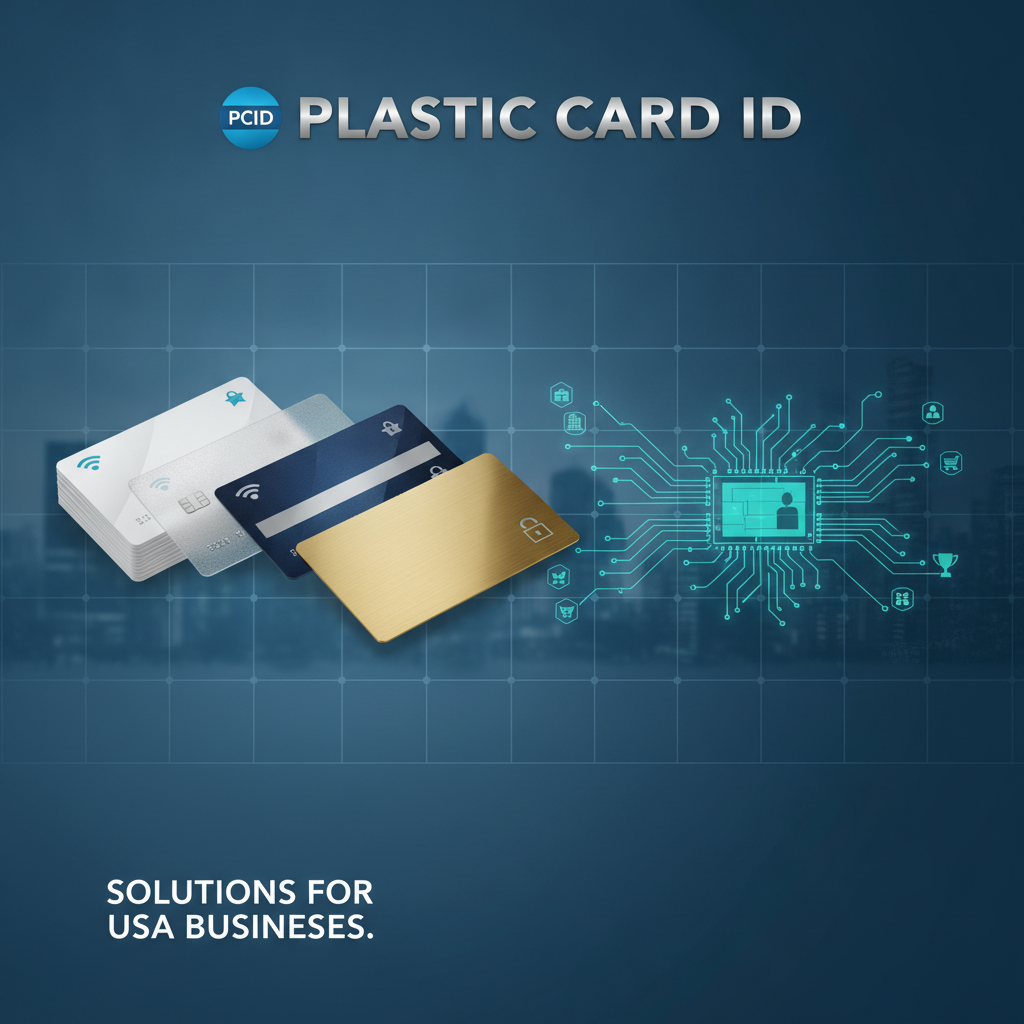
Then there are the technology-forward options: hotel key cards using LoCo magnetic stripes, casino player cards with RFID encoding, proximity access cards for corporate campuses, and contactless smart cards using MIFARE DESFire for high-security environments. At the far end of the spectrum, luxury metal cards in stainless steel, brass, and gold deliver a tactile experience that makes an unmistakable statement about the organization behind them.
Clear and Frosted Cards for Premium Programs
Clear and frosted PVC cards print differently than standard white stock - inks interact with transparent or translucent surfaces in ways that require printer calibration and design consideration. The visual result, however, is striking. A well-designed clear card is genuinely memorable in a way that standard white cannot replicate, which makes it a powerful tool for premium loyalty programs, VIP memberships, and high-end event credentials.
Minimum order quantities for clear and frosted cards are comparable to standard stock - typically 100-500 units depending on the specific product - making them accessible even for boutique programs with limited initial needs. CPE can walk through the design and printing considerations before your first order to ensure results match expectations.
Proximity and RFID Cards for Access Control
Proximity cards operating at 125 kHz are the standard technology for most commercial access control systems. They are passive, durable, and compatible with readers from virtually every major access control vendor. For organizations upgrading from key-based entry or legacy systems, proximity cards represent a significant security and convenience improvement at a reasonable per-card cost.
MIFARE DESFire cards operate at 13.56 MHz and offer encrypted data storage suitable for multi-application deployments - a single card that handles building access, cashless vending, and identity verification simultaneously. The right card technology can consolidate multiple credential types into a single card program, reducing per-person card costs and simplifying the cardholder experience. Call 800.835.7919 to discuss the right technology specification for your access control environment.
Metal Cards and Luxury Credentials
Stainless steel, brass, and gold metal cards occupy a category of their own. They are heavy, precise, and unmistakably premium. For elite membership programs, exclusive clubs, top-tier loyalty tiers, or executive credentials, a metal card communicates status and permanence that no plastic card - however well-designed - can fully match.
Metal cards carry higher per-unit costs and different minimum order considerations, but for programs where the card itself signals membership value, the return on that investment is often immediate and measurable. Members who receive a metal card do not throw it away. They keep it, display it, and talk about it. A metal card is marketing and credential combined.
Frequently Asked Questions About Minimum Orders for Blank Plastic Cards
After 25 years and more than 100,000 customers, certain questions come up reliably. The following captures the most common points of confusion and the straightforward answers that help buyers make confident decisions quickly.
Clarity at the ordering stage prevents problems at the program launch stage. Reading through these questions - even the ones that seem obvious - often surfaces a consideration buyers had not thought about, which is why this section exists. CPE believes informed buyers make better long-term partners, and long-term partnerships are the point.
Common Questions and Direct Answers
- What is the absolute minimum I can order? For standard blank PVC cards, minimums can start as low as 100 cards for many product lines. Some specialty items require 250-500 as a floor.
- Can I mix card types in a single order? Different card types are typically ordered separately since they involve different manufacturing processes and stock. However, a single account can carry multiple active orders simultaneously.
- Do blank cards come with a warranty? Cards that arrive defective or outside ISO specification are replaced. Cards damaged through use, improper storage, or incompatible equipment are not covered.
- How long does delivery take for standard blank card orders? Most standard blank PVC card orders ship within one to three business days, with delivery timelines depending on destination and shipping method selected.
- Is there a price break for ordering larger quantities? Yes. Per-card pricing drops at standard volume tiers, and the savings at 5,000 or 10,000 units versus 500 units can be substantial depending on card type.
- Do you serve businesses outside the USA? Plastic Card ID serves USA-based businesses and organizations exclusively.
For questions not covered above - particularly around technology specifications, printer compatibility, or program design - the team is reachable directly. No question is too specific when it comes to building a card program that actually works.
Storage and Shelf Life of Blank Cards
Blank PVC cards store well when kept away from extreme heat, direct sunlight, and moisture. Stored properly in their original packaging in a climate-controlled environment, blank cards can maintain print-ready condition for several years. This makes bulk ordering a practical strategy - you are not racing a clock to use your inventory before it degrades.
The practical storage consideration is physical space. A case of 500 standard CR80 cards occupies minimal shelf space. A pallet of 50,000 cards is a different conversation. For high-volume programs, CPE can work with clients on staged delivery schedules that match inventory to available storage without requiring a warehouse commitment.
Returning or Exchanging Cards
Blank cards that arrive defective or that fail to meet specification are eligible for replacement. Buyers who order the wrong card type - a common enough occurrence in first-time programs where magnetic stripe versus plain PVC decisions are made without full information - should contact the team as quickly as possible. The earlier a mistake is caught, the more options exist for resolution.
This is another reason why the pre-order conversation matters. A 10-minute call to confirm card type, encoding requirements, and printer compatibility before placing an order eliminates the most common sources of post-order problems. CPE encourages first-time buyers especially to take that step.
Ready to start your card program or scale an existing one? Call 800.835.7919 and talk to a specialist today.
Work With Plastic Card ID and Build a Card Program That Actually Delivers
 Fifty million cards sold. Over a hundred thousand customers served. Programs ranging from 50 cards a month to tens of thousands in a single run. Those numbers represent something more than sales volume - they represent a body of practical knowledge about what works, what does not, and how to help businesses of every size get card programs right without unnecessary cost or complexity.
Minimum order quantities are a starting point, not a ceiling. The right quantity for your program today may be 250 cards. In two years, it may be 25,000. What matters is having a supplier who can serve you well at both ends of that range and everywhere in between - someone who understands your program, your industry, and your goals well enough to give you genuinely useful guidance rather than just a catalog price list.
Why Experience at Scale Changes Everything
When a supplier has processed millions of card orders across hundreds of industries, they have encountered and solved virtually every problem that card programs can generate. That accumulated experience is available to every customer who calls CPE - whether you are ordering 100 cards for the first time or managing a multi-location program requiring tens of thousands of credentials annually.
The value is not just in the cards themselves. It is in the conversation that helps you choose the right card. The recommendation that prevents a printer compatibility issue. The guidance on order quantity that means you never run out at the wrong moment and never overstock unnecessarily. Twenty-five years of this work builds a kind of institutional knowledge that genuinely improves outcomes for buyers.
From Blank Stock to Complete Program Infrastructure
A complete card program is more than cards. It is the printer that produces them, the ribbons that print on them, the cleaning kits that keep the printer running, the sleeves and carriers that protect them, and - for mailing programs - the fulfillment services that get them into cardholders' hands. Plastic Card ID supplies all of it from one source.
That single-source model is not just convenient - it is strategically sound. Compatibility is guaranteed when cards, printers, and ribbons come from the same supplier relationship. Support conversations are faster when one team understands your entire program setup. And ordering is simpler when one account, one relationship, and one phone number covers everything your program needs to operate.
Starting Small and Growing With Confidence
Some of the strongest long-term client relationships at Plastic Card ID started with an order of a few hundred blank cards for a small business that was not entirely sure what it needed. Those clients grew their programs because they had the right foundation, the right support, and the flexibility to scale without switching suppliers or rebuilding systems from scratch.
Starting small is not a limitation - it is a smart way to learn your program needs before committing to volume. CPE is built to support that journey from the first order through whatever scale your program eventually reaches. The minimum order quantity conversation is really just the beginning of a much longer and more valuable relationship.
Plastic Card ID is ready to help you build, launch, or scale your card program today. Call 800.835.7919 and get the expert guidance your program deserves.
Previous Page