Blank Plastic Card Materials Compared: Find Your Best Option
Table of Contents []
- Blank Plastic Card Materials Compared: What Plastic Card ID Wants You to Know Before You Buy
- Standard PVC: The Industry Workhorse and Why It Dominates
- PVC Composite Cards: When Standard Is Not Quite Enough
- Clear and Frosted PVC: Specialty Stock for Premium Impressions
- Colored Stock PVC: Functionality Through Color Coding
- Metal Cards: When the Message Is Luxury
- Choosing the Right Material for Your Card Program with Plastic Card ID
Blank Plastic Card Materials Compared: What Plastic Card ID Wants You to Know Before You Buy
Walk into most card programs blind, and you will overspend, under-specify, or end up with cards that fail six months in. The material a blank plastic card is made from is not a footnote - it is the foundation of every ID badge, loyalty program, membership card, and access credential you will issue. Getting it right the first time saves money, protects your brand, and keeps card programs running without interruption.
This guide breaks down every major blank plastic card material on the market today - from standard PVC to specialty composites, clear stock, and metal - so you can match the right card to the right application with confidence. Whether you are running 50 cards a month or scaling into tens of thousands, understanding material differences will shape every decision you make downstream.
| Material | Durability | Print Compatibility | Best Use Case |
|---|---|---|---|
| Standard PVC | High | Excellent | ID, Loyalty, Membership |
| PVC Composite | Very High | Excellent | Financial-style cards, lamination |
| Clear / Frosted PVC | High | Good (specialty inks) | Premium branding, VIP cards |
| Colored Stock PVC | High | Good | Color-coded access, events |
| Metal (Stainless/Brass/Gold) | Exceptional | Engraving / Laser | Luxury membership, VIP |
Standard PVC: The Industry Workhorse and Why It Dominates
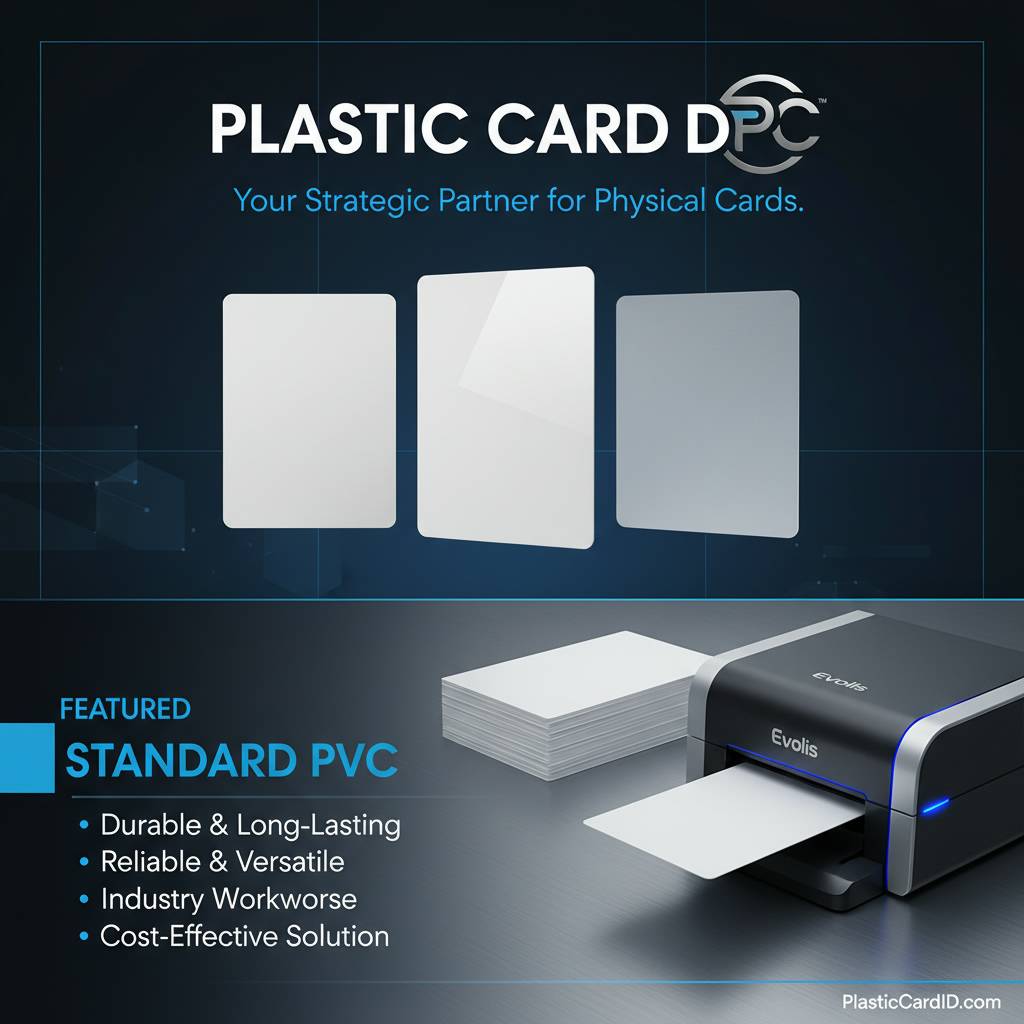 There is a reason standard PVC remains the most widely used blank card material in the United States. The CR80 format, measuring 3.375 x 2.125 inches at 30 mil thickness and fully compliant with ISO 7810, is essentially the universal language of card programs. It fits every wallet slot, every card printer tray, and every lanyard badge holder on the market. Familiarity breeds reliability here.
Standard PVC cards deliver a surface that accepts dye-sublimation printing with exceptional color fidelity, handles UV-protective overlaminates, and accommodates magnetic stripes, signature panels, and embedded chip modules without structural compromise. For organizations running in-house card programs with desktop printers from Evolis, Zebra, or Fargo, blank PVC is the natural starting point - low cost per card, predictable performance, and near-universal compatibility.
What Makes CR80 PVC the Default Choice
The 30 mil thickness is not arbitrary. It is the result of decades of industry standardization that ensures the card flexes without cracking, survives daily use in wallet compression, and maintains enough rigidity for reliable mag-stripe reads and chip contacts. Thinner cards delaminate under stress; thicker cards jam printers. The CR80 sweet spot is proven and precise.
When a business issues an employee badge, a customer loyalty card, or an event credential, the card itself communicates something non-verbal about the organization. A crisp, full-color printed PVC card signals professionalism and investment in the customer relationship. Paper alternatives simply do not carry that weight - physically or psychologically.
Magnetic Stripe Variants: HiCo vs. LoCo
Standard PVC blanks are available with pre-applied magnetic stripes in two coercivity levels. High-coercivity (HiCo) stripes, rated at 2750 Oe, resist accidental erasure from proximity to common magnets and are the preferred choice for access control, employee badges, and any card that will be used regularly over months or years. LoCo stripes at 300 Oe are suitable for short-term applications like hotel keys and event wristbands.
Choosing the wrong coercivity is one of the most common and most preventable mistakes in card program setup. An access card encoded on LoCo stock that gets stored near a phone, a clasp, or another magnetic surface may fail within weeks. Always match the stripe specification to the intended environment and lifespan of the card.
Blank PVC for In-House Printing Programs
Contact CPE at 800.835.7919 to discuss which blank PVC configuration pairs best with your specific card printer model. Not all blank cards perform equally across all printer brands - surface texture, laminate adhesion characteristics, and card feed tolerances vary enough to matter.
In-house card printing programs offer organizations total control over card issuance timing, design updates, and personalization. Buying blank CR80 cards in volume and printing on demand eliminates minimum order quantities for finished cards, reduces lead times to hours instead of weeks, and gives teams the flexibility to update designs without discarding pre-printed inventory. The per-card economics of in-house programs become compelling fast when volumes exceed a few hundred cards per year.
PVC Composite Cards: When Standard Is Not Quite Enough
PVC composite cards are constructed from a blend of PVC and polyester layers fused together under heat and pressure, producing a card that is measurably more durable and more resistant to cracking than pure PVC at the same thickness. The material is the industry standard for financial card issuance - and the same properties that make it ideal for credit cards make it attractive for high-frequency use cases in non-financial applications.
For organizations issuing cards that will be used multiple times daily over multi-year lifecycles - casino player cards, transit credentials, gym membership cards, corporate access badges in high-security environments - composite material offers a meaningful upgrade in card longevity. The cost difference over standard PVC is modest when amortized across card lifespan.
Lamination Compatibility and Card Longevity
Composite cards accept retransfer printing exceptionally well, which is relevant for organizations using retransfer card printers that apply an intermediate film layer onto the card surface. The result is edge-to-edge print coverage with no white border - a feature that transforms the visual quality of ID badges, especially those with full bleed background designs or photographic imagery.
Retransfer-printed composite cards are among the highest-quality finished cards achievable through desktop printer workflows, rivaling the output of commercial offset print runs in color vibrancy and surface consistency. For organizations where card appearance reflects brand value directly, composite plus retransfer is the combination to evaluate.
Use Cases That Justify the Composite Upgrade
Consider the environment the card lives in. A loyalty card that stays in a wallet, handled twice a week for three years, will flex thousands of times. A casino player card might be inserted and ejected from a reader dozens of times per visit. These use patterns stress card cores in ways that standard PVC handles adequately for most users, but composite materials handle with a clear margin of superiority.
Casino player cards, corporate access credentials for enterprise environments, and premium membership cards are the applications where composite material consistently justifies its slightly higher cost. The reduction in card replacement frequency alone often offsets the material premium within the first program year.
Encoding Options Unique to Composite Stock
Composite cards support the same encoding options as standard PVC - magnetic stripes, smart chips, RFID antennas, and signature panels - but the denser layered construction provides a more stable substrate for embedded antenna coils used in contactless cards. This matters for MIFARE DESFire applications and other high-security contactless protocols where antenna integrity directly affects read reliability and encryption performance.
For access control programs using RFID or NFC technology, the antenna-to-substrate bonding in composite cards results in a more consistent contactless read range and a longer functional lifespan for the embedded electronics. It is not a dramatic difference in controlled environments, but in demanding physical deployments it is a difference worth noting.
| Card Type | Mag Stripe | Smart Chip | RFID / Proximity |
|---|---|---|---|
| Standard PVC | Yes | Yes | Yes |
| PVC Composite | Yes | Yes | Yes (preferred) |
| Clear PVC | Yes | Limited | Limited |
| Metal Card | No | Hybrid only | No |
Clear and Frosted PVC: Specialty Stock for Premium Impressions
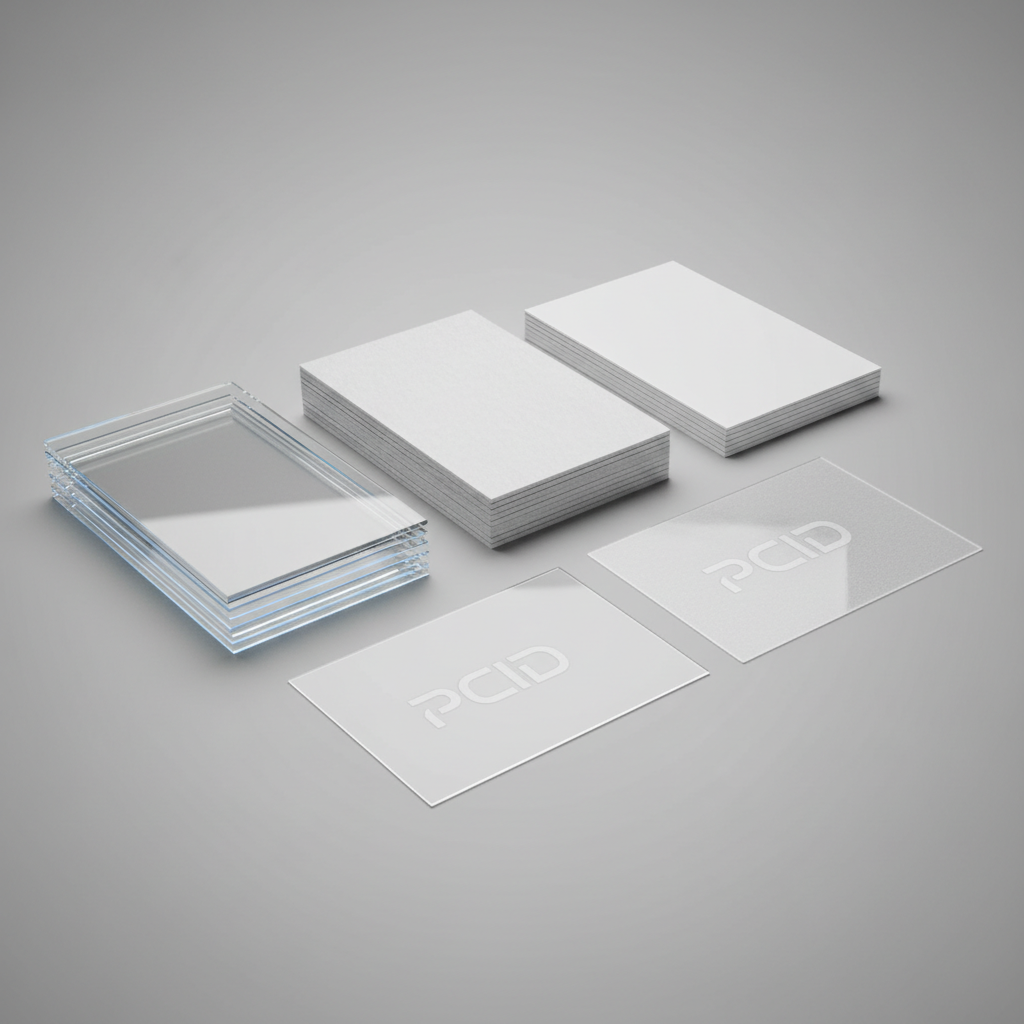 Clear and frosted PVC cards occupy a distinct niche in blank card stock selection. Visually, they communicate something that a standard white card simply cannot: sophistication, intentionality, and a willingness to invest in details that customers notice. A clear plastic card handed to a VIP member or a high-value retail customer creates an immediate tactile and visual impression that paper and standard white cards cannot replicate.
Frosted cards offer a translucent, diffuse surface that softens light and gives printed graphics a distinctive matte-meets-transparent quality. Full clear cards allow color-printed elements to appear as if floating against whatever background the card is held against - a dramatic visual effect when done with high-quality dye-sublimation printing and UV-stable inks.
Printing Considerations for Clear Stock
Clear PVC requires attention to ink compatibility. Not all dye-sublimation ribbon formulations perform equally on non-white surfaces - the absence of an opaque white substrate means color vibrancy is influenced by the card's transparency. White ink underprinting, available on select card printer models, solves this by laying an opaque white layer beneath color graphics to restore vibrancy and prevent color washout.
Organizations considering clear or frosted cards for in-house printing should verify their printer's capability before committing to clear stock inventory. CPE can advise on compatible hardware configurations - and pairing the right printer with the right stock is the difference between stunning results and wasted material.
Where Clear Cards Deliver the Highest ROI
Retailers issuing premium loyalty cards, clubs issuing VIP membership credentials, and event organizers creating collector-quality attendee passes all represent strong use cases for clear stock. The upgrade in perceived card value translates directly into how recipients treat the card - clear cards get kept, displayed, and talked about in ways that white cards rarely inspire.
Gift card programs that switch from paper certificates to premium clear plastic see engagement differences immediately. Customers carry plastic. They share it. They refer to it when making purchase decisions. The physicality of a premium clear card keeps a brand top-of-wallet in ways that digital alternatives struggle to match.
Frosted Cards for Corporate and Access Applications
Frosted PVC has found a natural home in corporate ID and access control environments where the aesthetic of a standard white badge feels dated or misaligned with a brand's visual identity. A frosted card with a minimalist printed design and an embedded proximity chip delivers both function and form - access control capability wrapped in a card that employees are proud to wear.
Hotel key cards represent another strong frosted card application. The translucent surface allows for striking print designs while the underlying PVC construction provides the magnetic stripe reliability that RFID hotel lock systems require. Contact 800.835.7919 to explore frosted and clear card options alongside compatible hotel key encoding configurations.
Colored Stock PVC: Functionality Through Color Coding
Colored PVC card stock serves a purpose beyond aesthetics. In multi-department organizations, event environments with multiple access tiers, and campus settings where visual credential verification must happen quickly and at a distance, color-coded cards do real functional work. A red card cleared for one zone, a blue card cleared for another - staff can make access decisions without scanning or reading a name.
Colored blank cards are manufactured with pigment throughout the PVC core, not just surface-coated. This means the color persists even if the surface is lightly scratched, providing a more durable and tamper-evident color presentation than surface-printed cards on white stock.
Color Options and Organizational Applications
Standard colored stock is available in a practical range of core colors - typically red, blue, green, yellow, and black, with additional specialty colors available in larger volume orders. Organizations running event credentialing programs with multiple access levels can assign colors to tiers and issue the appropriate blank stock to their card printing station for on-demand issuance without pre-sorting or manual color coding.
Schools, universities, healthcare facilities, corporate campuses, and convention centers are among the most consistent buyers of colored card stock for exactly these reasons. The operational efficiency of visual color-coding at scale is genuinely underestimated by organizations that have not tried it.
Black PVC for High-Contrast Printing
Black PVC card stock deserves special mention. A black card printed with metallic silver or white ink creates a dramatic visual contrast that standard white cards simply cannot achieve. For VIP programs, premium membership tiers, and exclusive brand applications, the black card communicates exclusivity without requiring metal card costs or specialty manufacturing.
Black cards print beautifully in white and silver on retransfer printers, and with some direct-to-card printer ribbon configurations that include a white channel. The result is a card that looks custom and premium at a per-card cost that remains well within the range of standard PVC programs.
Metal Cards: When the Message Is Luxury
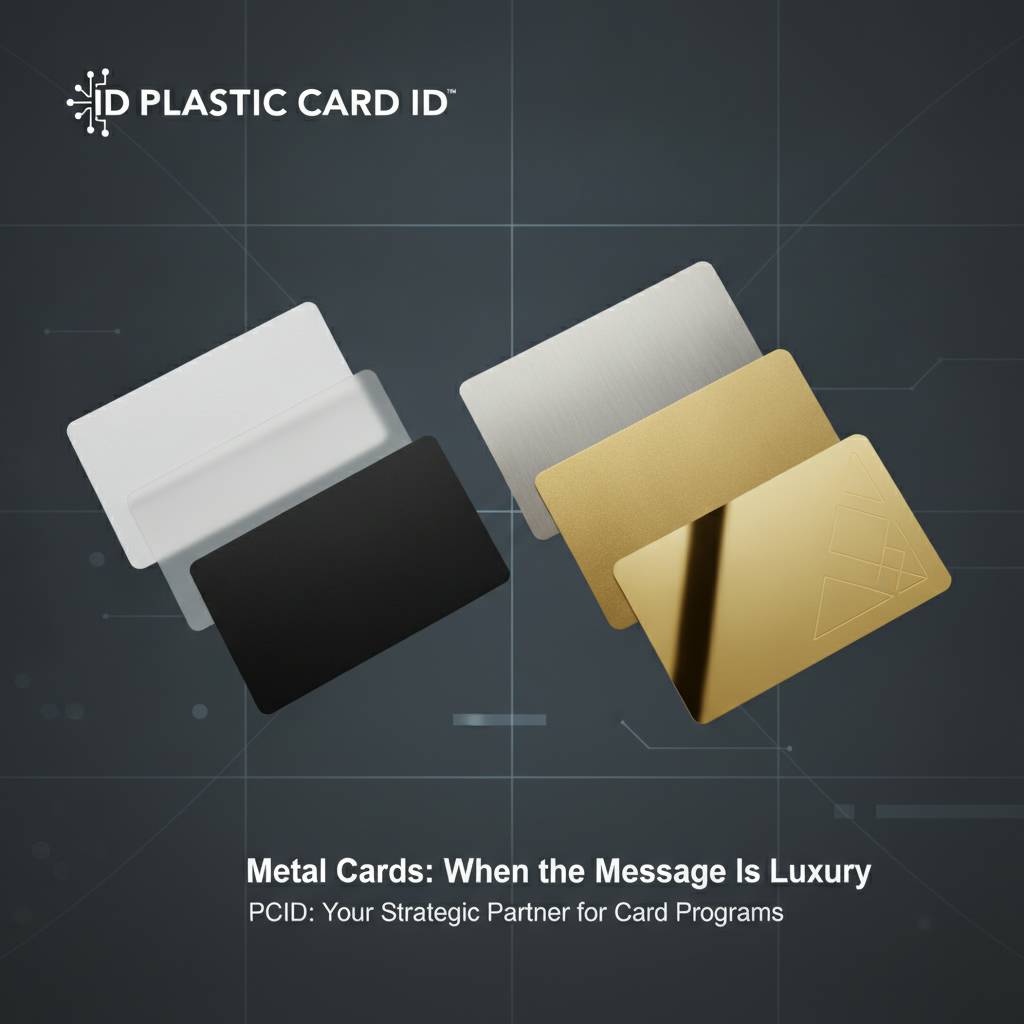
Metal cards exist at a different level of conversation than plastic entirely. In stainless steel, brass, and gold finishes, a metal card is less a credential and more a statement - a physical object that communicates the issuing organization's commitment to the relationship it represents. The weight of a metal card in a recipient's hand is a brand moment that no other card format can replicate.
Luxury membership programs, exclusive clubs, high-net-worth financial advisory firms, premium hotel rewards tiers, and ultra-VIP retail loyalty programs are the environments where metal cards deliver unmistakable return on investment. The card becomes a conversation piece, a status symbol, and a retention tool simultaneously.
Materials and Finish Options
Stainless steel cards offer the most neutral and versatile base - brushed or polished finishes take laser engraving cleanly and resist corrosion through years of use. Brass cards provide a warmer tone and age with a distinctive patina that some luxury programs leverage intentionally. Gold-finished cards deliver the highest visual impact and are most appropriate for ultra-premium positioning.
Engraving depth, cutout patterns, and selective color fill are customization techniques that transform a blank metal card into a precisely branded artifact. These are not quick-turn in-house printing projects - they are purpose-manufactured specialty cards for programs where the per-card cost is a deliberate investment rather than a line item to minimize.
Limitations and Tradeoffs Worth Knowing
Metal cards do not support magnetic stripes, standard embedded chips, or RFID antennas in the same way plastic cards do. Hybrid configurations that incorporate a plastic inlay within a metal frame can accommodate some encoding, but the design must account for these constraints from the start. Pure metal cards function best as non-encoded premium credentials or display items rather than functional access or loyalty program workhorses.
For programs that want the visual prestige of metal for a VIP tier but require encoding functionality, a paired approach works well: a metal card as the premium presentation piece alongside a functional encoded PVC card in the same wallet. This gives members the prestige object and the operational card without compromising either objective.
Pricing Context for Metal Card Programs
- Entry-level stainless steel cards for smaller program quantities typically range from $15-$45 per card depending on customization complexity.
- Brass and gold-finished cards with laser engraving and cutout details may range from $30-$85 per card at moderate volumes.
- Large-volume orders reduce per-card costs significantly - programs ordering 500 or more cards can achieve pricing in the $8-$20 range for standard metal configurations.
- Hybrid metal-plastic cards with embedded encoding capabilities carry premium pricing, typically $25-$75 per card, reflecting the additional manufacturing complexity.
- Always request a formal quote for metal card programs, as customization variables have a larger impact on pricing than with standard PVC stock.
Choosing the Right Material for Your Card Program with Plastic Card ID
The best blank card material is never the most expensive option or the most technically sophisticated - it is the one that matches the specific demands of your program, your printing setup, your card use environment, and your budget. A beautifully specified loyalty card program running on standard CR80 PVC with a well-configured desktop printer will outperform a misspecified composite card program every time. Material selection is always in service of program goals, not the other way around.
What sets CPE apart from transactional card suppliers is the depth of guidance available before a single card ships. With more than 25 years and 50 million cards of accumulated program knowledge serving over 100,000 customers across every industry segment in the United States, the team understands not just what materials exist but which material performs best in which specific deployment scenario. That institutional knowledge is available to every client, whether the order is 500 cards or 500,000.
Buyer Tips: Matching Material to Application
- For employee ID badges used daily over 2-3 year cycles, standard PVC CR80 at 30 mil is the proven standard - upgrade to composite for high-security or retransfer print applications.
- For loyalty and gift card programs, standard white PVC prints beautifully and delivers strong ROI; consider clear or frosted stock for premium tiers where visual differentiation matters.
- For access control and RFID programs, composite substrate improves antenna stability and card longevity - specify HiCo magnetic stripes when combining mag stripe with RFID.
- For event credentials requiring quick visual identification, colored stock PVC eliminates sorting errors and speeds up access lane processing meaningfully.
- For ultra-premium membership or VIP programs, metal cards create a brand moment that plastic cannot match - budget accordingly and plan for longer lead times.
- For in-house printing programs, always verify card stock compatibility with your specific printer model before ordering in volume - a quick call to CPE prevents costly incompatibility issues.
Beyond cards themselves, a complete program requires the right printer ribbons, cleaning kits to maintain print head longevity, card carriers and sleeves for presentation and mailing, and card affixing services for larger outbound campaigns. CPE stocks and supplies all of these as part of a genuine one-stop card program resource.
RFID, Smart Chip, and Proximity Card Material Considerations
Smart card programs introduce an additional material variable: the embedded electronics. RFID antennas and chip modules are laminated between card layers during manufacturing, and the substrate material directly affects how well those components survive the card's operational life. Composite materials and high-quality PVC laminates both perform reliably for most applications, but extreme-environment deployments - outdoor access control, industrial facility credentialing, hospitality environments with frequent cleaning - benefit from denser composite construction.
MIFARE DESFire technology, used in high-security contactless access control and advanced loyalty applications, requires specific card constructions to maintain cryptographic integrity and read performance over the card's lifespan. Specifying the wrong substrate for a DESFire program is a mistake that manifests months down the line in field failure rates, not at the point of sale. Expert guidance from the start prevents expensive mid-program corrections.
Getting the Most from Your Blank Card Investment
Volume planning is one of the most impactful decisions in any card program, and it is directly tied to material selection. Higher volumes justify composite or specialty stock upgrades that would not pencil out at low volumes. In-house printing programs with predictable monthly card volumes benefit from stocking blank PVC in quantities that reduce per-card costs while maintaining fresh inventory rotation for cards with pre-applied encoding components.
Partnering with Plastic Card ID means having access to the full catalog - blank PVC across all configurations, specialty stock, encoded blanks, metal cards, card printers, ribbons, and all supporting supplies - under one relationship. Call 800.835.7919 today and let the Plastic Card ID team help you build a card program specification that performs from day one. The right material, matched to the right program, issued through the right equipment, is how card programs succeed long-term - and that conversation starts here.
Previous Page