Blank Plastic Cards for RFID Access Systems Explained
Table of Contents []
- Blank Plastic Cards for RFID Access Systems - Plastic Card ID
- What Makes a Blank RFID Card Different From an Ordinary Plastic Card
- Why Buying Blank Cards Gives Your Organization Maximum Control
- RFID Access Cards for Every Industry and Application
- Choosing the Right Blank RFID Card Specification
- Frequently Asked Questions About Blank RFID Cards
- Ordering, Shipping, and Volume Programs With Plastic Card ID
Blank Plastic Cards for RFID Access Systems - Plastic Card ID
Walk into nearly any modern office building, hospital, university campus, or government facility and you will notice something: people are tapping cards, waving badges, and moving through secured doors without fumbling for keys or typing codes. That seamless flow of access is powered by blank plastic cards engineered for RFID technology - and the quality of those cards determines how reliably your entire access system performs.
Plastic Card ID has been supplying blank and custom plastic cards to businesses across the United States for over 25 years. More than 100,000 customers and 50 million cards later, the team understands something that many buyers only learn after a frustrating experience with a lesser supplier: not all blank RFID cards are built the same, and choosing the right card stock for your access system is a decision that pays dividends every single day your program is running.
| Card Type | Frequency | Common Use | Format |
|---|---|---|---|
| Proximity Access Card | 125 kHz | Door access, time and attendance | CR80, 30 mil |
| MIFARE Classic | 13.56 MHz | Campus ID, transit, loyalty | CR80, 30 mil |
| MIFARE DESFire EV3 | 13.56 MHz | High-security access, government | CR80, 30 mil |
| HID Compatible Card | 125 kHz | Corporate security, parking | CR80, 30 mil |
| Dual Interface Smart Card | 13.56 MHz Contact | Multi-application enterprise | CR80, 30 mil |
What Makes a Blank RFID Card Different From an Ordinary Plastic Card
 Standard blank PVC cards are impressive in their own right - a 30 mil CR80 card is durable, professional, and wallet-sized to the ISO 7810 standard that card printers and cardholders worldwide expect. But an RFID-enabled blank card carries something hidden inside the PVC laminate: an antenna and an integrated circuit. That embedded technology is what transforms a simple plastic rectangle into a functional access credential.
The antenna is typically a coil of copper wire or etched aluminum laminated between layers of PVC. When this card enters the read range of a compatible reader, the antenna harvests energy from the reader's electromagnetic field - no battery required - and the chip wakes up to transmit its stored data. The entire exchange happens in milliseconds. CPE stocks a wide range of these cards precisely because access systems vary enormously in their frequency requirements and memory demands.
125 kHz Proximity Cards: The Workhorses of Physical Access
Low-frequency proximity cards operating at 125 kHz have been the backbone of commercial door access systems for decades. They are simple, robust, and compatible with an enormous installed base of readers across the United States. If your facility already runs an HID, EM4100, or similar 125 kHz-based system, these blank proximity cards slot directly into your existing infrastructure without requiring any hardware upgrades.
The read range on a typical proximity card falls between 2 and 12 inches depending on the reader and card quality. That is enough for a smooth tap-and-go experience at a door without being so sensitive that cards in a pocket trigger unwanted reads. For employee badging, time-and-attendance tracking, and general door control, 125 kHz proximity cards represent a cost-effective and proven solution.
13.56 MHz Smart Cards: Where Security Gets Serious
High-frequency smart cards operating at 13.56 MHz - the MIFARE family being the most widely deployed - offer dramatically more capability than basic proximity cards. These cards store encrypted data in memory sectors, support mutual authentication between card and reader, and can carry multiple applications on a single card. A campus ID card, for instance, might handle building access, meal plan debits, library privileges, and event admission all from one card.
MIFARE DESFire EV3 represents the current pinnacle of contactless smart card security available in a standard CR80 form factor. With AES-128 encryption, advanced anti-cloning mechanisms, and flexible file structures, DESFire is the card of choice for government facilities, healthcare campuses, and any organization where credential forgery is a serious concern. Plastic Card ID supplies these cards blank, ready for your encoding workflow.
Dual Interface Cards: One Card, Two Worlds
Some enterprise applications demand both contactless convenience and the additional security verification of a physical chip contact. Dual interface cards carry an embedded ISO 7816 contact chip alongside the RFID antenna, making them compatible with both tap readers and contact readers in a single credential. This is especially common in large corporate environments where some readers were upgraded to contactless while legacy contact-based stations remain in service.
Stocking dual interface blank cards means you are not painting yourself into a corner as your access infrastructure evolves. Organizations that manage multiple building types, partner facilities, or transitional security upgrades will find dual interface cards to be a remarkably flexible investment. Order them blank and print employee photos, names, and departments on-site with a compatible card printer.
Why Buying Blank Cards Gives Your Organization Maximum Control
There is a fundamental difference between ordering pre-printed cards from a third party and maintaining an in-house card program with blank stock. When you control the blank cards, you control the timeline. An employee starts Monday morning - their badge is ready Monday morning. A contractor's access expires Friday - you update and reissue without sending anything out of house. The organization that owns its blank card inventory never waits on a vendor's production schedule.
Cost efficiency compounds over time with blank card programs. The per-card price of a blank RFID card is lower than ordering individually personalized, pre-printed credentials. Add a desktop card printer from Evolis, Zebra, or Fargo and you gain the ability to produce professional, photo-quality badges on demand. CPE carries the full ecosystem - cards, printers, ribbons, and cleaning kits - so you are not cobbling together solutions from different suppliers who may not play well together.
Calculating the Real Cost of Your Card Program
Buyers sometimes focus exclusively on the per-card price and miss the full picture. True program cost includes card stock, encoding (if done externally), printer consumables, replacement cards for lost or damaged credentials, and the labor involved in card management. When you run the numbers across a year, an in-house blank card program typically outperforms outsourced card production once you are issuing more than 50-75 cards per month.
For organizations issuing fewer than 50 cards monthly, bulk purchasing blank RFID cards in advance still reduces per-card costs compared to on-demand ordering. Plastic Card ID offers volume pricing that rewards buyers who stock up - and RFID blank cards store without degradation when kept in reasonable conditions, so there is little risk in purchasing a quarter's worth of inventory at once.
Encoding Blank RFID Cards In-House
The blank card is only half the equation. To function in your access system, each card needs to be encoded with its unique identifier or, in the case of smart cards, its secure application data. Many desktop card printers from the Evolis, Zebra, and Fargo lineups include built-in RFID encoding modules, allowing you to print and encode in a single pass. This is the most efficient workflow available for organizations managing their own card programs.
For facilities that already have an encoding station separate from their printer, blank RFID cards can be batch-encoded before printing or handed to cardholders blank with encoding handled at the reader. The specific workflow depends on your access control software, but CPE can help you match the right blank card specification to your existing hardware so nothing gets lost in translation.
Protecting Your Card Investment With the Right Accessories
A quality blank RFID card is durable - 30 mil PVC construction resists bending, scratching, and everyday wear better than paper or thin-stock alternatives. But protecting that investment with proper card carriers, badge holders, and lanyards extends card life further and presents a more professional image. Plastic Card ID supplies card accessories alongside card stock so you can outfit your entire program in one order.
Card sleeves and protective overlaminates are particularly relevant for access cards that see heavy daily use - security desk check-in cards, visitor passes, and contractor badges. A sleeve adds a meaningful layer of abrasion resistance and keeps magnetic stripe data on combo cards from degrading prematurely. Small accessory decisions compound into measurable savings over a multi-year card program lifecycle.
RFID Access Cards for Every Industry and Application
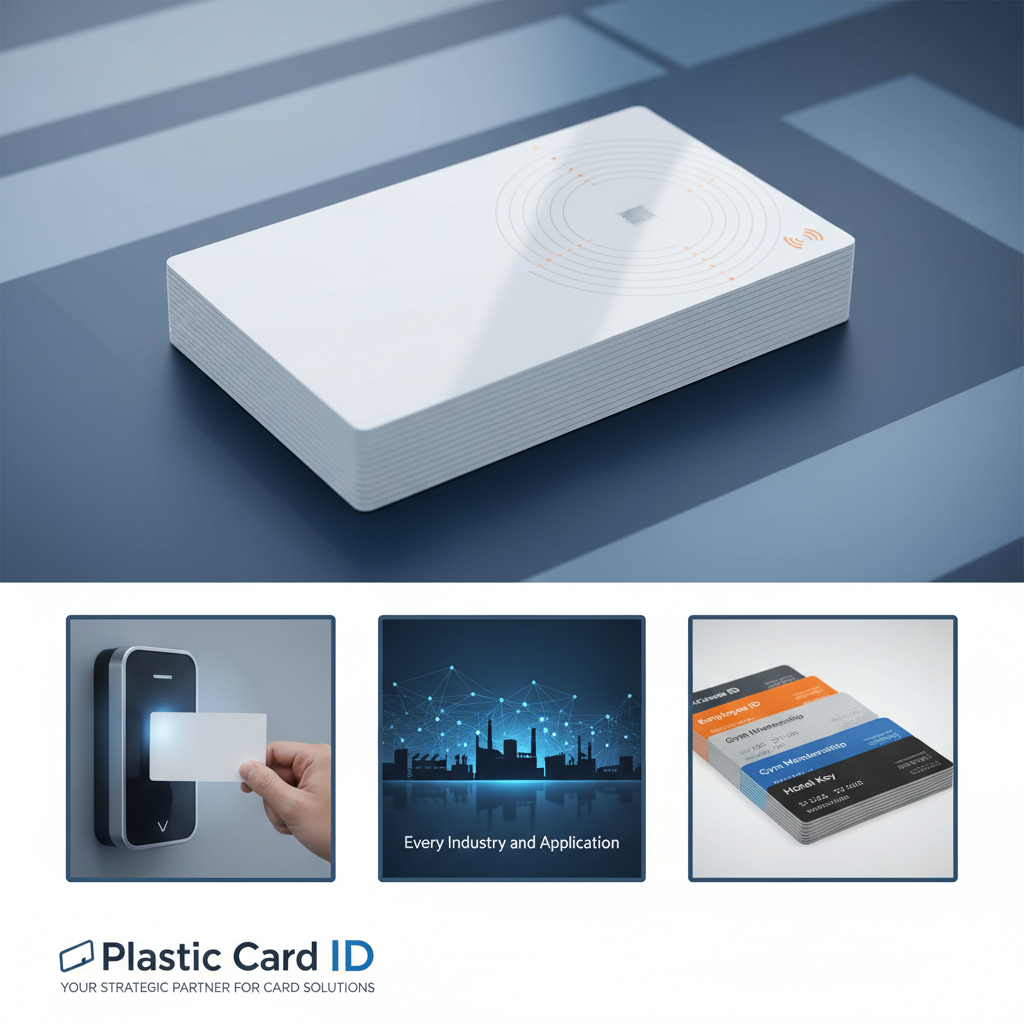 Blank RFID cards are not a one-size-fits-all product, and the industries using them are as varied as the access problems they solve. Healthcare facilities need cards that survive sanitizing wipe-downs and work reliably near electromagnetic equipment. Universities want cards flexible enough to handle a dozen different applications. Corporate campuses want high-security credentials that are difficult to clone. Each of these requirements points toward different card specifications - and Plastic Card ID stocks them all.
What cuts across every industry is the underlying need for credentials that work the first time, every time. A failed door access at 2 a.m. is more than an inconvenience - it is a security gap and potentially a safety risk. Sourcing blank RFID cards from a supplier with 25 years of experience and a track record across 100,000 customers means you are not experimenting with your physical security infrastructure.
Corporate and Enterprise Access Control
Multi-building corporate campuses represent some of the most demanding RFID card environments. Cards must survive daily use across parking gates, elevator controls, server room doors, and executive suite access - all potentially running on different reader generations with different security profiles. HID-compatible and MIFARE DESFire cards are the dominant choices here, and Plastic Card ID supplies both in bulk quantities with fast turnaround.
For large enterprises, the ability to order tens of thousands of blank RFID cards at consistent quality is not optional - it is foundational. Lot-to-lot variation in chip quality or antenna performance creates headaches in high-volume deployments. Consistent card specifications across every order is something the CPE team prioritizes because enterprise clients cannot afford to re-test every new shipment.
Healthcare and Hospital Badge Programs
Hospitals and healthcare networks use RFID access cards for staff credentialing, controlled substance room access, patient area security, and equipment tracking. These environments are tough on cards - frequent hand washing, glove use, and proximity to medical equipment all challenge card performance. Healthcare buyers should look at cards with robust laminate construction and chips rated for extended read/write cycles.
Beyond access control, many healthcare organizations combine their staff ID badge with the RFID credential, printing employee photos, department information, and emergency contact details directly on the blank card using an on-site Evolis or Zebra printer. This dual-purpose design reduces the number of cards each employee carries and makes it immediately clear whether someone belongs in a given area. A well-designed healthcare badge program enhances both security and workflow.
Universities and Campus Card Programs
A modern campus card might do more work than any other credential in any other sector. Student ID, building access, dining, library, recreation center, transit - the list of applications a single card can carry is remarkable when backed by a capable MIFARE smart card. Universities that issue thousands of new cards each fall semester need a reliable blank card supplier who can scale to demand without quality slippage.
- MIFARE Classic 1K and 4K for mid-range campus applications
- MIFARE DESFire EV3 for high-security research buildings and data centers
- Combo mag stripe and RFID cards for legacy system compatibility
- Clear or frosted card stock for visually distinctive VIP or faculty tiers
- Bulk blank card orders to align with enrollment cycles and reduce per-card cost
Campus card offices that stock several semesters' worth of blank RFID inventory avoid the scramble that occurs when a late enrollment surge hits. Plastic Card ID works with university card offices across the country and understands the seasonal demand patterns that make advance bulk ordering a smart strategic move.
| Industry | Recommended Card | Key Requirement |
|---|---|---|
| Corporate Enterprise | MIFARE DESFire / HID | High security, anti-cloning |
| Healthcare | MIFARE Classic / DESFire | Durability, multi-application |
| University | MIFARE 1K/4K or DESFire | Multi-app, high volume |
| Hotel / Hospitality | MIFARE Classic | Fast encoding, room key use |
| Government | MIFARE DESFire EV3 | AES encryption, compliance |
Choosing the Right Blank RFID Card Specification
Shopping for blank RFID cards without knowing your system's requirements is like ordering a printer without knowing whether you need inkjet or laser. The specification that matters most is frequency - your access control readers operate at either 125 kHz or 13.56 MHz, and the cards you purchase must match. Mixing frequencies results in cards that simply do not read, which is a frustrating and preventable problem.
Beyond frequency, smart card buyers need to consider memory capacity and encryption support. A basic 125 kHz proximity card stores only a static ID number - there is nothing to configure beyond what the manufacturer writes at the factory. A MIFARE DESFire card, by contrast, requires application setup and key management before it will function in your system. Understanding your access software's card requirements before purchasing saves time, money, and a great deal of frustration.
Matching Cards to Your Existing Readers
The fastest way to confirm card compatibility is to check your reader manufacturer's documentation or contact their support line. Most commercial access control brands - HID Global, Allegion, Lenel, ASSA ABLOY, and others - publish the card formats their readers support. Cross-reference that list against Plastic Card ID's catalog and you will have a clear, confident purchase decision.
If your facility is planning a reader upgrade alongside a card re-issuance, this is an ideal time to evaluate moving from 125 kHz to 13.56 MHz. The security benefits of modern smart cards are substantial, and a simultaneous reader and card upgrade eliminates the transition awkwardness of running two card populations in parallel. CPE can help you think through the timing and volume requirements.
Card Thickness, Overlay, and Combo Options
Standard blank RFID cards arrive in the CR80, 30 mil format - the same dimensions as a credit card, fully compatible with all major desktop card printer brands. Some specialty applications call for variations: slightly thinner cards for certain printer feeders, cards with a pre-applied signature panel for employee ID use, or cards with a magnetic stripe in addition to the RFID chip for systems that still rely on mag stripe verification at legacy readers.
Combo RFID-plus-magnetic stripe cards are particularly popular in hospitality and corporate environments where older mag stripe readers coexist with newer contactless ones. A single card serves both reader types, reducing the number of credentials an employee or guest carries. Plastic Card ID stocks these combination cards in both HiCo and LoCo magnetic stripe configurations, giving your program flexibility across mixed-reader environments.
Specialty Formats: Clear, Frosted, and Custom Shapes
Standard white PVC blank cards are the default for good reason - they provide a clean printing surface, consistent opacity for photo ID printing, and broad compatibility with card printer ribbons. But some programs benefit from visual differentiation. Clear and frosted RFID cards give a distinctive, premium appearance that organizations use to distinguish VIP access tiers, executive credentials, or special-event passes from standard employee badges.
Custom die-cut RFID cards in non-standard shapes are also available for applications where novelty and branding matter - trade show exhibitor badges, resort access passes, and themed event credentials. Even luxury metal RFID cards in stainless steel, brass, or gold finishes are part of the Plastic Card ID catalog for programs where the credential itself sends a message about exclusivity and quality.
Frequently Asked Questions About Blank RFID Cards
Buyers new to RFID card procurement often arrive with a mix of technical questions and practical concerns. The questions below reflect the most common points of confusion - and the answers that help organizations make confident, well-informed purchasing decisions.
Can I Print on Blank RFID Cards With a Standard Card Printer?
Yes - with the right printer. Most desktop card printers from Evolis, Zebra, and Fargo are designed to accept standard CR80, 30 mil cards. Because RFID chips and antennas are laminated inside the card body and do not affect the surface, the printing process is identical to printing on a non-RFID blank card. The key is ensuring your printer's feeder and rollers are clean, as debris can cause cards to jam or print inconsistently.
For encoding, you need either a printer with a built-in RFID encoding module or a standalone encoding station. Not all printers include encoding capabilities as standard - some offer it as an add-on module. If you are purchasing a new printer alongside blank RFID cards, CPE recommends confirming encoding capability before finalizing the printer selection. Matching your printer's encoding module to your card's chip type is an easy step to overlook but a critical one.
What Is the Shelf Life of Blank RFID Cards?
Blank RFID cards stored in their original packaging in a climate-controlled environment maintain performance for many years. The chip and antenna assembly is fully enclosed within the PVC laminate, protecting it from moisture, dust, and physical damage. Most manufacturers rate their chips for a minimum of ten years of data retention and hundreds of thousands of read/write cycles - far beyond what most organizations will ever use in the card's working life.
The practical implication is that buying blank RFID cards in larger quantities to take advantage of volume pricing carries very little risk of obsolescence due to degradation. Cards do not expire while sitting in a box. Bulk purchasing is a financially sensible strategy for organizations with predictable ongoing card needs, and Plastic Card ID structures its volume pricing accordingly.
How Do I Reach Plastic Card ID for Card Selection Guidance?
Plastic Card ID operates as a strategic partner, not merely a catalog order taker. When you are unsure which blank RFID card specification matches your access system, the team is ready to help you work through the decision - whether that means reviewing your reader documentation together, discussing volume requirements, or recommending compatible printer options from the Evolis, Zebra, and Fargo lineups.
Reach the team directly at 800.835.7919. Buyers placing their first RFID card order are especially encouraged to call before purchasing - a five-minute conversation can prevent a costly mismatch between card specification and reader infrastructure. Expert guidance at the point of purchase is part of what 25 years of experience looks like in practice.
Ordering, Shipping, and Volume Programs With Plastic Card ID
Placing a blank RFID card order with Plastic Card ID is straightforward - but the structure of that order matters more than most buyers initially realize. Minimum order quantities, volume pricing tiers, and lead times all interact to shape the best ordering strategy for your program. Whether you need 500 blank proximity cards for a small office or 25,000 MIFARE DESFire cards for a hospital network expansion, the approach should fit the scale of your program.
CPE serves programs of every size - from a single-location gym issuing 50 membership cards a month to national enterprises managing tens of thousands of credentials across dozens of facilities. The same care and consistency in card quality applies at every volume level. You are never too small to receive professional service and never too large to be accommodated.
Volume Pricing Tiers and What to Expect
Blank RFID cards are priced on a per-unit basis that decreases meaningfully as order quantities increase. Entry-level orders typically start in the range of 100-500 cards, with mid-volume pricing kicking in at 500-2,500 cards and significant bulk pricing available above 5,000 units. For very large programs ordering 25,000 cards or more, Plastic Card ID offers custom pricing arrangements that reflect the scale of the commitment.
The smartest buyers align their order quantity with their projected 90-day consumption rather than ordering just enough to get through the next few weeks. The per-card savings from moving up one pricing tier often exceed the carrying cost of holding slightly more inventory. Thinking in quarters rather than weeks is the habit that separates efficient card program managers from reactive ones.
Shipping and Turnaround for RFID Card Orders
Standard blank RFID card orders ship from Plastic Card ID's US-based fulfillment operation to destinations across the country. Standard processing and shipping timelines are clearly communicated at the point of order. For programs with time-sensitive needs - a new facility opening, a large enrollment event, or an emergency re-issuance after a security incident - expedited options are available.
Because Plastic Card ID serves USA-based businesses exclusively, there are no international shipping complications, customs delays, or currency conversion issues. Domestic fulfillment means predictable delivery windows and direct support if any issue arises with an order. For ongoing programs, establishing a recurring order cadence with CPE reduces the administrative overhead of repeat purchasing decisions.
The Full One-Stop Ecosystem for Your Card Program
Blank RFID cards are the foundation, but a complete card program requires more than card stock alone. Plastic Card ID supplies everything that surrounds the card: Evolis, Zebra, and Fargo desktop card printers; printer ribbons in full color and monochrome; cleaning kits to maintain print quality and card feed reliability; card carriers and sleeves to protect credentials in daily use; and card affixing and mailing services for programs that distribute credentials by post.
- Blank RFID and proximity cards in 125 kHz and 13.56 MHz formats
- MIFARE Classic, DESFire EV3, and HID-compatible card stock
- Dual interface smart cards for contact and contactless environments
- Desktop card printers with optional RFID encoding modules
- Color and monochrome printer ribbons for all major printer brands
- Card cleaning kits and maintenance supplies
- Badge holders, lanyards, card sleeves, and protective accessories
- Card affixing and mailing services for distributed credentialing programs
Consolidating your card program supplies with a single supplier simplifies procurement, reduces shipping costs, and means you are working with a team that understands how every component in your program interacts. A one-stop card program partner is simply more efficient than managing five different vendor relationships for products that are all meant to work together.
Ready to source blank RFID cards that match your access system perfectly? Contact Plastic Card ID today and speak with a card program specialist.
Call Plastic Card ID now at 800.835.7919 - your access card program deserves a partner with 25 years of proven expertise and over 50 million cards of real-world experience behind every recommendation.
Previous Page
Next Page