Blank Plastic Cards for Barcode Scanning Applications
Table of Contents []
- Blank Plastic Cards for Barcode Scanning - Plastic Card ID
- Why the Card Surface Makes or Breaks Barcode Performance
- The Full Catalog: Blank Card Varieties Built for Scanning
- Card Printers That Make Barcode Cards Print-Ready
- Applications: Who Uses Blank Barcode Cards and Why
- Buyer's Guide: Choosing the Right Blank Cards for Barcode Scanning
- Your Next Step with Plastic Card ID
Blank Plastic Cards for Barcode Scanning - Plastic Card ID
Walk into almost any well-run operation - a hospital, a gym, a university bookstore, a warehouse - and somewhere in that environment, a barcode gets scanned. Fast, accurate, repeatable. The magic isn't just in the scanner. It starts with the card itself. If your blank plastic cards aren't built to scan reliably every single time, the whole system breaks down. That's where Plastic Card ID comes in.
With more than 25 years supplying plastic cards to businesses across the United States, CPE has helped over 100,000 customers build card programs that actually work - day after day, scan after scan. Whether you need 50 cards this month or fifty thousand, the foundation of a great barcode card program is a great blank card. This page tells you exactly what to look for and why it matters.
| Card Type | Best Use Case | Barcode Compatible | Additional Features |
|---|---|---|---|
| Blank White PVC CR80 | ID, loyalty, membership | Yes - full surface print | Standard workhorse card |
| Magnetic Stripe Barcode | Loyalty, access, retail | Yes - dual encoding | HiCo or LoCo stripe |
| RFID Smart Card | Access control, events | Yes - printable surface | Contactless visual barcode |
| Clear / Frosted PVC | VIP, specialty programs | Yes - with proper ink | Premium visual appeal |
| Colored Stock PVC | Color-coded systems | Yes - contrast-dependent | Department or tier sorting |
Why the Card Surface Makes or Breaks Barcode Performance
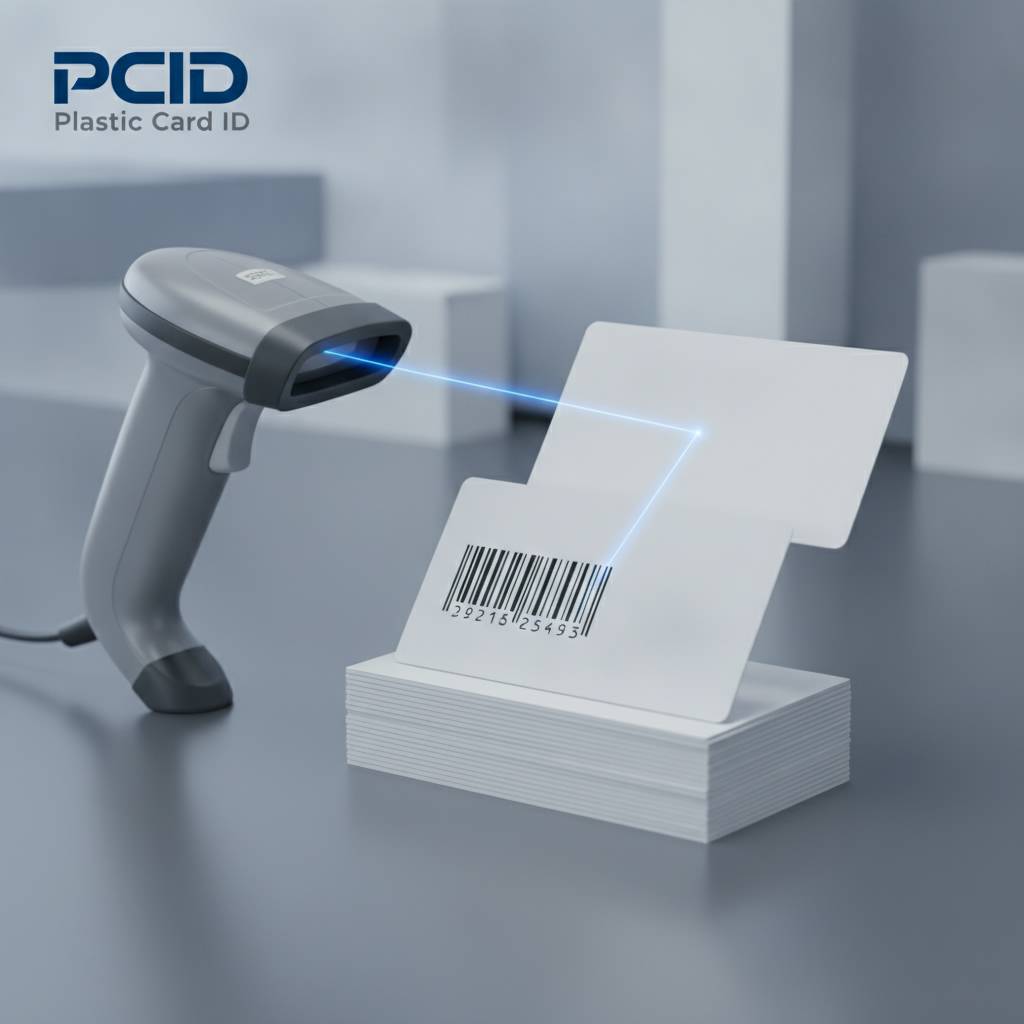 Most people focus on the printer or the scanner when troubleshooting barcode read failures. Rarely do they look at the card itself - and that's a mistake. The surface quality of a blank plastic card directly determines how cleanly a barcode prints and how reliably it scans. Inconsistent coatings, uneven stock thickness, or substandard PVC compounds can cause ink adhesion problems that corrupt the barcode's readability before the card is even put into use.
Standard CR80 blank PVC cards - measuring 3.375 x 2.125 inches at 30 mil thickness - are the ISO 7810 benchmark for a reason. That spec isn't arbitrary. It reflects decades of real-world testing across card printers, scanners, and handling conditions. When CPE sources blank cards, consistency in those dimensions and surface finish is non-negotiable. Variance of even a fraction of a millimeter can cause feed errors in direct-to-card and retransfer printers alike.
Surface Finish Types and Their Impact on Barcode Clarity
Glossy and matte surfaces behave differently under a card printer's print head. Glossy cards produce sharper barcode lines - tighter dots, higher contrast - which is generally preferred for 1D barcodes like Code 128 or Code 39. Higher contrast means faster, more reliable scanning across a wider range of scanner types. For operations running hundreds of scans per day, that consistency compounds into real operational efficiency.
Matte cards scatter light differently, which can slightly reduce the optical contrast of a printed barcode unless the ribbon and printer settings are optimized for that surface. That said, matte finishes are often preferred in environments where glare is a problem - certain lighting conditions in warehouses or event venues, for example. Understanding the trade-off matters when selecting your blank card stock.
Thickness, Rigidity, and Feed Reliability
A 30 mil PVC card is the gold standard for a reason. Cards that run thin - even slightly - can misfeed in high-volume printers, creating print misalignment that throws a barcode off-spec. Cards that are too rigid or brittle may crack at swipe points or flex zones, degrading the printed barcode over time. The right card stock balances durability with just enough flex to survive wallet life, badge holders, and repeated handling.
For operations printing in-house with Evolis, Zebra, or Fargo printers - all of which Plastic Card ID carries - blank card stock consistency is critical. These printer brands are engineered around standard CR80 tolerances. Using off-spec cards voids the reliability guarantee of even the best printer hardware. It's a systems issue, not a printer issue or a scanner issue - and it starts with the blank card.
Why Blank Cards Beat Pre-Printed Stock for Barcode Programs
Pre-printed cards lock you into a vendor's timeline, their minimum order quantities, and their design decisions. Blank cards give your organization total control over what goes on each card, when, and in what sequence. That's not a small thing - it's the difference between a rigid card program and an agile one that can adapt to changing membership rosters, inventory systems, or event configurations.
For businesses that need serialized barcodes - where each card has a unique number - printing in-house on blank stock is the only practical approach at anything below industrial pre-print volumes. You feed your database into your card printer software, print a batch of uniquely coded cards, and you're done. No waiting on a third-party print run. No minimum of 5,000 cards to get a reasonable price. Just your cards, your timeline, your program.
The Full Catalog: Blank Card Varieties Built for Scanning
Not every barcode card program looks the same. A hospital tracking patient wristband data has different needs than a fitness club issuing member check-in cards, or a retailer building a gift card program that drives 35-50% higher sales compared to paper alternatives. Plastic Card ID carries a comprehensive range of blank card stock precisely because real programs have real variation.
The catalog spans everything from standard white PVC to clear, frosted, and colored stock options. It includes magnetic stripe cards in both HiCo and LoCo formats, RFID and proximity cards for contactless access, and smart chip cards for high-security applications. Every card type in the lineup is printable, meaning barcode integration is possible across the entire range. The right card depends on your specific program requirements.
Standard White Blank PVC Cards
These are the workhorses. Blank white CR80 cards deliver the cleanest print surface for monochrome and full-color barcodes alike. If you're running a loyalty program, an employee ID system, a library card program, or any application where a barcode needs to scan consistently across thousands of cards, this is your foundation. The per-card cost is the lowest in the lineup, making large-scale programs highly economical.
At CPE, white PVC cards are available in volume tiers that reward scale. The more you order, the lower the per-card cost - and since blank cards don't expire and don't degrade in proper storage, ordering in larger quantities makes strong economic sense for established programs. Call 800.835.7919 to discuss your volume needs and get a quote tailored to your program size.
Magnetic Stripe Cards for Dual-Function Scanning
Many card programs use both a barcode and a magnetic stripe - one for optical scanning, one for mag-stripe readers at point-of-sale or access points. HiCo (high coercivity) stripes are more resistant to accidental demagnetization and are preferred for cards that will be carried in wallets alongside other magnetic cards. LoCo (low coercivity) stripes work well for shorter-term applications like hotel keys or event access.
The blank surface area on a magnetic stripe card remains fully printable, so your barcode, logo, and member data print cleanly on the face while the stripe handles swipe-based transactions on the back. This dual-function design is popular with retail loyalty programs, gym membership systems, and corporate ID programs that need both scanning and swiping capability in a single card.
Colored and Specialty Stock for Coded Systems
Color-coded card programs are a smart operational tool. Different colored cards for different departments, membership tiers, or access levels make visual sorting instantaneous - no scanning required for basic identification. Add a barcode for machine-level verification and you have a system that works for both humans and readers simultaneously. Plastic Card ID carries a range of colored PVC stock in standard CR80 format.
Clear and frosted cards occupy a premium visual tier - they're used for VIP programs, high-value memberships, and brands that want their card to stand out in a wallet. Clear cards require specific ribbon types to ensure sufficient barcode contrast for reliable scanning. CPE can advise on the right ribbon and printer combination for clear or frosted stock to ensure your barcodes perform correctly before you commit to a large print run.
| Barcode Format | Common Application | Scanner Type |
|---|---|---|
| Code 128 | Membership, ID, inventory | Laser, CCD, imager |
| Code 39 | Asset tracking, employee cards | Laser, CCD |
| QR Code | Event, loyalty, URL linking | 2D imager, smartphone |
| PDF417 | ID cards, driver licenses | 2D imager |
| Interleaved 2 of 5 | Warehouse, logistics | Laser, CCD |
Card Printers That Make Barcode Cards Print-Ready
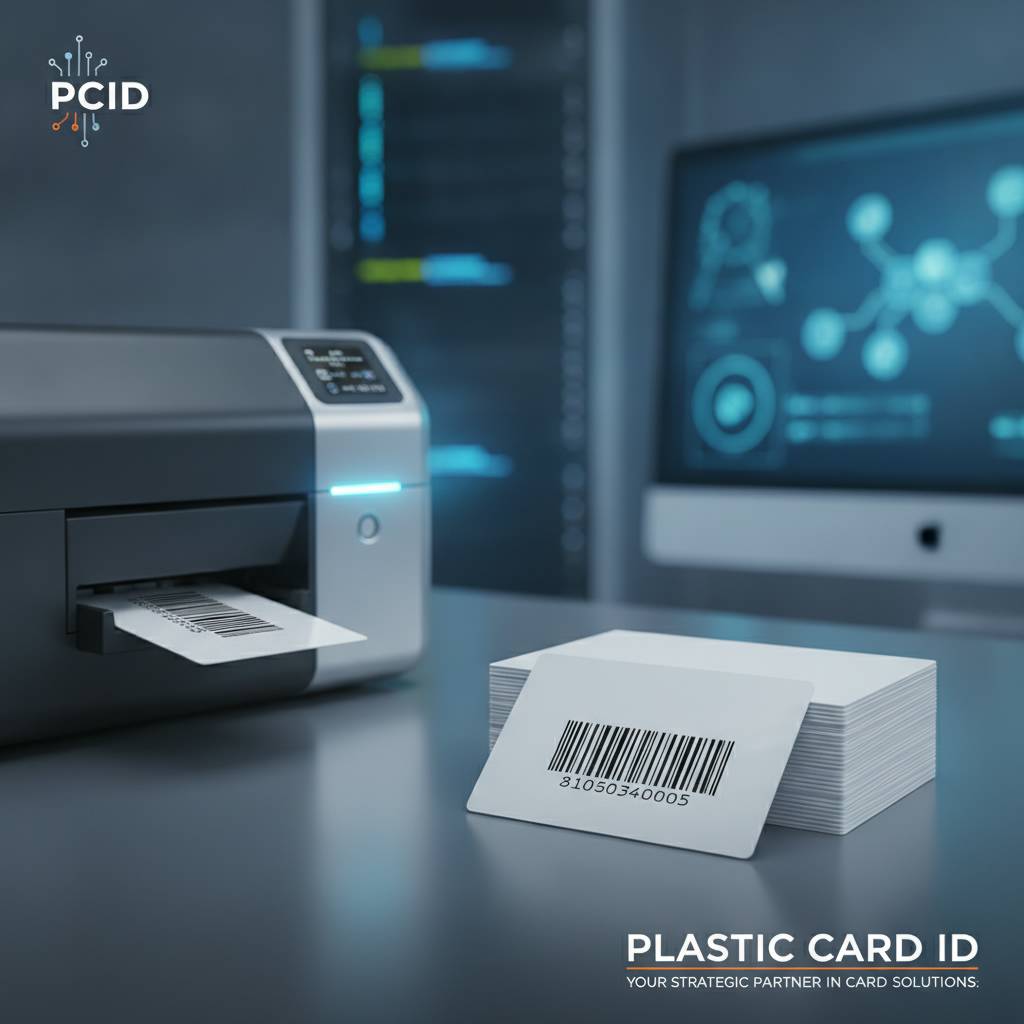 A great blank card does half the job. The other half belongs to the printer. Plastic Card ID carries card printers from three of the industry's most trusted brands - Evolis, Zebra, and Fargo - each suited to different program sizes, print quality requirements, and budget profiles. Pairing the right printer with the right blank card stock is what separates a card program that works from one that constantly frustrates.
For in-house barcode card printing, the printer needs to produce sharp, high-contrast barcode lines consistently across an entire print run - not just on the first card. Inkjet printers don't belong in this conversation. Direct-to-card and retransfer thermal printers are the standard for professional card programs, and the models CPE supplies are calibrated for exactly that kind of reliable, repeatable output.
Evolis Printers: Precision for Small to Mid-Volume Programs
Evolis printers are popular with organizations running card programs in the range of 50-2,000 cards per month. Models like the Primacy 2 and Avansia deliver excellent barcode print quality with intuitive software integration. The Evolis ecosystem supports a range of ribbon types specifically optimized for barcode clarity, including monochrome black ribbons for applications where barcode quality is the only priority and color isn't needed.
Evolis printers are also known for their ribbon efficiency - a meaningful cost factor when you're printing high volumes of cards with barcodes. Because monochrome printing uses only a single panel of the ribbon, per-card printing costs are significantly lower than full-color runs. For membership cards, library cards, or employee badges where the barcode is the primary data carrier, mono printing is often the right call.
Zebra and Fargo: Scalable Solutions for Larger Operations
Zebra and Fargo printers are built for organizations with higher throughput demands - corporate ID programs, large membership organizations, universities, and government agencies. These printers handle larger daily card volumes without sacrificing print quality, and their encoding options include magnetic stripe writing and smart card programming, making them ideal for multi-function card programs. Zebra's ZXP series and Fargo's HDP retransfer models are particularly well-regarded for barcode print precision.
Fargo's HDP (High Definition Printing) retransfer technology prints onto a film that is then applied to the card surface, rather than printing directly onto the card. The result is a barcode with exceptional edge definition - important for dense barcodes like PDF417 or DataMatrix formats used in ID card applications. If your program demands that level of quality, call 800.835.7919 and a specialist will walk you through the right printer configuration.
Ribbons, Supplies, and Maintenance for Scan-Ready Output
A printer is only as good as the consumables running through it. Plastic Card ID supplies OEM and compatible ribbons for all printer brands in the catalog, along with cleaning kits designed to maintain print head health and barcode print quality over the long haul. Dirty print heads are one of the leading causes of degraded barcode print quality - something that a consistent cleaning schedule with proper cleaning cards and rollers can prevent entirely.
Card carriers and sleeves round out the supply catalog, protecting printed barcode cards during mailing or distribution so they arrive in scan-ready condition. For organizations that mail cards to members or customers, CPE also offers card affixing and mailing services - a turnkey solution that handles the physical logistics of getting cards into people's hands without adding operational overhead to your team.
Applications: Who Uses Blank Barcode Cards and Why
The range of businesses and organizations running barcode card programs is genuinely broad. What they share is a need for reliable, scalable card-based identification or tracking. Blank plastic cards with printed barcodes serve as the physical interface between a person and a system - and when that interface works cleanly, operations run smoother, errors drop, and member or customer experience improves.
Consider the difference between a paper loyalty punch card and a plastic loyalty card with a scanned barcode. The paper card gets lost, duplicated, or worn out. The plastic card lives in a wallet, scans every time, and connects to a real database that tracks purchases, rewards, and customer behavior. Retailers who make this switch typically see loyalty program engagement rise substantially - and that engagement translates directly into repeat business.
Retail Loyalty and Gift Card Programs
Retailers represent one of the largest user groups for blank barcode card stock. A barcode-based loyalty program - where every purchase is tracked against a unique card number - creates a data loop that paper programs simply cannot replicate. Plastic gift cards with barcodes have been shown to drive 35-50% higher sales compared to paper gift certificates, a figure that reflects both improved customer behavior and reduced card loss and fraud.
Gift cards in particular benefit from the permanence and professionalism that plastic conveys. A plastic card doesn't get thrown away. It goes in a wallet, gets found again, and gets used. The barcode ties the physical card to a stored value balance in your system, making reload functionality straightforward and fraud resistance much stronger than paper alternatives.
Membership Organizations and Access Control
Gyms, clubs, libraries, professional associations, healthcare networks - all of these organizations issue membership cards that need to be scanned at point of entry or service. A well-designed barcode card program makes check-in seamless, reduces front-desk friction, and creates a reliable audit trail. When a member scans their card, your system knows who they are, what they're entitled to, and when they last visited - all in under a second.
For access control applications, barcode cards can be paired with proximity or RFID technology in a single card body. The barcode handles optical scanning at attended checkpoints while the RFID chip handles unattended door access. This layered approach gives organizations more flexibility in how and where cards are used without requiring separate card credentials for different access scenarios.
Event Credentials, Employee ID, and Asset Tracking
Event credentials represent a high-volume, time-sensitive use case for blank barcode cards. Festival wristbands are increasingly being replaced by rigid plastic credentials that include a barcode for gate scanning, a photo for visual verification, and access tier information printed clearly on the face. Plastic cards hold up through multi-day events in ways that paper and Tyvek simply don't.
- Employee ID cards with barcodes speed up time-and-attendance tracking at clock-in points
- Asset tracking cards barcode-tagged to equipment create scannable inventory records
- Student ID cards at schools and universities integrate with library, cafeteria, and access systems
- Patient ID cards at medical facilities streamline admissions and record retrieval
- Visitor badges with temporary barcodes allow controlled facility access with automatic expiration
In each of these scenarios, the blank card is the raw material that becomes the credential. Printed in-house, encoded to your specifications, issued on your timeline - that level of operational control is what drives organizations to build in-house card programs rather than relying on outsourced, pre-printed alternatives.
Buyer's Guide: Choosing the Right Blank Cards for Barcode Scanning
Buying blank cards for barcode scanning isn't complicated - but getting it right the first time saves money, avoids reprints, and protects the integrity of your card program. There are a handful of variables that matter most, and understanding them upfront will make every purchasing decision simpler and more confident going forward.
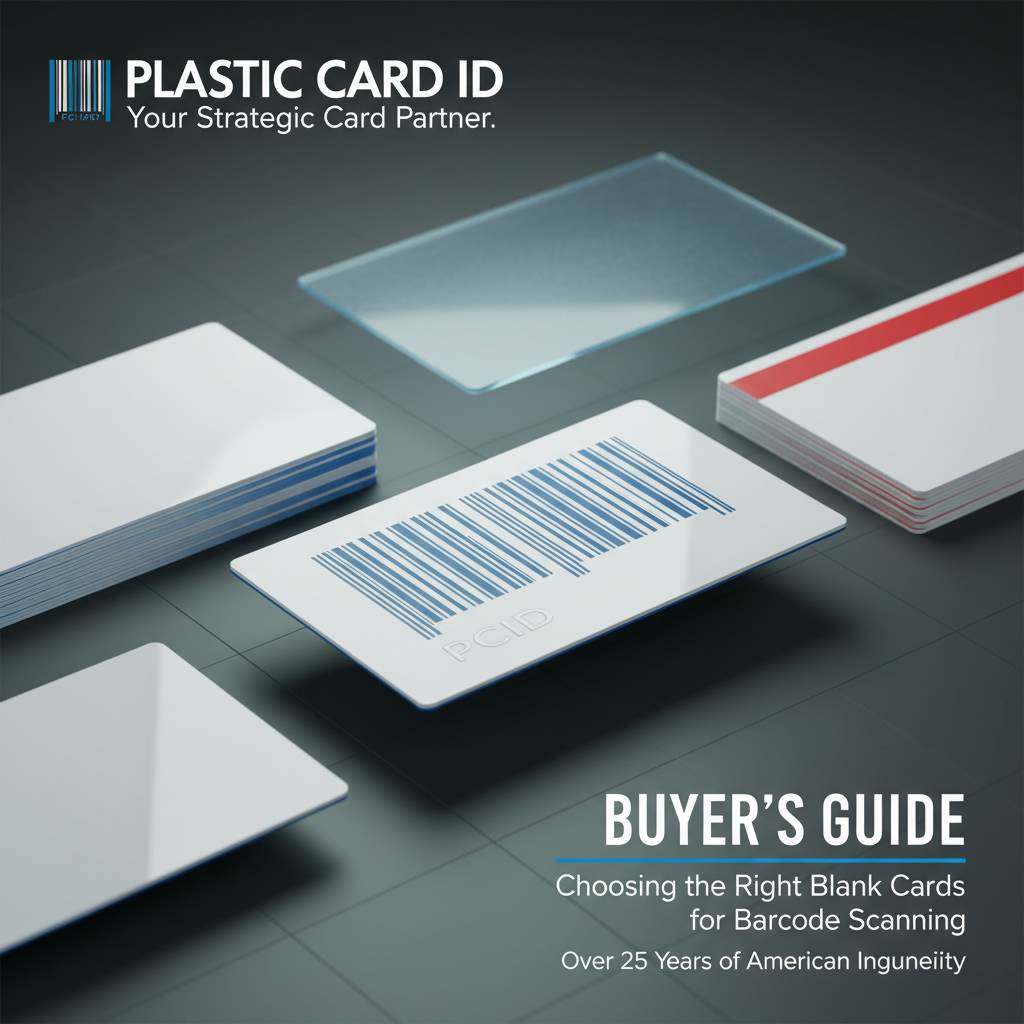
CPE has spent over two decades helping organizations navigate these decisions. The guidance below reflects what the team has learned from serving over 100,000 customers across the United States - from single-location small businesses running 50 cards a month to large organizations printing in the tens of thousands. The right blank card for your program depends on your scanner type, your printer, your environment, and your volume.
Key Factors to Evaluate Before You Order
- Scanner compatibility: Know whether you're using a 1D laser scanner, a 2D imager, or a smartphone-based QR reader - each has different optimal barcode formats and contrast requirements
- Printer type: Direct-to-card and retransfer printers have different surface requirements; match your card stock to your printer specification
- Card surface finish: Glossy surfaces generally deliver sharper barcode lines; matte may be preferred in high-glare environments
- Volume and storage: Blank PVC cards have a long shelf life in proper storage; ordering in higher volumes reduces per-card cost significantly
- Additional encoding needs: If your program also needs magnetic stripe or RFID, select the right card variant upfront rather than retrofitting later
- Color coding requirements: If your program uses department or tier color coding, factor in how colored stock affects barcode contrast
Test before you commit to volume. Plastic Card ID recommends running a small test batch with your specific printer, ribbon, and scanner combination before placing a large order. This is standard practice for professional card programs and eliminates the risk of discovering compatibility issues at scale.
Volume Pricing and Program Scaling
Blank card pricing is heavily volume-dependent. A program ordering 500 cards per month pays meaningfully more per card than a program ordering 5,000 per month - and the quality is identical. For organizations that are growing their card programs, it's worth projecting forward consumption and ordering to that projection rather than buying only what's immediately needed. Storage costs for blank card stock are negligible compared to the per-card savings from volume pricing.
Programs can scale from modest beginnings to significant operations without changing suppliers, printers, or card stock - which is exactly the kind of continuity CPE is built to support. Starting with 50 cards a month and growing to 5,000 is a journey Plastic Card ID has walked with hundreds of clients. The relationship is designed for that kind of long-term partnership, not a one-time transaction.
Frequently Asked Questions
Can I print any barcode format on a standard blank PVC card? Yes - Code 128, Code 39, QR, PDF417, DataMatrix, and most other common formats are printable using standard card printer software and appropriate ribbons. The limiting factor is your printer's DPI resolution; 300 DPI is generally sufficient for 1D barcodes while 600 DPI is recommended for dense 2D formats.
Do I need a special card stock for barcode scanning, or will any blank PVC card work? Standard ISO 7810 CR80 white PVC cards work well for the vast majority of barcode applications. Specialty surfaces (clear, frosted, colored) require attention to ribbon selection and contrast. When in doubt, call the team at Plastic Card ID - they'll point you to the right combination for your specific setup.
Your Next Step with Plastic Card ID
A barcode card program that scans cleanly, scales reliably, and represents your organization professionally doesn't require complexity - it requires the right blank card stock, the right printer, and a supplier who actually understands what a working card program looks like from the inside out. Plastic Card ID brings all three together under one roof.
From the first blank card to a fully operational program running tens of thousands of cards annually, CPE is built to support every stage of that journey. Fifty million cards sold, over 100,000 customers served, and more than 25 years of operational expertise - this is a team that has seen every card program challenge and knows how to solve them. Your barcode card program deserves a partner who gets it right from card one.
Ready to build a better barcode card program? Contact Plastic Card ID today at 800.835.7919 and speak with a specialist who will help you choose the right blank cards, printer, and supplies to make your program a success from day one.
Previous Page