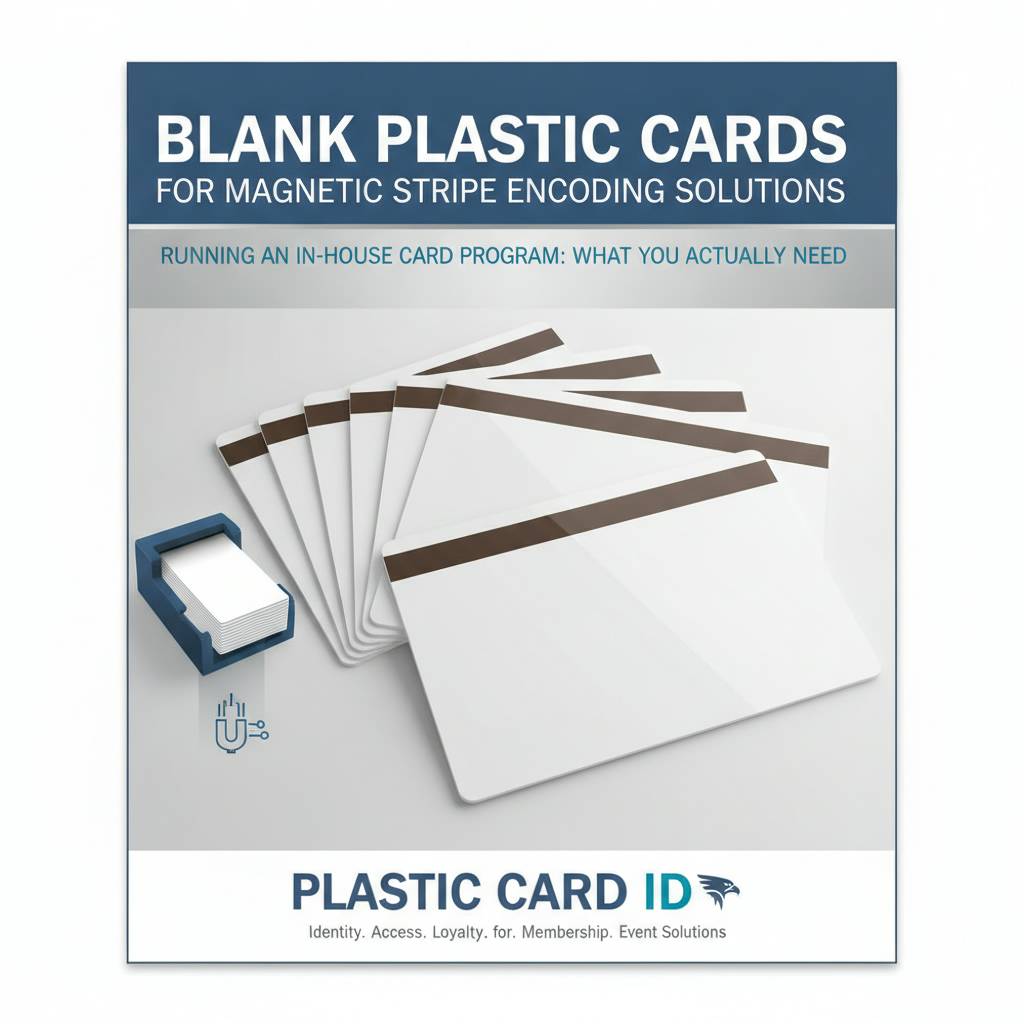
Blank Plastic Cards for Magnetic Stripe Encoding Solutions
Table of Contents []
- Blank Plastic Cards for Magnetic Stripe Encoding - Plastic Card ID
- Why the Magnetic Stripe Standard Still Dominates Card Programs
- The CR80 Standard and Why Blank Card Dimensions Matter
- Running an In-House Card Program: What You Actually Need
- Real-World Applications: Where Magnetic Stripe Cards Deliver Results
- Ordering Blank Magnetic Stripe Cards: Practical Buyer Guidance
- Partner With Plastic Card ID for Your Magnetic Stripe Card Program
Blank Plastic Cards for Magnetic Stripe Encoding - Plastic Card ID
There is something deceptively simple about a blank plastic card with a magnetic stripe. It sits there, unremarkable, until the moment it gets encoded - and then it becomes a hotel room key, a loyalty card that keeps customers coming back, an employee access badge, or a gift card that drives real revenue. Plastic Card ID has spent more than 25 years supplying exactly these cards to businesses across the United States, and what they have learned along the way is this: the card itself matters enormously.
Choosing the right blank magnetic stripe card before encoding is not a trivial decision. The coercivity rating, the card substrate, the stripe position, the surface finish - all of it shapes how reliably your card performs in readers, how long it survives in wallets and pockets, and whether your entire card program runs smoothly or generates constant support headaches. This page exists to help you make that decision intelligently.
| Card Type | Coercivity | Best Use Case | Track Options |
|---|---|---|---|
| Blank HiCo Magnetic Stripe | 2750 Oe | Gift cards, loyalty, ID | 1, 2, 3 |
| Blank LoCo Magnetic Stripe | 300 Oe | Hotel keys, short-term access | 1, 2, 3 |
| Clear PVC HiCo Stripe | 2750 Oe | Premium loyalty, member cards | 1, 2, 3 |
| Combo RFID Mag Stripe | 2750 Oe | Access control, casino, hotel | 1, 2, 3 |
Why the Magnetic Stripe Standard Still Dominates Card Programs
 Newer technologies arrive every year - contactless chips, NFC, QR codes - yet magnetic stripe cards continue to anchor millions of card programs in retail, hospitality, healthcare, and beyond. Why? Infrastructure. The installed base of magnetic stripe readers in the United States alone is staggering. Businesses already own the readers. Employees already know how to swipe. The friction of switching is real, and for many organizations, magnetic stripe cards remain the most practical, cost-effective choice available right now.
There is also a durability and reliability argument that often gets overlooked. A properly manufactured HiCo magnetic stripe card can survive years of regular use without losing its encoded data - far outperforming paper alternatives, digital punch cards, and fragile keytag systems. When CPE talks to clients considering their first plastic card program, this longevity factor is frequently the deciding point.
HiCo vs. LoCo: The Coercivity Decision That Changes Everything
Coercivity is a measure of magnetic resistance - how hard it is to alter or erase the data encoded on the stripe. High coercivity (HiCo) cards rated at 2750 Oersteds are designed for programs where the card will be used repeatedly over months or years. Gift card programs, loyalty programs, employee ID systems, and membership cards all fall into this category. The encoded data stays stable even when the card is stored near other magnetic objects.
Low coercivity (LoCo) cards, typically rated at 300 Oe, serve a different purpose entirely. They are ideal for temporary use - hotel room keys being the classic example - where the card will be encoded once, used for a short period, and then wiped and re-encoded for the next guest. The lower magnetic resistance makes them quick and easy to re-encode. Choosing HiCo when you need LoCo, or vice versa, can create real operational problems down the line.
Track Configuration and What It Means for Your System
Magnetic stripe cards can carry data on up to three tracks, each with its own specifications and typical uses. Track 1 holds alphanumeric data at higher density and is frequently used in systems that need to store names alongside account numbers. Track 2 is the most commonly used track in retail and loyalty applications - it is the standard track for most point-of-sale readers. Track 3 is available but used far less frequently in modern card programs.
Most blank magnetic stripe cards from Plastic Card ID are available in single-track or three-track configurations. If your card management software or reader hardware only uses one track, there is no operational need to pay for a three-track card - but if you anticipate any future expansion of your card program, specifying three-track cards from the start keeps your options open without requiring a card reorder later.
Matching Card Quality to Reader Hardware
One overlooked aspect of selecting blank magnetic stripe cards is the relationship between card quality and reader performance. A poorly manufactured card - inconsistent stripe coating, weak magnetic oxide layers, or substandard PVC substrate - can cause read errors even on well-maintained readers. Consistent card performance starts with consistent card manufacturing quality. This is why sourcing from a supplier with decades of quality control experience matters practically, not just in marketing terms.
Card printers from Evolis, Zebra, and Fargo - all available through Plastic Card ID - are calibrated for specific card tolerances. When blank cards meet those tolerances reliably, encoding happens cleanly the first time, every time. When they do not, encoder heads wear faster, error rates climb, and card programs that should run seamlessly become sources of constant frustration for staff and cardholders alike.
The CR80 Standard and Why Blank Card Dimensions Matter
Every standard plastic card you have ever used - credit card size, ID card size, gift card size - follows the ISO 7810 CR80 specification: 3.375 inches by 2.125 inches, 30 mil thick. This is not arbitrary. It is a globally standardized dimension that ensures compatibility with card printers, card readers, wallets, cardholders, and badge holders across the entire ecosystem. Deviating from CR80 dimensions creates compatibility problems that cascade through your entire card program.
Blank PVC cards for magnetic stripe encoding are almost universally produced to the CR80 standard. The 30 mil thickness is critical - thinner cards flex more than readers expect, causing inconsistent stripe reads; thicker cards can jam in precision-feed card printers. When CPE advises clients on card selection, dimensional compliance is always on the checklist, even when it seems obvious. The cards that cause the most problems are often the ones that look right but measure slightly off.
Surface Finish Options for In-House Printing
Blank magnetic stripe cards intended for in-house printing come in several surface finishes, each affecting print quality, card feel, and visual appearance differently. Glossy PVC cards produce vibrant, high-contrast prints and are the most common choice for loyalty and gift card programs. The glossy surface interacts well with dye-sublimation printing, which is the technology used in most desktop card printers from Evolis, Zebra, and Fargo.
Matte and frosted card surfaces create a more subdued, premium look and reduce glare on photographic prints - making them popular for employee ID badges and membership cards where a professional appearance is a priority. Some organizations opt for a glossy front with a matte back, keeping the printed face vibrant while providing a writable surface on the reverse. Knowing which finish your card printer ribbon is optimized for helps you get the best possible print quality on every card.
Color Stock Cards vs. Standard White PVC
Standard white PVC is the baseline, offering a clean canvas for full-color printing. But Plastic Card ID also carries colored PVC card stock in a range of colors - useful when you want a color-coded card system without printing a solid background on every card. Color stock cards save printer ribbon consumption, reduce per-card printing costs over time, and create visually distinct card categories at a glance.
A hospital might use yellow cards for visitors, blue for staff, and red for contractors - all blank, all magnetic stripe-equipped, all differentiated by stock color without any printing cost per card. Event organizers use similar logic for tiered access credentials. Strategic use of colored card stock can meaningfully simplify card management operations. It is a small decision with a surprisingly large downstream impact.
Clear and Frosted Specialty Cards with Magnetic Stripes
Clear PVC cards with magnetic stripes occupy a niche that is growing steadily. The transparent substrate creates a premium visual impression that standard white PVC simply cannot match. When printed with color accents, clear cards appear to float the design in space - an effect that customers notice and associate with quality and prestige. Loyalty programs and membership clubs that want their card to feel like a reward, not just a functional tool, often choose clear cards.
Frosted cards offer a middle ground between clear and opaque - a translucent, soft-touch aesthetic with slightly different print characteristics than clear PVC. Both options are available with HiCo magnetic stripes and standard CR80 dimensions, meaning they work with the same card printers and encoders as standard white PVC. The visual premium comes without any operational complexity.
Running an In-House Card Program: What You Actually Need
 The appeal of an in-house card program is substantial. You control the timeline, the design, the encoding, and the quantities. You can produce five cards on a Tuesday afternoon or five hundred on a Friday morning. You are not waiting on a third-party vendor, not paying rush fees, and not managing minimum order requirements for every small batch. In-house card programs give organizations a level of operational agility that outsourced programs simply cannot match.
But running an in-house program effectively requires the right combination of hardware, supplies, and card stock. A card printer capable of encoding magnetic stripes, blank HiCo or LoCo cards in the appropriate quantity, compatible printer ribbons, and a card management software solution that handles encoding logic - these are the four pillars. Plastic Card ID supplies all of them, which is the practical reason why so many organizations treat them as a strategic partner rather than just a card vendor.
Choosing the Right Card Printer for Magnetic Stripe Encoding
Not all card printers encode magnetic stripes - you need to specifically select a model with a magnetic encoder module. Evolis, Zebra, and Fargo all offer models at various price points and production capacities. Entry-level desktop printers handle small volumes well and are perfect for organizations issuing a few hundred cards per month. Mid-range models offer faster throughput and often include dual-side printing capabilities. High-volume production printers handle tens of thousands of cards with automated feeders and stackers.
The encoder module in the printer must match your card's coercivity. HiCo encoders will not reliably write LoCo cards, and LoCo encoders cannot write HiCo cards at all. This is a hardware specification, not a software setting - it is locked at the printer level. Confirming encoder compatibility before purchasing cards or printers prevents a common and expensive mistake that new card program managers make more often than experienced ones like to admit.
Ribbons, Cleaning Kits, and Supplies That Keep Programs Running
A card printer without the correct ribbon is an expensive paperweight. Printer ribbons are printer-specific - an Evolis ribbon does not work in a Zebra printer, and using the wrong ribbon can damage the printhead. Plastic Card ID carries ribbons for all the major printer brands and models they sell, making it straightforward to reorder the correct supplies without guesswork. Color ribbons (YMCKO and YMCKOK panels) handle full-color printing, while monochrome ribbons are economical for single-color text and barcode applications.
Cleaning kits are not optional accessories - they are maintenance essentials. Card debris, dust, and adhesive residue accumulate inside card printers and degrade print quality over time. Regular cleaning with manufacturer-approved cleaning cards and swabs keeps the printhead and rollers in optimal condition, extending printer lifespan and maintaining the card print quality that makes your program look professional. Neglecting cleaning is the single most common cause of premature card printer failure.
Card Carriers, Sleeves, and Mailing Services
A card program does not end when the card is printed and encoded. Getting the card to the cardholder matters too. Card carriers - the folded paper or cardstock holders that cards are inserted into for presentation or mailing - add a professional presentation layer that reinforces your brand. A loyalty card arriving in a custom carrier with program instructions feels like a considered experience. The same card stuffed loose in an envelope feels like an afterthought.
Card affixing and mailing services through Plastic Card ID handle the fulfillment side of card programs for organizations that prefer to outsource that step. Cards can be affixed to carriers, sorted, and mailed directly to cardholders - removing the logistics burden from internal staff and ensuring consistent, professional card delivery at scale. For organizations launching or scaling loyalty or membership programs, this service alone can eliminate a significant operational headache.
Real-World Applications: Where Magnetic Stripe Cards Deliver Results
The abstract case for magnetic stripe cards becomes concrete quickly when you look at what happens when organizations deploy them seriously. Retailers who make the switch from paper punch cards or paper gift certificates to plastic gift cards consistently see measurable revenue increases. Sales increases of 35-50% are documented among retailers who switch from paper to plastic gift cards - a figure that reflects both the higher perceived value of the physical card and the practical reality that plastic cards do not get lost, forgotten, or damaged the way paper ones do.
Loyalty programs face a similar dynamic. A plastic loyalty card that lives in a customer's wallet is a constant, low-cost brand impression. Every time the customer opens their wallet, your card is there. Paper punch cards end up crumpled in pockets, forgotten in junk drawers, or simply lost. The physical permanence of a plastic loyalty card changes how customers relate to the program - and that relationship change shows up in redemption rates and repeat purchase frequency.
Loyalty and Gift Card Programs
Retail loyalty programs built around blank PVC magnetic stripe cards give businesses complete control over their program economics. The cards are ordered blank, encoded in-house with customer account numbers using a card printer with a magnetic encoder, and handed to customers at the point of enrollment. There is no per-card fee to a third-party processor, no technology licensing cost, and no proprietary hardware lock-in. The business owns the program entirely.
Gift card programs follow a similar model. Blank HiCo magnetic stripe cards are encoded with gift card account numbers by the card management software at the point of sale, and the balance is stored in the business's own software system - not on the card itself. This means lost cards can be replaced, balances can be checked online or at the register, and the program can be managed entirely with off-the-shelf hardware and software. The simplicity of this model is exactly why small and mid-sized retailers favor it.
Employee ID and Access Control Badges
Employee ID cards with magnetic stripes serve a dual function - they identify the cardholder visually and authenticate them electronically. Printed in-house on a desktop card printer, the ID card carries the employee's photo, name, title, and department on the front, while the magnetic stripe on the back carries encoded access credentials for doors, time-and-attendance systems, or computer login authentication.
Organizations with access control systems often use HiCo magnetic stripe cards specifically because of their long-term data stability. An employee badge needs to work reliably for the duration of employment - potentially years. The stripe cannot degrade from wallet friction or proximity to other cards. HiCo coercivity is the specification that makes multi-year badge reliability achievable with standard plastic card stock.
Membership, Event, and Credential Cards
Membership organizations - gyms, clubs, professional associations, libraries - use magnetic stripe membership cards to manage check-ins, track member activity, and enforce access privileges at facilities or events. The magnetic stripe enables fast, error-free member authentication at check-in kiosks or reception desks, eliminating the manual lookup delays that frustrate members and staff alike. A magnetic stripe membership card makes every member interaction faster and more professional.
Event credential cards serve a slightly different purpose - they authenticate attendees at entry points, distinguish between ticket tiers, and sometimes carry pre-loaded value for on-site food and merchandise purchases. Blank magnetic stripe cards printed and encoded in small or large batches work well for conferences, trade shows, festivals, and private events. The credential looks and feels professional, and the magnetic encoding enables fast, automated entry processing even at high-traffic access points.
Ordering Blank Magnetic Stripe Cards: Practical Buyer Guidance
Before placing an order for blank magnetic stripe cards, a short checklist of specifications will prevent the most common ordering mistakes. Knowing your required coercivity (HiCo or LoCo), your track configuration needs (tracks 1, 2, or 3), your surface finish preference, and your approximate monthly volume helps narrow the selection quickly and ensures the cards you receive are immediately compatible with your existing hardware and software.
Volume matters for pricing. Blank card pricing follows standard economies of scale - larger orders carry lower per-card costs, and organizations with predictable monthly card volumes benefit from ordering in larger quantities even if it means holding some inventory. For a program running 200-500 cards per month, ordering in quarterly or semi-annual quantities rather than monthly can reduce per-card cost meaningfully without creating excessive inventory risk.
Minimum Orders, Lead Times, and Stocking Strategies
- Blank white PVC HiCo magnetic stripe cards are typically available in quantities from small packs suitable for new programs all the way to case quantities for high-volume operations.
- Standard lead times for blank stock cards are short - these are stocked items, not custom productions, which means orders can ship quickly without lengthy production queues.
- Organizations running time-sensitive programs (events, seasonal gift card launches) should maintain a safety stock of at least two to four weeks of card inventory to buffer against shipping delays.
- Custom-printed cards with magnetic stripes require design approval and production time - factor this into program launch timelines.
- Bulk orders placed with CPE benefit from volume pricing that makes per-card costs significantly more attractive than small repeated purchases.
Planning your stocking strategy around your encoding schedule also makes sense. If your card program encodes cards in batches - weekly or monthly - holding a supply of blank stock on hand ensures encoding can happen on your schedule without waiting for a card shipment. Inventory discipline in card programs is one of those operational details that separates smoothly running programs from chaotic ones.
Custom Die-Cut and Specialty Format Cards
Standard CR80 is the right choice for most programs, but Plastic Card ID also offers custom die-cut card formats for organizations that want something visually distinctive. Cards in custom shapes - whether rounded rectangles with exaggerated corners, key-tag formats, or entirely custom outlines - can still carry magnetic stripes and be encoded with standard equipment in many cases. These specialty formats work well for premium loyalty programs, VIP membership cards, and brand-forward marketing applications where differentiation is the goal.
Metal cards in stainless steel, brass, and gold represent the premium end of the card spectrum. These are not standard magnetic stripe cards - they are specialty products for programs where the card itself is meant to be a prestige object. Casino VIP programs, executive membership clubs, and luxury brand loyalty programs use metal cards to signal exclusivity. The physical weight and feel of a metal card creates an impression that standard PVC simply cannot replicate.
When to Call Plastic Card ID Directly
Complex card programs - those involving multiple card types, large encoding volumes, integration with access control systems, or specialty card formats - benefit from a direct conversation rather than an online order. Speaking with an experienced card program specialist can surface compatibility considerations, volume pricing opportunities, and configuration options that are not always obvious from a product catalog alone. Reach out to Plastic Card ID at 800.835.7919 to discuss your program requirements with a team that has helped build card programs for over 100,000 customers across the United States.
Whether you are launching a card program from scratch or optimizing an existing one, a brief conversation about specifications, quantities, and hardware compatibility can save time, money, and frustration. The team at CPE has encountered virtually every card program challenge imaginable across 25-plus years of operation - that depth of experience is available to you at no cost simply by picking up the phone.
Partner With Plastic Card ID for Your Magnetic Stripe Card Program
There is a meaningful difference between ordering cards from a commodity supplier and working with a partner who understands card programs from end to end. Plastic Card ID has spent over 25 years building that kind of expertise - not just in manufacturing and supply, but in the practical realities of running successful card programs at every scale from boutique retail loyalty cards to large-scale institutional ID systems. With more than 50 million cards sold and over 100,000 customers served across the United States, the depth of experience here is genuine.
Blank plastic cards for magnetic stripe encoding are the foundation of more card programs than most people realize - and getting that foundation right matters more than most buyers consider at the outset. Coercivity, track configuration, surface finish, substrate quality, dimensional compliance - these are not abstract specifications. They are the details that determine whether your card program runs flawlessly or generates constant operational friction. Plastic Card ID helps you get those details right from the start.
Ready to launch, scale, or optimize your magnetic stripe card program? Contact Plastic Card ID today at 800.835.7919 and speak with a card program specialist who can help you select the right blank magnetic stripe cards, matching card printers, ribbons, and supplies to build a card program that works exactly the way you need it to.
Previous Page