Things to Know Before Buying Blank Plastic Cards
Table of Contents []
- What Smart Buyers Know Before Ordering Blank Plastic Cards - A Guide from Plastic Card ID
- Understanding Card Specifications - Size, Thickness, and Standards
- Magnetic Stripe Cards - HiCo vs. LoCo Explained
- RFID, Proximity, and Smart Chip Cards - The Technology Tier Above Magnetic Stripe
- Choosing the Right Card Printer to Match Your Card Stock
- Ordering Quantities, Pricing Logic, and Program Scaling
- Partner With Plastic Card ID for Your Blank Plastic Card Program
What Smart Buyers Know Before Ordering Blank Plastic Cards - A Guide from Plastic Card ID
Most people assume buying blank plastic cards is straightforward - pick a size, pick a quantity, done. But experienced card program managers know better. The card stock you choose, the encoding options you select, and the printer compatibility you verify before placing an order can mean the difference between a card program that runs flawlessly and one that creates headaches from day one. There is more nuance here than most suppliers will tell you upfront.
Plastic Card ID has worked with over 100,000 customers across the United States over more than 25 years, selling upward of 50 million cards. That kind of volume teaches you things. This guide captures what seasoned card buyers already know - and what first-time buyers wish someone had told them before they clicked "order."
| Card Type | Best Use Case | Encoding Option | Printer Compatible |
|---|---|---|---|
| Blank PVC CR80 | Employee IDs, Loyalty, Events | None (print only) | All standard printers |
| HiCo Magnetic Stripe | Gift cards, Access, Time-tracking | Magnetic encoding | Printers with MSE module |
| LoCo Magnetic Stripe | Hotel keys, Short-use cards | Low-coercivity encoding | Printers with MSE module |
| RFID / Proximity | Access control, Smart credentials | Contactless chip | RFID-capable printers |
| Clear / Frosted PVC | Premium branding, VIP cards | Print only (specialty) | Select printers |
Understanding Card Specifications - Size, Thickness, and Standards
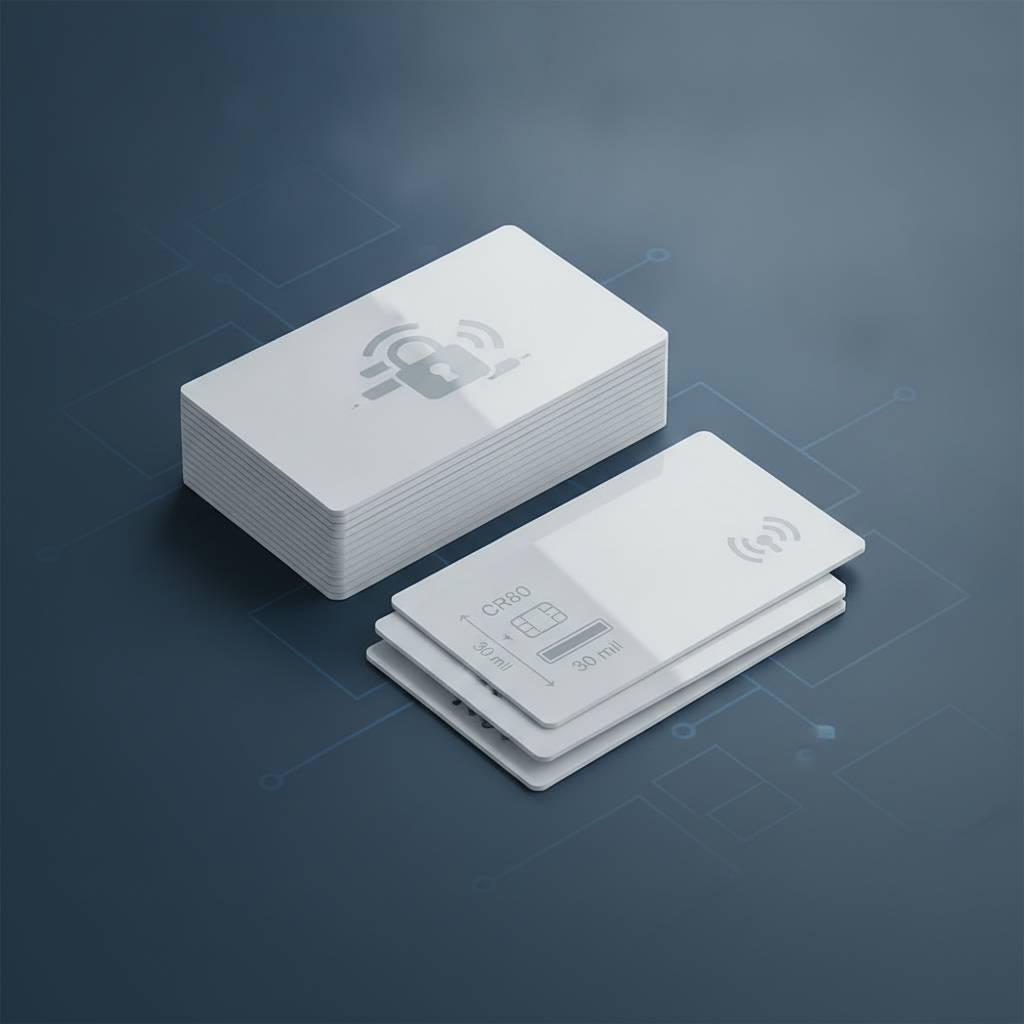 Before you order a single card, you need to understand what CR80 means and why it matters. The CR80 format - 3.375 inches by 2.125 inches at 30 mil thickness - is the ISO 7810 standard that defines the modern credit card form factor. Nearly every card printer on the market is built around it. When people talk about blank plastic cards, this is almost always what they mean, and for good reason.
Thickness is not a trivial detail. A 30 mil card feels substantial in someone's hand. It communicates value before a single word is read. Paper punch cards and flimsy alternatives simply cannot replicate that tactile signal of permanence and professionalism. When your loyalty card or membership credential feels like a real card, customers keep it. When it feels cheap, it ends up in the recycling bin within a week.
CR80 vs. Other Card Sizes
While CR80 dominates, there are other sizes worth knowing about. CR79 cards are slightly smaller and are designed to fit into adhesive badge holders. CR100 is a larger format sometimes used for specialty credentials. However, for the overwhelming majority of card programs - membership, loyalty, employee ID, event access - CR80 is the right answer, and defaulting to anything else requires a specific reason.
Specialty die-cut cards break the rectangular mold entirely. If your brand benefits from a unique shape - a key, a star, a house - die-cut options exist and can create memorable impressions. Just know that custom shapes require custom handling and are a different conversation from standard blank card stock.
The Importance of Card Thickness in Printer Compatibility
Card printers have specified thickness tolerances - typically 10 mil to 40 mil. Using cards outside that range can jam a printer or cause poor print quality. Standard 30 mil cards fit virtually every printer in the market. If you are running 10 mil adhesive-backed cards or 40 mil extra-thick stock, you need to verify compatibility with your specific printer model before ordering in bulk.
Printer compatibility is one of the most overlooked factors in card purchasing. A mismatch between card thickness and printer tolerance does not just waste cards - it can damage the printer's rollers and feed mechanism, leading to costly repairs. Always cross-reference your printer's specifications with the card stock you plan to order.
Material Matters Beyond PVC
Standard blank cards are PVC, which offers excellent print receptivity, durability, and compatibility with all major card printing technologies. But CPE also carries composite cards - a PVC-polyester blend - which are notably more resistant to heat and bending. These are especially valuable in environments where cards are exposed to direct sunlight or high temperatures regularly.
At the premium end, metal cards in stainless steel, brass, and gold are available for programs where luxury positioning matters. These are a different product category, but worth knowing about when you are designing a high-end membership or VIP loyalty program that needs to make a statement the moment it is handed over.
Magnetic Stripe Cards - HiCo vs. LoCo Explained
Magnetic stripe cards are far and away the most common encoded card type used in business card programs. But not all magnetic stripe cards are the same, and buying the wrong type can result in cards that fail to encode properly or data that gets wiped too easily. The distinction between HiCo and LoCo is something every card program manager needs to understand before placing an order.
High-coercivity (HiCo) cards require a stronger magnetic field to encode, which makes the data significantly more resistant to accidental erasure from everyday magnetic interference. Low-coercivity (LoCo) cards encode more easily but are more vulnerable to magnetic fields - which is why hotel key cards, designed for short-term single-visit use, are typically LoCo. For long-term programs like loyalty or membership, HiCo is almost always the right choice.
When to Choose HiCo Magnetic Stripe Cards
HiCo cards are the standard for gift card programs, employee time and attendance systems, access control applications, and any loyalty or membership program where cards are expected to last months or years. The data encoded on a HiCo card is durable enough to survive being near keys, phones, and other everyday magnetic sources that would degrade LoCo encoding.
Retailers who have switched from paper-based gift certificates to plastic gift cards with HiCo magnetic stripes have seen sales increases of 35-50%. That is not a marginal improvement - it is a business transformation. Physical gift cards drive impulse purchases, repeat visits, and brand recall in ways that paper alternatives simply cannot replicate.
LoCo Cards and Their Appropriate Applications
LoCo cards have their place. Hotel key cards are the classic example - they are programmed at check-in, used for a few days, and then wiped and reprogrammed for the next guest. The ease of re-encoding LoCo cards is a feature, not a bug, in that context. Event credentials and short-duration access passes are other appropriate use cases.
The mistake to avoid is using LoCo cards in programs where longevity is expected. If a customer is still using their loyalty card two years from now and the magnetic stripe has failed, that is a poor experience that reflects on your brand. Match your card type to your program's intended lifespan and you will avoid this problem entirely.
Encoding In-House vs. Pre-Encoded Cards
One major decision point: do you encode cards at the point of issuance using your card printer, or do you order cards pre-encoded? For most small to mid-size programs, in-house encoding makes the most sense. You control the data, you issue cards on demand, and you avoid the complexity of managing pre-encoded inventory. A card printer with a magnetic stripe encoding module makes this straightforward.
For large-scale programs in the tens of thousands, pre-encoding or batch encoding services may be worth exploring. Plastic Card ID can help you think through the right approach based on your volume and operational setup. Call 800.835.7919 to discuss your specific program needs with someone who has seen programs like yours before.
RFID, Proximity, and Smart Chip Cards - The Technology Tier Above Magnetic Stripe
 Magnetic stripe is reliable and affordable, but it requires physical contact - the card must swipe through a reader. RFID and proximity cards operate contactlessly, which makes them faster, more convenient, and in many cases more appropriate for access control environments where throughput matters. Understanding when to step up to this technology tier is essential for any organization managing building access or advanced credentialing.
Smart chip cards take things further still. Technologies like MIFARE DESFire offer encrypted, secure data storage that is substantially harder to clone or compromise than magnetic stripe. For organizations handling sensitive access or high-value loyalty programs, the security upgrade that smart chip technology provides is well worth the incremental cost per card.
Proximity Cards for Access Control
Proximity cards are the workhorses of commercial access control. They typically operate at 125 kHz and communicate with readers at short range - usually a few inches. Common formats include HID-compatible cards that work with widely deployed access control infrastructure already installed in countless office buildings, warehouses, and facilities across the country.
If your organization is already running a proximity-based access control system, ordering compatible blank proximity cards and encoding them with your existing system is often the most cost-effective approach to adding new cardholders. CPE carries a broad selection of proximity card formats to match the most common systems in use today.
RFID Smart Cards and MIFARE DESFire
Higher-frequency RFID cards operating at 13.56 MHz, including MIFARE DESFire variants, offer both contactless convenience and meaningful cryptographic security. These are appropriate for organizations where access credentials need to be resistant to cloning attacks - a real concern in high-security environments. Casino player cards, campus credentials, and premium membership programs increasingly use this technology tier.
MIFARE DESFire cards in particular support multiple applications on a single card - meaning one card can simultaneously serve as an access credential, a loyalty card, and an event pass. That kind of multi-application flexibility is genuinely powerful for organizations running complex card ecosystems.
Hotel Key Cards and Hospitality Applications
Hotel key cards are a specialized product category that straddles magnetic stripe and RFID technology. Many modern hotel properties use RFID-based key systems, while older properties still rely on LoCo magnetic stripe. Knowing which system your property uses determines which card type you need to order - and this is a question worth confirming before purchasing any quantity.
Beyond the technology question, hotel key cards are also a branding opportunity. A printed card carrying your property's logo and colors does double duty as a credential and a marketing touchpoint. Even a blank card becomes a brand vehicle the moment it goes through your card printer with the right design.
Choosing the Right Card Printer to Match Your Card Stock
Blank cards and card printers are two halves of the same equation. Ordering cards without confirming printer compatibility - or buying a printer without verifying it handles your required card type - creates problems that are entirely preventable. Plastic Card ID carries printers from Evolis, Zebra, and Fargo, three of the most trusted names in card printing, each with distinct strengths suited to different program scales and feature requirements.
The right printer depends on your volume, your encoding needs, and whether you require single-sided or dual-sided printing. A small nonprofit issuing 50 membership cards a month has very different needs from a regional retailer encoding thousands of gift cards per quarter. Matching printer capacity to program volume is one of the most important purchasing decisions you will make for your card program.
Entry-Level Printers for Small Programs
For organizations issuing under a few hundred cards per month, entry-level printers from Evolis or Fargo offer excellent print quality at an accessible price point. These printers handle standard CR80 PVC cards reliably and are available with optional magnetic stripe encoding modules for programs that need it. They are compact, easy to operate, and supported by a full range of compatible ribbons and cleaning kits.
Starting with a capable entry-level printer rather than a high-volume model makes sense when your program is new or still growing. You can always scale up later, and the operational simplicity of a smaller printer is genuinely valuable when you are still learning your card program's rhythms.
Mid-Range and High-Volume Printer Options
Organizations printing thousands of cards per month need printers built for sustained throughput - models with larger input hoppers, faster print speeds, and robust duty cycles. Zebra card printers, in particular, are well-regarded for high-volume environments. These printers often support dual-sided printing, lamination modules for added card durability, and advanced encoding including smart chip and RFID capability.
Lamination overlaminates applied by a printer's lamination module add significant resistance to wear, scratching, and UV exposure, extending the usable life of printed cards meaningfully. For employee ID programs where cards are handled daily, lamination is worth considering as a standard part of your card production workflow.
Ribbons, Cleaning Kits, and Ongoing Supplies
A card printer is only as good as its ongoing maintenance. Printer ribbons are consumables that need to be replenished regularly, and using the correct ribbon for your specific printer model is non-negotiable for print quality and printer longevity. CPE stocks compatible ribbons for Evolis, Zebra, and Fargo printers - ensuring you can source everything from one place.
Cleaning kits are equally important. Card printers accumulate dust, card debris, and adhesive residue over time, all of which degrade print quality and can cause jams. Regular cleaning cycles using manufacturer-recommended cleaning cards and swabs keep your printer operating at peak performance and extend its service life considerably. Call 800.835.7919 to get help matching the right supplies to your printer model.
Ordering Quantities, Pricing Logic, and Program Scaling
One of the most practical things to understand before buying blank plastic cards is how quantity pricing works - and how to use it strategically. Blank PVC cards are priced with volume breaks, meaning the per-card cost drops substantially as order quantity increases. Understanding where those breaks fall helps you plan smarter and avoid paying more per card than necessary.
For a small organization running a monthly card issuance cycle, the math often favors ordering a larger quantity upfront rather than placing small recurring orders. The savings on a per-card basis can be significant, and standard blank cards have a long shelf life when stored properly - away from direct heat, humidity, and physical stress that could warp or damage the stock.
Planning for Program Growth
Card programs almost always grow. A small gym that starts issuing 50 membership cards a month may find itself issuing 300 a month within two years. Planning your card purchasing with growth in mind - including selecting card stock and printer configurations that scale gracefully - saves you from having to rebuild your setup from scratch as your program expands.
- Start with a printer that has room to grow - a model that supports optional encoding modules you can add later as needs evolve.
- Order card stock at quantities that unlock meaningful per-card savings without over-committing to inventory you cannot store properly.
- Standardize on one or two card types rather than maintaining multiple SKUs - it simplifies reordering and inventory management considerably.
- Keep a small buffer stock on hand so you are never caught short when card issuance spikes around enrollment periods, holidays, or promotional events.
- Review your card program annually - encoding technology, printer capabilities, and card options continue to evolve, and a periodic audit ensures your setup remains the right fit.
Value-Added Services That Simplify Operations
Beyond card stock and printers, a complete card program often requires card carriers, sleeves for protecting issued cards, and mailing services for sending cards to members or employees at scale. Sourcing all of these from a single supplier reduces complexity, simplifies reordering, and ensures everything is compatible. Plastic Card ID functions as a true one-stop shop for card program operations.
Card affixing and mailing services are particularly valuable for membership organizations, loyalty programs, and any program where cards are distributed by mail rather than in person. Having a supplier handle fulfillment eliminates a significant operational burden and ensures cards arrive presented professionally rather than loosely stuffed into envelopes.
Specialty Card Options Worth Knowing About
Beyond standard white PVC, a surprising range of specialty card stocks is available. Clear and frosted cards create a premium visual effect that standard white cards cannot match. Colored stock in a variety of hues allows for color-coded credentialing systems - useful for tiered membership programs or multi-department employee badge systems. Each of these options prints differently from standard white PVC, so verify print settings with your printer documentation before running a large batch.
Luxury metal cards in stainless steel, brass, and gold represent the top tier of card program premium positioning. When a membership card or VIP credential needs to make an immediate impression of exclusivity and value, metal is the material that delivers it. These are not everyday cards - they are statement pieces, and they are priced accordingly, but for the right program they generate a return that far exceeds their cost.
Partner With Plastic Card ID for Your Blank Plastic Card Program
Twenty-five years and more than 50 million cards later, Plastic Card ID understands what businesses across the United States need from a card supplier - and it goes beyond just shipping boxes of cards. The organizations that run the most successful card programs are the ones with a knowledgeable partner helping them make the right decisions at every stage, from initial card selection through program scaling and ongoing supply management.
Whether you are launching a brand-new loyalty program, upgrading an existing employee ID system, or expanding into RFID-based access control, the knowledge base and catalog depth at CPE means you can find the right solution without compromising on quality or overpaying for features you do not need. The goal is always a card program that works exactly as intended, at the scale you need, within a budget that makes sense for your organization.
How to Get Started
The best first step is a conversation. Describe your program - what you are issuing cards for, how many per month, whether you need encoding, and what printer you already have or are considering. From that starting point, CPE can recommend the right card stock, confirm printer compatibility, and identify any value-added services that would make your program run more smoothly.
Thousands of organizations across the country have built reliable, professional card programs by starting with that conversation. There is no minimum order requirement that should intimidate a first-time buyer, and no program is too small to benefit from working with a supplier that knows this product category inside and out.
Contact Plastic Card ID Today
Ready to build a card program that works? Call Plastic Card ID at 800.835.7919 and speak with a card program specialist who can help you choose the right cards, the right printer, and the right supplies for your specific needs.
From 50 cards a month to tens of thousands, Plastic Card ID has the experience, the inventory, and the expertise to make your card program a genuine asset for your business. Reach out today and put 25 years of plastic card knowledge to work for you.
Previous Page