What Are Blank Plastic Cards? A Complete Overview
Table of Contents []
- What Are Blank Plastic Cards? Your Questions Answered by Plastic Card ID
- The Full Spectrum of Blank Plastic Card Technologies
- Why Blank Cards Outperform Paper in Every Measurable Way
- Building Your Card Program: A Practical Buyer's Guide
- Specialty and Advanced Blank Card Options
- Frequently Asked Questions About Blank Plastic Cards
- Partner With Plastic Card ID for Your Blank Plastic Card Program
What Are Blank Plastic Cards? Your Questions Answered by Plastic Card ID
Walk into any business, gym, hotel, or office building and you will encounter them everywhere - tucked into wallets, clipped to lanyards, sliding through readers. Blank plastic cards are the foundation of virtually every card-based program running in America today. Yet for all their ubiquity, a surprising number of organizations still don't fully understand what they are, what they can do, or why choosing the right one matters enormously.
At their core, blank plastic cards are standardized, unprinted PVC cards manufactured to the CR80 format - the same dimensions as a standard credit card. But calling them "blank" undersells them considerably. These cards can carry magnetic stripes, embedded chips, RFID antennas, and specialized coatings before a single image or character is ever printed on them. They are raw capability waiting to be defined by your program.
Whether you're launching a loyalty program, issuing employee ID badges, running a membership organization, or managing hotel access, understanding blank plastic cards is where everything begins. Plastic Card ID has spent over 25 years helping businesses across the United States get this foundation right - and the difference it makes is measurable.
The CR80 Standard: Why It Matters More Than You Think
CR80 is the ISO 7810 standard card format, measuring 3.375 inches by 2.125 inches at 30 mil thickness. This isn't arbitrary. Every card reader, printer, wallet slot, ID badge holder, and card carrier on the market is engineered around this specification. Deviating from it creates compatibility headaches that can derail an otherwise well-designed program.
The 30 mil thickness strikes a careful balance - substantial enough to feel authoritative in hand, yet thin enough to stack cleanly, print reliably, and encode without issues. Thicker novelty cards exist, but for serious operational programs, CR80 at 30 mil is the professional standard for good reason.
Choosing a non-standard thickness or format can mean replacing equipment, reprinting batches, or dealing with encoding failures mid-program. Getting the spec right from the start is not a minor detail - it is the foundation of operational reliability.
PVC Composition: Built for Real-World Demands
Blank plastic cards are manufactured from polyvinyl chloride - PVC - chosen for its combination of durability, print receptivity, and dimensional stability. PVC cards resist bending, moisture exposure, and the daily mechanical stress of being inserted into and removed from readers hundreds of times over their service life.
The material also accepts dye-sublimation and thermal transfer printing with exceptional fidelity, meaning the images, text, and barcodes you print on them remain sharp and legible through extended use. This matters especially for cards that carry embedded data, where the readability of printed information must match the reliability of the encoded data.
For organizations transitioning from paper-based systems, the durability difference alone justifies the switch. Paper cards fail, fade, and signal impermanence - plastic cards do none of those things, and their longevity translates directly into lower per-card costs over time.
Blank vs. Pre-Printed: Understanding the Strategic Choice
Blank cards give your organization complete design control. You print exactly what you need, when you need it, using your own card printer or a bureau printing service. This flexibility is invaluable for programs that issue cards with variable data - names, photos, employee numbers, access levels - because each card must be unique.
Pre-printed cards make sense when your design is fixed and your quantities are high. But for most operational programs, the agility of blank stock combined with in-house or on-demand printing delivers better economics and tighter control over your card inventory and issuance workflow.
The organizations that get the most value from blank card programs are those that treat card issuance as a business process - systematic, repeatable, and scalable. CPE exists precisely to supply and support those programs at every stage.
| Card Type | Key Feature | Common Applications |
|---|---|---|
| Plain PVC Blank | Pure print surface, no encoding | ID badges, event credentials, punch cards |
| HiCo Magnetic Stripe | High coercivity, durable encoding | Gift cards, loyalty cards, access cards |
| LoCo Magnetic Stripe | Low coercivity, short-term encoding | Hotel key cards, short-term passes |
| RFID / Proximity | Contactless reading, various frequencies | Access control, time and attendance |
| Smart Chip (Contact) | Embedded microprocessor | Secure ID, casino player cards, transit |
| Clear / Frosted PVC | Translucent or opaque-clear finish | Premium membership, VIP credentials |
The Full Spectrum of Blank Plastic Card Technologies
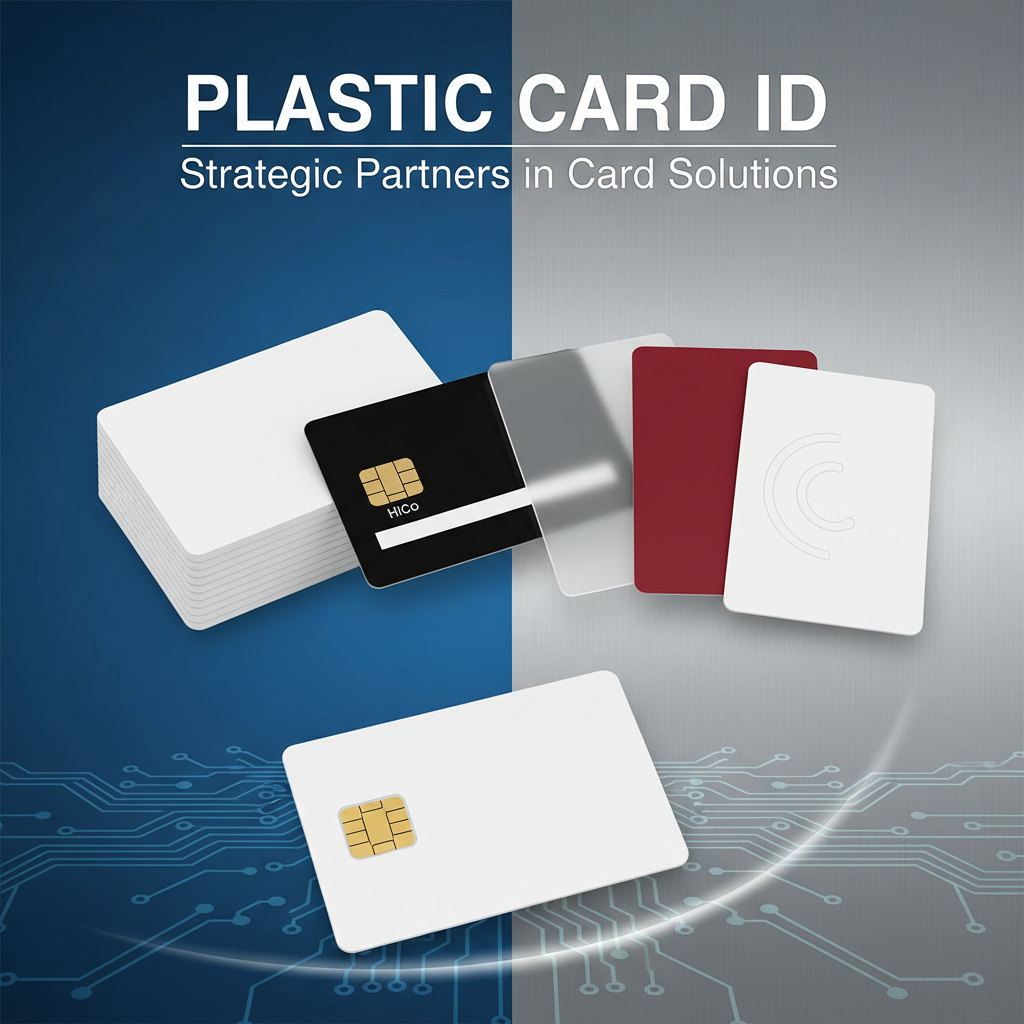 Not all blank cards are created equal, and the technology embedded in a card before it's ever printed determines what your program can actually do. This is where the decision gets interesting - and where working with an experienced partner like Plastic Card ID pays real dividends. The wrong card technology for your application means wasted investment. The right one means seamless operation from day one.
The landscape of card technologies spans from simple plain PVC all the way to sophisticated contactless smart cards carrying encrypted data in embedded microchips. Each type occupies a distinct position in the ecosystem of card-based programs, and understanding that ecosystem is essential before placing your first order.
Magnetic Stripe Cards: HiCo vs. LoCo Explained
Magnetic stripe cards encode data on a strip of iron oxide particles bonded to the card surface. The critical specification is coercivity - the magnetic strength of that encoding. High coercivity (HiCo) cards are encoded at 2750 Oe and resist magnetic interference from everyday sources like magnets in purses and wallets. For programs where cards must hold their data reliably over months or years, HiCo is the correct choice.
Low coercivity (LoCo) cards, encoded at 300 Oe, are intentionally easier to write and rewrite. This makes them ideal for hotel key card applications where the same card gets re-encoded for each guest stay. The reduced durability of LoCo encoding isn't a flaw in this context - it's the feature.
Magnetic stripe cards remain one of the most widely deployed card technologies in the United States, compatible with an enormous installed base of readers across retail, hospitality, access control, and loyalty applications. For many programs, they deliver exactly the right balance of functionality, compatibility, and cost.
RFID and Proximity Cards: Contactless Access Done Right
RFID cards contain an antenna and chip embedded within the card body itself, invisible to the eye but capable of communicating with compatible readers without physical contact. Proximity cards operating at 125 kHz have been the access control workhorse for decades, while higher-frequency options including 13.56 MHz cards - including MIFARE DESFire - deliver enhanced security and data capacity.
Contactless technology transforms the user experience of access control programs. Cardholders wave or tap rather than insert and remove, reducing reader wear and accelerating throughput at high-traffic entry points. For corporate campuses, healthcare facilities, and multi-building complexes, this is not a luxury - it is an operational requirement.
The blank RFID card you order from CPE arrives with its antenna and chip intact, ready to be programmed to your specific access control system and printed with your organization's branding. The combination of contactless function and professional appearance projects exactly the credibility your program needs.
Smart Chip Cards: Maximum Security and Data Capacity
Contact smart chip cards carry an embedded microprocessor capable of storing and processing data with encryption that magnetic stripes simply cannot match. These are the cards of choice for casino player reward programs, government and institutional ID programs, and any application where data security and tamper resistance are non-negotiable priorities.
Smart chip technology also enables multi-application cards - a single card that functions simultaneously as an ID credential, a loyalty card, and an access token. For organizations looking to consolidate card programs, this is a compelling operational and cost-reduction strategy.
Specialty formats including clear plastic cards, custom die-cut shapes, and luxury metal cards in stainless steel, brass, and gold round out the advanced offering. When your card program needs to make a powerful first impression, these premium formats deliver an experience that standard plastic cannot replicate.
Why Blank Cards Outperform Paper in Every Measurable Way
There is a persistent temptation, particularly among smaller organizations and new programs, to defer the switch from paper-based credentials to plastic cards. The upfront investment feels avoidable. But the data tells a different story - one that makes the switch not just sensible but strategically urgent for any program serious about results.
Retailers who transition gift card programs from paper certificates to plastic cards consistently report sales increases in the range of 35-50%. That figure is not a statistical outlier - it reflects the fundamental difference in how consumers perceive, retain, and use plastic versus paper. A plastic card lives in a wallet. A paper certificate lives in a junk drawer, if it survives at all.
Loyalty Programs: The Wallet Presence Advantage
Loyalty cards that physically reside in a customer's wallet generate repeat visits in ways that paper punch cards fundamentally cannot. Physical presence creates psychological commitment. Every time a customer opens their wallet, your brand appears. That passive brand impression has real commercial value that accumulates quietly over the life of the card.
Paper punch cards get lost, damaged, forgotten in coat pockets, and rejected at point of sale when they're too crumpled to scan. Plastic loyalty cards are none of these things. They hold their shape, their print quality, and their encoding integrity through years of wallet use. The operational friction they eliminate - reprinting cards, handling disputes over damaged paper, manually tracking punches - saves staff time that compounds into real cost savings.
For organizations running loyalty programs of any scale, the transition to plastic is not a cost center. It is a revenue driver, a customer experience upgrade, and an operational efficiency improvement delivered in a single CR80 package.
Membership and ID Cards: Signaling Legitimacy at Scale
Membership organizations, professional associations, gyms, clubs, and any entity that issues credentials face a credibility challenge. The credential itself must signal that membership in your organization means something. Paper membership cards undermine that signal before the member even looks at the design - the medium contradicts the message.
Plastic membership cards, by contrast, communicate permanence, investment, and organizational seriousness. Members who receive a professional plastic card feel their membership is valued. They are more likely to carry the card, display it, and renew their membership when the time comes. These behavioral effects are well-documented and commercially meaningful.
Employee ID programs carry similar dynamics. A professionally printed, durable plastic ID badge communicates organizational structure, security awareness, and operational maturity. Vendors, visitors, and employees themselves respond differently to a program built on professional plastic credentials versus improvised alternatives.
Gift Cards: The 35-50% Revenue Lift That Changes Programs
The revenue impact of switching to plastic gift cards deserves its own focus because the numbers are so significant. A 35-50% increase in gift card sales is not a marginal improvement - it can transform the economics of a retail gift card program entirely. The plastic card functions as a branded marketing piece that recipients display, share, and talk about in ways that paper equivalents simply do not inspire.
Gift cards also have measurable overspend behavior - recipients frequently spend more than the card's face value when redeeming. Plastic cards, with their higher perceived value and wallet presence, amplify this effect. The average gift card recipient who holds a premium-feeling plastic card is more likely to choose your business over a competitor when deciding where to redeem.
For small retailers especially, a well-designed plastic gift card program can be a competitive equalizer - delivering the same professional card experience as major national chains at a per-card cost that makes economic sense even at modest volumes starting at 50 cards per month.
Building Your Card Program: A Practical Buyer's Guide
 Understanding what blank plastic cards are is one thing. Knowing how to build a card program around them is another. The gap between those two points is where most organizations make costly mistakes - ordering the wrong card type, underestimating quantity needs, or overlooking the consumables and equipment necessary to actually run the program.
Plastic Card ID has guided over 100,000 customers through exactly this process, and the patterns are consistent. Organizations that plan thoughtfully before their first order run better programs, spend less over time, and scale more smoothly when demand grows.
Matching Card Technology to Your Application
Start with the function, not the format. What does your card need to do? If it needs to open doors, you need proximity or RFID technology. If it needs to carry a loyalty account balance, you need a magnetic stripe at minimum. If it needs to display a photo alongside encoded access data, you need a card that supports both printing and encoding - which is most of the lineup, but it's worth confirming.
- Access control programs - 125 kHz proximity or 13.56 MHz RFID, compatible with your existing reader infrastructure
- Loyalty and gift card programs - HiCo magnetic stripe for durable encoding, printable surface for branding
- Hotel key card programs - LoCo magnetic stripe, writable and re-writable at your front desk
- Photo ID and badge programs - Plain PVC blank, compatible with your dye-sublimation card printer
- Casino player card programs - Smart chip or magnetic stripe with high-security encoding requirements
- Premium membership programs - Clear, frosted, or specialty stock with optional metallic finishes
- High-security institutional ID - MIFARE DESFire smart cards with encryption capability
Getting this alignment right before ordering eliminates the most common and expensive mistake in card program setup - discovering incompatibility after the cards arrive. CPE specialists have the technical knowledge to guide this conversation for programs of any complexity.
Quantities, Pricing, and Program Economics
Blank plastic cards are priced by quantity, and the per-card cost drops meaningfully as order volume increases. Programs running 50 cards per month operate on a very different economics model than programs producing tens of thousands of cards, but both can run profitably and professionally with the right supplier relationship.
Factor the full program cost into your planning: cards, printer ribbons, cleaning kits, card carriers, and any mailing or fulfillment services you need. The true cost of a card program is not the card alone - it's the complete system of materials and equipment that produces and delivers finished cards to end users. Understanding this upfront prevents budget surprises later.
For organizations considering an in-house card printing setup, the investment in a card printer from Evolis, Zebra, or Fargo pays back quickly when weighed against the per-card cost of outsourcing print production. Plastic Card ID carries the full lineup of card printers and the complete range of compatible ribbons and supplies to keep those printers running reliably.
Card Printers: Completing Your In-House Program
A blank card becomes a finished credential only when it passes through a card printer. The printer market breaks into entry-level single-sided models suitable for low-volume ID programs and high-throughput dual-sided models built for large organizations issuing hundreds or thousands of cards per month. Matching printer capability to program volume is as important as matching card type to application.
Evolis, Zebra, and Fargo each bring distinct strengths to the market. Evolis printers are known for compact form factors and ease of use, making them excellent for reception desk or HR department deployment. Zebra printers offer enterprise-grade durability and throughput for high-volume programs. Fargo printers provide advanced security features including lamination and holographic overlay options for high-security ID programs.
Every card printer requires compatible ribbons, cleaning kits, and periodic maintenance to deliver consistent print quality. Plastic Card ID supplies all of these as a full program partner - not just a card vendor - which means your program has a single source for everything it needs to operate reliably.
Specialty and Advanced Blank Card Options
Standard PVC cards cover the majority of program requirements, but the full catalog of blank card options extends considerably further. For organizations with specific aesthetic, security, or functional requirements that plain white PVC cannot meet, specialty card options open up possibilities that can genuinely differentiate a program.
These advanced formats are not niche products for unusual applications - they are used regularly by organizations across hospitality, gaming, luxury retail, corporate, and institutional sectors to achieve program goals that standard cards simply cannot deliver.
Clear and Frosted PVC Cards
Clear plastic cards are exactly what they sound like - fully transparent PVC cards that create a dramatically different visual effect when printed. Designs that incorporate the card's transparency as a design element can achieve looks that feel genuinely premium. Frosted variants offer a translucent matte finish that photographs beautifully and feels distinctive in hand.
These cards are popular for VIP membership programs, premium loyalty tiers, and any application where the card itself is expected to make a strong aesthetic impression. The functional specs - CR80, 30 mil, compatible with standard printers and encoders - are unchanged. Only the visual impact is elevated.
Colored Stock and Custom Die-Cut Cards
Blank colored stock cards offer a base color alternative to white PVC, enabling design approaches where the card color itself is part of the brand identity. Custom die-cut shapes take this further, allowing cards to be produced in non-rectangular formats for events, promotional campaigns, and brand experiences where the standard card shape isn't the right fit.
Custom shape cards create remarkable retention and recall in promotional contexts - a card cut to echo a brand's logo or product shape becomes a physical conversation piece rather than just a credential. These are high-engagement tools for marketing and event programs that understand the value of memorable physical touchpoints.
Luxury Metal Cards: Stainless Steel, Brass, and Gold
At the premium end of the spectrum, luxury metal cards in stainless steel, brass, and gold deliver an experience that no polymer card can replicate. The weight, the sound, the feel - everything about a metal card communicates exclusivity and high value. These are the credentials issued by organizations whose brand positioning demands that the card itself signal elite status.
High-net-worth customer programs, executive membership tiers, VIP event credentials, and corporate gifting applications are among the uses where metal cards deliver measurable return on the premium investment. When the card is the message, metal says what plastic cannot.
Frequently Asked Questions About Blank Plastic Cards
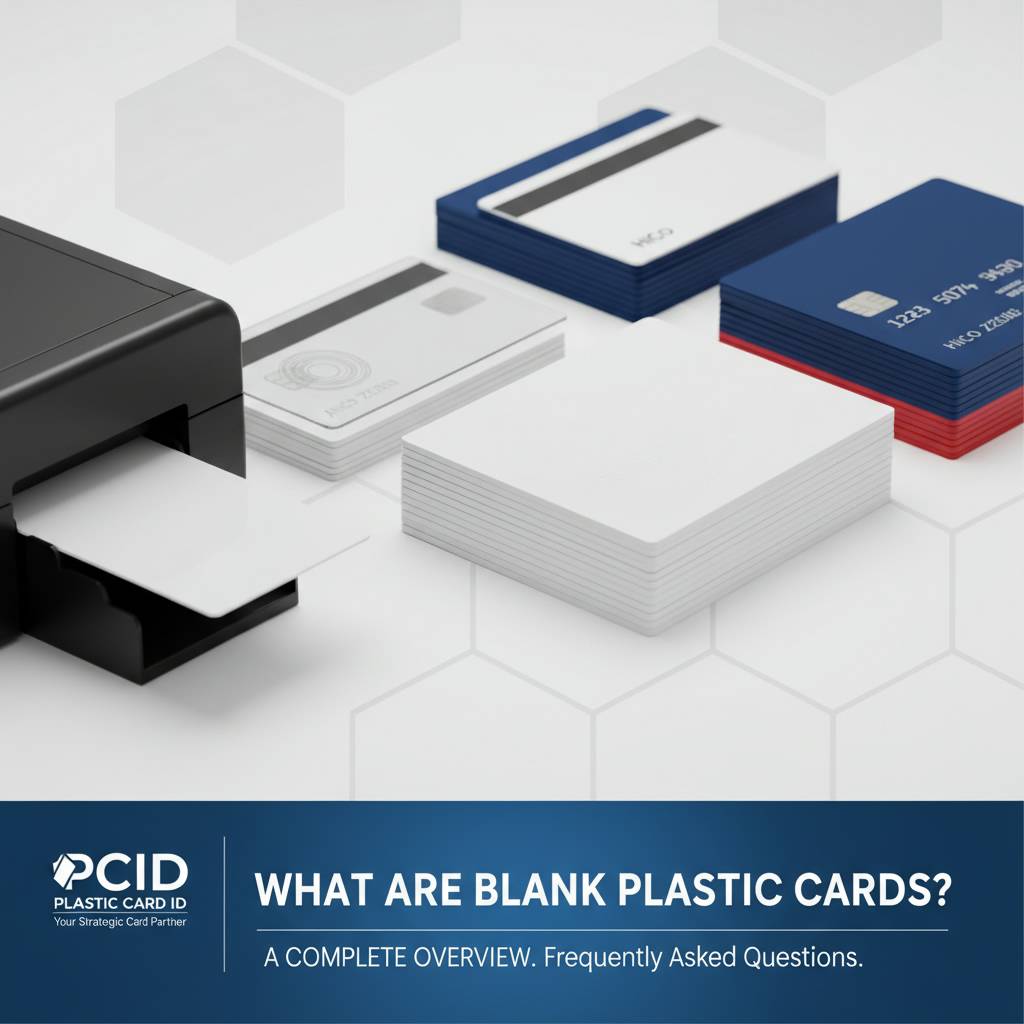
After more than 25 years and over 50 million cards sold, Plastic Card ID has heard every question. The ones below come up consistently from organizations at every stage - from first-time buyers figuring out what they need to experienced program managers refining existing operations.
What thickness should I order for standard card programs?
30 mil is the correct answer for the vast majority of programs. This is the ISO 7810 CR80 standard thickness, and it's what virtually all card printers, readers, badge holders, and wallets are designed to accommodate. 20 mil cards exist and have specific use cases - predominantly for card mailer inserts or applications where a thinner profile is specifically required - but they are not interchangeable with 30 mil equipment setups.
If you're unsure whether your printer is configured for a specific thickness, consult the manufacturer's specifications before ordering. Most professional card printers handle 30 mil without any adjustment. Some advanced models can handle a range of thicknesses with appropriate settings changes, but 30 mil remains the universal default.
Can I print on RFID and magnetic stripe cards with a standard card printer?
Yes, with the right printer configuration. Many card printers designed for ID and loyalty card programs include encoding modules - magnetic stripe encoders and, for some models, RFID encoding capability. The printable surface of encoded cards is the same PVC material as plain cards; the encoding technology is embedded within or beneath that surface and doesn't interfere with printing.
The important distinction is the encoding step versus the printing step - some printers handle both simultaneously in a single pass, while others require separate encoding hardware. Understanding your printer's capability is essential when ordering encoded blank card stock. CPE can help you verify compatibility before you commit to an order.
To speak with a card specialist directly, call 800.835.7919 - the team has the technical knowledge to answer compatibility questions for any printer or reader system in your program.
How many cards should I order for a new program?
The honest answer depends on your program's volume and how quickly you expect demand to grow. Ordering too few means frequent reorders and higher per-card costs. Ordering too many ties up capital in inventory that may sit longer than planned. Most new programs benefit from starting with a quantity that covers three to six months of projected issuance while qualifying for meaningful volume pricing.
For programs with highly variable data - like photo ID badges - ordering a larger quantity of blank stock and printing on demand is typically more efficient than ordering in small batches. For programs with static or semi-static designs, a larger pre-printed run can make economic sense once the design is locked.
Partner With Plastic Card ID for Your Blank Plastic Card Program
Blank plastic cards are simultaneously simple and sophisticated - simple in their standardized physical format, sophisticated in the range of technologies and applications they enable. Getting them right, from specification through ongoing supply, requires a supplier who understands both dimensions of that equation and is invested in your program's long-term success.
That is precisely what Plastic Card ID delivers. Over 25 years. More than 100,000 customers. Over 50 million cards. A complete catalog spanning every card technology, format, and specialty option your program could require. Card printers, ribbons, cleaning kits, card carriers, and mailing services - everything your program needs from one partner who knows cards inside and out.
A True One-Stop Shop for USA Card Programs
From the first blank card order to full-scale program support, CPE is structured to grow with your program rather than just fulfill a transaction. Whether your program issues 50 cards a month or tens of thousands, the catalog, the pricing, and the expertise are available to support you at every stage of that journey.
No other supplier in the United States combines the depth of card technology options, the breadth of supporting equipment and consumables, and the program-level experience to serve as a genuine strategic partner rather than a commodity vendor. That distinction matters enormously when your card program is integral to your business operations.
Ready to Start or Scale Your Card Program?
Plastic Card ID is ready to help you identify exactly the right blank plastic cards for your application, match them to the right printer and supplies, and structure an order that makes sense for your program's scale and budget. Call 800.835.7919 today and put 25 years of card program expertise to work for your organization.
From plain PVC blanks to RFID smart cards, from loyalty programs to high-security access credentials, Plastic Card ID has the cards, the equipment, and the knowledge to make your program a measurable success. Reach out now at 800.835.7919 and discover why over 100,000 organizations across the United States trust CPE with their card programs.
Previous Page