Glossy vs Matte Finish Blank Plastic Cards Explained
Table of Contents []
- Glossy vs Matte Finish Blank Plastic Cards: What Plastic Card ID Wants You to Know Before You Order
- Understanding Card Surface Finish at the Material Level
- How Finish Affects Printer Performance and Ribbon Selection
- Matching Card Finish to Program Type: A Practical Framework
- Pricing, Quantities, and What to Expect When You Order
- Frequently Asked Questions About Glossy and Matte Plastic Cards
- Partner with Plastic Card ID for Your Blank Plastic Card Program
Glossy vs Matte Finish Blank Plastic Cards: What Plastic Card ID Wants You to Know Before You Order
There is a moment every card program manager eventually faces - standing between two stacks of sample cards, one gleaming under the light and one quietly subdued, wondering which finish actually serves their program better. It sounds like a small decision. It is not. The finish on your blank plastic cards shapes how they print, how they feel, and how recipients perceive the organization behind them. Get it right and your cards look authoritative, scan cleanly, and wear well. Get it wrong and you end up reprinting or switching suppliers mid-program.
This guide breaks down the real differences between glossy and matte finish blank plastic cards - not in marketing language, but in operational terms that help you make a smarter purchase the first time. Whether you are running an employee badge program, a retail loyalty initiative, or an event credential operation, understanding card surface finish is foundational knowledge that pays off immediately.
| Feature | Glossy Finish | Matte Finish |
|---|---|---|
| Visual Appeal | High shine, vibrant colors | Subtle, professional look |
| Fingerprint Visibility | Shows easily | Minimal visibility |
| Print Compatibility | Standard dye-sub ribbons | May need matte overlay ribbon |
| Magnetic Stripe Option | Yes | Yes |
| Glare Under Light | Present, can obscure details | Minimal to none |
| Best For | Gift cards, loyalty, retail | ID badges, access, membership |
| Scratch Resistance | Moderate | Moderate to high |
Understanding Card Surface Finish at the Material Level
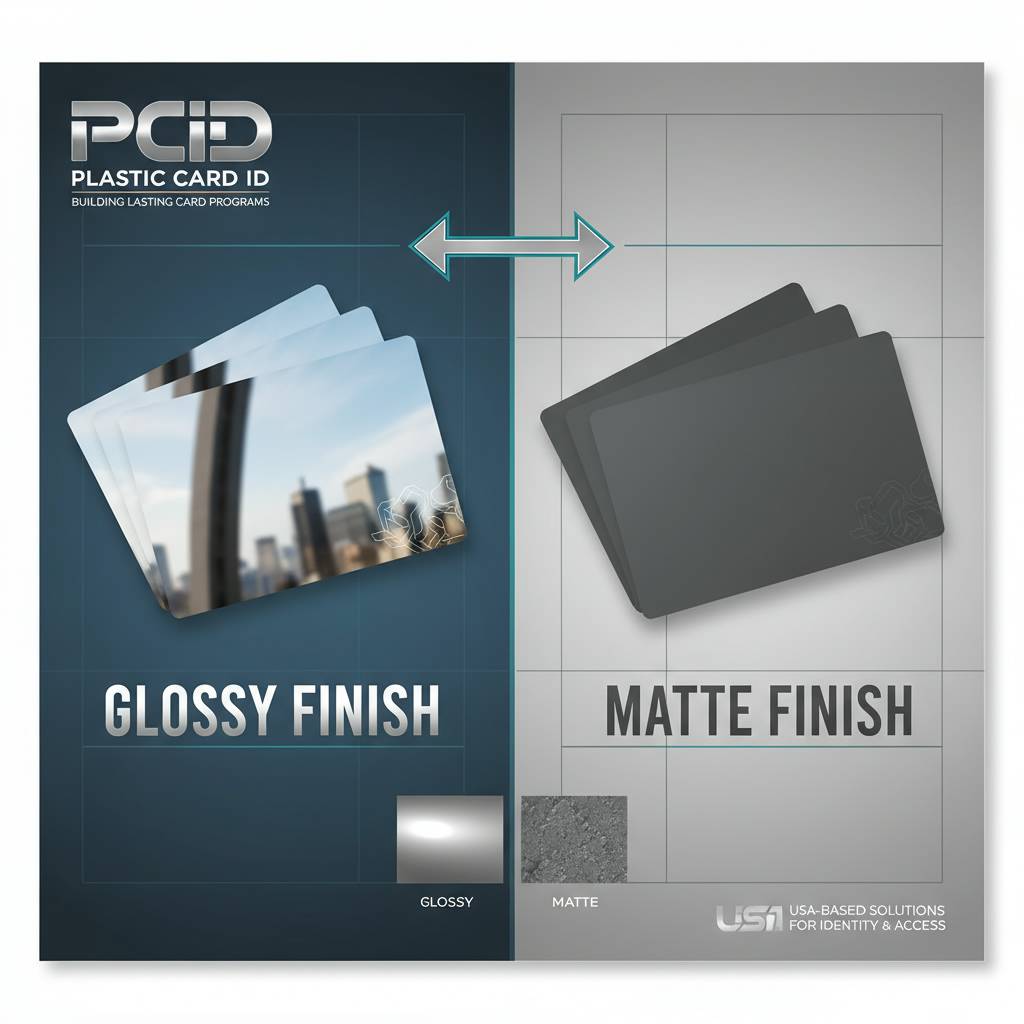 Blank CR80 plastic cards - the standard 30 mil, ISO 7810 format used in virtually every card program in the country - are manufactured with different surface textures applied during the lamination process. The finish is not simply a coating slapped on afterward; it is integrated into the card's outermost layer, affecting both the tactile experience and how printing media bonds to the surface.
Most standard blank PVC cards ship with a glossy finish because that is the industry default. Matte finish cards require a slightly different laminate layer that diffuses light rather than reflecting it. Both finishes accept dye-sublimation printing, which is the dominant print technology for ID cards and plastic card programs using desktop card printers from brands like Evolis, Zebra, and Fargo.
What Glossy Finish Actually Means for Your Cards
A glossy card surface is smooth, reflective, and has a polished appearance that makes colors look exceptionally vibrant. When you print a full-color design on a glossy blank card, the saturation pops - reds are bolder, gradients are cleaner, and photography reproduces with noticeable depth. This is why retail gift cards and loyalty cards almost universally favor the glossy finish.
The tradeoff is that glossy surfaces attract fingerprints and smudges at a much higher rate than matte cards. In high-touch environments - card wallets, badge holders passed between people, event credentials handled by staff all day - gloss cards can look worn and dirty within hours of distribution. It does not affect functionality, but it does affect perception.
What Matte Finish Brings to the Table
Matte plastic cards have a soft, non-reflective surface that reads as premium in a different way - understated, clean, and professional. Executive membership cards, corporate ID badges, and high-end loyalty programs frequently choose matte because it signals seriousness rather than flash. Under fluorescent lighting, a matte card is significantly easier to read - no glare washing out printed text or photo detail.
Matte surfaces also hide handling wear far more gracefully. A matte card that has been in someone's wallet for three months looks largely the same as it did on day one. This is an underrated operational benefit for programs where card longevity and maintained appearance directly affect brand perception. Think healthcare ID programs, university credentials, or premium membership clubs.
Frosted and Clear Cards: A Third Option Worth Knowing
Beyond the standard glossy-matte spectrum, CPE also carries clear plastic cards and frosted cards that open up entirely different design possibilities. Clear cards have transparent PVC with a slight gloss and allow designs that incorporate the see-through element intentionally. Frosted cards sit between clear and opaque, with a semi-translucent finish that resembles matte visually while offering a distinctive texture.
These specialty options are particularly popular for VIP membership programs, nightclub and venue access cards, and upscale retail loyalty programs. They are not the right choice for standard employee ID programs where card readers and photo verification require high contrast and clarity, but for branding-forward applications, they are exceptional.
How Finish Affects Printer Performance and Ribbon Selection
One thing most buyers overlook when choosing between glossy and matte blank cards is the downstream effect on their card printer and ribbon selection. Your card printer does not care about aesthetics - it cares about surface chemistry. The way dye-sublimation dye bonds to a card surface is directly influenced by the laminate finish, and choosing the wrong pairing creates problems ranging from faded prints to ribbons not transferring cleanly.
Standard full-color YMCKO ribbons are designed primarily for glossy card stock, because glossy is the market default. If you switch to matte cards, you may find that color saturation drops slightly unless you are using a matte overlay ribbon or a printer profile adjusted for that surface. CPE carries the full ribbon lineup for Evolis, Zebra, and Fargo printers precisely so that clients running matte card programs are not left hunting for compatible consumables.
Evolis, Zebra, and Fargo Compatibility with Different Finishes
Evolis printers - including the popular Primacy 2 and the workhorse Badgy series - handle both glossy and matte cards without significant adjustment for most standard programs. Zebra's ZC and ZXP series printers are similarly versatile. Fargo printers, which are widely used in enterprise ID programs, support matte overlaminates that can actually convert a glossy card into a matte-finished credential after printing, giving you the best of both worlds if the volume justifies it.
The important takeaway is that your card finish decision should happen before you purchase your printer, not after. Mismatched card stock and printer settings are one of the most common - and most avoidable - causes of poor print quality in in-house card programs. Talk to CPE before locking in your setup and you will avoid an expensive lesson.
Magnetic Stripe Cards and Finish Interaction
Both HiCo (High Coercivity) and LoCo (Low Coercivity) magnetic stripe cards are available in glossy and matte finishes. The magnetic stripe itself sits on the card surface independent of the face laminate, so the finish choice does not affect encoding reliability or stripe read performance in either case. HiCo stripes are the industry standard for programs where card longevity and reliability matter - they resist accidental erasure from everyday magnets and maintain data integrity far longer than LoCo stripes.
Where finish does matter for mag stripe cards is at the swipe terminal. A heavily smudged glossy mag stripe card can occasionally cause misreads at older swipe readers with tight tolerances. Matte stripe cards, which tend to stay cleaner in the stripe area, can actually perform more consistently over the card's lifespan in high-transaction retail environments. This is a subtle point, but for high-volume gift card or loyalty programs processing thousands of swipes monthly, it is worth noting.
RFID and Smart Chip Cards: Does Finish Matter?
For contactless RFID cards - including proximity access cards and MIFARE DESFire smart cards - the card finish has no effect whatsoever on the antenna or chip performance. The technology lives inside the card, and the outer surface is simply the housing. That said, matte RFID cards are increasingly popular in corporate access control programs because they accept printed overlays and personalization more cleanly and maintain a professional appearance at security checkpoints.
Hotel key cards, casino player cards, and proximity access credentials are all available in both finishes. The choice typically comes down to brand standards and the volume of card handling the credential will endure. Casino player cards, which are touched and handled constantly, often go matte for that reason.
Matching Card Finish to Program Type: A Practical Framework
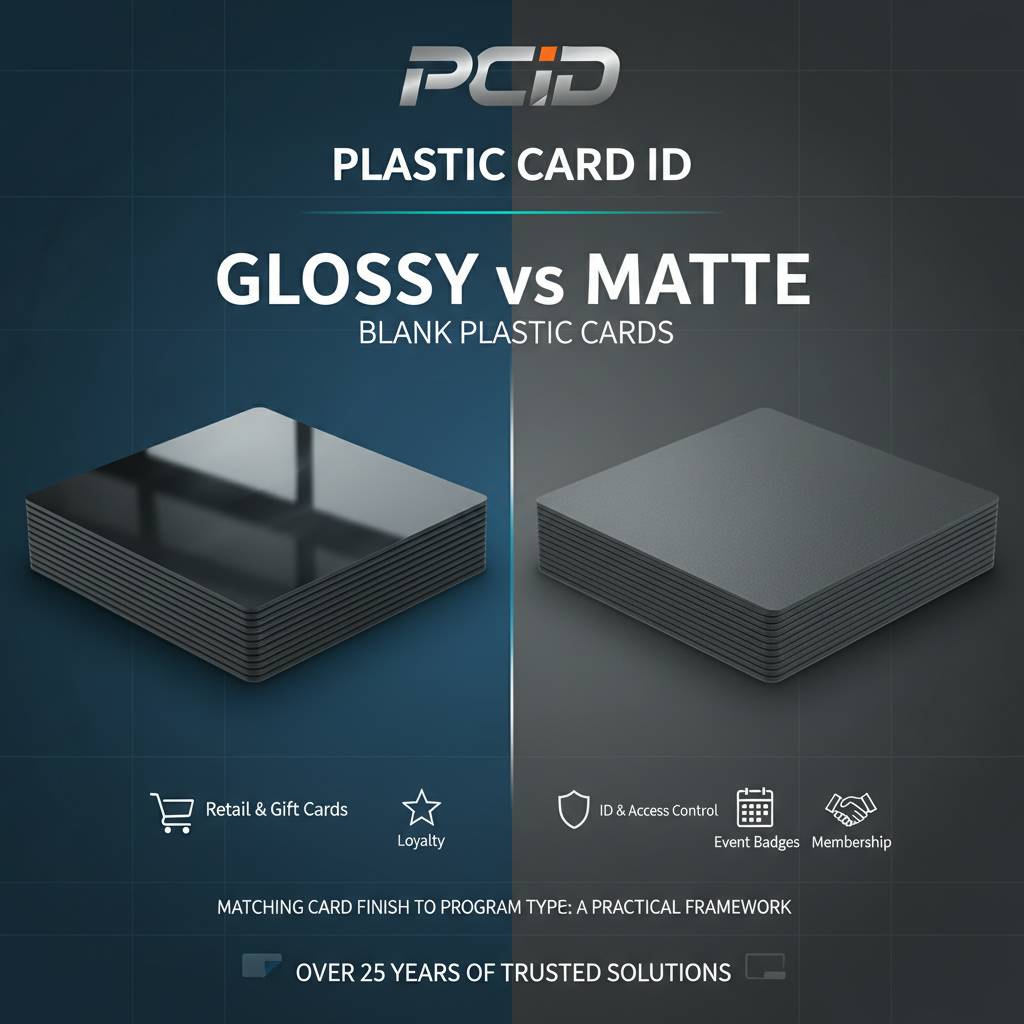 The right finish is not universal. It depends on what the card needs to do, who will carry it, and how your organization wants to be perceived when that card changes hands. Trying to find one finish that works for every program is the wrong approach - instead, match the finish to the program's specific functional and brand requirements.
Below is a framework that has emerged from working with over 100,000 customers across every industry vertical in the United States. It is not a rigid rulebook, but it will get most buyers to the right decision efficiently.
Retail Gift Cards and Loyalty Programs
Glossy wins here, decisively. Retailers who switched from paper punch cards or paper gift certificates to glossy plastic cards have reported sales increases in the range of 35-50%. That lift is not incidental - it is driven by the card's physical presence in a customer's wallet, its visual appeal at point of sale, and the psychological shift from a disposable paper item to something worth keeping.
Loyalty cards in glossy PVC live in wallets alongside payment cards, which means they get seen and used regularly. A matte loyalty card is not a wrong choice - some premium retailers deliberately choose matte to signal exclusivity - but for mainstream retail loyalty and gift card programs, glossy stock is the workhorse finish that performs reliably at scale.
Employee ID Badges and Access Credentials
Matte finish is almost always the better choice for employee ID programs. Here is why: ID badges are worn on lanyards, clipped to clothing, scanned at doors, and handled constantly. Glare from a glossy surface under office or warehouse lighting can obscure a photo or name when someone is visually checking a badge at a checkpoint. Matte cards maintain readable contrast under virtually any lighting condition, which is an operational safety advantage in secure facilities.
Additionally, matte surfaces accept handwriting - useful in smaller operations where badge customization happens in the field. And in environments where badges are exposed to friction, like manufacturing floors or healthcare settings, matte cards maintain their appearance longer without showing the micro-scratches that make glossy badges look worn within weeks.
- Security checkpoints where visual ID verification happens under fluorescent lighting
- Healthcare and clinical environments requiring frequent handling and scanning
- Manufacturing and industrial settings with friction-heavy wear conditions
- Corporate offices where badge appearance reflects brand standards
- Educational institutions issuing student or staff credentials with photo identification
Event Credentials and Temporary Passes
Event credentials occupy an interesting middle ground. For high-profile events - conferences, trade shows, VIP events, industry summits - glossy cards deliver the visual impact that matches the occasion's prestige. Attendees are more likely to keep a glossy credential as a memento, which extends brand impressions well beyond the event itself.
For staff credentials, access control passes, and vendor badges at those same events, matte is often the practical choice. Staff badges get handled aggressively, inserted into readers repeatedly, and clipped and unclipped dozens of times per shift. Matte stock handles that abuse more gracefully and stays legible longer. Running both finishes for a single event - glossy attendee badges, matte staff credentials - is a completely legitimate approach that CPE can support from a single order.
Pricing, Quantities, and What to Expect When You Order
Blank plastic cards are priced primarily by quantity, card type, and any added features like magnetic stripes, RFID inlays, or smart chips. The finish itself - glossy versus matte - typically adds little to no cost for standard CR80 PVC stock, which means the decision is purely functional rather than budgetary for most buyers. Specialty finishes like frosted, clear, or custom colored stock may carry a modest premium depending on volume.
Orders can range from as few as 50 cards for small organizations testing a new program, up to tens of thousands for large-scale rollouts. Volume pricing tiers make the per-card cost progressively more favorable as quantities increase. For organizations running ongoing programs - issuing cards monthly to new employees or new members - establishing a standing order relationship with a strategic supplier like CPE is far more cost-effective than one-off purchases.
Ordering Blank Cards for In-House Printing Programs
Blank CR80 cards - the standard 3.375 x 2.125 inch, 30 mil format - give organizations total design control over their card program. Every card becomes whatever you need it to be: an employee badge, a loyalty card, an event credential, a membership card, or an access token, depending entirely on what you print or encode onto it. In-house printing programs typically achieve a lower per-card cost over time compared to ordering pre-printed cards, especially at mid-to-high volumes.
For in-house programs, the finish of your blank card stock needs to match your printer's ribbon type and overlay settings. Glossy blank cards with a YMCKO ribbon produce vibrant, photo-quality results on most desktop card printers. Matte blank cards paired with a matte overlay ribbon or a printer configured for matte stock produce crisp, professional credentials without glare. Getting the pairing right from the start saves wasted materials during setup.
Value-Added Services That Complete Your Card Program
Beyond blank card stock and card printers, a complete card program requires accessories and fulfillment support that most buyers do not think about until they need them. Printer ribbons, cleaning kits, card sleeves, card carriers, and card affixing and mailing services all form part of the operational infrastructure that keeps a card program running smoothly. Having a single supplier handle all of these needs eliminates the coordination overhead that slows down program managers.
Card mailing services are particularly valuable for membership organizations, associations, and loyalty programs that need to distribute cards to recipients across a geographic area. Rather than managing printing, packaging, and mailing internally, organizations can hand off fulfillment entirely and focus on program management. Call 800.835.7919 to discuss which value-added services fit your specific program requirements and volume.
Specialty and Premium Card Options
For programs where standard PVC is not enough, CPE offers luxury metal cards in stainless steel, brass, and gold finishes - a category that has grown significantly as premium membership and VIP loyalty programs have expanded. Metal cards carry a tactile and visual weight that communicates exclusivity from the moment they are held. The psychological impact of a metal card in a customer's hand is genuinely different from any plastic card, regardless of finish.
Custom die-cut shapes, colored PVC stock in non-standard colors, and casino-specific player cards with specialized coatings round out the specialty catalog. These are not mass-market items, but for the programs where they fit, they deliver brand differentiation that standard card formats simply cannot match.
Frequently Asked Questions About Glossy and Matte Plastic Cards
After working with over 100,000 customers across the United States, certain questions come up consistently when buyers are deciding between glossy and matte blank cards. The answers below address the most common points of confusion directly and practically.

Can I Print on Both Glossy and Matte Cards with the Same Printer?
Yes, most desktop card printers from Evolis, Zebra, and Fargo can handle both glossy and matte card stock. The key variable is the ribbon and overlay configuration. Switching between finishes mid-program may require adjusting printer settings or changing ribbon types to maintain consistent print quality. For programs printing both types, it is worth testing your specific printer and ribbon combination before committing to a large card order.
Some organizations run separate printers for separate programs precisely to avoid this reconfiguration overhead. If your operation issues both employee badges (matte) and customer loyalty cards (glossy), having dedicated printers for each program type is a practical solution that pays for itself in time savings and consistent output quality.
How Long Do Glossy and Matte Cards Last Compared to Each Other?
Both finishes are manufactured from durable PVC and rated for similar lifespans under normal use conditions. The primary durability difference is perceptual rather than material - glossy cards show wear more visibly through scratches and fingerprints, while matte cards maintain their appearance longer despite accumulating the same physical wear. In terms of structural integrity and functional performance, both finishes last equally well.
Card life is more strongly influenced by use environment than finish. A glossy card carried in a dedicated card slot in a quality wallet can last years. A matte card clipped to a badge holder and swung against machinery daily may degrade faster regardless of finish. Design your card program around the actual use environment your cards will experience.
What Quantities Make Sense for Testing a New Card Finish?
For organizations considering a switch from glossy to matte or vice versa, ordering a small test batch - typically 50-500 cards depending on program scale - before a full program rollout is the most sensible approach. Testing your printer, your ribbon, and your design against the actual card stock you plan to use is an investment that prevents costly mistakes at full volume.
Sample cards and small test batches are available precisely for this purpose. Running your card through its intended use case - printing, encoding, reading, wearing, or swiping - with your actual equipment and actual workflow tells you far more than any spec sheet. Programs that skip the test phase account for a disproportionate share of mid-program supplier switches and reprints.
Partner with Plastic Card ID for Your Blank Plastic Card Program
The difference between a card program that runs smoothly for years and one that creates constant friction often comes down to the supplier relationship behind it. Knowing your finish, your card type, your printer compatibility, and your volume trajectory before you order is what separates programs that scale from programs that struggle. CPE brings over 25 years and more than 50 million cards of experience to that conversation - and that background shows up in the quality of guidance you receive, not just the quality of the cards you receive.
Whether you are launching a new employee ID program, scaling up a loyalty initiative, or sourcing blank card stock for an access control system, the right finish matters and the right supplier matters more. From blank CR80 glossy and matte stock to magnetic stripe cards, RFID credentials, smart chips, specialty formats, and the full lineup of card printers and accessories needed to run a complete program, everything is available from one source.
Call Plastic Card ID today at 800.835.7919 - because your card program deserves a supplier who understands every detail of what makes it work.
Previous Page