Blank Plastic Cards for Healthcare Worker IDs: Buy Now
Table of Contents []
- Why Plastic Card ID Is the Healthcare ID Card Partner You Have Been Looking For
- The Full Spectrum of Blank Card Options for Healthcare Settings
- Card Printers That Complete Your Healthcare ID System
- Building a Healthcare Worker ID Program: A Practical Buyer's Guide
- Common Questions About Blank Plastic Cards for Healthcare Worker IDs
- Advanced Healthcare Credential Options From Plastic Card ID
- Partner With Plastic Card ID for Your Healthcare Worker ID Card Needs
Blank Plastic Cards for Healthcare Worker IDs
| Card Type | Best Use | Typical Volume | Key Feature |
|---|---|---|---|
| Blank CR80 PVC Cards | Staff photo IDs | 50 to 10,000 | Full design control, low cost |
| Magnetic Stripe Cards | Time and attendance | 100 to 50,000 | HiCo or LoCo encoding |
| Proximity Access Cards | Door access control | 25 to 5,000 | 125kHz contactless entry |
| RFID Smart Cards | Secure facility access | 50 to 20,000 | MIFARE DESFire encryption |
| Colored Stock PVC Cards | Department color-coding | 50 to 5,000 | Instant visual identification |
Why Plastic Card ID Is the Healthcare ID Card Partner You Have Been Looking For
Walk into any hospital, clinic, or care facility and one thing becomes immediately obvious: every authorized person is wearing a credential. Not a laminated paper badge. Not a sticky label with a printed name. A proper plastic ID card that communicates authority, professionalism, and accountability at a glance. The difference between a well-run healthcare environment and a chaotic one often comes down to how clearly roles are identified, and blank plastic cards for healthcare worker IDs are where that clarity begins.
Plastic Card ID has been supplying plastic cards to American businesses and organizations for over 25 years. More than 100,000 customers and upward of 50 million cards shipped - those numbers do not accumulate by accident. They reflect decades of getting the details right, order after order, program after program. Healthcare organizations of every size - from solo medical practices to sprawling regional hospital networks - have trusted CPE to provide the blank cards that fuel their in-house ID programs.
The stakes in healthcare ID credentialing are uniquely high. Patients and visitors need to know who is authorized to care for them. Staff need fast, reliable access to restricted areas. Administrators need a system that scales as headcount shifts. A reliable supply of quality blank plastic cards, paired with the right card printer, solves all three challenges at once - and does it with a cost efficiency that outsourced badge printing simply cannot match.
The Case for In-House Healthcare ID Card Printing
Outsourcing ID card production means waiting days or weeks for a new hire's badge to arrive. In a busy clinical environment, that delay creates real problems - temporary workarounds, security gaps, and a new employee who starts their first shift feeling like an afterthought. Bringing card printing in-house eliminates the wait entirely.
With a desktop card printer and a supply of blank CR80 PVC cards, your HR or security team can produce a finished, professional-looking healthcare worker ID in minutes. Design updates, department changes, and credential renewals happen on your schedule, not a vendor's. In-house printing puts the control where it belongs: with your organization.
What "Blank" Really Means for Your Program
A blank CR80 plastic card is not an unfinished product - it is a foundation. The card itself conforms to ISO 7810 standards, measuring the same dimensions as a standard credit card at 30 mil thickness. What makes it "blank" is the absence of pre-printed graphics, which is precisely the point. Your design, your branding, your data fields go on it.
Healthcare facilities that print in-house can encode a nurse's name, photo, title, department, and employee number in a single print pass. Some facilities add a magnetic stripe for time-and-attendance systems or an RFID chip for door access. The blank card is the raw material; the finished healthcare worker ID is whatever you need it to be.
Volume Flexibility That Matches Healthcare Realities
Healthcare staffing is not static. Travel nurses arrive and depart. Seasonal hiring surges. New departments open. A card supplier that locks you into massive minimum orders is a poor fit for an industry defined by constant change. CPE works with programs that print as few as 50 cards a month and others that require tens of thousands, without penalizing smaller buyers for their volume.
That flexibility is not incidental - it is a core part of how Plastic Card ID approaches its role as a strategic partner. Call 800.835.7919 to discuss your facility's specific volume needs and find the card and printer combination that makes the most sense for your program.
The Full Spectrum of Blank Card Options for Healthcare Settings
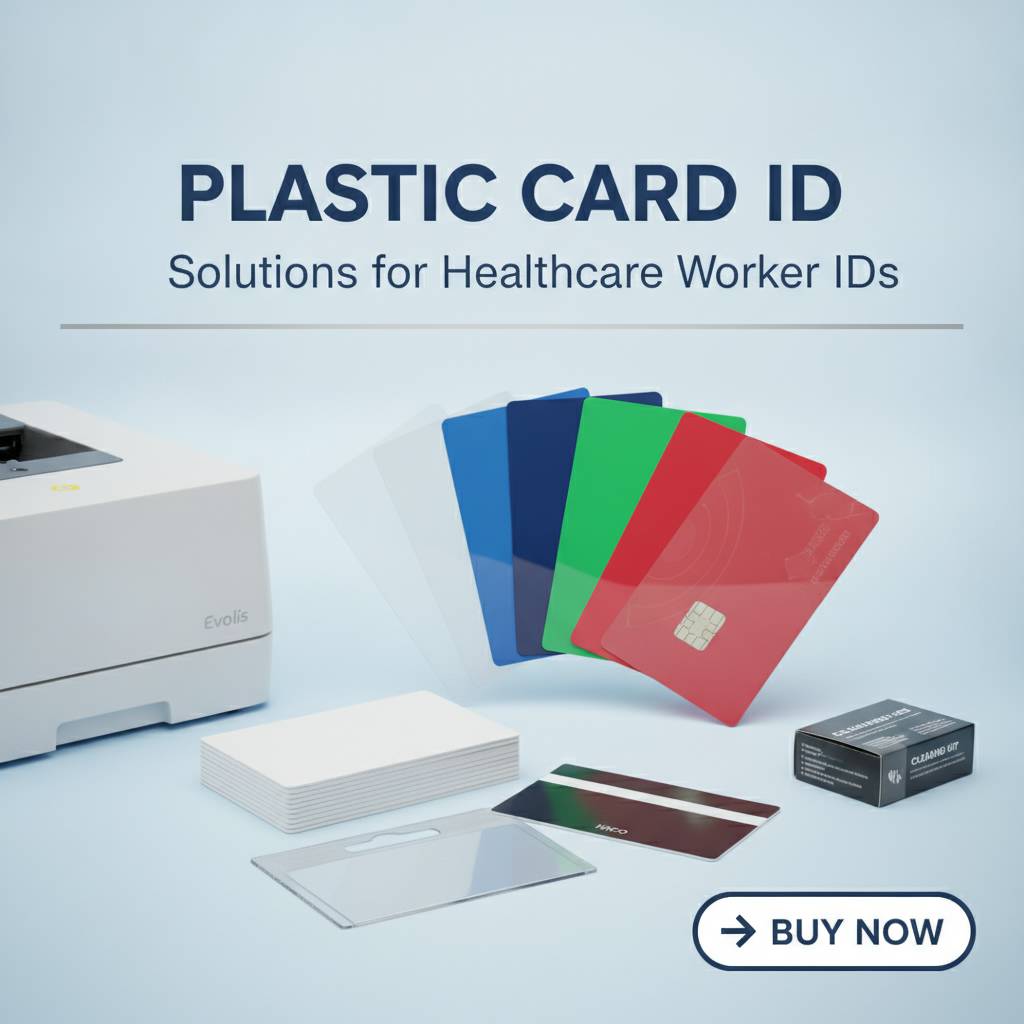 Not every healthcare worker ID has the same requirements. A receptionist's badge may need nothing more than a printed photo and name. A pharmacy technician's credential might require magnetic stripe encoding for controlled substance access logs. A surgeon entering a sterile OR suite may tap a contactless smart card against a reader. One type of blank card does not serve all these needs equally well - and that is exactly why CPE maintains such a broad product catalog.
Understanding the options available helps facilities build smarter, more layered credential programs that address both identification and access control within a single card format. Here is a closer look at the card types most relevant to healthcare environments.
Standard Blank CR80 PVC Cards
The workhorse of any in-house ID program. These cards print cleanly, laminate well, and hold up through daily wear on lanyards and badge reels. At 30 mil thickness, they have the feel of a professional credential - substantial, not flimsy. For facilities focused purely on visual identification, this is the most cost-effective choice available.
Blank CR80 cards are compatible with virtually every desktop and mid-range card printer on the market. Whether you run an Evolis, Zebra, or Fargo printer, these cards feed reliably and produce sharp, vivid output that reflects well on your organization's professional standards.
Magnetic Stripe Cards for Healthcare Data Systems
Many healthcare organizations already use magnetic stripe readers for time-and-attendance tracking, cafeteria purchases, parking systems, or records access. Adding a magnetic stripe to your healthcare worker ID cards allows a single credential to serve multiple functions simultaneously, reducing the number of cards each employee needs to carry.
CPE carries both HiCo (high coercivity) and LoCo (low coercivity) magnetic stripe cards. HiCo stripes are more resistant to demagnetization - an important consideration in clinical settings where cards may come near medical equipment. LoCo cards are appropriate where lower-security encoding is sufficient and cost savings are a priority.
RFID and Proximity Cards for Access-Controlled Healthcare Environments
Hospitals and large medical campuses often have dozens of restricted zones: medication rooms, server closets, imaging suites, executive areas, and laboratory spaces. Proximity cards operating at 125kHz and RFID smart cards using MIFARE DESFire encryption give facilities a contactless access control layer that integrates with most commercial security platforms.
These cards print just like standard PVC cards, so your ID badge and your access credential live on the same piece of plastic. Staff tap to enter restricted areas and wear the same card as their visual identification. That consolidation simplifies credential management and reduces the total number of cards each employee must maintain.
Colored Stock Cards for Department Color-Coding
Color is an underutilized identification tool in many healthcare settings. Issuing colored-stock blank PVC cards by department - blue for nursing, red for emergency services, green for environmental services, for example - creates an instant visual layer of identification that photographs and titles alone cannot deliver as quickly.
Color-coded credentials help patients, visitors, and staff identify authorized personnel at a glance during high-pressure situations. CPE stocks a range of colored PVC card options, giving facilities the raw materials to build a department-color program without requiring custom pre-printed cards from an outside vendor.
Card Printers That Complete Your Healthcare ID System
Blank cards are only half of the equation. The card printer you choose determines print quality, speed, encoding capability, and long-term total cost of your ID program. Plastic Card ID carries a curated lineup of card printers from three of the industry's most respected manufacturers - Evolis, Zebra, and Fargo - each offering models suited to different facility sizes and program complexities.
Choosing the Right Printer for Your Facility Size
A 20-person outpatient clinic and a 3,000-employee regional medical center have fundamentally different printing needs. Small facilities printing 50 cards per month benefit from compact, easy-to-operate desktop printers that require minimal training. Larger operations that print hundreds of cards weekly need mid-volume or high-capacity printers with faster throughput and higher-capacity ribbon cartridges.
Getting the printer specification right from the start saves significant money over the life of the program. Underspecifying means frequent bottlenecks and premature wear on equipment. Overspecifying means paying for capacity you will never use. CPE helps clients match the right printer to their actual printing volume and feature requirements.
Printer Supplies: Ribbons, Cleaning Kits, and More
A card printer is only as reliable as the consumables running through it. Plastic Card ID supplies printer ribbons for Evolis, Zebra, and Fargo printers, along with cleaning kits designed to maintain print head performance and extend printer life. Neglecting regular cleaning is the leading cause of preventable print quality degradation in in-house card programs.
Ordering ribbons and cleaning supplies from the same source as your blank cards simplifies procurement and ensures compatibility. Consistent supply sourcing is a surprisingly powerful efficiency gain for busy administrative teams managing multiple vendors and purchase orders simultaneously.
Card Accessories That Complete the Credential Experience
A beautifully printed healthcare worker ID deserves the right finishing touches. Card carriers, sleeves, lanyards, badge reels, and clip holders protect the card surface and make daily wear more practical for clinical staff. Plastic Card ID stocks a full selection of card accessories, so facilities can outfit their entire credential program from a single supplier.
Card sleeves are particularly useful in healthcare settings where cards are handled frequently, exposed to moisture, or clipped to scrubs and lab coats throughout a shift. Protecting the printed surface extends card life and maintains the professional appearance of your credentials over time.
Building a Healthcare Worker ID Program: A Practical Buyer's Guide
 Starting or overhauling a healthcare worker ID card program involves more decisions than most administrators initially expect. What card type is right? How many cards are needed per month? What data needs to be encoded? Which printer handles the workload? Having clear answers to these questions before purchasing saves time, money, and frustration. Below is a practical framework for planning your program effectively.
Step One: Define What Your ID Card Needs to Do
Start by listing every function the card must serve. Is it purely a visual identification credential? Does it need a magnetic stripe for an existing time-and-attendance system? Does it need contactless access control capability? Will it be used across a single building or across a multi-campus health system? Each answer narrows the field of appropriate card types significantly.
Facilities that need a card to serve multiple functions should plan for that from the beginning rather than trying to retrofit encoding capabilities onto an existing card program. Multi-function cards save money and reduce credential complexity for employees long-term. Getting this definition right is the single most important planning step.
Step Two: Estimate Your Volume Accurately
Volume drives nearly every downstream decision in a card program - printer selection, ribbon type, bulk card pricing, and replenishment frequency. Start with your current headcount and add a reasonable buffer for turnover, temporary staff, and card replacements due to loss or damage. Most healthcare facilities find their actual monthly card consumption is higher than their initial estimate.
- Factor in new hire onboarding rates, particularly if your facility uses travel nurses or contract clinical staff regularly.
- Account for annual card renewals if your ID program includes expiration dates on credentials.
- Add a 10-15% buffer for lost, damaged, or stolen cards that require replacement outside normal cycles.
- Consider whether multiple departments or locations will share a single printer and card supply or manage independent programs.
- Review whether seasonal staffing patterns create volume spikes that require additional card inventory on hand.
Step Three: Choose Your Card Supplier Carefully
Not all blank card suppliers are equal. Card thickness consistency, surface quality, and batch-to-batch uniformity matter enormously when running cards through a precision card printer. Poor-quality cards cause jams, misprints, and accelerated print head wear - problems that cost far more to fix than the money saved by buying the cheapest cards available.
Plastic Card ID supplies cards that meet ISO 7810 standards and print consistently across all major card printer brands. With over 50 million cards shipped to more than 100,000 customers nationwide, the quality track record speaks for itself. Contact CPE at 800.835.7919 to discuss card specifications and request samples for your evaluation.
Common Questions About Blank Plastic Cards for Healthcare Worker IDs
Healthcare administrators evaluating in-house ID programs often have similar questions about card types, compatibility, and program logistics. The answers below address the most frequently raised concerns from facilities in the planning and procurement stages.
Are Blank PVC Cards Compatible With Any Card Printer?
Standard CR80 blank PVC cards at 30 mil thickness are compatible with virtually all desktop and mid-range dye-sublimation card printers, including all models sold by Plastic Card ID from Evolis, Zebra, and Fargo. Specialty cards - such as those with embedded RFID chips or magnetic stripes - need to be matched carefully to printers with the corresponding encoding hardware, which CPE can help configure correctly.
Always verify that the printer's encoding module matches the card's chip frequency or magnetic stripe coercivity before purchasing. Mismatches between card specifications and printer capabilities are the most common source of encoding errors in new programs. Getting this match right the first time prevents costly reprints and wasted card stock.
How Many Cards Should a Healthcare Facility Keep in Stock?
A general best practice is to maintain at least a 60 to 90-day supply of blank cards on hand. This buffer protects against shipping delays, unexpected demand spikes from rapid hiring, and the occasional bulk spoilage that comes with any print operation. Facilities that run very lean inventory frequently find themselves scrambling to onboard new staff when card stock runs out unexpectedly.
Ordering in larger quantities also reduces per-card cost, which adds up meaningfully over a full year's consumption. Plastic Card ID makes it easy to order in quantities that match your actual program scale, whether that means a few hundred cards or several thousand at a time.
What Is the Difference Between HiCo and LoCo Magnetic Stripe Cards in Healthcare?
The coercivity of a magnetic stripe refers to how much magnetic force is required to write data to the stripe - and consequently how resistant it is to accidental demagnetization. HiCo (high coercivity) cards require more force to encode but hold their data far more reliably in environments with ambient electromagnetic fields. For healthcare settings with MRI equipment, monitoring devices, or other electromagnetic sources, HiCo is the recommended choice.
LoCo cards are appropriate for low-risk encoding environments where cost is a higher priority than magnetic durability. For most healthcare facilities, the modest cost premium for HiCo cards is easily justified by the reduction in card failures and the inconvenience of re-encoding demagnetized credentials.
Advanced Healthcare Credential Options From Plastic Card ID
Beyond standard blank PVC cards, CPE offers a range of advanced credential formats that address the more complex identification and access control needs found in larger or higher-security healthcare environments. These options extend what is possible within a single card program without requiring multiple vendors or separate credential systems.
RFID Smart Cards With MIFARE DESFire Encryption
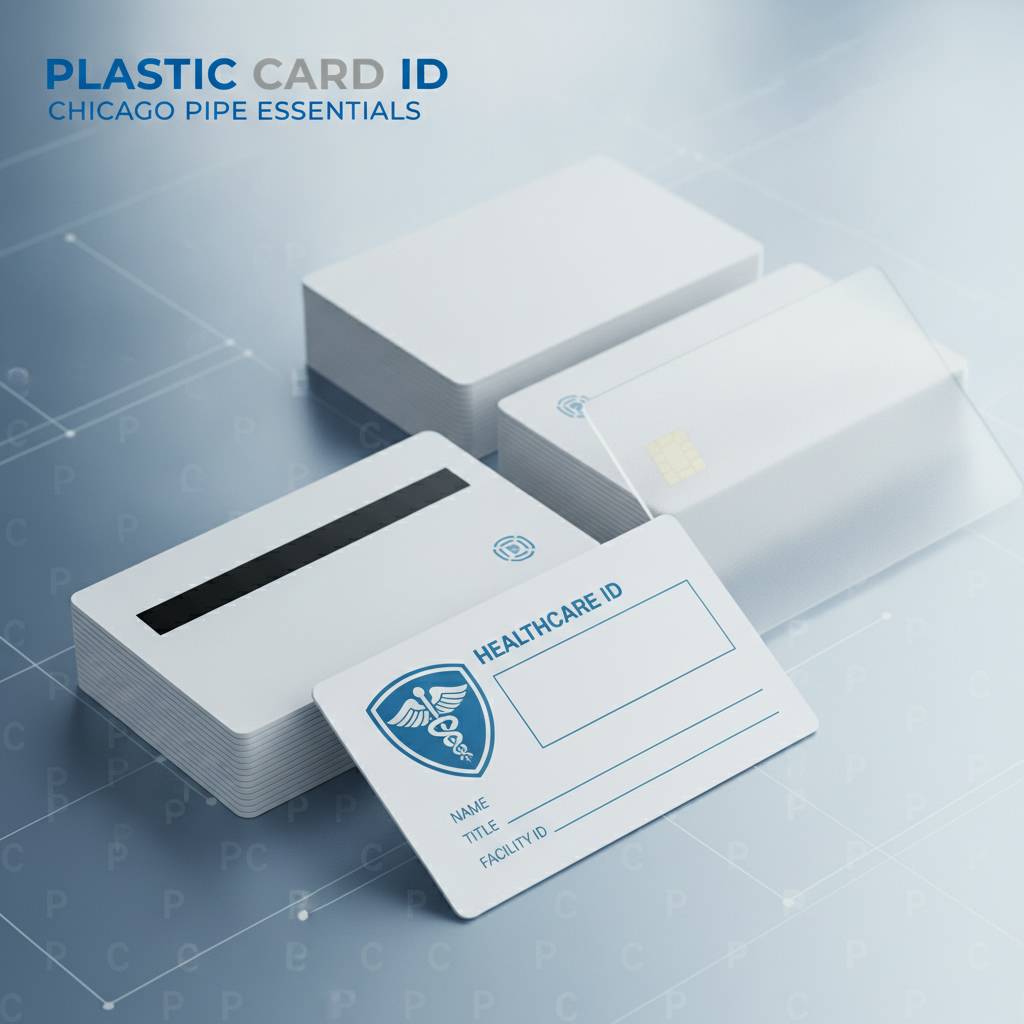
High-security healthcare environments - research hospitals, pharmaceutical manufacturing facilities, and federal medical centers - require access control credentials that go beyond basic proximity card technology. RFID smart cards using MIFARE DESFire encryption provide cryptographic authentication that is significantly harder to clone or intercept than older 125kHz proximity card formats.
These cards look identical to standard PVC cards and can be printed with the same desktop card printers your facility already uses, provided the printer has the appropriate smart card encoding module. The security upgrade happens at the chip level, invisibly to the end user while providing meaningfully stronger protection at every access point.
Clear and Frosted Specialty Cards for Premium Healthcare Credentials
Some healthcare organizations - large academic medical centers, specialty clinics, and executive health programs, for example - want their staff credentials to reflect the premium nature of their brand. Clear and frosted plastic cards create a visually distinctive credential that stands apart from standard white PVC stock while maintaining full compatibility with standard card printers and encoding systems.
A clear or frosted card with a well-designed print layout communicates a level of institutional sophistication that resonates both internally with staff and externally with the patients and visitors who see those credentials every day. CPE stocks both formats in standard CR80 dimensions.
Card Affixing and Mailing Services for Multi-Location Health Systems
Large health systems managing credentials across multiple campuses sometimes find that centralized card distribution is more efficient than local printing at each site. Plastic Card ID offers card affixing and mailing services that allow organizations to produce cards centrally and have them delivered directly to recipients or individual facility locations.
This service is particularly valuable during large-scale onboarding events, annual credential renewal cycles, or the launch of a new health system campus where local printing infrastructure is not yet established. Call 800.835.7919 to learn how the card affixing and mailing service can be incorporated into your facility's credential distribution workflow.
Ready to build a smarter healthcare worker ID program? The right cards and equipment are one conversation away.
Partner With Plastic Card ID for Your Healthcare Worker ID Card Needs
There is a reason more than 100,000 organizations across the United States have turned to CPE for their plastic card programs. Experience, product depth, program flexibility, and genuine partnership - those qualities do not emerge from a transaction-focused supplier. They come from an organization that has spent 25 years learning what its clients actually need and building the catalog and service structure to deliver it consistently.
Healthcare worker identification is not a place to cut corners. The cards your staff wear every day communicate your facility's standards to every patient, visitor, and regulator who walks through your doors. Blank plastic cards for healthcare worker IDs, when sourced right and printed on quality equipment, create credentials that command the respect and trust your team has earned. From a 50-person clinic to a multi-campus health system, CPE has the products, the volume flexibility, and the experience to support your program at every stage.
Contact Plastic Card ID today at 800.835.7919 to speak with a card program specialist and get your healthcare worker ID program running at its full potential.
Previous Page