Blank PVC Cards Explained: Everything You Need to Know
Table of Contents []
- Blank PVC Cards Explained: Everything Plastic Card ID Wants You to Know
- The Full Spectrum of Blank Card Options
- In-House Card Printing: Why Blank Cards and Card Printers Work Together
- Real Business Applications: What Blank PVC Cards Actually Do
- Buyer's Guide: Selecting the Right Blank PVC Cards for Your Program
- Frequently Asked Questions About Blank PVC Cards
- Why Plastic Card ID Is the Right Partner for Your Card Program
Blank PVC Cards Explained: Everything Plastic Card ID Wants You to Know
Walk into almost any organization running a card program and you will find the same humble rectangle at the center of it all - a blank PVC card. Compact, durable, and deceptively simple, these cards are the raw material behind employee badges, loyalty programs, access credentials, event passes, membership cards, and more. Understanding exactly what they are, how they work, and why they outperform every alternative is genuinely useful knowledge before you spend a dollar.
This page breaks down blank PVC cards from the ground up: dimensions, construction, encoding options, print compatibility, and the real-world business results that make them worth every penny. Whether you are ordering 100 cards or 100,000, the fundamentals apply equally - and knowing them helps you buy smarter and run a better program.
What Exactly Is a Blank PVC Card?
A blank PVC card is a CR80-format card manufactured from polyvinyl chloride - the same proven material used across decades of card programs worldwide. The CR80 standard, defined by ISO 7810, specifies exact dimensions of 3.375 inches by 2.125 inches with a thickness of 30 mil (0.030 inches). That is the same size as a standard credit card, which means it fits perfectly in wallets, badge holders, and card readers without modification.
The "blank" designation simply means the card arrives without any printing, encoding, or personalization. It is a clean slate. Your organization prints on it, encodes it, and deploys it exactly as your program requires. That flexibility is precisely what makes blank cards the preferred choice for in-house card programs across every industry in the United States.
CR80 Dimensions and the ISO 7810 Standard
Standardization matters more than most buyers initially realize. When a card meets ISO 7810 specifications, it fits every standard card printer, every card slot, and every badge holder on the market. There is no guesswork, no retrofitting, and no compatibility headache. Purchasing off-standard cards to save a few cents per unit is a false economy that creates real operational friction down the line.
The 30 mil thickness is equally important. Thinner cards flex, warp under heat, and wear out faster in high-use environments. Thicker novelty cards jam in card printers. The 30 mil CR80 card is engineered to perform reliably across the full lifecycle of a card program, from the moment it enters your printer to the last swipe or scan of its useful life.
Why PVC Material Outperforms Paper and Composite Alternatives
Paper punch cards feel flimsy because they are flimsy. They tear, smear, fade, and get lost at the bottom of a bag. Composite or paper-core cards can delaminate when exposed to moisture or heat. Pure PVC cards - the kind CPE supplies - hold their shape, retain vibrant print color, and survive the daily abuse of wallets, keychains, and badge holders without complaint.
Retailers who switch from paper gift certificates to plastic gift cards consistently report sales increases of 35-50%. Loyalty cards that live in a customer's wallet generate far more repeat visits than a paper punch card that gets crumpled and forgotten. The physical durability of PVC is not a trivial product detail - it directly translates into program performance and business revenue.
| Card Type | Key Feature | Best Use Case |
|---|---|---|
| Standard White PVC (CR80) | ISO 7810 compliant, 30 mil | Employee IDs, loyalty cards, memberships |
| Magnetic Stripe (HiCo) | High-coercivity encoding, durable | Access control, gift cards, hotel keys |
| Magnetic Stripe (LoCo) | Low-coercivity, easy to re-encode | Short-term passes, event credentials |
| RFID / Proximity Card | Contactless scanning, no swipe needed | Building access, time and attendance |
| Smart Chip (MIFARE DESFire) | Encrypted contactless data storage | Casino player cards, secure access |
| Clear / Frosted PVC | Transparent or semi-transparent finish | Premium branding, specialty programs |
| Colored Stock PVC | Pre-colored base, no printing needed | Color-coded departments, event tiers |
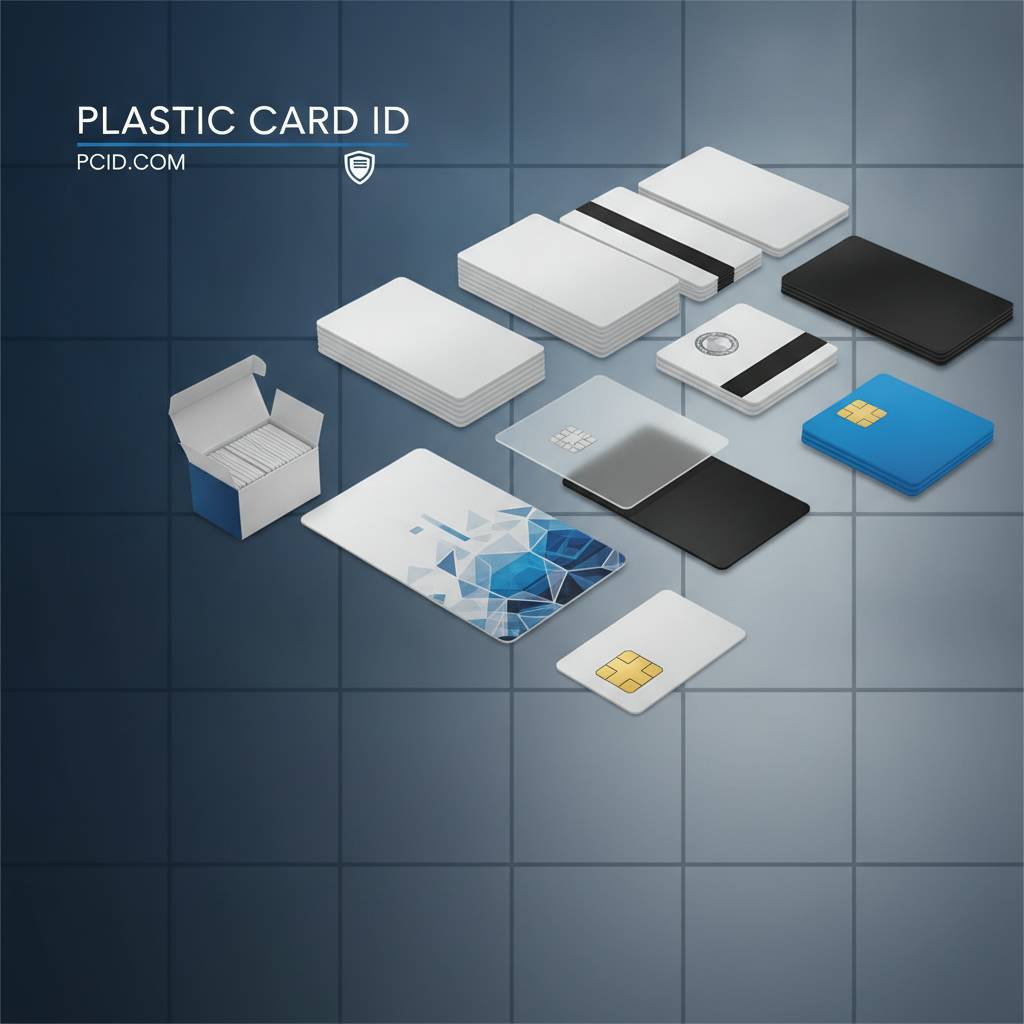
The Full Spectrum of Blank Card Options
 Calling them "blank PVC cards" is accurate but incomplete. The category spans a surprising range of configurations, each engineered for a specific function. Choosing the right card type before you print or encode is the first decision in building a card program that actually performs the way you need it to.
Most buyers start with the standard white CR80 and then layer in features - a magnetic stripe for data encoding, an RFID chip for contactless access, or a specialty finish for premium branding impact. Understanding what each option does prevents costly mistakes and helps you match card specifications to your real-world requirements.
Magnetic Stripe Cards: HiCo vs. LoCo
Magnetic stripe cards carry a thin band of iron oxide particles on the back of the card. Data is written to this stripe by a magnetic card encoder and read by a swipe reader. The stripe technology is mature, affordable, and compatible with an enormous installed base of readers in the United States, making it the practical choice for most data-carrying card applications.
High-coercivity (HiCo) stripes require a stronger magnetic field to encode and are proportionally harder to accidentally erase. That durability makes HiCo the right choice for cards that will be swiped frequently or carried near other magnets - gift cards, access cards, hotel key cards, and employee badges. Low-coercivity (LoCo) stripes encode more easily and are suitable for short-duration applications like event credentials or temporary visitor passes where re-encoding flexibility matters more than long-term durability.
RFID, Proximity, and Smart Chip Cards
Contactless technology has fundamentally changed access control and loyalty programs. RFID and proximity cards communicate with readers through radio frequency - no swipe, no contact, no wear on the card surface. Hold the card near a reader and the transaction completes in milliseconds. For high-traffic entry points, cafeteria payment systems, or time-and-attendance tracking, that speed and convenience is a genuine operational advantage.
Smart chip cards take contactless technology further by incorporating encrypted data storage. MIFARE DESFire cards, for instance, support sophisticated applications like casino player tracking, multi-function campus credentials, and secure building access where data integrity and tamper resistance are non-negotiable. These are not novelty items - they are enterprise-grade tools deployed in demanding environments every day.
Clear, Frosted, Colored, and Specialty Finishes
Not every card program calls for a standard white card. Clear PVC cards offer a striking visual effect - printed elements appear to float, and the transparent background creates a premium, modern aesthetic that standard white cards simply cannot replicate. Frosted cards deliver a similar premium feel with a soft, diffused translucency that photographs beautifully and stands out in a wallet stack.
Colored stock cards - available in a range of pre-dyed base colors - allow organizations to implement color-coded systems without printing. Different departments, access tiers, or event categories can each carry a distinct card color for instant visual identification. For the most dramatic statement, luxury metal cards in stainless steel, brass, and gold deliver a tactile presence that communicates prestige before a single word is read.
In-House Card Printing: Why Blank Cards and Card Printers Work Together
The blank card is only half of an in-house card program. The other half is the printer. Together, they give your organization complete control over design, personalization, timing, and cost - advantages that ordering pre-printed cards from an outside vendor simply cannot match at the same level of flexibility.
When you stock blank cards and operate your own printer, you can produce a new employee badge in ten minutes, reissue a lost membership card on the spot, or update a loyalty card design without minimum order quantities or wait times. That operational agility has real value, particularly for organizations with ongoing, high-frequency card issuance needs.
Choosing the Right Card Printer for Your Program
Card printers from Evolis, Zebra, and Fargo each serve distinct segments of the market. Entry-level single-sided printers handle simple badge programs and low-volume loyalty card issuance efficiently and affordably. Mid-range dual-sided printers add the ability to print full information on both card faces, which is essential for comprehensive employee ID programs. High-volume retransfer printers deliver edge-to-edge, photographic-quality printing for premium card programs where visual impact matters.
Matching the printer to your expected monthly volume prevents both underinvestment - buying a printer that cannot keep up with demand - and overinvestment in capabilities you will never use. CPE stocks a comprehensive lineup across all three major brands and can help you match the right hardware to your specific program requirements without the guesswork.
Ribbons, Cleaning Kits, and Consumables
A card printer performs only as well as its consumables allow. Using the correct printer ribbon for your specific card printer model is not optional - it is essential for consistent print quality and printer longevity. YMCKO ribbons (yellow, magenta, cyan, black, overlay) are the standard for full-color card printing. Monochrome ribbons serve high-volume single-color applications like basic ID cards at a significantly lower cost per card.
Cleaning kits are equally important and frequently overlooked. Dust, debris, and ribbon residue accumulate inside card printers and degrade print quality over time. Regular cleaning cycles using manufacturer-specified kits extend printer lifespan, prevent costly service calls, and ensure every card that rolls off the printer meets the quality standard your program demands.
Card Carriers, Sleeves, and Mailing Services
Producing a great card is only useful if it reaches the cardholder in perfect condition and in a format that communicates your organization's professionalism. Card carriers - folded paper or cardstock mailers designed to hold a card - allow you to mail individual cards with a personalized message, terms and conditions, or activation instructions in a polished, branded package.
Protective card sleeves extend the useful life of printed cards by shielding them from scratching, bending, and surface contamination. For organizations mailing cards at scale, card affixing and mailing services handle the physical logistics of attaching cards to carriers and dispatching them - eliminating a labor-intensive step from your internal workflow and getting cards to recipients faster.
| Program Element | What You Need |
|---|---|
| Card Stock | CR80 blank PVC cards (with or without magnetic stripe, RFID, or chip) |
| Printer Hardware | Evolis, Zebra, or Fargo card printer matched to your volume |
| Consumables | Matching printer ribbons and cleaning kits |
| Distribution | Card carriers, sleeves, or mailing services as needed |
Real Business Applications: What Blank PVC Cards Actually Do
 Abstract specifications become meaningful when you see them applied. Blank PVC cards power an extraordinarily diverse range of programs across industries, and the common thread is always the same: a physical card that can be printed, encoded, and issued quickly and affordably drives better outcomes than any paper-based or purely digital alternative in its category.
The tangible presence of a physical card creates a psychological commitment that digital alternatives cannot replicate. A loyalty card in a wallet is a constant, silent reminder of your brand. An employee badge worn daily reinforces organizational identity. A membership card handed to a new member signals that they now belong to something real and lasting.
Employee ID and Access Control Programs
Employee ID programs are among the most common applications for blank PVC cards, and for good reason. A professionally printed badge communicates that your organization takes security and professional identity seriously - to employees, visitors, and clients alike. Paper badges feel temporary. Plastic badges feel permanent, because they are.
Paired with a magnetic stripe or RFID chip, the same card that displays an employee photo and name becomes an access credential, a time-clock token, or a cafeteria payment card. Multi-function credentials reduce the number of cards employees carry and simplify the administrative overhead of managing separate systems. That consolidation is both a cost saving and a quality-of-life improvement for cardholders.
Loyalty and Gift Card Programs for Retailers
The business case for plastic loyalty and gift cards is not theoretical - it is documented and consistent. Retailers switching from paper-based loyalty punch cards to plastic wallet cards see measurable increases in program enrollment, visit frequency, and average transaction value. The card itself functions as a marketing touchpoint every time a customer opens their wallet, even when they are shopping somewhere else entirely.
Gift card programs on plastic carry a similar multiplier effect. Plastic gift cards are more likely to be given as gifts, more likely to be redeemed at full value, and more likely to drive incremental spending beyond the card balance than paper equivalents. For retailers and hospitality businesses, this is a revenue lever worth pulling with a well-specified plastic card program.
Membership and Association Cards
Gyms, professional associations, clubs, libraries, universities, and healthcare networks all rely on membership cards to establish belonging and facilitate access. A laminated paper card communicates improvisation. A printed PVC card communicates investment, stability, and institutional credibility. That perception difference influences how members engage with your organization and how they describe it to others.
For organizations issuing cards at moderate volume - 50 to a few hundred per month - in-house printing on blank stock is the most cost-effective and flexible approach available. You maintain full design control, issue cards on demand without minimum order waiting periods, and avoid paying pre-printing premiums for quantities you may not fully deploy before designs change.
Buyer's Guide: Selecting the Right Blank PVC Cards for Your Program
Buying blank PVC cards is straightforward once you understand what to specify. Most purchasing mistakes come from under-specifying - ordering standard cards when the application required a HiCo magnetic stripe, or buying cards incompatible with the printer already in house. A few deliberate decisions upfront prevent those problems entirely.
Key Specifications to Confirm Before You Order
- Card format: CR80 is the standard for nearly all applications. Confirm your printer, readers, and badge holders are designed for CR80 before considering any alternative.
- Thickness: 30 mil is the standard and correct choice for card printers. Do not substitute thinner or thicker cards unless your printer explicitly supports them.
- Magnetic stripe: Specify HiCo for long-term, frequently used cards. Specify LoCo for short-term or re-encodable applications.
- Contactless technology: Specify the correct RFID frequency (125 kHz for proximity, 13.56 MHz for MIFARE) to match your existing reader infrastructure.
- Finish: White gloss is the default for dye-sublimation printing. Confirm finish compatibility with your printer and ribbon type before ordering specialty finishes.
- Quantity: Buy in quantities that match your actual usage cycle. Overstocking ties up budget; understocking creates issuance delays at inconvenient moments.
Confirming these six specifications before placing any order eliminates the most common sources of card program friction. If your requirements fall outside the standard options, CPE has served over 100,000 customers across the United States and has almost certainly addressed your specific situation before.
Volume Tiers and Cost Considerations
Blank PVC card pricing follows predictable volume tiers - the more you buy, the lower the per-card cost. For small programs issuing 50-200 cards per month, per-card cost is less critical than flexibility and lead time. For programs issuing thousands of cards monthly, per-card cost compounds meaningfully and volume purchasing becomes a genuine budget optimization strategy.
The total cost of running a card program includes cards, ribbons, printer maintenance, and distribution - not just the per-card purchase price. Running those numbers across a full program year frequently reveals that in-house printing on blank stock is substantially more economical than ordering pre-printed cards from a vendor, even after accounting for printer amortization and consumables.
Contact CPE for Expert Guidance
With over 25 years of experience and more than 50 million cards sold, CPE has the depth of knowledge to help you specify the right card for your exact application. Whether you are launching a new program or optimizing an existing one, the team is ready to assist. Call 800.835.7919 to speak with a card program specialist who understands your industry and your requirements.
There is no minimum order too small and no program too large. CPE serves clients from boutique retailers printing 50 cards a month to enterprise organizations running mass production in the tens of thousands. The expertise scales with your program.
Frequently Asked Questions About Blank PVC Cards
Questions about blank PVC cards tend to cluster around a few recurring themes: compatibility, encoding, volume, and application suitability. The answers below address the questions most commonly asked by first-time buyers and experienced card program managers alike.
Are All Blank PVC Cards Compatible With All Card Printers?
Standard CR80, 30 mil, white gloss PVC cards are compatible with virtually all major card printers on the market, including all models from Evolis, Zebra, and Fargo. Specialty cards - clear PVC, frosted, colored stock, or cards with embedded RFID chips - may have specific compatibility requirements that vary by printer model and ribbon type. Always confirm specialty card compatibility with your printer manufacturer or supplier before ordering in volume.
Magnetic stripe cards with pre-applied stripes are compatible with standard card printers for printing and with separate card encoders or combined printer-encoder units for data writing. The stripe itself does not interfere with the printing process on any standard dye-sublimation or direct-to-card printer.
Can I Print on Cards That Already Have a Magnetic Stripe or Chip?
Yes - and this is a critical point that surprises many first-time buyers. The magnetic stripe occupies only a thin band on the back of the card. The front face, and the remainder of the back, print exactly like a standard blank card. You print your design first, then encode the stripe using a card encoder or a printer with an integrated encoding module. The two processes are entirely independent.
Smart chip cards with embedded RFID or contact chips are equally printable. The chip occupies a defined area on the card face, and your design simply accounts for that placement. Printers compatible with chip cards handle them without issue, and the encoding of the chip is handled separately from the visual printing process.
What Is the Minimum Order Quantity for Blank PVC Cards?
Blank PVC cards are available in quantities suited to programs of any size. Small organizations just launching card programs can order modest quantities to test formats and workflows before committing to larger volume purchases. Enterprise programs running continuous high-volume issuance benefit from bulk pricing on larger orders that reduces per-card cost meaningfully across the program year.
CPE works with programs at every scale - from organizations issuing 50 cards a month to clients deploying cards in the tens of thousands. There is no application too small to merit a quality card solution, and no program too large to be served with the full depth of available inventory, expertise, and logistical capability.
Why Plastic Card ID Is the Right Partner for Your Card Program
Choosing a card supplier is a longer-term decision than it might initially appear. Card programs have ongoing consumable needs, evolving specifications, and periodic equipment decisions that benefit from a supplier relationship built on genuine expertise rather than transactional catalog ordering. That distinction matters when something unexpected comes up - and in card programs, something unexpected always eventually comes up.
A strategic partner who understands your program from end to end is worth meaningfully more than a commodity supplier who ships boxes. Over 25 years and more than 100,000 customers, Plastic Card ID has built its reputation on exactly that kind of engaged, knowledgeable partnership - one that helps clients run successful programs rather than simply fulfilling orders.
A Catalog Built for Real Card Programs
The Plastic Card ID catalog is not assembled to be comprehensive on paper - it is built to serve every practical requirement of a functioning card program. Standard white CR80 cards in volume. HiCo and LoCo magnetic stripe cards. RFID proximity cards and MIFARE DESFire smart chip cards. Clear, frosted, and colored stock. Evolis, Zebra, and Fargo printers. Ribbons, cleaning kits, card carriers, sleeves, and mailing services. Every component of a complete card program, from a single source.
That integration matters operationally. Sourcing cards from one vendor, ribbons from another, and cleaning supplies from a third introduces coordination overhead and compatibility risk that a single-source relationship eliminates entirely. When every component comes from a supplier who understands how they work together, the program runs more smoothly from day one.
Serving USA-Based Businesses Across Every Industry
Plastic Card ID serves businesses and organizations across the full spectrum of American industry - retail, hospitality, healthcare, education, corporate, entertainment, government, and more. The catalog covers identity, access control, loyalty, membership, marketing, and event card solutions, all designed and supplied for USA-based clients. Every card program is different, but the commitment to quality, expertise, and reliable supply is constant.
Casino player card programs, hotel key card systems, university ID programs, gym membership cards, corporate access credentials, retail loyalty programs - all of them run on PVC cards sourced from a supplier who understands the application deeply. That application knowledge is what separates a strategic partner from a box shipper, and it is what CPE brings to every client relationship.
Ready to Start or Improve Your Card Program?
Whether you are building a new card program from scratch or looking to improve the cost, quality, or flexibility of an existing one, the conversation starts with a phone call. Reach Plastic Card ID directly at 800.835.7919 to speak with a specialist who can help you specify the right cards, match the right printer, and set up a supply arrangement that keeps your program running without interruption.
Blank PVC cards are the foundation of thousands of successful card programs running across the United States right now. The right card, the right printer, and the right supplier are all it takes to add yours to that number.
Contact Plastic Card ID today at 800.835.7919 and let a 25-year veteran of the card industry help you build a program that performs from day one and keeps delivering value for years to come.
Previous Page