Blank Magnetic Stripe Cards Explained: HiCo vs LoCo
Table of Contents []
- What Every Business Should Know About Blank Magnetic Stripe Cards - Plastic Card ID
- The Magnetic Stripe Explained - How It Actually Works
- HiCo vs LoCo - The Difference That Determines Reliability
- Blank Magnetic Stripe Card Options Available at Plastic Card ID
- Choosing the Right Card Printer for Magnetic Stripe Encoding
- Practical Buying Guide - Magnetic Stripe Cards for First-Time Buyers
- Card Programs That Rely on Magnetic Stripe Technology - Real-World Applications
- Partner With Plastic Card ID for Your Magnetic Stripe Card Program
What Every Business Should Know About Blank Magnetic Stripe Cards - Plastic Card ID
Swipe a card. That single, satisfying motion triggers a data transaction that has powered industries from hospitality to retail for decades. Yet most business owners purchasing magnetic stripe cards for the first time have no idea what separates a card that works flawlessly in every reader from one that fails at the worst possible moment. The answer lives in a thin strip of iron-based particles - and the science behind it matters more than most people expect.
Plastic Card ID has supplied magnetic stripe cards to businesses of every size across the United States for over 25 years. That depth of experience means the team has seen what works, what fails, and what separates a successful card program from a frustrating one. This guide breaks it all down, starting with the technology itself and ending with practical buying decisions.
| Feature | HiCo (High Coercivity) | LoCo (Low Coercivity) |
|---|---|---|
| Coercivity Rating | 2750 Oersteds | 300 Oersteds |
| Stripe Color | Dark Brown / Black | Light Brown |
| Data Durability | Highly Resistant to Erasure | More Susceptible to Erasure |
| Best Use Case | Long-Term Employee, Loyalty, ID Cards | Hotel Keys, Event Passes, Temporary Access |
| Rewrite Capability | Requires Higher-Powered Encoder | Easily Re-Encoded |
| Cost | Slightly Higher | Slightly Lower |
The Magnetic Stripe Explained - How It Actually Works
 A magnetic stripe is not simply a decorative band across the back of a plastic card. It is a precisely engineered recording medium made from microscopic iron-oxide particles suspended in a binding material and laminated onto the card surface. When a card is encoded, those particles are magnetized in specific directional patterns that represent digital data readable by a card swipe reader.
The technology follows the ISO 7811 standard and typically includes up to three tracks. Track 1 holds alphanumeric data at 210 bits per inch. Track 2, the most commonly used, carries numeric data at 75 bits per inch. Track 3 can be read and re-written, making it useful for stored-value and loyalty applications. Understanding which tracks your system uses before ordering cards can save significant time and money.
Track Configurations and What They Mean for Your Program
Many businesses assume their card reader uses all three tracks, but that is rarely the case. Point-of-sale gift card systems commonly rely on Track 2 only. Hotel lock systems often use Track 3 for its rewritable properties. Access control systems tend to use Track 1 or Track 2 depending on the controller manufacturer's specifications.
Ordering a card pre-encoded on the wrong track - or with data formatted incorrectly - results in a card that appears physically perfect but fails every single read. CPE recommends confirming your system's track requirements with your software provider before placing an order, especially for first-time programs or system upgrades.
ISO Standards and Why They Protect Your Investment
The CR80 form factor - 3.375 inches by 2.125 inches at 30 mil thickness - is governed by ISO 7810. Magnetic stripe placement and encoding density fall under ISO 7811. These standards exist specifically so that cards encoded on one manufacturer's encoder can be read on another brand's reader. Compliance with ISO standards is not optional if interoperability matters to your operation.
Every blank magnetic stripe card sold by Plastic Card ID conforms to these standards. That means when you invest in a card printer with an encoding module from Evolis, Zebra, or Fargo, the blank cards will perform exactly as expected - track after track, swipe after swipe.
How Data Gets Onto a Blank Magnetic Stripe Card
Blank magnetic stripe cards arrive unencoded. Data is written to the stripe during the printing process using a magnetic encoding module built into the card printer. This is fundamentally different from chip encoding, which requires a contact or contactless interface. For magnetic stripe cards, the encoder head physically magnetizes the particles in patterns that correspond to the characters being written.
The encoding process is fast - typically completed in the same pass as the print job - which is why magnetic stripe cards remain the fastest in-house card production option available. A business printing 50 employee badges in the morning can have fully encoded, print-ready cards in hand within an hour using a desktop card printer.
HiCo vs LoCo - The Difference That Determines Reliability
Coercivity measures how resistant a magnetic material is to becoming demagnetized. It is expressed in Oersteds, and for magnetic stripe cards, it is the single most important specification that determines whether your cards will hold their data under real-world conditions. Two standards dominate the market: High Coercivity, abbreviated HiCo, and Low Coercivity, abbreviated LoCo. Choosing the wrong one for your application can mean replacing cards constantly - or worse, losing customer trust.
The right coercivity choice is the difference between a card program that runs smoothly for years and one that generates a steady stream of complaints. Both types are available in the same CR80 dimensions and can be printed using compatible card printers, so the physical difference is in the stripe's magnetic properties - not the card's appearance or printability.
High Coercivity Cards - Built for Permanence
HiCo cards are rated at 2750 Oersteds. That rating means the magnetic particles on the stripe resist being remagnetized or demagnetized by the kinds of everyday magnetic fields that cards encounter in wallets, near smartphones, and alongside other cards. The dark brown or near-black appearance of HiCo stripes is a visual identifier that purchasing teams and printer technicians use to confirm card type at a glance.
Because of their resistance to accidental erasure, HiCo cards are the right choice for any application where the card is expected to be used repeatedly over an extended period. Employee ID cards, loyalty program cards, membership cards, and access control badges are natural fits. A loyalty card that lives in a customer's wallet for 18 months and survives proximity to keys, coins, and magnetic clasps needs HiCo. Nothing less will do.
HiCo encoding requires a printer with a high-coercivity encoding module. Standard LoCo encoders do not produce a strong enough magnetic field to write reliably to HiCo stripes. Before purchasing HiCo blank cards, confirming your printer's encoding module rating is essential - most Evolis, Zebra, and Fargo desktop printers offer both configurations depending on the model selected.
Low Coercivity Cards - Built for Flexibility
LoCo cards are rated at 300 Oersteds. The lower resistance to demagnetization might sound like a disadvantage, but for specific applications, it is precisely the right property. Hotel key cards are the classic example. A guest checks in, the front desk encodes the card with room access permissions and a checkout date, the guest uses the card for three nights, and at checkout the data becomes worthless. Re-encoding the card for a new guest is easy, fast, and cost-effective.
Event access credentials, temporary visitor badges, convention passes, and short-term employee passes share this same logic. The card's lifespan is intentionally brief. LoCo cards support that use case perfectly. The ability to re-encode a LoCo card dozens of times over its physical life makes it the economical choice for high-turnover card programs.
Identifying the Right Type for Your Specific Situation
A straightforward framework helps make the HiCo vs LoCo decision. Ask two questions: How long will the card be in use? And will the data on the stripe need to be changed? If the card is permanent or semi-permanent and the data is fixed, choose HiCo. If the card is temporary or the data needs periodic rewriting, choose LoCo. There is no gray area between the two - the coercivity rating is either appropriate for the application or it is not.
Some organizations run both types simultaneously. A country club, for instance, might issue HiCo membership cards to annual members and LoCo event passes for guest day visitors. CPE has worked with clients across retail, healthcare, hospitality, and education to build exactly these kinds of tiered card programs. Reach out to the team at 800.835.7919 to discuss which specification fits your current or planned program.
Blank Magnetic Stripe Card Options Available at Plastic Card ID
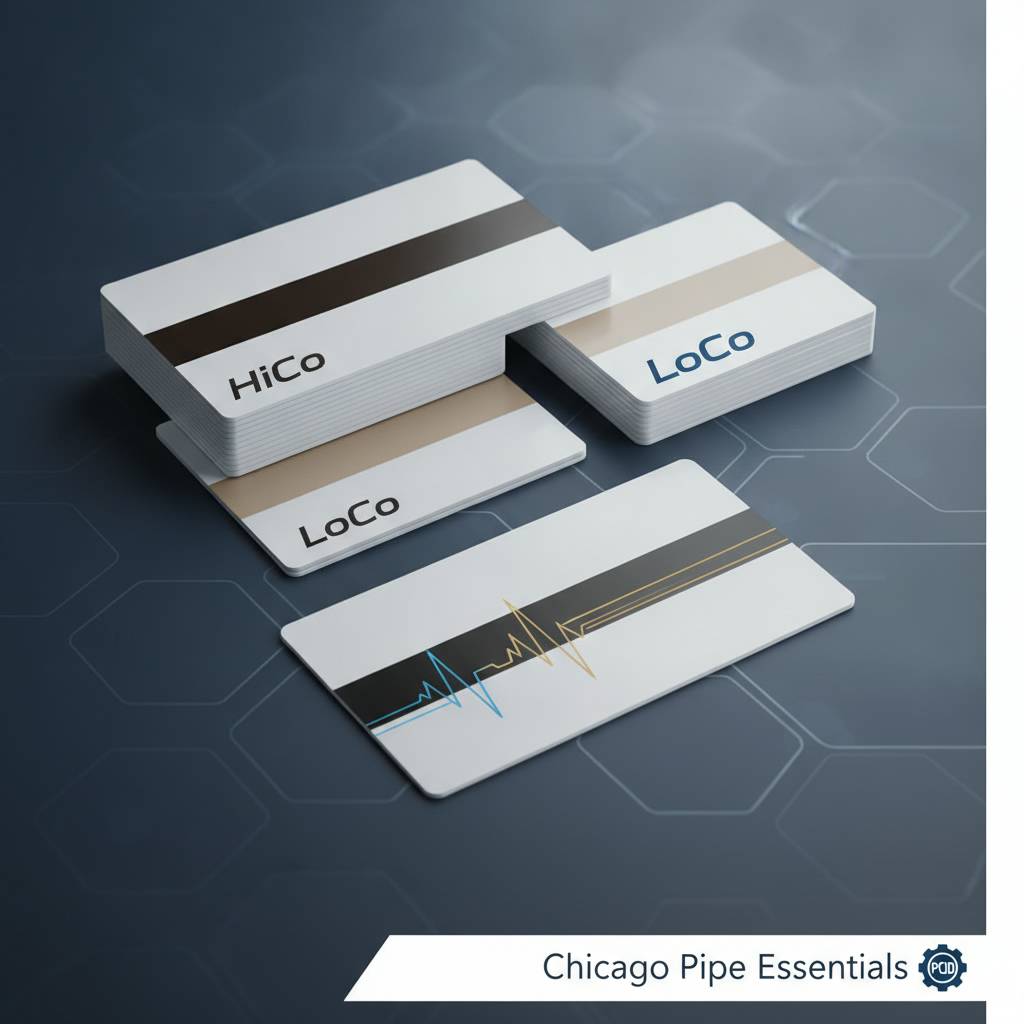 The catalog at Plastic Card ID covers a comprehensive range of blank magnetic stripe card types, all manufactured to ISO 7810 and 7811 standards. Whether a business needs 500 plain white HiCo cards for an in-house employee badge program or 10,000 pre-printed LoCo cards for a hotel chain's key card rotation, the inventory and production capacity exists to deliver at scale.
Blank cards are available in standard white PVC, colored stock, clear and frosted finishes, and with options for signature panels, holograms, and slot punching. The stripe itself can be the standard dark stripe across the back or configured for dual interface depending on the program requirements. Starting with the right blank card means every print job produces a professional, functional final product without surprises.
Standard White PVC HiCo and LoCo Cards
The standard white CR80 blank magnetic stripe card is the backbone of most in-house card programs. Available in both HiCo and LoCo configurations, these cards accept dye-sublimation printing, retransfer printing, and direct-to-card printing with equal reliability. The bright white surface produces vivid, photographic-quality output when paired with quality ribbons from Evolis, Zebra, or Fargo.
These cards are sold in quantities ranging from small starter packs suited for organizations issuing 50-100 cards monthly all the way to bulk pallet orders for large enterprises. Per-card pricing drops meaningfully at volume thresholds, making the economics of magnetic stripe cards highly favorable compared to outsourced printing at low quantities and even better at scale.
Specialty Magnetic Stripe Card Options
Not every program calls for a standard white card. Clear and frosted PVC magnetic stripe cards create a distinctive visual presentation that plain white cannot achieve - popular among boutique hotels, upscale retail stores, and premium loyalty programs. Colored PVC stock in black, gold, silver, and other hues adds instant brand differentiation at a minimal cost premium over standard cards.
Custom die-cut shapes, while requiring a longer production lead time, allow for creative formats that stand out. And for organizations seeking the ultimate brand statement, metal card options in stainless steel, brass, and gold are available with magnetic stripe capability - delivering the weight, feel, and perceived prestige that signals a truly premium program. A metal loyalty card with a HiCo stripe is not just a transaction tool - it is a brand artifact customers keep.
Accessories That Complete a Magnetic Stripe Card Program
- Printer ribbons: YMCKO and YMCKOK ribbons from Evolis, Zebra, and Fargo designed specifically for magnetic stripe card printing ensure consistent print quality and encoding performance.
- Cleaning kits: Regular cleaning of the encoding head and print head extends printer life and maintains encoding accuracy - critical for high-volume HiCo programs.
- Card carriers and sleeves: Protective sleeves prevent LoCo cards from accidental erasure during distribution and storage, a common oversight that causes unnecessary card failures.
- Card affixing and mailing services: For organizations distributing cards by mail, Plastic Card ID offers card affixing and mailing fulfillment as a value-added service, removing a significant logistical burden from internal teams.
- Lanyards and badge holders: Completing the presentation of employee and event credential cards with professional carrying hardware reinforces the program's professionalism.
Choosing the Right Card Printer for Magnetic Stripe Encoding
A blank magnetic stripe card is only as good as the printer and encoder used to produce the finished card. The encoder module - either built into the printer or added as an option - must match the coercivity of the cards being used. Mismatches produce encoded cards that fail reads intermittently, which is one of the most frustrating and hardest-to-diagnose problems in a card program.
Plastic Card ID supplies card printers from Evolis, Zebra, and Fargo, three of the most respected brands in the industry. Each offers desktop single-sided and dual-sided models with optional magnetic stripe encoding modules in both HiCo and LoCo configurations. Selecting the right printer at program launch prevents encoding problems before they can start.
Evolis Printers for Magnetic Stripe Programs
Evolis printers, including the Primacy 2 and Zenius lines, are known for quiet operation, compact footprint, and consistent card output. Their magnetic encoding modules are available in both coercivity configurations and integrate seamlessly with most card management software platforms. For small-to-medium operations printing 50-500 cards per month, Evolis represents an excellent balance of performance and value.
Evolis printers support single-wire encoding, meaning the encoding and printing process completes in one pass through the machine. This matters for throughput efficiency when deadlines are tight - a common reality for HR departments processing new employee batches or event teams printing day-of credentials.
Zebra and Fargo for Higher Volume Encoding
Zebra's ZC Series and Fargo's HDP Series occupy the mid-to-high volume segment of the market. Retransfer printing technology found in models like the Fargo HDP5000 produces sharper, more durable card images and superior edge-to-edge print coverage compared to direct-to-card alternatives. Both brands' encoding modules are built for reliability across high card volumes. 800.835.7919 is the number to call when evaluating printers for programs running in the thousands of cards monthly.
Zebra and Fargo printers also offer lamination modules that apply a protective overlay to printed cards, significantly extending card life in demanding environments. For employee badges worn daily, access cards handled hundreds of times, or loyalty cards subjected to wallet wear, lamination is a worthwhile addition to the production process.
Practical Buying Guide - Magnetic Stripe Cards for First-Time Buyers
Buying magnetic stripe cards for the first time involves more variables than purchasing standard office supplies, but the decision framework is straightforward once the terminology is clear. The single most common mistake first-time buyers make is ordering on price alone without confirming the coercivity, track configuration, and quantity break that fits their actual program requirements.
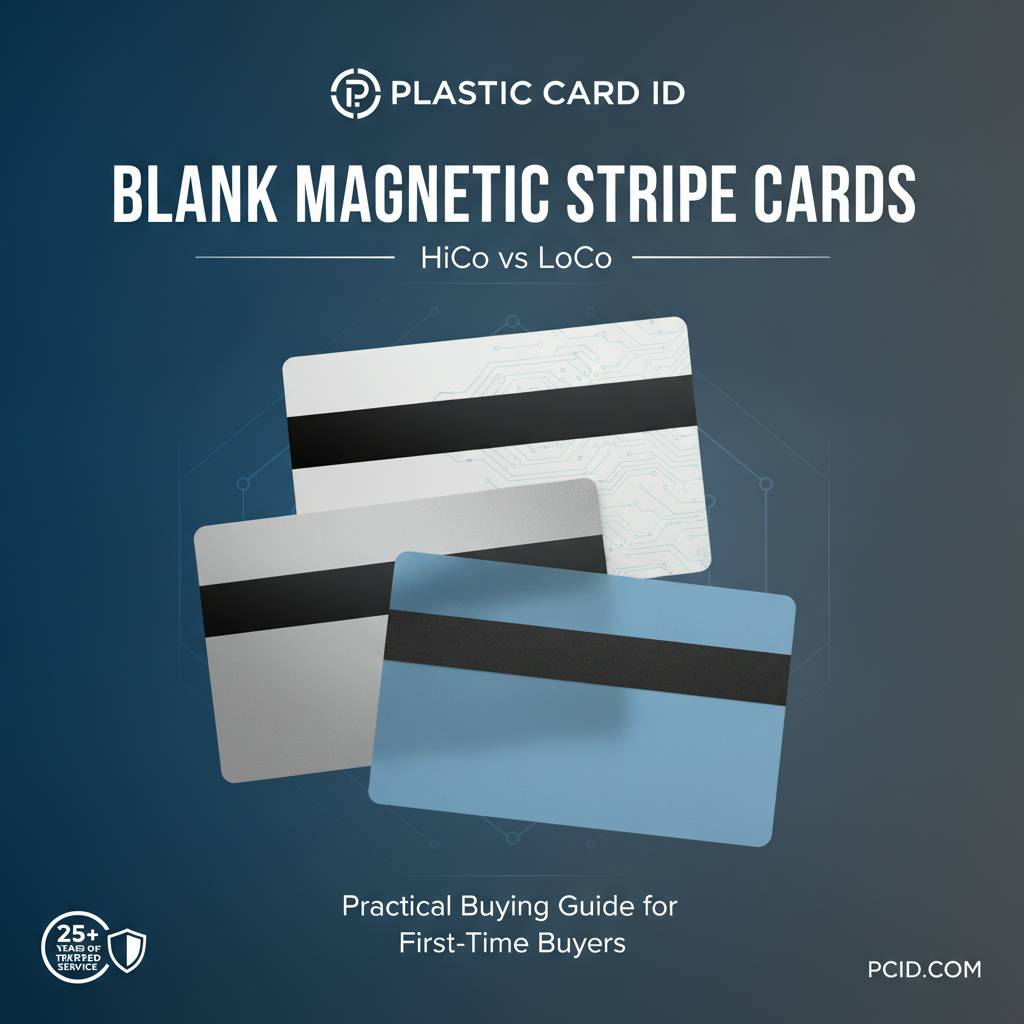
The second most common mistake is under-ordering. Running out of blank cards mid-program - especially in high-frequency issuance environments like employee onboarding or hotel check-in - creates operational disruption that far outweighs the modest cost savings of ordering conservatively. Ordering a 10-15% buffer above projected monthly usage is a best practice that every experienced card program manager eventually adopts.
Questions to Answer Before Placing Your First Order
- What is the intended card lifespan - temporary (days to weeks) or permanent (months to years)?
- Will the magnetic stripe data need to be rewritten, or is it encoded once and fixed for the card's life?
- Which track or tracks does your card management software and reader system use?
- Does your existing printer or the printer you plan to purchase have an encoding module, and what is its coercivity rating?
- What quantity do you need monthly, and at what volume threshold does the per-card pricing become significantly better?
- Does the card need additional features - signature panel, hologram, slot punch, or custom finish?
Answering these questions before contacting a supplier turns a potentially confusing procurement conversation into a fast, efficient transaction. The CPE team is available to walk through this checklist with any buyer who needs guidance - whether the program is 50 cards a month or 50,000.
Understanding Volume Pricing and Program Economics
Magnetic stripe cards follow standard volume pricing economics - the per-card cost decreases at higher quantity thresholds. For most businesses, the break-even point between purchasing pre-encoded cards from a supplier versus investing in in-house printing equipment falls somewhere between 500 and 2,000 cards per year, depending on design complexity and turnaround time requirements. Below that threshold, purchasing pre-encoded cards from Plastic Card ID is almost always more cost-effective. Above it, in-house production typically wins.
The total cost of ownership calculation for in-house programs must include printer purchase or lease, ribbon costs, cleaning supply costs, and staff time for card production. When all those inputs are factored in, the economics of magnetic stripe card programs become clearer and the right decision for each organization's situation becomes obvious. Getting the economics right at program launch sets up long-term success without surprise cost overruns.
Card Programs That Rely on Magnetic Stripe Technology - Real-World Applications
Magnetic stripe technology is decades old, but it remains the dominant data carrier for card programs that do not require the processing power of a chip or the contactless range of RFID. The infrastructure for reading magnetic stripes is ubiquitous, inexpensive, and well-understood by the technicians who maintain it. That combination of factors means magnetic stripe cards will remain a practical, cost-effective solution for the foreseeable future across a wide range of industries.
Businesses that have switched from paper-based systems to plastic magnetic stripe cards consistently report measurable operational and revenue improvements. Retailers making the transition from paper gift certificates to plastic gift cards with magnetic stripes see sales increases of 35-50% in their gift card programs. Loyalty cards that live in a customer's wallet as a physical plastic card dramatically outperform paper punch cards in redemption rates and customer retention metrics.
Loyalty and Gift Card Programs
Retail loyalty programs are one of the strongest use cases for HiCo magnetic stripe cards. The card needs to survive wallet storage alongside credit cards, keys, and coins for potentially years. HiCo's resistance to incidental demagnetization is not a nice-to-have in this context - it is the specification that determines whether the program functions reliably. A loyalty card that fails at the register is worse than no loyalty card at all. It creates a negative customer experience at the precise moment you want the opposite.
Gift card programs add an additional dimension: cards are often purchased and stored before use, sometimes for weeks or months. That extended pre-use period means the card must maintain its encoded data through storage conditions that include proximity to other magnetized objects and temperature variations. HiCo handles all of it. LoCo, under the same conditions, carries a meaningful risk of data degradation.
Employee ID and Access Control Cards
Employee badge programs that include magnetic stripe access control data combine two functions on a single card: visual identification via the printed surface and electronic access via the encoded stripe. This dual-function approach is cost-effective and practical for organizations with 50-5,000 employees. The badge printed Monday morning is swiped against the reader that same afternoon, and it is expected to keep working without fail for the duration of that employee's tenure.
HiCo is the unambiguous choice for employee access control programs. The cards will be handled daily, stored in badge holders and wallets, and exposed to whatever electromagnetic environment the workplace contains. Reliability is non-negotiable when security access is at stake. Organizations building or upgrading access control programs should discuss their specific reader system requirements with the CPE team before specifying cards.
Event Credentials and Temporary Access Passes
Large conferences, trade shows, conventions, and venue access programs have a different relationship with card lifespan. An attendee badge for a three-day conference needs to work reliably for those three days - not three years. LoCo cards meet that requirement at a lower cost per card and with the option for post-event re-encoding if the organization reuses cards for multiple events. This is a meaningful operational advantage for event producers running programs on tight margins.
For recurring events where the same cards are reissued with updated access permissions each cycle, LoCo's rewritability becomes a genuine program asset rather than just a cost consideration. Smart card program design matches the technology to the use case - and LoCo cards in event credentials is textbook smart design.
Partner With Plastic Card ID for Your Magnetic Stripe Card Program
 Magnetic stripe cards are not complicated once the fundamentals are understood - but getting those fundamentals right from the start is what separates card programs that run smoothly for years from those that generate ongoing problems. HiCo versus LoCo is a single decision point, but it is a consequential one. The right blank card, paired with the right printer and the right encoder, produces a reliable, professional product that does exactly what it is supposed to do, every time.
Plastic Card ID has been helping businesses across the United States navigate exactly these decisions for over 25 years, serving more than 100,000 customers and delivering over 50 million cards. That track record is built on supplying the right product for each application - not simply the most expensive or the most popular. The team at CPE treats every client as a long-term partner, not a one-time transaction. Whether the program is 50 cards a month or tens of thousands, the expertise and inventory are in place to support it at every stage.
Ready to build or upgrade your magnetic stripe card program? Contact Plastic Card ID today at 800.835.7919 and speak with a card program specialist who can help you select the right blank cards, the right printer, and the right accessories to launch with confidence.
Previous Page